
A hill town in the Litchfield Hills, made in 1779 from the parishes of Judea and New Preston and named for George Washington, where marble saws and iron works once ran and the Gunnery, Steep Rock and Lake Waramaug drew the summer people.
Washington on the map
Click the map to look closer.
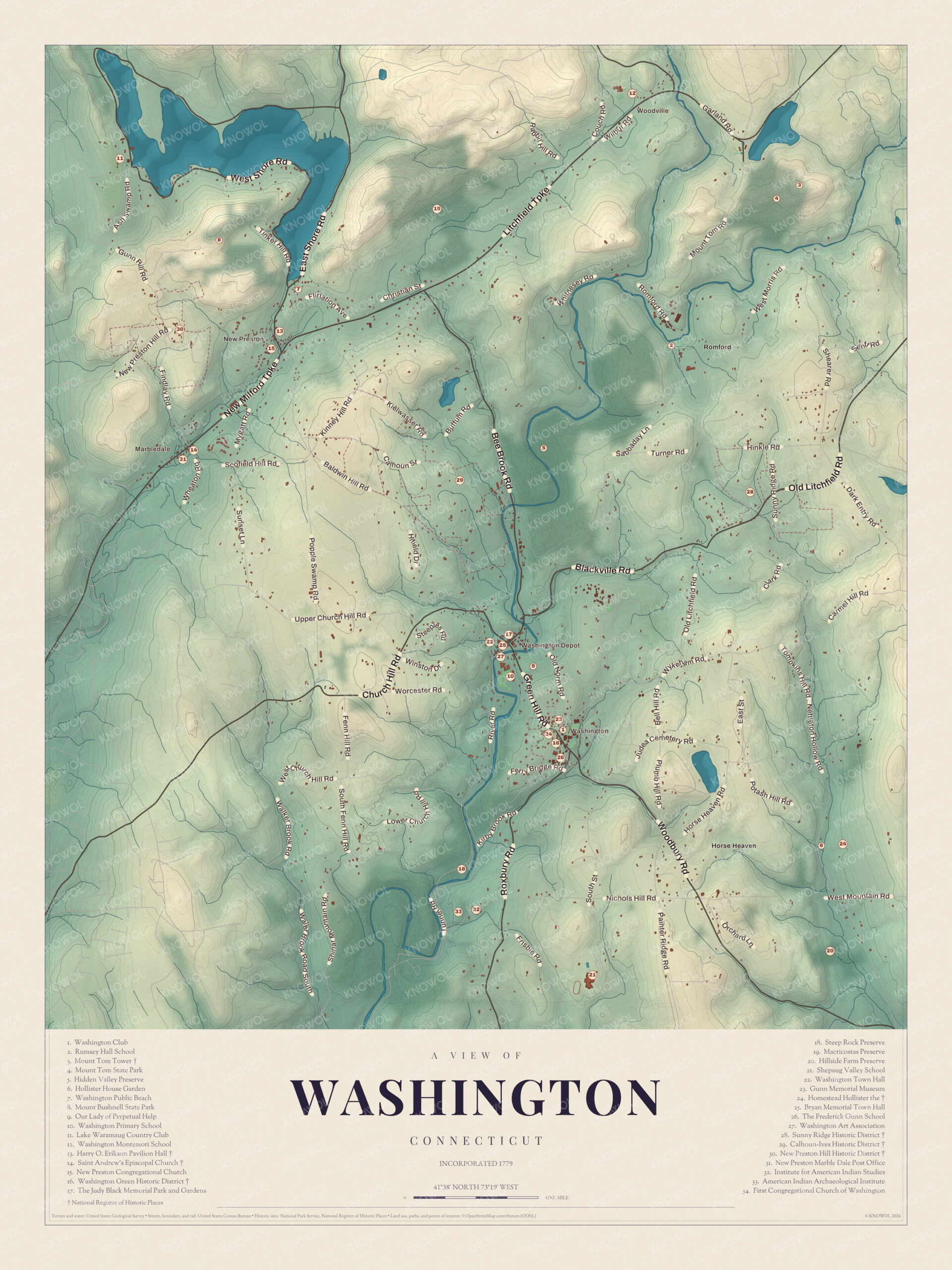
Washington today
By KNOWOL
Shaded hills from Woodville down through the Shepaug valley, every street from New Preston and Lake Waramaug to the Green, and a guide of 34 numbered landmarks with the National Register sites marked.4
The story of Washington
The town that was almost Hampden
Washington began as two parishes. Judea was settled about 1734 by Joseph Hurlbut, and its first sermon was preached in a bedroom of his house. New Preston, to the northwest, took in land from Kent and New Milford. During the Revolution the people asked to become a town: 176 signers from Woodbury, 47 from Kent and 20 each from Litchfield and New Milford. They wanted to call it Hampden, but their agents were talked into Washington instead, and on January 7, 1779, it became the first town Connecticut made after the Declaration of Independence. The general himself came through more than once. By Cogswell family tradition, on one visit just after Arnold's treason he stopped at their New Preston tavern for breakfast, stayed fifteen minutes, and drank a bowl of milk pacing the floor.5261
Marble saws and pork wagons
Washington once worked as hard as it farmed. About 1800 Philo Tomlinson and Samuel Bassett opened a marble quarry in Marbledale and built what was said to be the first stone saw mill in Connecticut, and Tomlinson invented the feeder that fed sand and water to the saws. Stone mills along the Aspetuck cut slabs for monuments. At Woodville, Chittenden's Iron Works once employed a hundred men or more, and lime and brick were made on Christian Street. Before the railroad, wagons hauled the farms' produce twenty-five miles to New Haven, and the carrier Erastus Hurlbut once took eighty-five hogs in a single week. By 1895 the factories were gone and the farms shipped milk to New York, while fishermen cast for trout among the old dams.789
Make men of them
Frederick W. Gunn grew up in Washington, went to Yale, and came home to teach. He was an abolitionist when that wasn't safe even in Connecticut, and for a while he had to leave town. When he returned he and his wife, Abigail, opened the school that became the Gunnery, and abolitionists backed him by sending their sons. In 1861 he started one of America's earliest summer camps. A visitor once asked what he meant to do with all those boys romping about the grounds. Make men of them, he said. One of those boys, the architect Ehrick Rossiter, came back to shape the Green as a summer colony and in 1925 gave the land that started Steep Rock.101114
Through the years
22 moments from 1734 to today.
- 1734Joseph Hurlbut settles in the eastern part of what's now Washington, the start of the parish of Judea.1
- 1736The settlement is prosperous enough to put up its first frame house.5
- 1741The General Assembly incorporates the Judea society, and a meetinghouse goes up on the ledges of the Green.12
- 1742Rev. Reuben Judd is ordained in a grove as Judea's first minister.13
- 1746Edward Cogswell sets up an ironworks on the East Aspetuck River in New Preston.1
- 1749Rev. Daniel Brinsmade is ordained in Judea and serves for forty-four years.14
- 1753A fever kills twenty or thirty people in Judea in six months.15
- 1770Rev. Jeremiah Day, father of a future president of Yale, is ordained minister of New Preston.16
- 1776Dysentery sweeps through Judea and takes about thirty lives.15
- 1779On January 7, Judea and New Preston become a town. The petitioners wanted Hampden but settled on Washington.2
- 1780Just after Arnold's treason, by family tradition, General Washington stops for breakfast at the Cogswell tavern in New Preston.6
- 1800About this year a marble quarry and what was said to be Connecticut's first stone saw mill open in Marbledale.7
- 1801The meetinghouse on the Green burns in April, and the church that stands today replaces it.17
- 1823St. Andrew's, the brick Gothic church in Marbledale, is finished.18
- 1827Orville H. Platt, later a United States senator, is born in Washington.19
- 1850Frederick and Abigail Gunn open the boarding school that becomes the Gunnery.4
- 1861Gunn opens one of America's earliest summer camps.1
- 1872The Shepaug Railroad arrives, and the station in Davies' Hollow is named Romford for Romulus Ford.20
- 1897The Pavilion Club builds Pavilion Hall in New Preston for plays, dinners and dances.21
- 1925Ehrick Rossiter gives 100 acres along the Shepaug, founding the Steep Rock land trust.1
- 1955The August flood tears through Washington Depot and washes away much of the village center.1
- 1995Washington Green, Calhoun-Ives and Sunny Ridge are all listed on the National Register.3
Places to see
The numbers match the landmark guide printed on the 2026 map.
- 8Mount Bushnell State ParkSouth of Lake Waramaug. 214 acres for hiking.
- 13Harry O. Erikson Pavilion HallNew Preston. The village's social hall since 1897.
- 14Saint Andrew's Episcopal ChurchMarble Dale. Early Gothic Revival brick church.
- 16Washington Green Historic DistrictWashington Green. The triangular green, settled in 1734.
- 18Steep Rock PreserveShepaug River. The river loops below the bluff.Visit their website
- 23Gunn Memorial MuseumWykeham Road. In the Willis House of 1781.Visit their website
- 26The Frederick Gunn SchoolWashington Green. The Gunnery, founded in 1850.Visit their website
- 29Calhoun-Ives Historic DistrictNorth of the Depot. 475 acres of old farms.
- 30New Preston Hill Historic DistrictWest of New Preston. Hilltop village with a stone church.
- 34First Congregational Church of WashingtonWashington Green. Meetinghouse of 1801 on Ionic columns.
On the National Register
All 7 places in Washington on the National Register of Historic Places that still stand today, oldest first, and why each one matters.3
-
Washington Green Historic District
The village around the triangular town green, settled in 1734, with its Congregational church and the campus of the Gunnery. Many of its white wood buildings, and several of stone, were designed by the architect Ehrick K. Rossiter, a Gunnery graduate.22
-
Sunny Ridge Historic District
An old crossroads village on a stagecoach and mail route between Hartford and Cornwall. The Rising Sun Tavern here opened in 1748, and a second tavern followed about 1790.23
-
New Preston Hill Historic District
The first center of New Preston, where its meetinghouse went up in 1754 on a stage road between Hartford and the Hudson. Its triangular green is anchored by the Federal period stone church of 1824, a rare survivor.24
-
Calhoun-Ives Historic District
About 475 acres of farmhouses, barns, fields and orchards along stone-walled roads, settled by the Calhoun, Ives and Averill families in the 1730s. Its oldest house was built by James Calhoun about 1765.25
-
The Hollister Homestead
A Georgian house built for Gideon Hollister, who ran a sawmill nearby, with barns from the 1700s and 1800s. It's also home to Hollister House Garden, an English garden of outdoor rooms begun in 1979.26
-
St. Andrew's Episcopal Church
Believed to be one of the first Gothic Revival churches in rural Connecticut, a brick church with a square tower and lancet windows. Its congregation dates to 1764 in New Preston.18
-
Harry O. Erikson Pavilion Hall
Built by the Pavilion Club, a group of New Preston property owners, as a public hall for plays, dinners and dances for villagers and guests of the Lake Waramaug inns. It kept that role until 1940, when the town took it over.21
In their words
“Few localities can produce as many well-read and educated, moral, christian men and women as Judea.”
Dwight C. Kilbourn, The Connecticut Quarterly, 189527
“"Make men of them," he replied”
Frederick W. Gunn, asked what he would do with the boys of the Gunnery, The Connecticut Quarterly, 189511
“Washington has been a nursery of eminent men”
Chief Justice Church at the Litchfield County centennial of 1851, quoted in The Connecticut Quarterly, 189528
Nearby towns
Sources
- Washington, Connecticut, Wikipedia
- History of ancient Woodbury, Connecticut (1871), on the town of Washington, Internet Archive
- National Register of Historic Places listings in Litchfield County, Connecticut, Wikipedia
- Map of Washington, Connecticut in 2026, KNOWOL (USGS elevation, Census Bureau roads)
- The Connecticut Quarterly (1895), on the first settlers of Judea, Internet Archive
- Chapter sketches, Connecticut Daughters of the American Revolution (1901), on the Cogswell tavern, Internet Archive
- History of the towns of New Milford and Bridgewater, Connecticut (1882), on the Marbledale quarries, Internet Archive
- The Connecticut Quarterly (1895), on Washington's old mills, Internet Archive
- The Connecticut Quarterly (1895), on hauling produce to New Haven, Internet Archive
- History of Connecticut in monographic form (1925), on the Gunnery, Internet Archive
- The Connecticut Quarterly (1895), on the Gunnery, Internet Archive
- The Connecticut Quarterly (1895), on the Green, Internet Archive
- Chapter sketches, Connecticut Daughters of the American Revolution (1901), on Judea, Internet Archive
- History of ancient Woodbury, Connecticut (1871), on Rev. Daniel Brinsmade, Internet Archive
- History of ancient Woodbury, Connecticut (1871), on sickness in Judea, Internet Archive
- History of ancient Woodbury, Connecticut (1871), on the ministers of New Preston, Internet Archive
- The Connecticut Quarterly (1895), on the church on the Green, Internet Archive
- St. Andrew's Episcopal Church (Washington, Connecticut), Wikipedia
- Encyclopedia of Connecticut biography (1917), on Orville H. Platt, Internet Archive
- The Connecticut Quarterly (1895), on Davies' Hollow and Romford, Internet Archive
- Harry O. Erikson Pavilion Hall, National Register nomination, Connecticut State Historic Preservation Office
- Washington Green Historic District, Wikipedia
- Sunny Ridge Historic District, Wikipedia
- New Preston Hill Historic District, Wikipedia
- Calhoun-Ives Historic District, Wikipedia
- The Hollister Homestead, Wikipedia
- The Connecticut Quarterly (1895), Washington by Dwight C. Kilbourn, Internet Archive
- The Connecticut Quarterly (1895), on Washington's eminent men, Internet Archive