
Settled beside Horn Pond in 1640, Woburn is the birthplace of Count Rumford and the home of the Middlesex Canal's engineer, and for most of a century it was the leading leather town of Middlesex County.
Then and now
The same town 143 years apart. Click either map to look closer.
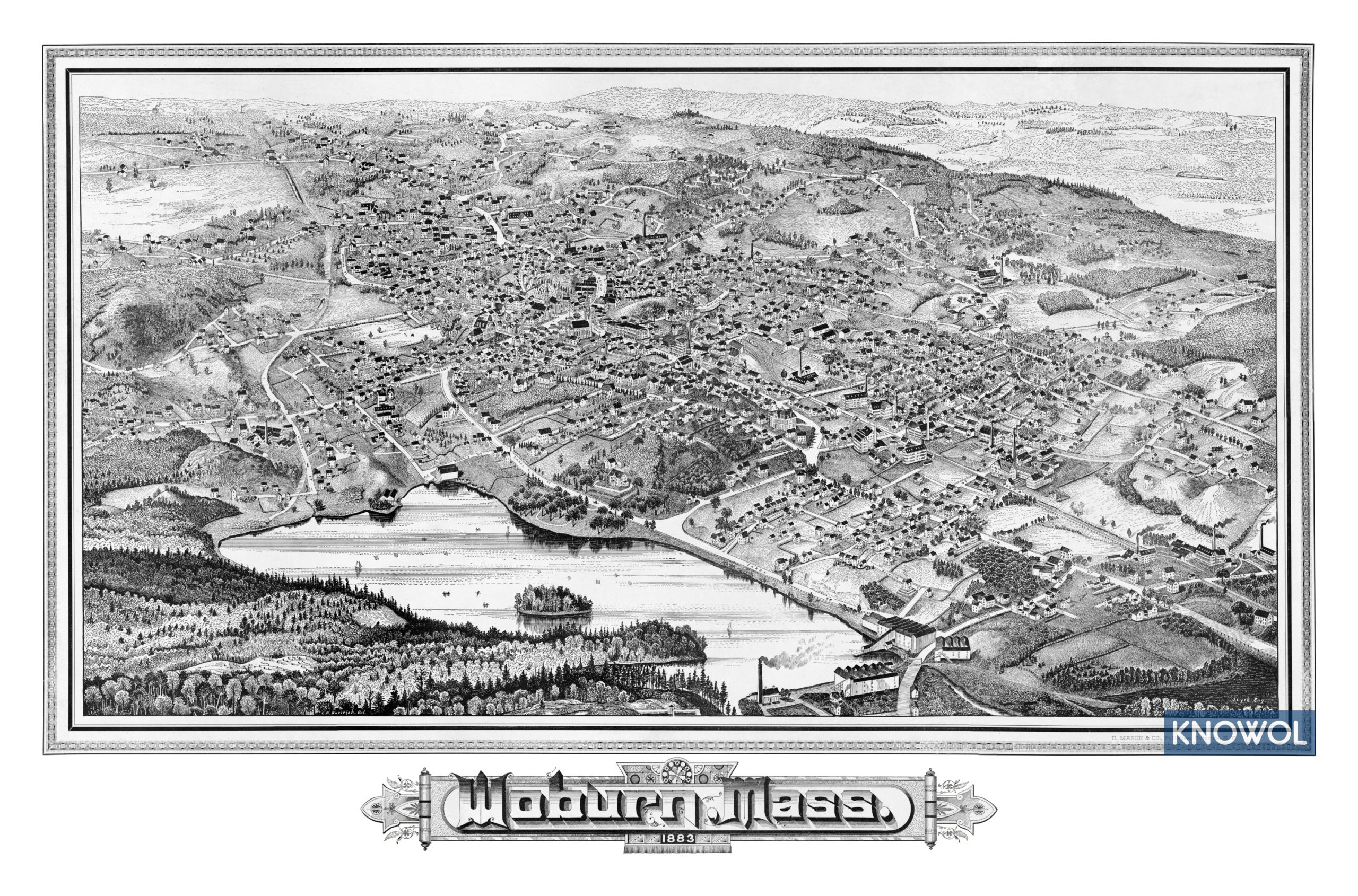
The bird's-eye view
By Lucien Burleigh
Woburn as it looked in 1883, drawn as if from the sky by Lucien Burleigh, with its street names and old landmarks, when about 10,000 people lived here.6
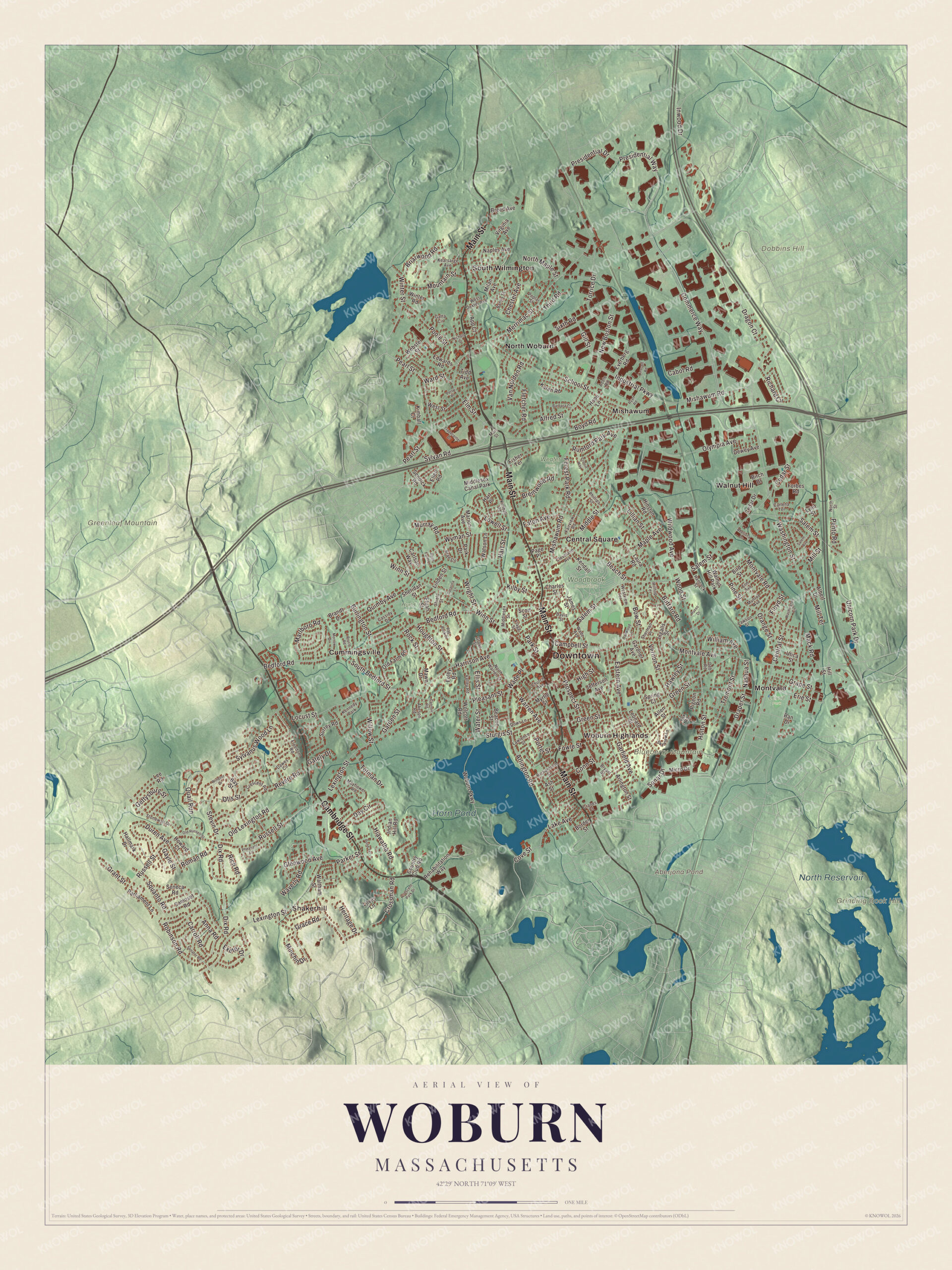
Woburn today
By KNOWOL
Every street and building in the city with its ponds, hills and terrain, from Horn Pond, Aberjona Pond and the North Reservoir to Blueberry Mountain, Dobbins Hill and Greenleaf Mountain, and the neighborhoods from Downtown and Shakerhill out to Cummingsville, Montvale and North Woburn.7
The story of Woburn
Charlestown Village becomes Woburn
Woburn began as Charlestown's back country. In November 1640 Charlestown named a committee of thirteen, with Robert Sedgwick as its chairman, to set the bounds and pick the site of a new town, and settlers came out to the land near Horn Pond. When the General Court made it a town in 1642, the whole act was five words long: "Charlestowne Village is called Wooborne." That December the new church ordained Thomas Carter as its first minister. Edward Johnson laid a plan of the town's land before the founders, served as its first town clerk, and later told its founding in his book Wonder-Working Providence. An 1890 county history says the name honors Sedgwick, who'd been baptized at Woburn in Bedfordshire, England.812910
The leather town
Woburn worked leather from its first years, but the trade really grew around the War of 1812, when Deacon John Cummings and General Abijah Thompson began tanning in a small way. Before the railroads, buyers were so eager that they'd stop the leather wagons in Charlestown and bargain for the load before it ever reached Boston. Apprentices trained in their yards opened shops of their own in the 1840s, and Cummingsville grew up around the Cummings business. In 1865 the fathers of 138 of the 241 babies born in town worked on leather. By January 1879 there were 24 shops with 1,288 hands, turning out 14,800 sides and 10,180 calfskins a week. A 1927 county history put it simply: Woburn was foremost for its tanneries.3111213
By canal boat to Horn Pond
Loammi Baldwin of Woburn helped plan and build the Middlesex Canal, and when it was finished in 1803 he threw a grand jubilee near his home. The canal ran a little west of the main village, and Horn Pond, which helped keep it full of water, became a pleasure ground. In 1813 the Mishawum House on Main Street advertised that small parties could ride the packet boat out from Boston, arriving at one o'clock, dine, and spend the next morning fishing and hunting. In the 1830s visitors still came by boat to Horn Pond, where the canal had six locks, to find summer houses, a fountain, boathouses and a bowling alley on the island in the pond. The railroads soon put the canal out of business.14151617
Through the years
25 moments from 1640 to today.
- 1640Settlement begins near Horn Pond.1
- 1642The General Court makes the village a town in five words: "Charlestowne Village is called Wooborne."2
- 1642Thomas Carter is ordained as Woburn's first minister.9
- 1646The First Burial Ground is laid out, about this year.18
- 1668Gershom Flagg's tannery is built near the meetinghouse.1
- 1675King Philip's War begins. During the war Woburn pays part of its taxes in shoes.19
- 1702Judge Samuel Sewall rides through Woburn and stops to view its hop-yards.20
- 1730Wilmington is set off from Woburn.1
- 1753Benjamin Thompson, the future Count Rumford, is born in North Woburn on March 26.21
- 1776Loammi Baldwin, at war near New York, writes home that Rag Rock would look like a little knoll there.22
- 1799Burlington is set off from Woburn.1
- 1803The Middlesex Canal is finished, and Loammi Baldwin throws a grand jubilee near his home.14
- 1807A house frame falls during a raising at Central Square on July 14. Four men die.23
- 1813The Mishawum House on Main Street advertises canal-boat outings from Boston.16
- 1835The Lowell railroad opens, and a village grows up at East Woburn, now Montvale.15
- 1837In a town of 2,600 people, 383 men and 320 women work at making shoes.15
- 1850Winchester is set off from Woburn.1
- 1860The First Congregational Church builds its tall-steepled church on Main Street.24
- 1865The fathers of 138 of the 241 babies born in town this year work on leather.11
- 1876Work begins on H. H. Richardson's Winn Memorial Library, finished in 1879.25
- 1877The Rumford Historical Association is founded on Count Rumford's 124th birthday.26
- 1879Woburn's 24 leather shops employ 1,288 hands.3
- 1883Lucien Burleigh draws his bird's-eye view of Woburn.6
- 1888On June 12 the town votes 966 to 32 to become a city. The first city government takes office in January 1889.4
- 1892Woburn celebrates the 250th anniversary of its incorporation, October 2 to 7.27
Places to see
Places worth a visit in Woburn today.
- DowntownMain Street and Woburn Square. Library, First Church and the oldest burial ground.
- Main StreetNorth to south through the city. The old stage road toward Portsmouth.
- Central SquareOn Main Street. Where a house frame fell in 1807.
- Horn PondWest of downtown. Where settlement began in 1640.
- North WoburnNorth end of the city. Count Rumford's birthplace, 1753.
- CummingsvilleToward the Burlington line. Grew up around the Cummings tannery.
- MontvaleEast Woburn. Grew up beside the 1835 railroad.
- MishawumAlong the Lowell rail line. A commuter rail stop until 2020.
On the National Register
All 10 places in Woburn on the National Register of Historic Places that still stand today, oldest first, and why each one matters.5
-
First Burial Ground
Established c. 1646, it is the city's first and oldest cemetery. It occupies a 1.4-acre (0.57 ha) parcel at the corner of Park and Centre Streets near Woburn Square.18
-
Loammi Baldwin Mansion
Henry Baldwin, one of Woburn's first settlers, built the original house in 1661, and his great-grandson Col. Loammi Baldwin, the canal engineer, greatly enlarged it in 1803. Six generations of Baldwins lived here, and in 1971 it was moved to a site beside the Middlesex Canal to make way for a shopping area.28
-
Count Rumford Birthplace
National Historic Landmark
Ebenezer Thompson built this house in 1714, and his grandson Benjamin Thompson, the future Count Rumford, scientist and inventor of the Rumford fireplace, was born in its west end on March 26, 1753. It is a house museum and a National Historic Landmark.21
-
1790 House
A Federal house built in 1790 for Woburn lawyer Joseph Bartlett and bought by Col. Loammi Baldwin shortly before it was finished. It stands near the Baldwin House, with the Middlesex Canal between them, after a move closer to the canal to make room for a hotel.29
-
Middlesex Canal
The surviving remnants of the 27-mile barge canal that linked the Merrimack River with the port of Boston. Its chief engineer was Woburn native Loammi Baldwin, and Horn Pond in Woburn supplied extra water when it was needed.17
-
Middlesex Canal Historic and Archaeological District
Listed in 2009, this district covers the canal's whole route, including the stretches that have since been built over. The 1972 listing covers the remnants that still survive.30
-
First Congregational Church in Woburn
The congregation, established in 1642, is one of the oldest in the United States, and its church building (the sixth for the congregation) is a local landmark. The Italianate-style church was built in 1860, and its 196-foot (60 m) steeple is believed to be the tallest wooden steeple in North America.24
-
Woburn Public Library
National Historic Landmark
H. H. Richardson designed this Romanesque Revival library, built from 1876 to 1879 with a bequest from the Winn family and long called the Winn Memorial Library. It still houses the Woburn Public Library, founded in 1856, and is a National Historic Landmark.25
-
US Post Office-Woburn Center Station
The single story Classical Revival building was built out of sandstone in 1911. It is nine bays in width, with a central portico supported by Doric columns sheltering the main entrance.31
-
Jack's Diner
Built in 1952 by the Worcester Lunch Car Company as #834, it is believed to be the only surviving stainless steel diner built by the company that is located in Massachusetts. It is located on a site that has housed a diner since at least 1937, when the Worcester Lunch Car Company also delivered a diner to this site.32
In their words
“Those of our native population who have traveled, or have found homes elsewhere, have felt, wherever they have been, that Woburn has been a place good to hail from.”
William R. Cutter, History of Middlesex County, 189033
“She has always given proof of that feeling by sending her supplies of fresh vegetables and fruit, and milk, with cream at the top, while the mother still provides her daughter with gowns, groceries, and shoe leather.”
Martha E. Sewall Curtis of Burlington, Woburn's daughter town, at the 250th anniversary, 189227
“Woburn was foremost for its tanneries; Medford for its ships.”
Middlesex County and its people, 192713
Nearby towns
Sources
- Woburn, Massachusetts, Wikipedia
- The history of Woburn, Middlesex County, Mass. (1868), on the act of incorporation, Internet Archive
- History of Middlesex County, Massachusetts (1880), on Woburn's leather manufacture, Internet Archive
- History of Middlesex County, Massachusetts (1890), Edward F. Johnson on Woburn as a city, Internet Archive
- National Register of Historic Places listings in Middlesex County, Massachusetts, Wikipedia
- Beautifully detailed map of Woburn, Massachusetts in 1883, restored by KNOWOL
- Map of Woburn, Massachusetts in 2026, KNOWOL
- History of Middlesex County, Massachusetts (1890), on Robert Sedgwick and Woburn's name, Internet Archive
- History of Middlesex County, Massachusetts (1880), on Thomas Carter's ordination, Internet Archive
- Captain Edward Johnson of Woburn, Massachusetts and some of his descendants (1905), Internet Archive
- The history of Woburn, Middlesex County, Mass. (1868), on work upon leather, Internet Archive
- History of Middlesex County, Massachusetts (1890), on the Cummings tannery, Internet Archive
- Middlesex County and its people (1927), on the towns and their trades, Internet Archive
- History of Middlesex County, Massachusetts (1890), on Col. Loammi Baldwin, Internet Archive
- History of Middlesex County, Massachusetts (1890), on Woburn in the 1830s, Internet Archive
- History of Middlesex County, Massachusetts (1890), on the Mishawum House, Internet Archive
- Middlesex Canal, Wikipedia
- First Burial Ground, Wikipedia
- Middlesex County and its people (1927), on Woburn's early tanners, Internet Archive
- The history of Woburn, Middlesex County, Mass. (1868), on Judge Sewall's ride and the hop-yards, Internet Archive
- Count Rumford Birthplace, Wikipedia
- History of Middlesex County, Massachusetts (1890), on Loammi Baldwin's letters of 1776, Internet Archive
- History of Middlesex County, Massachusetts (1890), on the fall of the Clapp house frame, Internet Archive
- First Congregational Church in Woburn, Wikipedia
- Woburn Public Library, Wikipedia
- History of Middlesex County, Massachusetts (1890), on the Rumford Historical Association and Count Rumford, Internet Archive
- Proceedings at the two hundred and fiftieth anniversary of the incorporation of the town of Woburn, October 2 to 7, 1892 (1893), Internet Archive
- Loammi Baldwin Mansion, Wikipedia
- 1790 House, Wikipedia
- Middlesex Canal Historic and Archaeological District, Wikipedia
- US Post Office-Woburn Center Station, Wikipedia
- Jack's Diner, Wikipedia
- History of Middlesex County, Massachusetts (1890), William R. Cutter's introduction to Woburn, Internet Archive