
A long Main Street town in the Pomperaug valley, settled from Stratford in 1673, where a drum on Lodge Rock once called people to meeting, Connecticut's clergy met in 1783 to choose a bishop, and the old houses now hold the state's antique shops.
Woodbury on the map
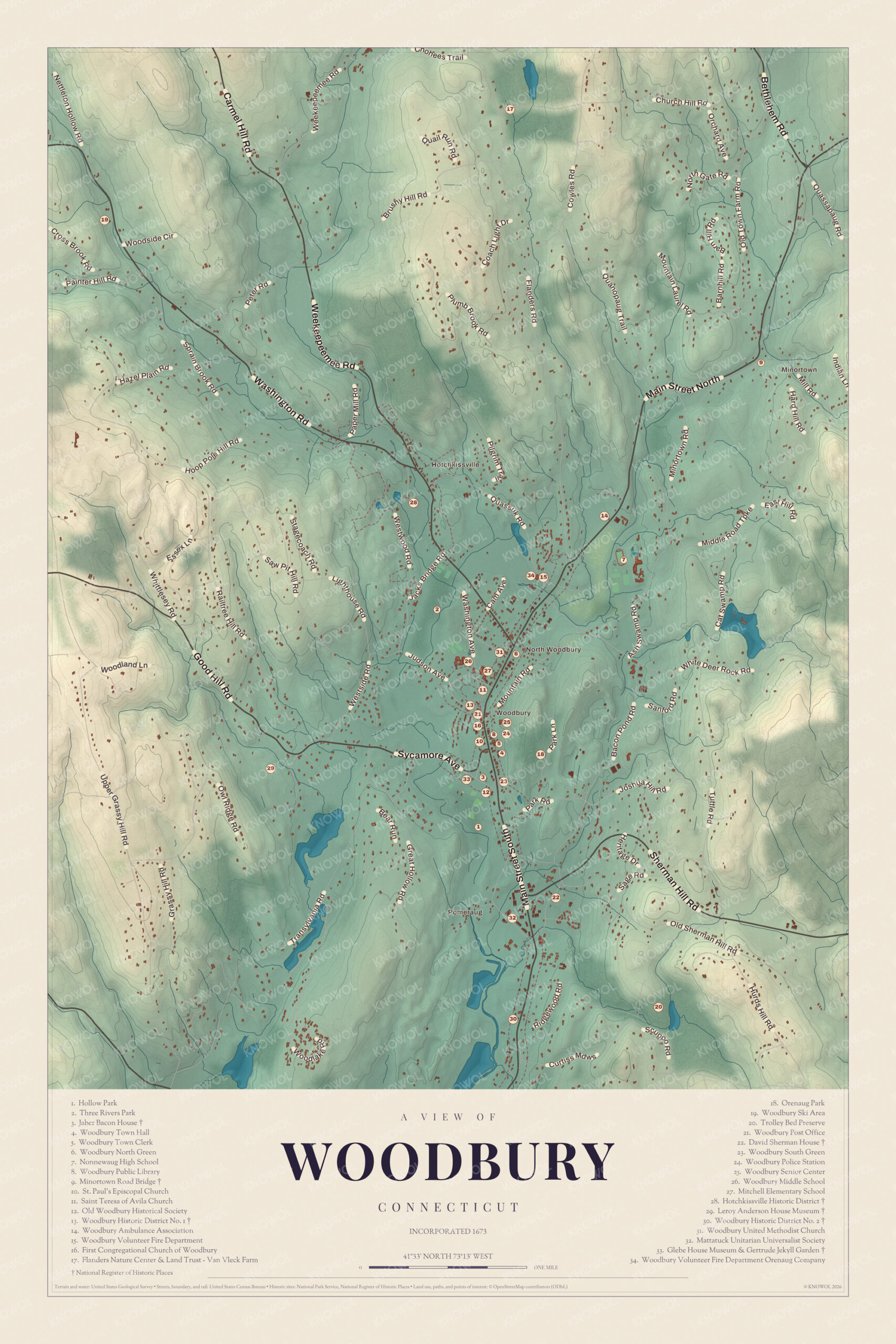
Click the map to look closer.
Woodbury today
By KNOWOL
Shaded hills from the town center down to Pomeraug, Main Street with its long line of landmarks, Woodbury, North Woodbury and Hotchkissville by name, and a guide of 34 numbered landmarks with the National Register sites marked.5
The story of Woodbury
Lost on the way to Pomperaug
Woodbury began with a church quarrel in Stratford. When the dissenting second church decided to move inland, an old story says two preachers, Mr. Walker and Mr. Reed, each gave a sermon on the day it was settled who would go. Walker preached on a reed shaken in the wilderness. Reed answered that the devil was a great walker, and ought to be kept walking at a distance. Walker went. Tradition also says the settlers were told to follow the Pomperaug eight miles up from the Housatonic, but the stream looked too small, so they followed the Shepaug to Roxbury valley before crossing east to the right place. Fifteen families had arrived by 1673, and the first two children born here, Sarah Sherman and Thomas Wheeler, came that same year.6718
The drum on Lodge Rock
In 1681 a committee of Robert Treat and Nathan Gold settled a quarrel over where Woodbury's first meeting-house should go, and drove a stake beside the cart way from Parson Walker's house to the corn mill. On Sundays a drum was beaten on the rock where the Masonic Lodge now stands. The same drum called town meetings, mustered the train-band and sounded the alarm in wartime. During the French and Indian wars, guards stood on Lodge Rock while the people, carrying their own guns, worshiped inside. The old meeting-house later served as a town hall and, near the end, as a slaughter-house. The Masons organized here in 1765, and in 1839 they built their temple on top of the cliff, where it's lit up at night.9101
The rector behind the panel
The Reverend John Rutgers Marshall and his wife Sarah moved into the Glebe House in 1771, and the years that followed were hard ones. A 1902 church history calls him a staunch American, but many townsmen distrusted him for his ties to the Church of England, and twice he was beaten and left in the road. Committees came on Mondays to arrest him and never found him. Years later people learned why: a sliding panel in a closet opened straight into the cellar, where he hid for days, coming out only at night. In 1774 he wrote his aunts that a church convention would meet at his house and asked for wine. In March 1783 ten clergymen met in Woodbury and chose Samuel Seabury, who became the first American Episcopal bishop.1112131
Through the years
24 moments from 1673 to today.
- 1673Fifteen families from Stratford, about fifty people, arrive at Pomperaug Plantation.1
- 1673Sarah Sherman and Thomas Wheeler are the first girl and boy born in the new settlement.8
- 1674The settlement is recognized as a town and named Woodbury, a dwelling place in the woods.1
- 1681The first meeting-house goes up, and a drum beaten on Lodge Rock calls people to it.9
- 1706Local leaders, notably Nonnewaug, formally deed the land to the settlers.1
- 1740About this year the Glebe House is built on Hollow Road.11
- 1760Roswell Moore builds the Jabez Bacon House for a merchant who traded as far west as Ohio.14
- 1765Woodbury's Masonic lodge is founded.10
- 1771The Rev. John Rutgers Marshall and his wife Sarah move into the Glebe House.11
- 1772The town sets up its first public library.2
- 1774Marshall writes that a church convention will meet at his house that spring.13
- 1783Ten clergymen meet in Woodbury in March and choose Samuel Seabury, who becomes the first American Episcopal bishop.1
- 1785St. Paul's Episcopal Church is built.1
- 1800The town pays Major Cunningham for the music at its mourning for George Washington.15
- 1803The Washington Turnpike opens through Hotchkissville.16
- 1813The New Milford fever kills 44 people in Woodbury.17
- 1814Josiah Hotchkiss turns a sawmill on the Weekeepeemee River into a textile mill.16
- 1817The First Congregational Church of Woodbury, the congregation's third building, goes up.5
- 1825Woodbury's hatters bury their brother Fisher Hartshorn, dead of smallpox, and raise a monument to him.18
- 1839The Masonic temple is built on top of the cliff above Main Street.1
- 1850The Woodbury Library Association starts auctioning the use of its books each month.19
- 1890The Berlin Iron Bridge Company builds the Minortown Road Bridge for $625.20
- 1946Leroy Anderson, spending the summer in Woodbury, writes "Sleigh Ride" in a heat wave.21
- 1953The Andersons build their Mid-Century Modern house on Grassy Hill Road.21
Places to see
The numbers match the landmark guide printed on the 2026 map.
- 3Jabez Bacon HouseHollow Road. A merchant's Georgian house of 1760.
- 9Minortown Road BridgeOver the Nonnewaug River. Iron lenticular truss of 1890.
- 10St. Paul's Episcopal ChurchMain Street. Built in 1785.Visit their website
- 13Woodbury Historic District No. 1Main Street. Two miles of houses back to the 1680s.
- 16First Congregational Church of WoodburyMain Street. The congregation's third building, 1817.Visit their website
- 18Orenaug ParkEast of Main Street. Park on the rocks above the village.
- 22David Sherman HouseMiddle Quarter Road. Cider for Rochambeau's army, 1781.
- 28Hotchkissville Historic DistrictWashington and Weekeepeemee Roads. Mill village on the Weekeepeemee River.
- 29Leroy Anderson House MuseumGrassy Hill Road. Home of the composer of "Sleigh Ride."Visit their website
- 33Glebe House Museum and Gertrude Jekyll GardenHollow Road. Where the clergy met in 1783.Visit their website
On the National Register
All 8 places in Woodbury on the National Register of Historic Places that still stand today, oldest first, and why each one matters.4
-
Woodbury Historic District No. 1
The linear town center from Flanders Road to Old Sherman Hill Road, with 161 historic buildings. About half were built before 1830, thirteen before 1740, and the oldest houses and barns date to the 1680s.3
-
Glebe House
The rectory of St. Paul's Church, home of the Rev. John Rutgers Marshall. In March 1783 ten clergymen met here in the first Episcopal election in the United States, and Samuel Seabury became Connecticut's bishop. It has been a museum since the 1920s, with a garden designed by Gertrude Jekyll.11
-
Jabez Bacon House
A well-kept Georgian house built by the carpenter Roswell Moore for Jabez Bacon, a merchant and banker who sent traders as far west as Ohio. A later owner, Daniel Curtiss, trained Collis P. Huntington as a salesman.14
-
David Sherman House
A Colonial saltbox on the route of the French army in 1781. Local histories say David Sherman gave the soldiers apples and cider and held a party for officers camped at Newtown.22
-
Woodbury Historic District No. 2
About a mile of Main Street at the Southbury line, with 27 historic houses from the late 1700s on, including a fine Greek Revival house with a flushboarded pediment.23
-
Hotchkissville Historic District
A mill village that grew after the Washington Turnpike opened in 1803 and Josiah Hotchkiss built his textile mill in 1814. The main mill burned in 1920, but the Federal and Greek Revival houses remain.16
-
Minortown Road Bridge
A 64-foot wrought iron lenticular truss by the Berlin Iron Bridge Company, built when the town replaced its wooden bridges. In 2001 it was one of seventeen such bridges left in the state.20
-
Leroy Anderson House
The Mid-Century Modern house of stone, wood and glass that Joseph Stein designed for the composer Leroy Anderson, who wrote "Sleigh Ride" in Woodbury. His grand piano is still inside.21
In their words
“Wherever there has been labor to be performed, or deeds of valor to be done, the sons of Woodbury have ever been in the front rank.”
William Cothren, History of ancient Woodbury, 187124
“The hills are higher every year, the trees nobler, the walks and drives more attractive, the town more beautiful, and the people kinder in their welcome.”
Herbert J. Wyckoff of North Woodbury, coming home, in The town and people, 190125
“Woodbury is one of the prettiest country villages in New England”
F. E. Judson, writing from Los Angeles, in The town and people, 190126
Nearby towns
Sources
- Woodbury, Connecticut, Wikipedia
- History of ancient Woodbury, Connecticut, William Cothren (1871), on the library of 1772, Internet Archive
- Woodbury Historic District No. 1, Wikipedia
- National Register of Historic Places listings in Litchfield County, Connecticut, Wikipedia
- Map of Woodbury, Connecticut in 2026, KNOWOL (USGS elevation, Census Bureau roads)
- Connecticut historical collections, John Warner Barber (1836), on Mr. Walker and Mr. Reed, Internet Archive
- Connecticut historical collections, John Warner Barber (1837), on the first settlers, Internet Archive
- History of ancient Woodbury, Connecticut, William Cothren (1871), on the first children born, Internet Archive
- History of ancient Woodbury, Connecticut, William Cothren (1871), on the first meeting-house and Lodge Rock, Internet Archive
- History of ancient Woodbury, Connecticut, William Cothren (1871), chronology, Internet Archive
- Glebe House (Woodbury, Connecticut), Wikipedia
- Sketches of church life in colonial Connecticut (1902), on Mr. Marshall's hiding place, Internet Archive
- Sketches of church life in colonial Connecticut (1902), on the convention of 1774, Internet Archive
- Jabez Bacon House, Wikipedia
- History of ancient Woodbury, Connecticut, William Cothren (1871), on mourning Washington, Internet Archive
- Hotchkissville Historic District, Wikipedia
- History of ancient Woodbury, Connecticut, William Cothren (1871), on the fever of 1813, Internet Archive
- Connecticut historical collections, John Warner Barber (1836), on the hatters' monument, Internet Archive
- History of ancient Woodbury, Connecticut, William Cothren (1871), on the Woodbury Library Association, Internet Archive
- Minortown Road Bridge, Wikipedia
- Leroy Anderson House, Wikipedia
- David Sherman House, Wikipedia
- Woodbury Historic District No. 2, Wikipedia
- History of ancient Woodbury, Connecticut, William Cothren (1871), on the sons of Woodbury, Internet Archive
- The town and people: writings from residents of Woodbury, Connecticut (1901), Herbert J. Wyckoff, Internet Archive
- The town and people: writings from residents of Woodbury, Connecticut (1901), F. E. Judson, Internet Archive