
A college town in the Connecticut River valley, set off from Hadley in 1759, where one church's members founded an academy and a college, the mills made palm-leaf hats and gold pens, and Emily Dickinson wrote in her family's house on Main Street.
Then and now
The same town 140 years apart. Click either map to look closer.
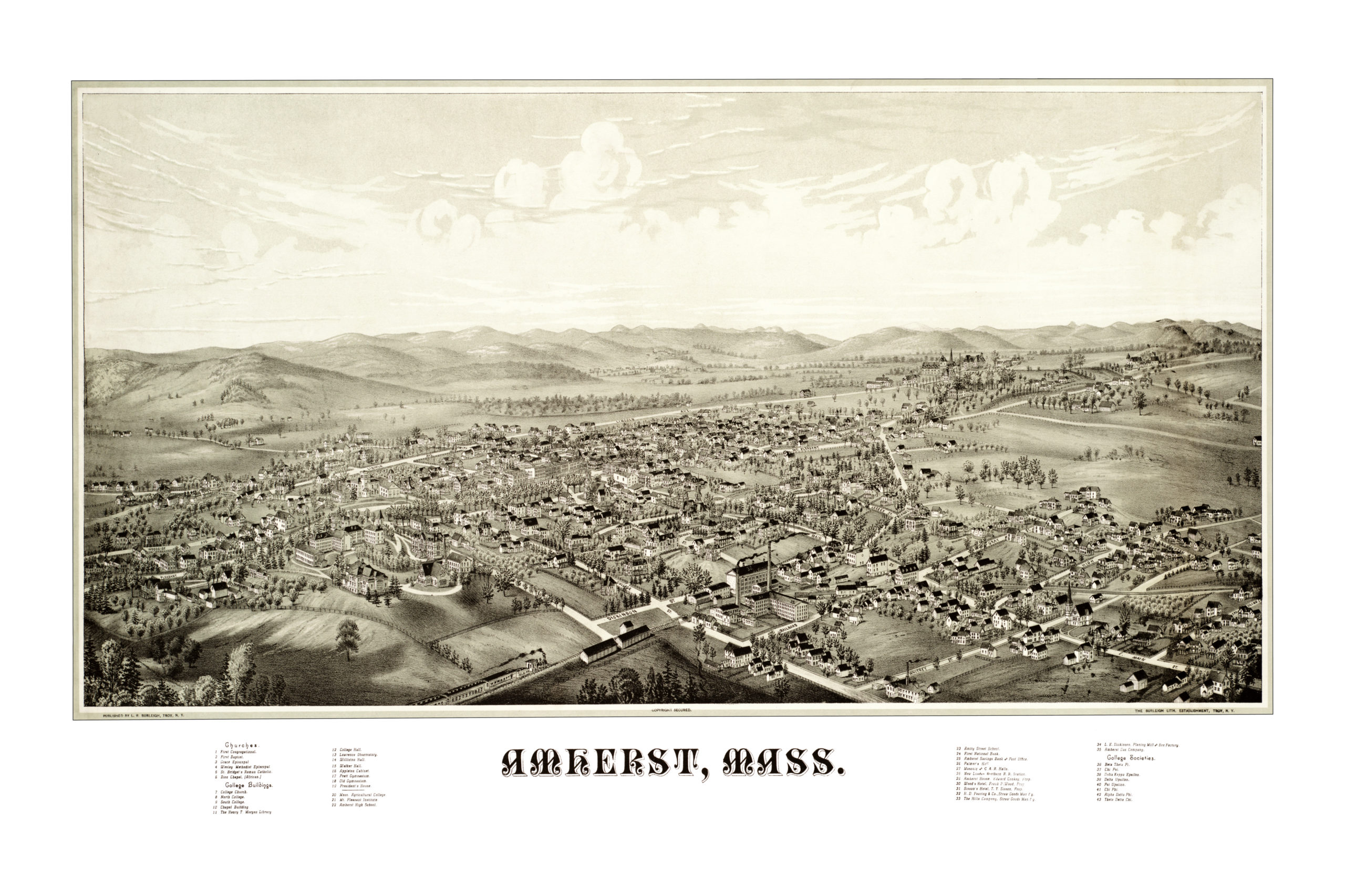
The bird's-eye view
By Lucien R. Burleigh
Amherst drawn as if from the sky in 1886, with Massachusetts Agricultural College (now UMass Amherst), the Old Fraternity Buildings, Old South College, Masonic Hall and the Amherst House.4
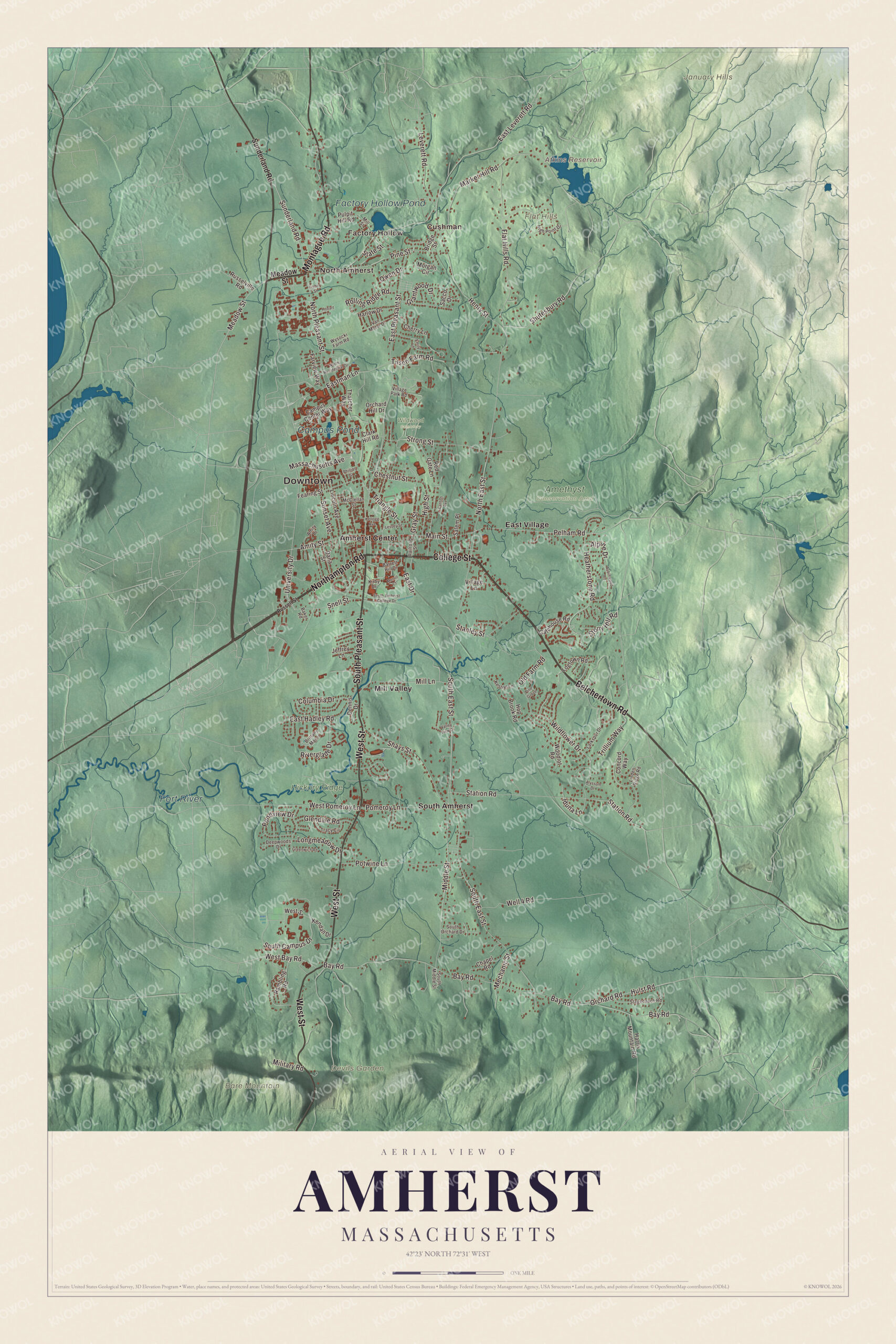
Amherst today
By KNOWOL
Shaded terrain from the Holyoke Range to North Amherst, with the Fort River, Campus Pond at the university, Factory Hollow Pond, the Atkins Reservoir, East Village and Bare Mountain, and the main roads printed by name.5
The story of Amherst
Hats, gold pens and cider brandy
Amherst is known for its colleges, but it made things too. Leonard M. Hills came up from Ellington, Connecticut, in 1829 and became the town's pioneer maker of palm-leaf hats. Under Hills and his son Henry the business grew into the largest of its kind in the country. It burned in 1879, was rebuilt bigger, and in the 1920s still kept about three hundred people at work. Ira C. Haskins started a gold pen factory about 1850 that turned out more than fifty styles, and an 1879 count found two hat factories and two gold pen makers in the village. South Amherst once built baby carriages, and an old distillery used up 3,000 barrels of cider a year making cider brandy.6738
The church that started the colleges
In 1812 Samuel F. Dickinson, the poet's grandfather, and Hezekiah W. Strong started a subscription for an academy, and when Amherst Academy was incorporated in 1816, Noah Webster, then living in town, sat on its board. Webster and his family had a square pew in the old meeting-house on the hill. Out of the academy came Amherst College, founded in 1821. At the First Church's 150th anniversary in 1889, the college's historian, Professor William S. Tyler, said the church's members had founded both, and since the agricultural college was Amherst College's daughter, the church was the mother of them all. When that agricultural college graduated its Pioneer Class in 1871, people decorated their houses along the street to the campus.910118121314
Lyman's Hill and North Amherst City
Amherst people have always held on to their own names for places. A 1905 book of Amherst homes says the early settlers named hill and brook after their owners, and the names stuck. The college men called a South Amherst hill Mount Pollux, but in town it stayed Lyman's Hill, after the deacon who owned it. President Hitchcock and a senior class couldn't talk Sunderland into calling Mount Toby Mettawompe. In the northeast the post office became Cushman, yet older folks still said North Amherst City, though an 1894 guide warned it was one street with a station, store, church and school. Factory Hollow, Nuttingville, Hawley Swamp and Kelloggville were names everyone knew, and Turkey Pass lost its name only when its trap rock was hauled off for state highways.1516
Through the years
25 moments from 1658 to today.
- 1658John Pynchon of Springfield buys the land from Umpanchla, Quonquont and Chickwalopp for wampum and a coat.1
- 1704The wide east street is laid out, the road East Village later grows around.17
- 1727The first permanent English settlers arrive in Hadley's outlands.1
- 1730Hadley lays out a burying ground for its east inhabitants, today's West Cemetery.18
- 1734The east part of Hadley becomes its own precinct.1
- 1738Nathaniel Kellogg is granted water rights for a gristmill at the great falls of the Mill River, the start of Cushman.19
- 1744About this year Nehemiah Strong builds the house on Amity Street that's now the Amherst History Museum.20
- 1759Amherst becomes a township, named for Major General Jeffery Amherst.1
- 1783A second parish is set up at East Village.21
- 1812Samuel F. Dickinson and Hezekiah W. Strong start a subscription to build Amherst Academy.9
- 1813Samuel Fowler Dickinson builds the Homestead on Main Street.10
- 1821Amherst College is founded.8
- 1825Town meetings are still held in the church at the head of the East Village common.17
- 1826Amherst's first newspaper appears, the Chemist and Meteorological Journal.3
- 1829Leonard M. Hills settles in Amherst and starts making palm-leaf hats.6
- 1830Emily Dickinson is born in the Homestead.10
- 1838A major fire devastates downtown Amherst.22
- 1838South Amherst gets its own post office.3
- 1853The railroad reaches Amherst Center, and East Village's days as a rival center end.21
- 1867The Massachusetts Agricultural College, today's UMass Amherst, opens.3
- 1871The agricultural college graduates its first class, the Pioneer Class.14
- 1879The Hills hat factory burns, and it's rebuilt bigger than before.7
- 1886Lucien R. Burleigh publishes his bird's-eye view of Amherst.4
- 1910The African American congregation that became Goodwin Memorial AME Zion finishes its own church.23
- 1916The Strong House is given to the Amherst Historical Society.20
Places to see
Places worth a visit in Amherst today.
- Emily Dickinson MuseumMain Street. The poet's Homestead and the Evergreens.Visit their website
- Amherst CollegeAmherst Center. Where Melvil Dewey worked and Frost taught.Visit their website
- University of Massachusetts AmherstNorth of the center. Began as Massachusetts Agricultural College.Visit their website
- Campus PondUMass campus. Dammed by two students for ice.
- Hampshire CollegeSouth Amherst. One of the Five Colleges.Visit their website
- East VillageMain and East streets. A rival town center until 1853.
- Cushman VillageNortheastern Amherst. Mill village at the Mill River falls.
- North AmherstNorth Amherst. Home of the Henry Street salamander tunnels.
- Fort RiverEast of East Village. Free-flowing, with no dams at all.
- Bare MountainHolyoke Range. Bald peak with wide views.
On the National Register
All 16 places in Amherst on the National Register of Historic Places that still stand today, oldest first, and why each one matters.2
-
Amherst West Cemetery
Hadley voted to lay out this burying ground for its eastern precinct in 1730, and the oldest marked grave dates from 1737. Emily Dickinson and her family are buried here, along with early settlers and Civil War veterans, both white and African American.18
-
Cushman Village Historic District
A mill village that grew at the falls of the Mill River, where Nathaniel Kellogg was granted water rights for a gristmill in 1738. The mills are gone, but most of the houses date from before 1860, the village's busiest years.19
-
North Amherst Center Historic District
A well-kept farming village at a five-way crossroads, surveyed in 1739 while it was still part of Hadley. By 1833 it had a church, school and tavern, and its Romanesque library came in 1893.24
-
South Amherst Common Historic District
The common, also called Fiddlers Green, grew from a road junction of 1760. Nathaniel Coleman's house of about 1742 still stands at its south end, and the common was the hub of the rural south part of town.25
-
Strong House
Nehemiah Strong built this house only a few years after settlement began, and his son Simeon, later a justice of the state's highest court, enlarged it in the 1790s. It has belonged to the Amherst Historical Society since 1916 and houses the Amherst History Museum.20
-
Lincoln-Sunset Historic District
Known as Millionaire's Row, it was one of Amherst's first planned neighborhoods, built up by merchants, business owners and professors after Lincoln Street was platted in 1882. Its oldest house is the Solomon Boltwood House of about 1751.26
-
East Village Historic District
East Village was one of Amherst's main centers until the railroad reached Amherst Center in 1853. Its 49 buildings include some of the town's oldest, among them three houses and a tavern from the 1700s.21
-
Amherst Central Business District
The civic and commercial heart of town since the 1700s, rebuilt in brick after the fire of 1838 and later fires. It takes in the northern third of the town common, Town Hall, Grace Episcopal and First Baptist churches, and since 2011 the Lord Jeffery Inn.22
-
Emily Dickinson House
National Historic Landmark
The Homestead, built by the poet's grandfather Samuel Fowler Dickinson, was Emily Dickinson's birthplace and her home from 1855 to 1886, and her poems were found in her room after her death. With the Evergreens next door it's now the Emily Dickinson Museum.10
-
Dickinson Historic District
Built around the Emily Dickinson Home, it reaches east along Main Street to the railroad station. It also takes in the houses of Leonard Hills, the palm-leaf hat maker, and the Gothic First Congregational Church of 1867.27
-
Prospect-Gaylord Historic District
A 19th century neighborhood just off the center, along Prospect Street, laid out in 1824. Its centerpiece is the Hope Community Church of 1912, a historically African American church whose building fund W. E. B. Du Bois helped raise.28
-
Conkey-Stevens House
A brick Greek Revival house built for Conkey, a leading local lawyer, and given a Second Empire mansard roof in 1870 by Albert Stevens, who made his money with the Union Pacific Railroad.29
-
Westside Historic District
One of Amherst's oldest known African American neighborhoods, with houses on Baker Street from 1869 into the 1870s and fields that still set it apart.30
-
Old Chapel
A granite Romanesque building with a clock tower, built on the agricultural college campus as its library, museum and assembly hall. Its first bell, Old Aggie, came in 1892; the tower now holds carillon bells.31
-
Goodwin Memorial African Methodist Episcopal Zion Church
Built in 1910 by an African American congregation that raised its own money to have a church of its own, with help from a 1904 visit by Booker T. Washington. It was renamed in 1967 for Moses Goodwin and his family.23
-
Baird House
The only Frank Lloyd Wright design in Massachusetts, a Usonian house for Amherst College English professor Theodore Baird. Parts were made in a New Jersey factory and assembled on the site.32
In their words
“The people of Amherst were proud of the college which they had done so much to establish; they have never lost that pride”
The history of the town of Amherst, Massachusetts, 189612
“Inasmuch as the Agricultural College was the daughter of Amherst College, this Church is the mother of them all.”
Professor William S. Tyler at the First Church's 150th anniversary, 188913
“North Amherst "City" is not so large as its name would lead one to believe.”
The handbook of Amherst, Massachusetts, 189416
Nearby towns
Sources
- Amherst, Massachusetts, Wikipedia
- National Register of Historic Places listings in Hampshire County, Massachusetts, Wikipedia
- Western Massachusetts; a history, 1636-1925 (1926), on the villages and industries of Amherst, Internet Archive
- Beautiful old map of Amherst, Massachusetts in 1886, restored by KNOWOL
- Map of Amherst, Massachusetts in 2026, KNOWOL (USGS elevation, Census Bureau roads)
- Western Massachusetts: a history, 1636-1925 (1926), on Leonard M. Hills, Internet Archive
- Western Massachusetts: a history, 1636-1925 (1926), on Fred H. Hawley and the Hills hat company, Internet Archive
- History of the Connecticut Valley in Massachusetts (1879), on the villages of Amherst, Internet Archive
- History of western Massachusetts (1855), on Amherst Academy, Internet Archive
- Emily Dickinson Museum, Wikipedia
- An historical review: one hundred and fiftieth anniversary of the First Church of Christ in Amherst (1890), on the old meeting-house, Internet Archive
- The history of the town of Amherst, Massachusetts (1896), on the town and its college, Internet Archive
- An historical review: one hundred and fiftieth anniversary of the First Church of Christ in Amherst (1890), William S. Tyler's paper, Internet Archive
- Brief history of the Massachusetts agricultural college, semicentennial, 1917 (1917), on the Pioneer Class, Internet Archive
- Historic homes of Amherst (1905), on local place names, Internet Archive
- The handbook of Amherst, Massachusetts (1894), on North Amherst City, Internet Archive
- The handbook of Amherst, Massachusetts (1894), on East Amherst, Internet Archive
- Amherst West Cemetery, Wikipedia
- Cushman Village Historic District, Wikipedia
- Strong House (Amherst, Massachusetts), Wikipedia
- East Village Historic District (Amherst, Massachusetts), Wikipedia
- Amherst Central Business District, Wikipedia
- Goodwin Memorial African Methodist Episcopal Zion Church, Wikipedia
- North Amherst Center Historic District, Wikipedia
- South Amherst Common Historic District, Wikipedia
- Lincoln-Sunset Historic District, Wikipedia
- Dickinson Historic District, Wikipedia
- Prospect-Gaylord Historic District, Wikipedia
- Conkey-Stevens House, Wikipedia
- Westside Historic District (Amherst, Massachusetts), Wikipedia
- Old Chapel (Amherst, Massachusetts), Wikipedia
- Theodore Baird Residence, Wikipedia