
A Bristol County shire town named for Taunton in Somerset, famous first for the alewives that crowded up the Mill River every April and later for the calico, carpet tacks, locomotives and britannia ware that made it the Silver City.
Taunton then and now
The same town 151 years apart. Click either map to look closer.
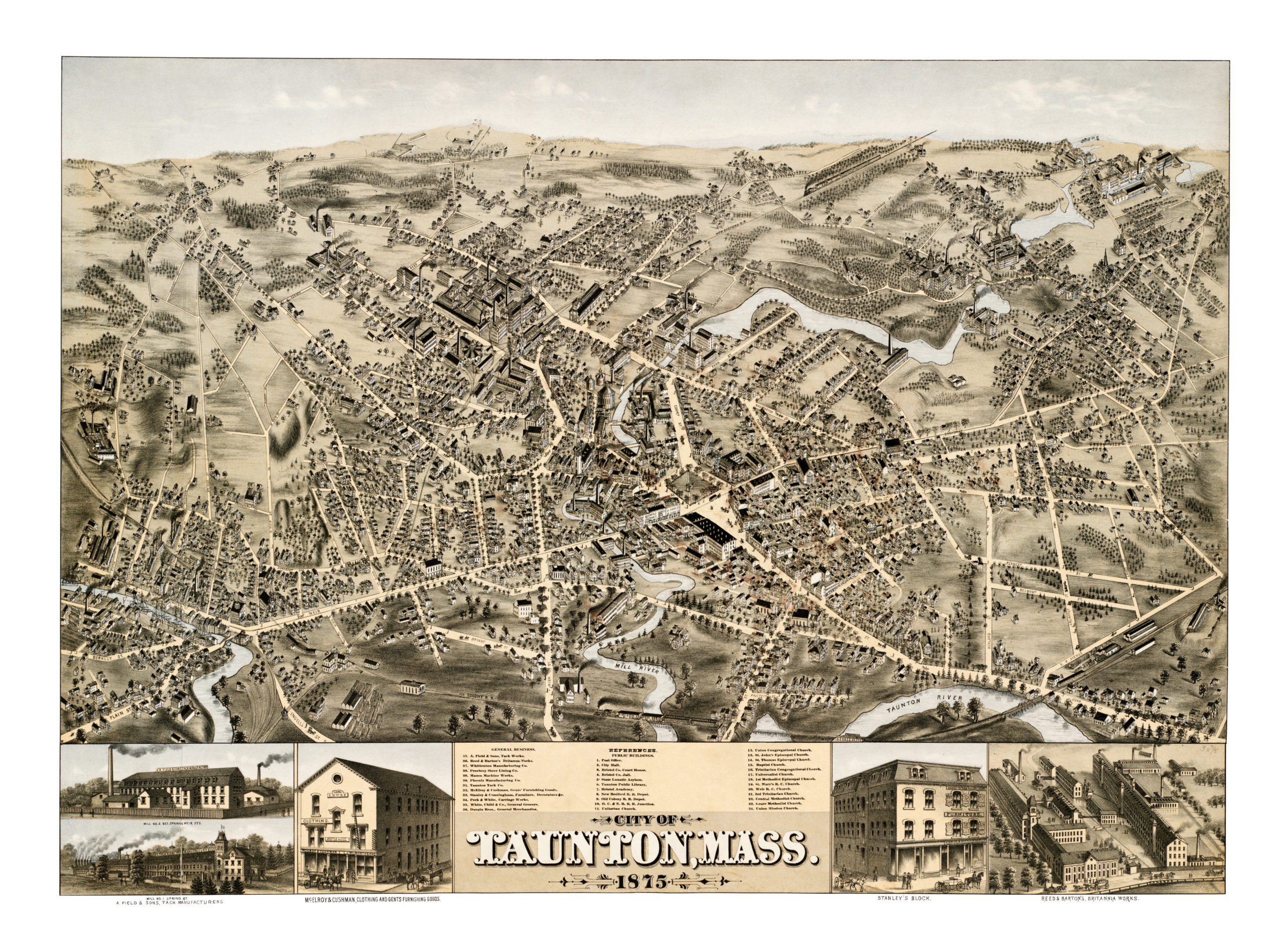
Taunton in 1875
By O.H. Bailey & Co.
Taunton as it looked in 1875, with landmarks such as the State Lunatic Asylum, the Taunton Public Library, Taunton City Hall, Whittenton Manufacturing, the Taunton Tack Company and the Bristol County Court House.5
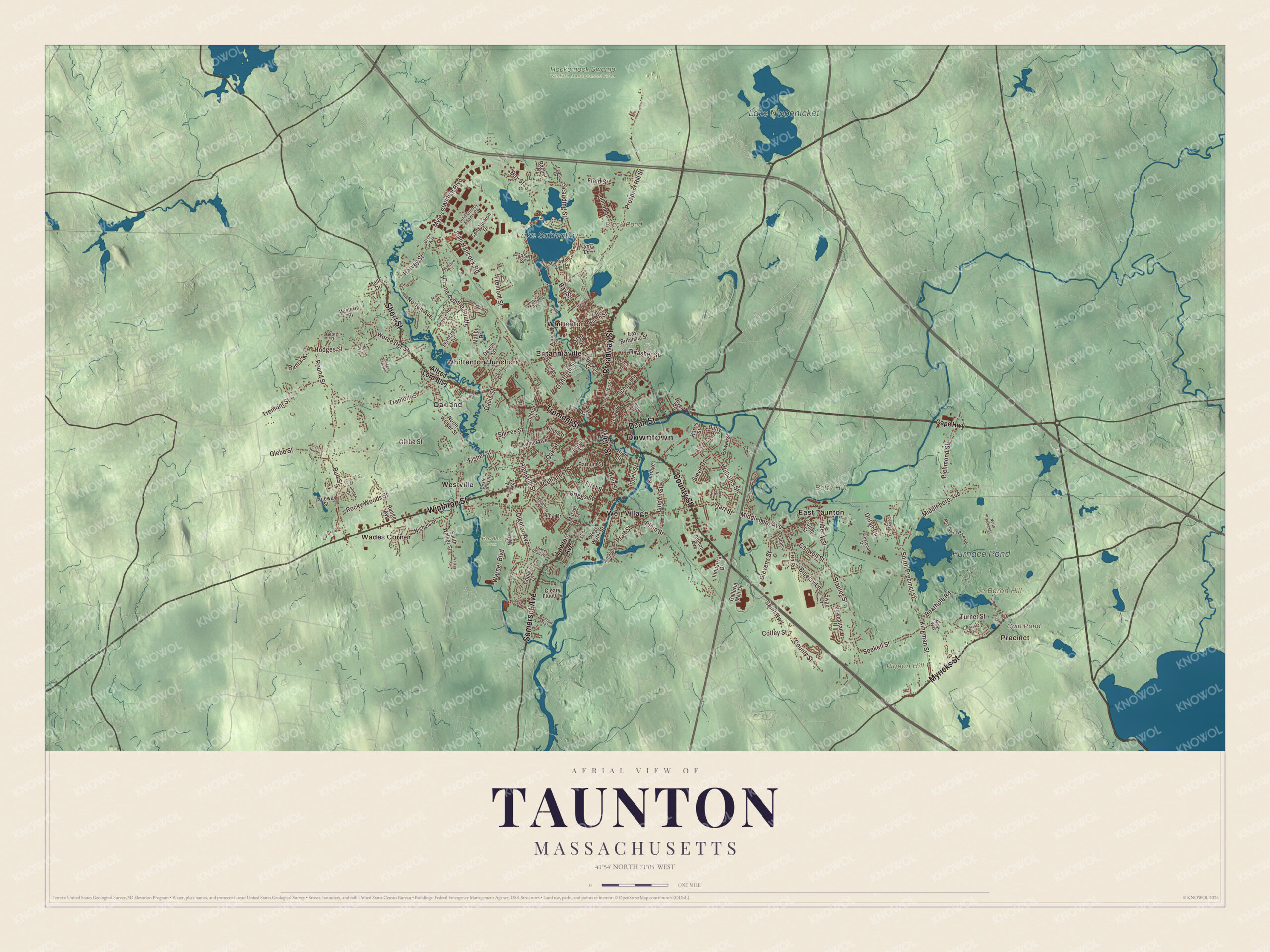
Taunton today
By KNOWOL
The whole city in one view, from Downtown and Britanniaville out to East Taunton, Oakland, Precinct, Wades Corner and Weir Village, with Lake Sabbatia, Black Pond, Cain Pond, Pigeon Hill, Betty Hill and Le Baron Hill printed on the map.6
The history of Taunton, Massachusetts
The herring town
Before there was a Taunton, the falls on the Mill River had a name: Cohannet. A Taunton man writing in the early 1700s called them the best place anywhere around for catching alewives. Old residents remembered hundreds of Native families coming up from Mount Hope every April, dancing and shouting, camping by the falls and carrying home a year's supply of fish. The run was so thick that children could catch them in nets. In 1666 townspeople took the owners of a sawmill to the Plymouth court for blocking the fish, and won. Tradition says a traveler who asked the name of the place in herring season got a hearty answer: Taunton, good Lord! By 1820 the mill dams had nearly stopped the run, and the first issue of Taunton's first newspaper, named Cohannet, could only sigh: Poor Taunton!789
Britannia, calico and carpet tacks
Taunton's nickname, the Silver City, started with a watchmaker's hunch. Isaac Babbitt thought the britannia ware Americans bought from England could be made at home. After experiments behind his shop, he and William Crossman turned out inkstands and shaving boxes in 1824, the first britannia articles made in the United States, says the 1893 town history. That business grew into Reed & Barton. Around it the mill streams filled up: a calico print works in 1823, canton flannel at Oakland in 1827, and carpet tacks that Judge Edmund H. Bennett said reached the palaces of presidents and princes. The Old Colony Iron Company's five hundred hands were the life of East Taunton, and by 1874 William Mason's locomotive works covered ten acres.310111
More dangerous than Boston
In the fall of 1774, months before the fighting at Lexington, Taunton made its feelings plain. In October a red flag went up on Taunton Green with the words Liberty and Union, and that flag still flies at the center of the city. Taunton women held their own protest tea party at Luscombtown, near the Neck of Land bridge. A Boston paper of the day said it was more dangerous to be a Tory at Taunton than in Boston itself. The surgeon William McKinstry, a Tory, lost his brick-ended house on High Street when the state confiscated it in 1779, and the house still stands. Near that same Neck of Land bridge, David Carver kept the inn where, the 1924 county history says, Lafayette stopped.21213141
Taunton, Massachusetts through the years
25 moments from 1621 to today.
- 1621Edward Winslow and Stephen Hopkins pass through on a visit to Massasoit, believed to be the first Englishmen here.15
- 1637Settlers from Plymouth Colony buy the land in the Tetiquet Purchase.1
- 1638Richard Paul marries Margery Turner, the first wedding in the town.16
- 1639Taunton is incorporated as a town, named for Taunton in Somerset, England.1
- 1640Richard Paul is licensed to keep the town's first public house, on Main Street near Dean.16
- 1641The colony gives Taunton a thirty-shilling fine to spend making the swamps toward Plymouth passable.17
- 1666Townspeople win a complaint at the Plymouth court against a Mill River sawmill that blocked the herring run.8
- 1685Taunton becomes the shire town of the new Bristol County.1
- 1688Joseph Willis builds the house on Worcester Street that is now the city's oldest building.18
- 1747Work begins on the first court-house in Taunton.19
- 1772Major William Sever starts making stoneware on Crooked Lane, now Ingell Street.20
- 1774In October the Liberty and Union flag is raised on Taunton Green.2
- 1784A January freshet sweeps away every bridge and dam on the streams, and boats float up Dean Street.20
- 1806Capt. Silas Shepard's Green Mill, the town's first cotton mill, goes up on Weir Street.10
- 1821The Beethoven Society is organized, and it gives its first concert the next February.21
- 1823The Taunton Manufacturing Company is formed, with a calico print works.10
- 1824Isaac Babbitt and William Crossman make britannia ware, the beginning of Reed & Barton.3
- 1836Mount Pleasant Cemetery opens on July 4.22
- 1844The Old Colony Iron Company is incorporated at East Taunton.10
- 1864Taunton becomes a city.1
- 1875O.H. Bailey & Co. publishes its map of Taunton.5
- 1889Taunton celebrates its 250th anniversary on June 4 and 5.10
- 1903The Taunton Public Library opens in its Carnegie building on Pleasant Street.23
- 1914Taunton Green is lit up for Christmas, the start of the Christmas City.1
- 1942Camp Myles Standish opens, a departure point for over a million soldiers bound for Europe.1
Places to see in Taunton, Massachusetts
Places worth a visit in Taunton today.
- DowntownTaunton Green. Around the Green, given in 1743.
- BritanniavilleMill River, below Whittenton. Village of the britannia and silver works.
- Weir VillageTaunton River. Old river landing, inns and stove works.
- East TauntonEast of downtown. Home of the Old Colony Iron Company.
- OaklandOakland village. Canton flannel mills from 1827.
- Lake SabbatiaNorth of downtown. The lake below Prospect Hill.
- Dean StreetRoute 44, east of the Green. Mill owners' houses and the 1876 depot.
- Winthrop StreetRoute 44, west of the Green. Big houses and Westville's 1792 church.
- BroadwayNorth from the Green. Pilgrim Church and St. Mary's Square.
Taunton on the National Register of Historic Places
21 of the 92 places in Taunton on the National Register of Historic Places that still stand today, oldest first, and why each one matters. See the full list of National Register places in Taunton.4
-
Church Green
Once called Meetinghouse Common, it was Taunton's first town center and the site of its first meetinghouse, about 1647. The district takes in the First Parish Church, the Old Colony Historical Society and Taunton City Hall.24
-
Neck of Land Cemetery
Laid out in 1687 near where the Mill River meets the Taunton River, it was the city's first cemetery, and most of its graves are older than 1800. Elizabeth Pool, the town's foundress, is buried here.25
-
Joseph Willis House
Joseph Willis, a Bridgewater man granted land in Taunton for his service in King Philip's War, built this house in 1688. It is the city's oldest surviving building and one of the oldest in the state.18
-
Taunton Green Historic District
The heart of downtown, built around the Green that was given to the town in 1743 as a militia training ground. The Liberty and Union flag still flies on the Green, and since 1914 it has been lit up every December, giving Taunton the name Christmas City.26
-
Brow's Tavern
It was built circa 1780 and enlarged circa 1800. The tavern is reputed to have once served travelers on the Bristol Path, now known as Tremont Street.27
-
Westville Congregational Church
Built in 1792 in Oakland village by members who left the First Parish, it was taken apart and moved to Westville in 1824. It is the city's oldest church building and a well-kept Federal meetinghouse.28
-
Hopewell Mills District
A village of early 1800s brick tenements built for workers at the Hopewell Mills, founded in 1818 by Charles Richmond with Samuel Crocker and Silas Shepard. The mill itself burned in 1904.29
-
Old Colony Iron Works-Nemasket Mills Complex
Iron was made here on the Taunton River at the Raynham line from the 1820s, and by the mid-1870s the Old Colony Iron Company made more nails than any other company in New England. Nemasket Mills took over the western part in 1889.30
-
Reed and Barton Complex
The 14-acre home of Reed & Barton on both banks of the Mill River, with brick works built between 1830 and 1890. The silversmiths, whose business began in 1824, made Taunton the Silver City, and the business ran until 2015.31
-
Bristol County Courthouse Complex
Three court buildings on Court Street. The Superior Courthouse of 1894, designed by Frank Irving Cooper, has a 170-foot tower capped by a copper-clad dome, and the older Greek Revival courthouse of 1826 was moved to its present spot in the 1890s.32
-
Mount Pleasant Cemetery
Opened on July 4, 1836, on the old King family homestead, where burials go back to 1710, it is an early garden cemetery on the model of Mount Auburn in Cambridge, laid out by Joseph Wilbar.22
-
Pilgrim Congregational Church
A Romanesque fieldstone church on Broadway, designed by Richard Upjohn and built in 1852 for a congregation that split from the First Parish Church.33
-
St. Thomas Episcopal Church
The parish goes back to 1728, when land was deeded for a church near the Three Mile River. Its Gothic Revival church on High Street was designed by Richard Upjohn.34
-
Albert Field Tack Company
The ornate main office of 1868 of a tack and nail company founded in the 1820s, an unusually high-style building for a factory. It has since been made into apartments.35
-
St. Mary's Complex
The parish, the first in Taunton, was established in 1830, and the present church, its third, was built in 1868, to a design by Patrick C. Keely. The complex, also including a rectory, convent, and school, was listed on the National Register of Historic Places in 1984.36
-
Central Fire Station
Built in 1869, it is the oldest fire station in the city and is called the oldest continuously operated fire station in the country, never closed for any period of time.37
-
Old Colony Railroad Station
The Dean Street station, a brick Italianate depot of 1876, is the only railroad station left in the city. Passenger trains stopped here until the 1890s.38
-
Harris Street Bridge
Built in 1887, it is the oldest surviving bridge in the city, and was built as part of one of the city's earliest public works projects after incorporation as a city. It was added to the National Register of Historic Places in 1984.39
-
Lothrop Memorial Building-G.A.R. Hall
It was originally built in 1888 as the First Presbyterian Church, on land purchased from Marcus Morton, and now houses professional offices. It was for many years home to the William H. Bartlett GAR Post No. 3 of the Grand Army of the Republic, a veterans organization, which ran the building as a community center.40
-
Taunton Public Library
A Beaux Arts library of 1903 on Pleasant Street, built with help from Andrew Carnegie, with a modern addition of 1979.23
-
King Airfield Hangar
Built in 1919 on Henry King's dairy farm as part of King's Field, one of the first private airports in New England, where the family ran a flying school with a surplus Curtiss Jenny. It is the oldest piece of the airfield left.41
Taunton in their words
“It is more dangerous to be a Tory at Taunton, than in Boston itself.”
A Boston newspaper of 1774, quoted in Taunton's quarter millennial book, 188912
“Humble carpet tacks introduce our name into the palaces of presidents and princes.”
Judge Edmund H. Bennett on the Taunton Tack Company, at Taunton's 250th anniversary, 188910
“Poor Taunton! The numerous dams which have been thrown across thy rivers have almost prevented the ascent of those finny tribes, which in days of yore were the cause of thy renown.”
Cohannet, Taunton's first newspaper, 1820, as quoted by the Old Colony Historical Society7
Towns near Taunton, Massachusetts
Sources for the history of Taunton
- Taunton, Massachusetts, Wikipedia
- A history of Bristol County, Massachusetts (1924), on the flag and the tea party of 1774, Internet Archive
- History of Taunton, Massachusetts from its settlement to the present time (1893), on Isaac Babbitt and britannia ware, Internet Archive
- National Register of Historic Places listings in Taunton, Massachusetts, Wikipedia
- Amazingly detailed map of Taunton, MA from 1875, restored by KNOWOL
- Map of Taunton, Massachusetts in 2026, KNOWOL
- Collections of the Old Colony Historical Society (1878), James M. Cushman on Cohannet alewives and the falls on Mill River, Internet Archive
- Representative men and old families of southeastern Massachusetts (1912), on the Mill River sawmill and the herring, Internet Archive
- A history of Bristol County, Massachusetts (1924), on the saying Taunton, good Lord, Internet Archive
- Quarter Millennial Celebration of the City of Taunton, Massachusetts (1889), Edmund H. Bennett's historical address on Taunton's industries, Internet Archive
- Gazetteer of the state of Massachusetts (1874), on Taunton, Internet Archive
- Quarter millennial celebration of the city of Taunton, Massachusetts (1889), on Taunton in 1774, Internet Archive
- McKinstrey House, Wikipedia
- A history of Bristol County, Massachusetts (1924), on Taunton's old inns, Internet Archive
- Historical collections relating to every town in Massachusetts (1844), on Taunton, Internet Archive
- History of Taunton, Massachusetts from its settlement to the present time (1893), on the first public house, Internet Archive
- History of Bristol County, Massachusetts (1883), on the road through the swamps to Plymouth, Internet Archive
- Joseph Willis House, Wikipedia
- History of Bristol County, Massachusetts (1883), on the court-houses, Internet Archive
- Our county and its people: a descriptive and biographical record of Bristol County, Massachusetts (1899), on stoneware and the freshet of 1784, Internet Archive
- Our county and its people: a descriptive and biographical record of Bristol County, Massachusetts (1899), on the Beethoven Society, Internet Archive
- Mount Pleasant Cemetery, Wikipedia
- Taunton Public Library, Wikipedia
- Church Green, Wikipedia
- Neck of Land Cemetery, Wikipedia
- Taunton Green Historic District, Wikipedia
- Brow's Tavern, Wikipedia
- Westville Congregational Church, Wikipedia
- Hopewell Mills District, Wikipedia
- Old Colony Iron Works-Nemasket Mills Complex, Wikipedia
- Reed and Barton Complex, Wikipedia
- Bristol County Courthouse Complex, Wikipedia
- Pilgrim Congregational Church, Wikipedia
- St. Thomas Episcopal Church, Wikipedia
- Albert Field Tack Company, Wikipedia
- St. Mary's Complex, Wikipedia
- Central Fire Station, Wikipedia
- Old Colony Railroad Station, Wikipedia
- Harris Street Bridge, Wikipedia
- Lothrop Memorial Building-G.A.R. Hall, Wikipedia
- King Airfield Hangar, Wikipedia