At noon on June 1, 1905, a dozen soldiers in Portland, Oregon, jumped to their cannon and fired a salute of 100 guns. That boom opened the Lewis and Clark Exposition, a world’s fair for the 100th birthday of Lewis and Clark’s trip to the Pacific. Across the country, President Theodore Roosevelt sat in his office at the White House. When the bands in Portland played the “Star Spangled Banner,” he pressed a golden telegraph key. The signal raced over the wires and “set the works of the exposition going.”
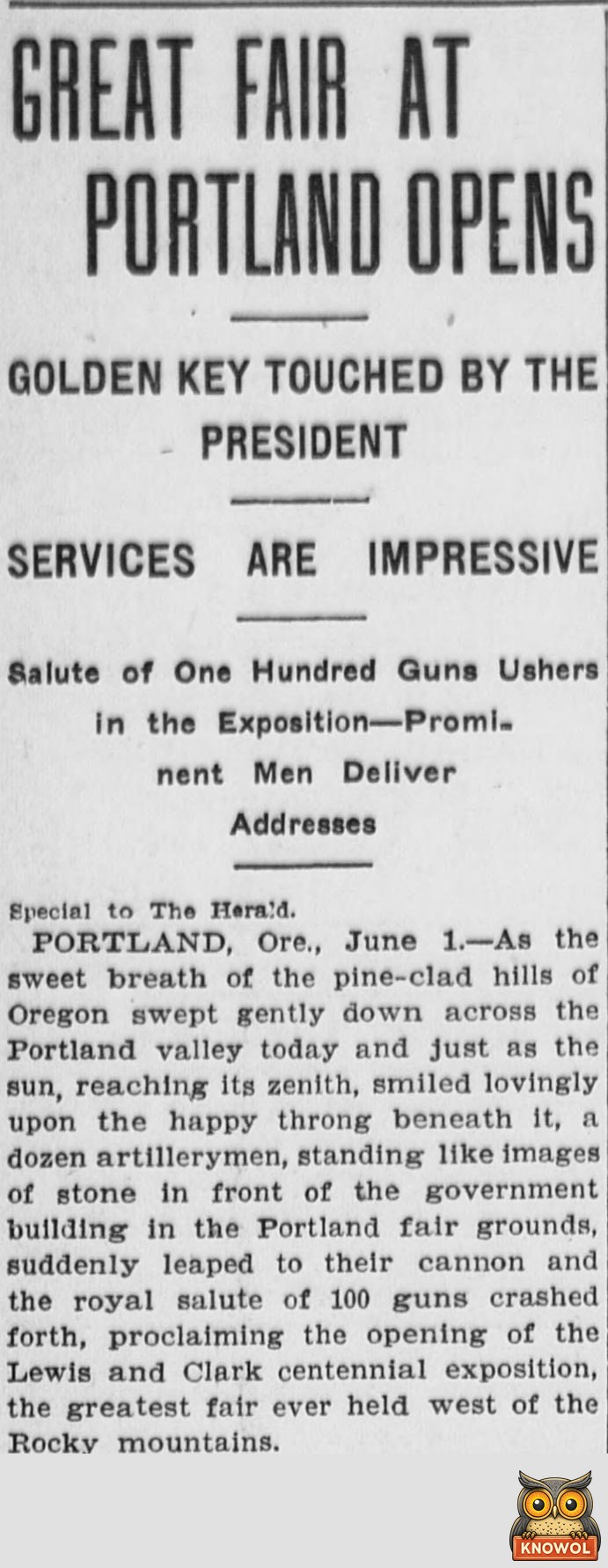
“Great Fair at Portland Opens.” Los Angeles Herald, Los Angeles, California, June 2, 1905, page 1. Library of Congress, Chronicling America. Click the clipping to read it full size.
Then the crowd of 40,000 people spread out over the fairgrounds. Thousands of them went straight to one place, the California building. The Los Angeles Herald told why. Inside stood “California’s capitol building made of almonds, the great walnut elephant and a giant grizzly bear made of fresh prunes.”
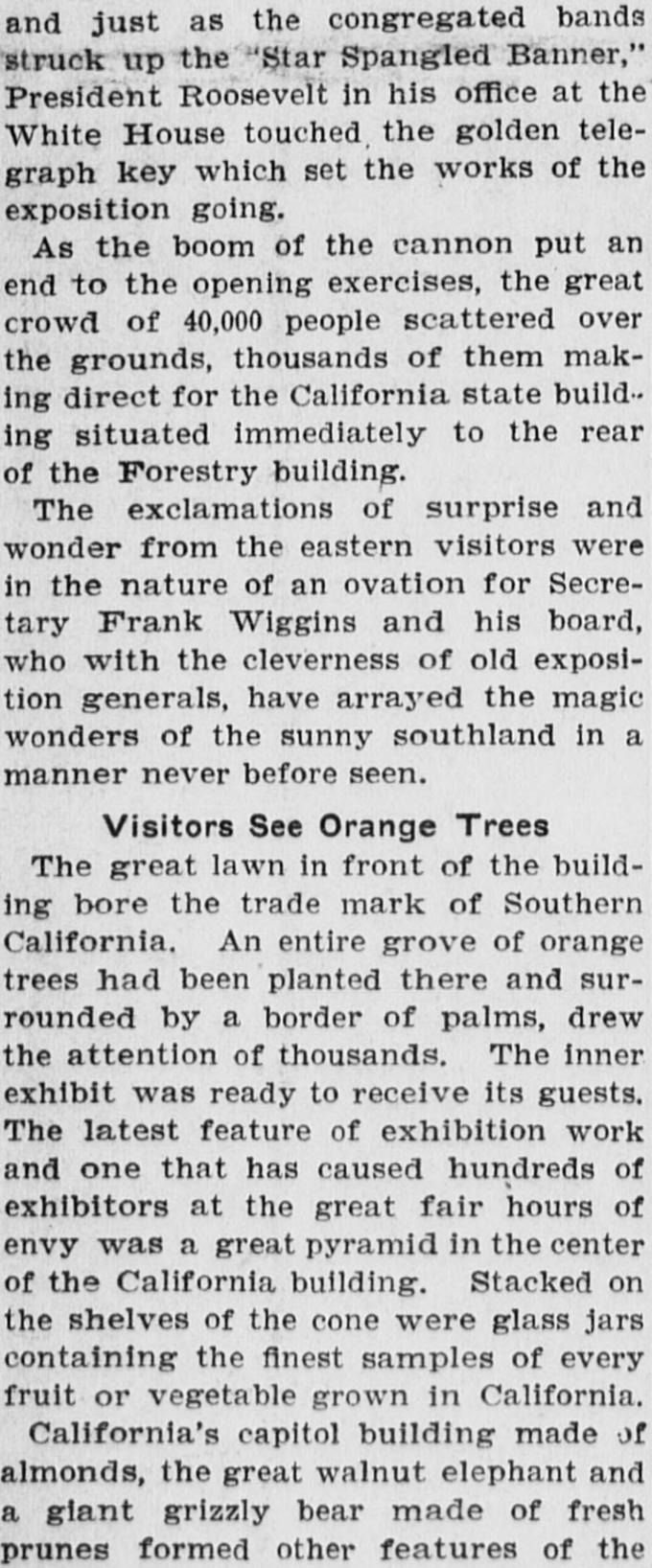
The President’s golden key, the crowd of 40,000 and the California building. Los Angeles Herald, Los Angeles, California, June 2, 1905, page 1. Library of Congress, Chronicling America. Click the clipping to read it full size.
A bear with a record player
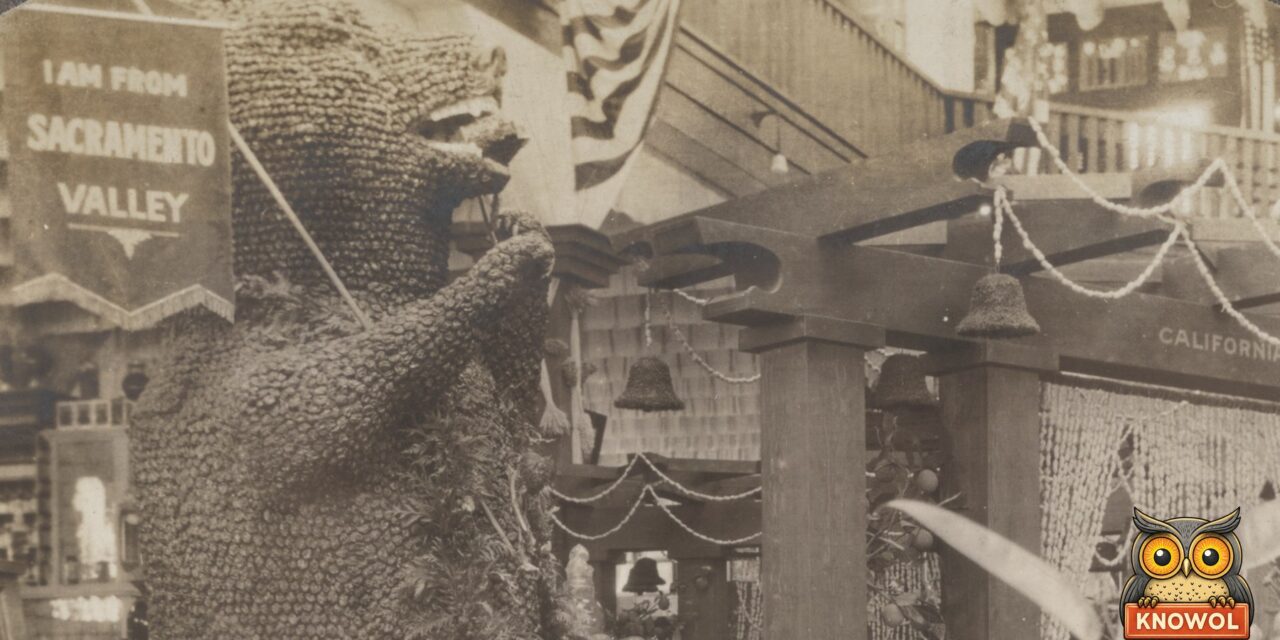
The photo at the top of this story is that very bear. It sat up on its back legs, as big as a real grizzly, with its mouth open wide. A banner beside it said “I am from Sacramento Valley.” That’s the farm country around Sacramento, California, where the prunes were grown. A prune is a dried plum, sweet and sticky and dark.
A San Francisco Call reporter looked it over three weeks after opening day. “Guarding the Capitol is the much talked of prune bear,” he wrote. It sat “upright on its haunches, a graphaphone protruding from its grinning jaws.” A graphophone (the paper spelled it with an “a”) was an early kind of record player. So California’s prune bear had a talking machine sticking out of its mouth.
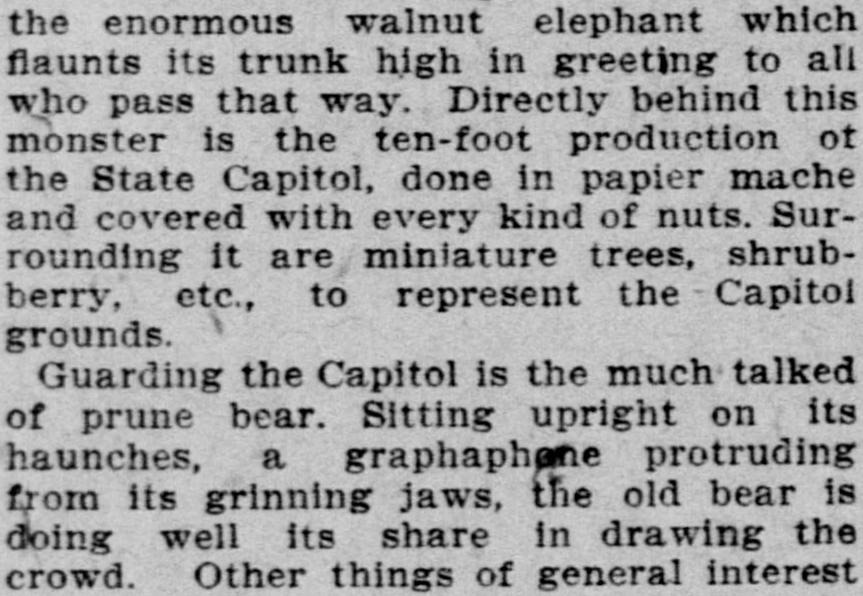
The walnut elephant, the nut-covered Capitol and the prune bear with its talking machine. The San Francisco Call, San Francisco, California, June 23, 1905, page 5. Library of Congress, Chronicling America. Click the clipping to read it full size.
Nearby stood the walnut elephant, which “flaunts its trunk high in greeting to all who pass that way.” Behind the elephant was a ten-foot model of the State Capitol in Sacramento, covered with nuts. Above them all rose a tall pyramid of glass jars, filled with every fruit and vegetable grown in California.
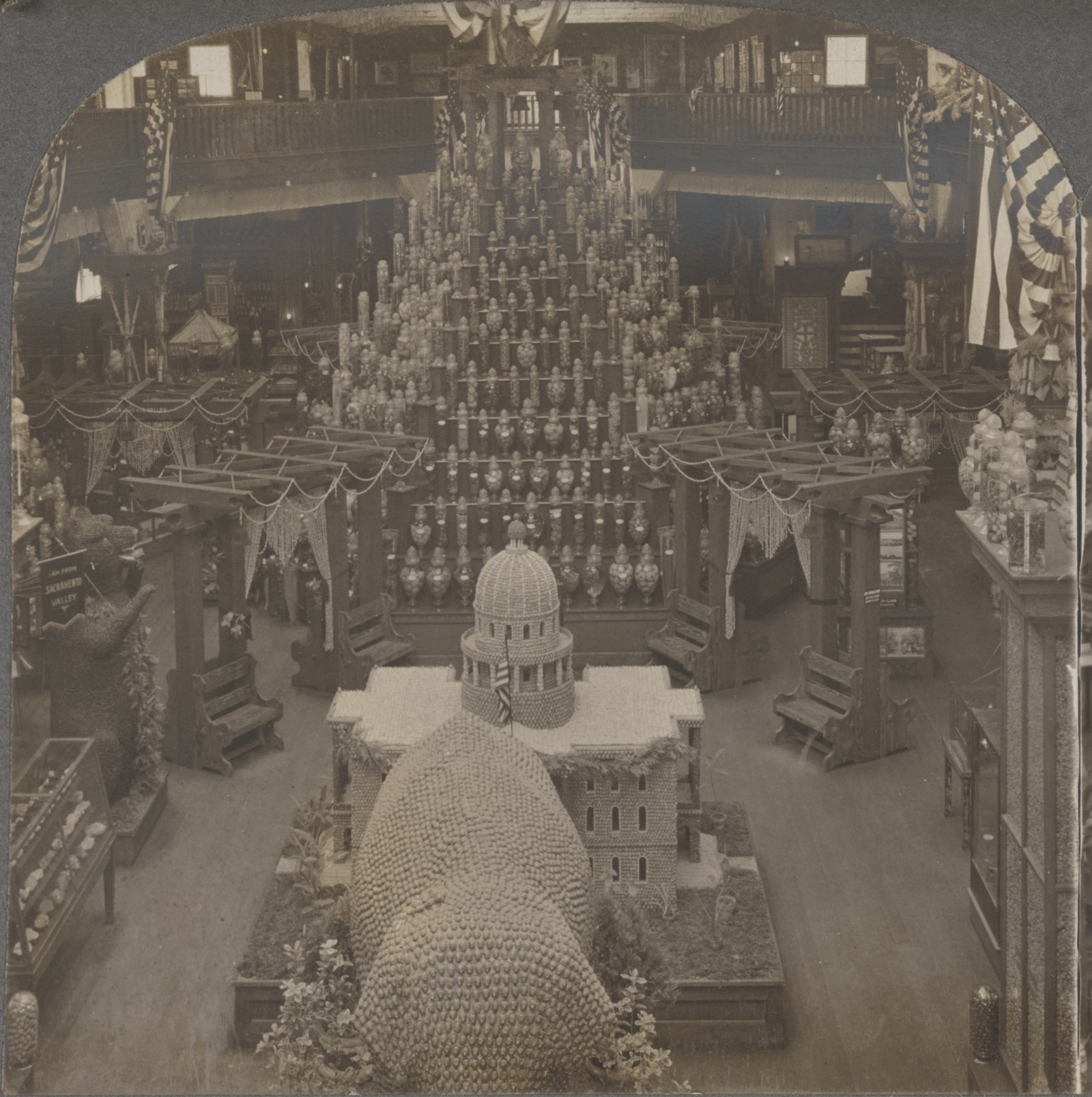
Inside the California building at the Portland fair, 1905. The walnut elephant (seen from behind) stands in front of the nut-covered Capitol, under the pyramid of fruit jars. The prune bear and its Sacramento Valley sign are at the far left. Keystone View Company stereograph, Library of Congress. Click the picture to see it full size.
An ad you could walk around
Each food animal was really an ad. A reporter at the St. Louis world’s fair the summer before explained it. “Figures of animals done with horticultural trimmings,” he wrote, were “very good material for advertising a State’s resources.” In plain words, a giant bear made of prunes made people remember where good prunes came from.
The walnut elephant had already been to St. Louis. Before the Portland fair opened, the Call reported that “the walnut elephant was shown at St. Louis, but the others of the menagerie are new.” A menagerie is a collection of animals. So Portland got a brand-new bear “full of prunes,” as “large as life.”
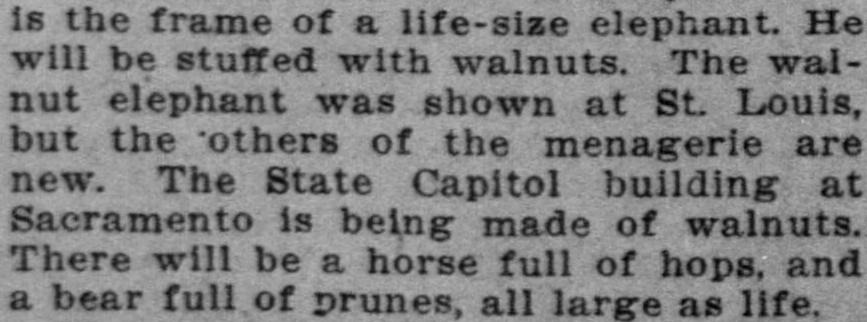
The walnut elephant was a return visitor; the prune bear was new. The San Francisco Call, San Francisco, California, May 28, 1905, page 19. Library of Congress, Chronicling America. Click the clipping to read it full size.
When Southern California first planned the elephant for St. Louis in 1903, the Call said it would be “thirteen feet high” and “weigh about two tons.” That’s 4,000 pounds of elephant.
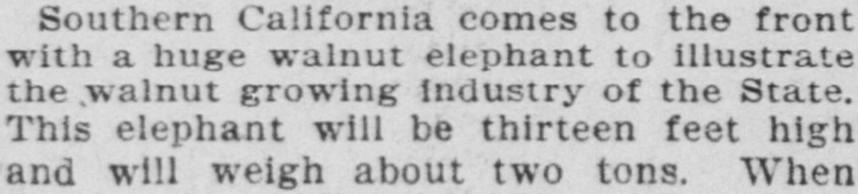
The plan for the walnut elephant. The San Francisco Call, San Francisco, California, September 6, 1903, page 33. Library of Congress, Chronicling America. Click the clipping to read it full size.
The St. Louis bear had glowing eyes
Portland’s bear had an older cousin. At the 1904 world’s fair in St. Louis, Missouri, the Sacramento Valley showed off a grizzly made of prunes, too. Its eyes lit up with electric light. “Sacramento’s grizzly has, besides some flies, a curious throng of people around it all day,” the Call reported.
Kids were the bear’s best fans. “Children drag their parents clear across the fair grounds in a search for the bear with the glowing electric eyes,” the reporter wrote. He also pointed out that if the bear were alive, it “would soon devour its own sweet covering.”
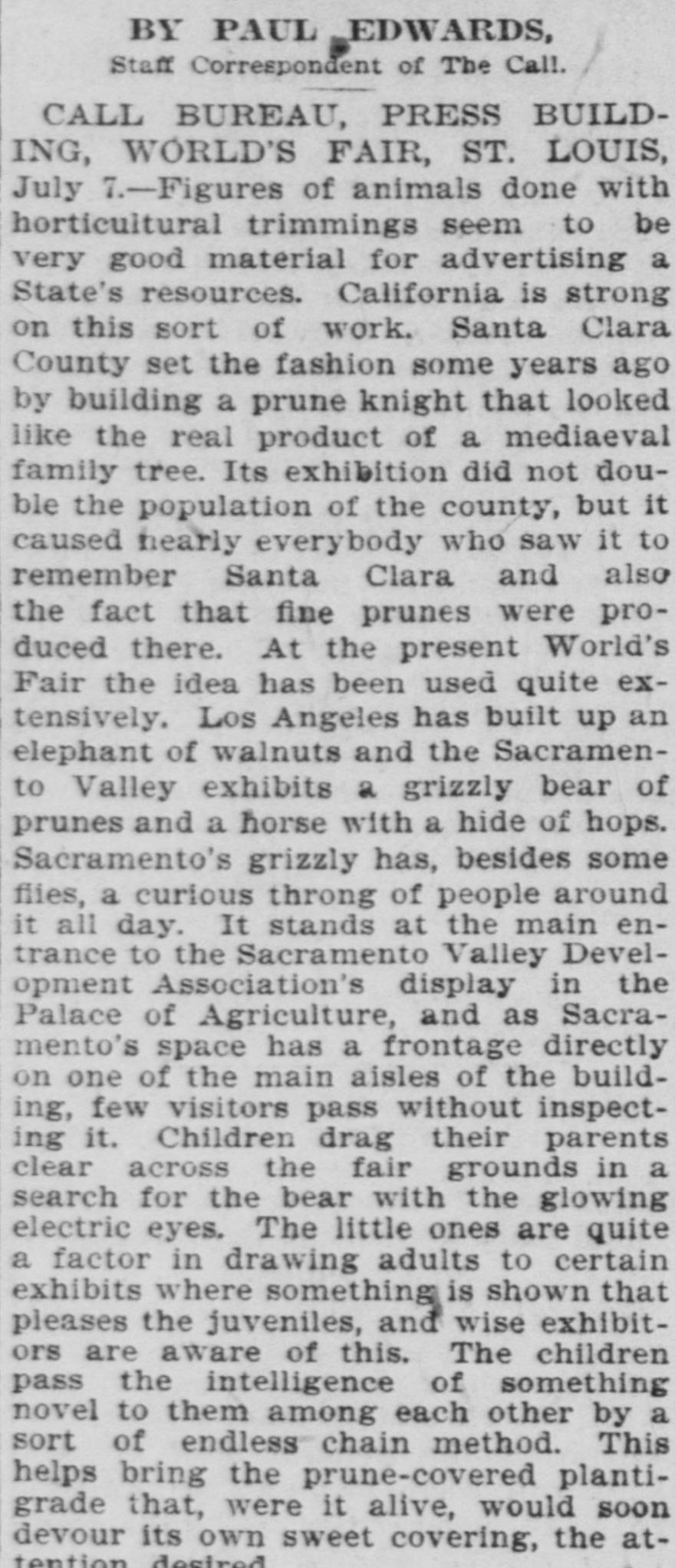
Paul Edwards on the prune grizzly at the St. Louis world’s fair. The San Francisco Call, San Francisco, California, July 8, 1904, page 9. Library of Congress, Chronicling America. Click the clipping to read it full size.
Guess the prunes
The St. Louis bear came with a game. A sign on the bear said “Guess! the number of Prunes on the Bear.” Visitors wrote their guesses in big books. The man in charge, Judge Wills, had one unhappy visitor, though. A woman pinned a card on the bear that said “A boarding-house nightmare.” The paper guessed she had eaten too many cheap prunes at boarding houses (homes that rented rooms with meals), where landladies served them to save money. The judge wanted to give her “some high quality prunes” to change her mind.
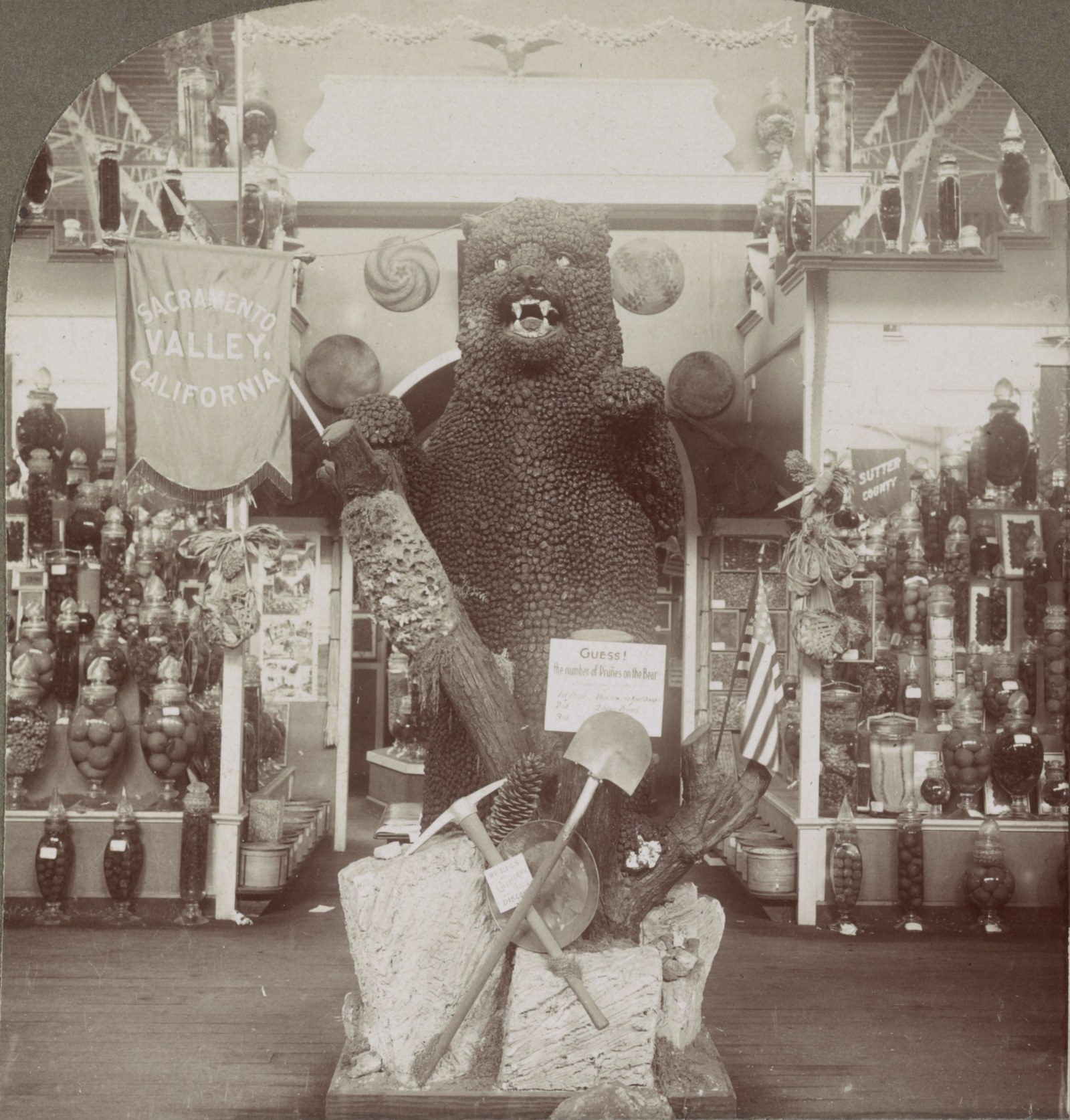
The prune bear at the St. Louis world’s fair, 1904, with the “Guess!” sign on its front. Whiting View Company stereograph, Library of Congress. Click the picture to see it full size.
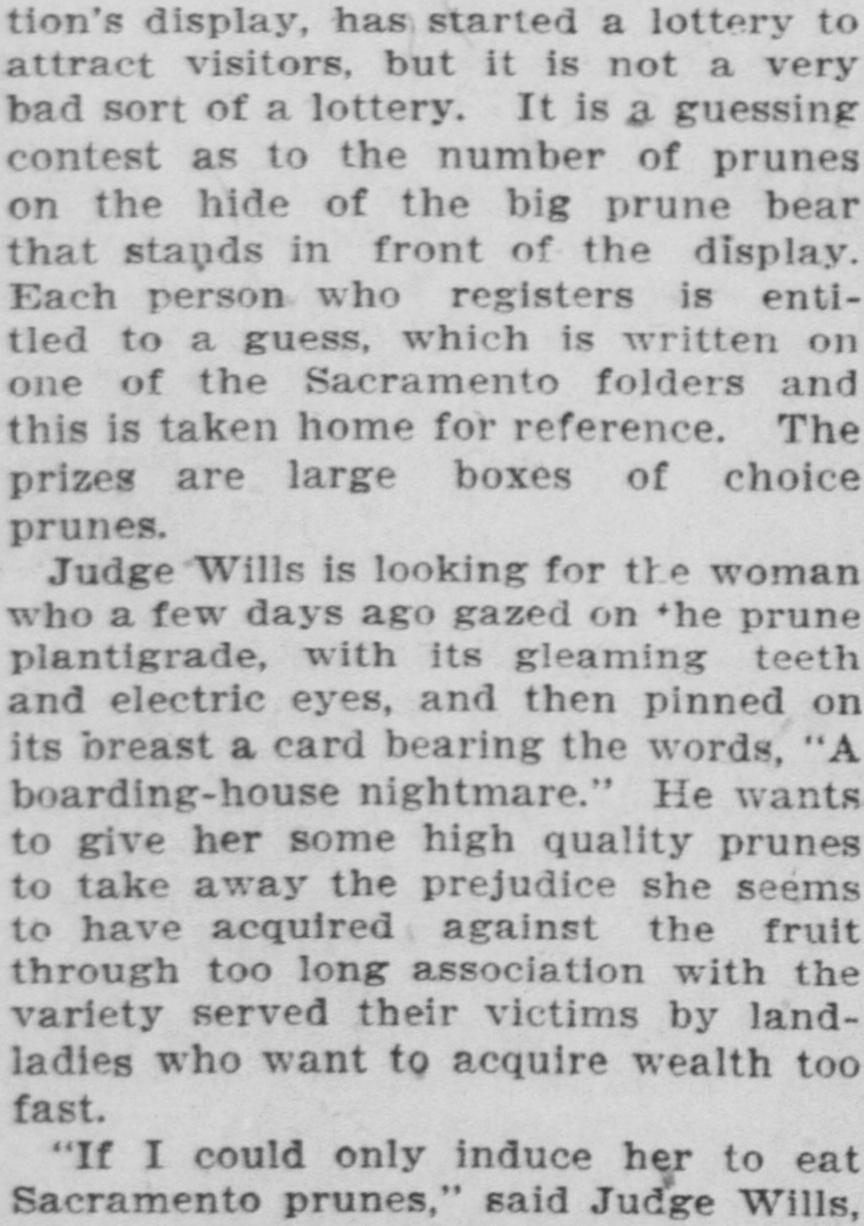
The guessing contest and the “boarding-house nightmare” card. The San Francisco Call, San Francisco, California, August 26, 1904, page 3. Library of Congress, Chronicling America. Click the clipping to read it full size.
In November, the answer came out. The bear was covered with 14,265 prunes. A West Virginia man named Oliver Schwob guessed it exactly. F. W. Castle of St. Louis guessed 14,262, and Maud Redmond of Chicago guessed 14,268. Both were off by just three prunes. Mr. Schwob’s first prize was not more prunes. It was “a box of early Sacramento Valley sweet oranges.”
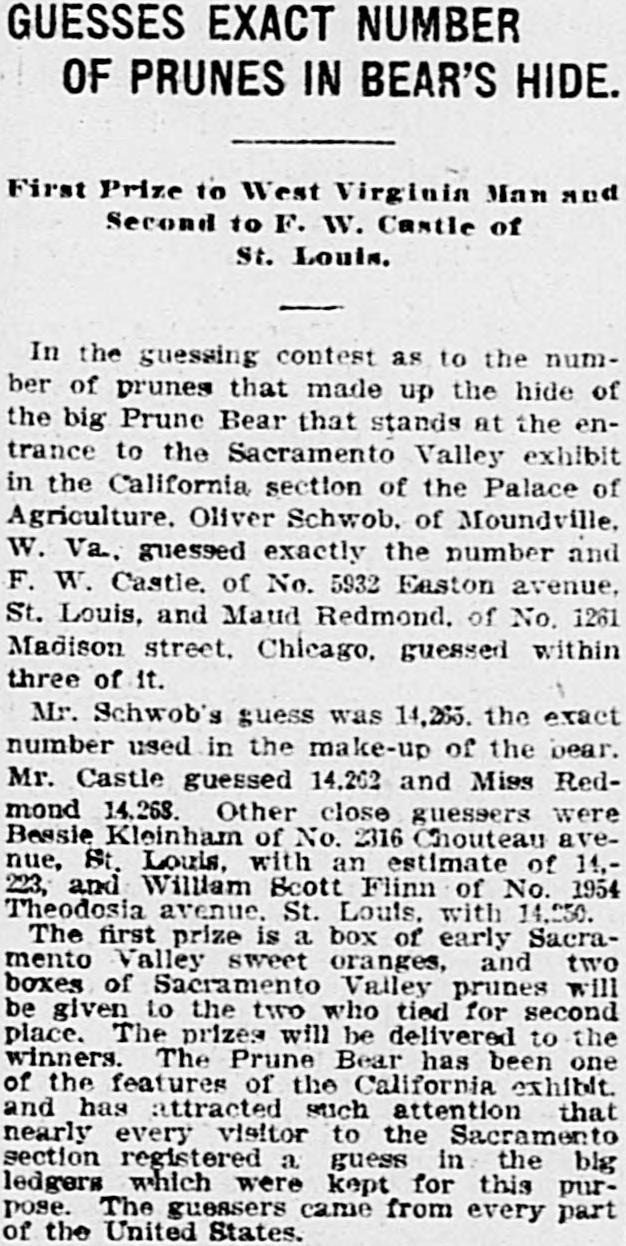
“Guesses Exact Number of Prunes in Bear’s Hide.” The St. Louis Republic, St. Louis, Missouri, November 13, 1904, page 2. Library of Congress, Chronicling America. Click the clipping to read it full size.
A prize trip from Pullman, Washington
That summer, a young woman named Louise Slater won a trip to the Portland fair. She was the girl chosen from Pullman, Washington, for an outing of young women to the fair, and the trip was her prize. She called it “one of the happiest events of my life.”
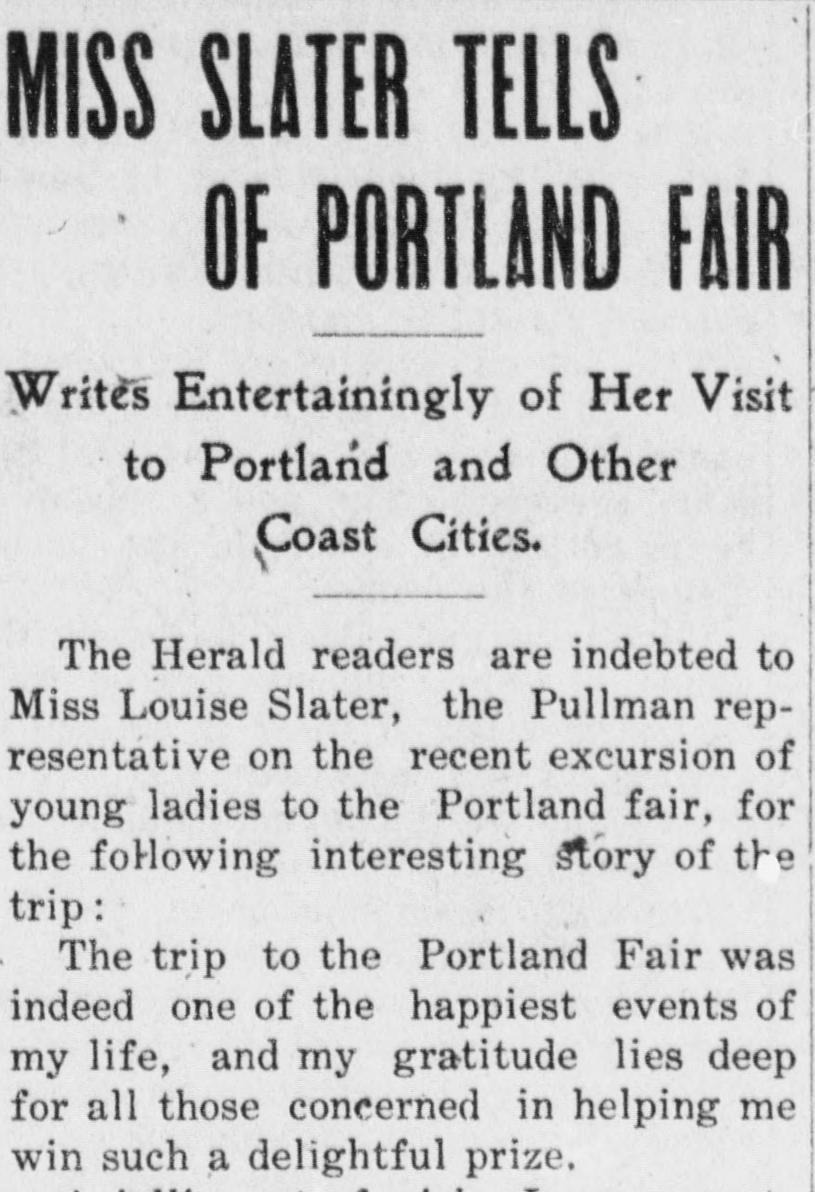
“Miss Slater Tells of Portland Fair.” Pullman Herald, Pullman, Washington, August 5, 1905, page 1. Library of Congress, Chronicling America. Click the clipping to read it full size.
She wrote home about what she saw. In the Washington building, a milkmaid milked a cow, “done in wax to represent butter.” And in the California building, she found “a bear made of prunes and an elephant made of English walnuts which attract much attention.”
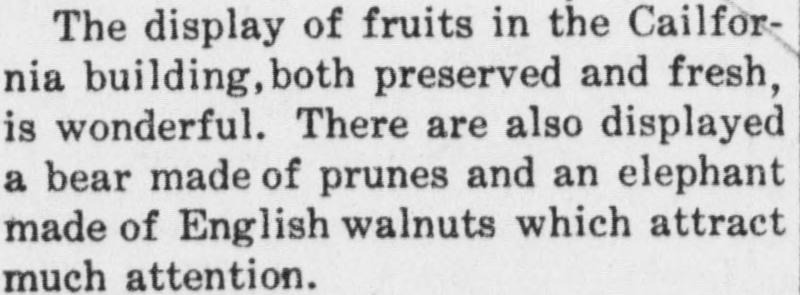
Louise Slater on the California building. Pullman Herald, Pullman, Washington, August 5, 1905, page 1. Library of Congress, Chronicling America. Click the clipping to read it full size.
By the numbers
- 100 cannon shots opened the fair.
- 40,000 people filled the grounds on opening day, the Los Angeles Herald said.
- 14,265 prunes covered the St. Louis bear.
- 3 prunes: how far off the two closest losing guesses were.
- 13 feet tall and about two tons: the plan for the walnut elephant.
Leave out the prune bear
Not everyone loved the food animals. In late 1906, California was getting ready for the next big fair, in Jamestown, Virginia. A newspaper in Auburn, California, hoped the governor would “leave out the prune bear and the almond capitol this time.” The Los Angeles Herald answered that prune bears belonged to the Sacramento and San Joaquin valleys, “not to Los Angeles.”
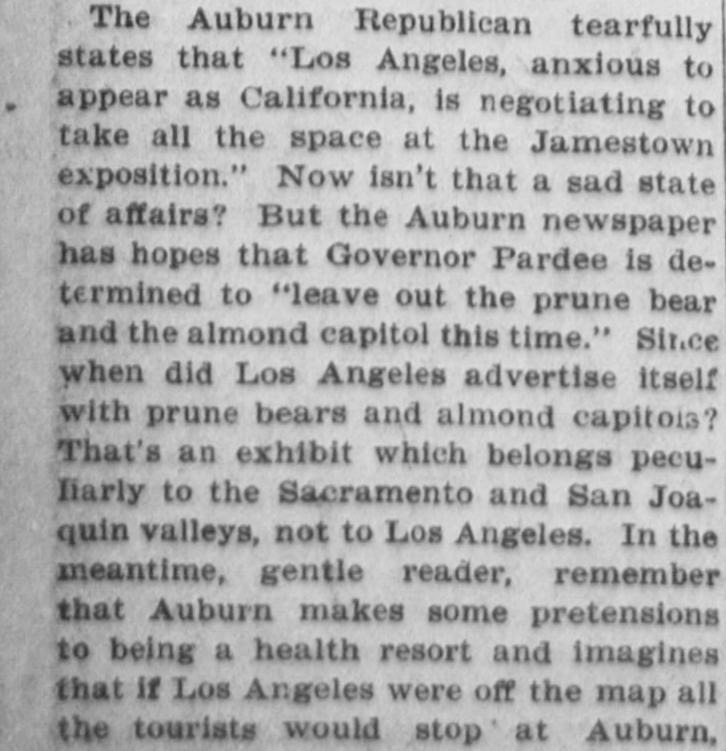
“Leave out the prune bear.” Los Angeles Herald, Los Angeles, California, November 20, 1906, page 6. Library of Congress, Chronicling America. Click the clipping to read it full size.
But for one summer in Portland, the prune bear was a star. The President opened the fair with a golden key from clear across the country. Then thousands of people walked right past the speeches and the cannons to see a bear made of dried plums, with a record player in its mouth.
Sources
- Los Angeles Herald (Los Angeles, California): “Great Fair at Portland Opens,” June 2, 1905, page 1; the “leave out the prune bear” item, November 20, 1906, page 6. Library of Congress, Chronicling America.
- The San Francisco Call (San Francisco, California): the walnut elephant plan, September 6, 1903, page 33; Paul Edwards, “Advertise California,” July 8, 1904, page 9; the guessing contest, August 26, 1904, page 3; the California building being set up, May 28, 1905, page 19; California’s exhibit at the Portland fair, June 23, 1905, page 5. Library of Congress, Chronicling America.
- “Guesses Exact Number of Prunes in Bear’s Hide,” The St. Louis Republic (St. Louis, Missouri), November 13, 1904, page 2. Library of Congress, Chronicling America.
- “Miss Slater Tells of Portland Fair,” Pullman Herald (Pullman, Washington), August 5, 1905, page 1. Library of Congress, Chronicling America.
- Photos: “The Prune Bear, made of prunes grown in the Sacramento Valley, Calif., at the Portland, Ore. Exposition” (the cover; stereograph copyright 1905 by C. L. Wasson, International Stereograph Co.); “Interior California Building, Lewis and Clark Exposition, Portland, Oregon, U.S.A.” (Keystone View Company, 1905); “Bear in mind the Prune Exhibit of the World’s Fair, St. Louis, Mo.” (Whiting View Company, 1904). Library of Congress Prints and Photographs Division. No known restrictions on publication.