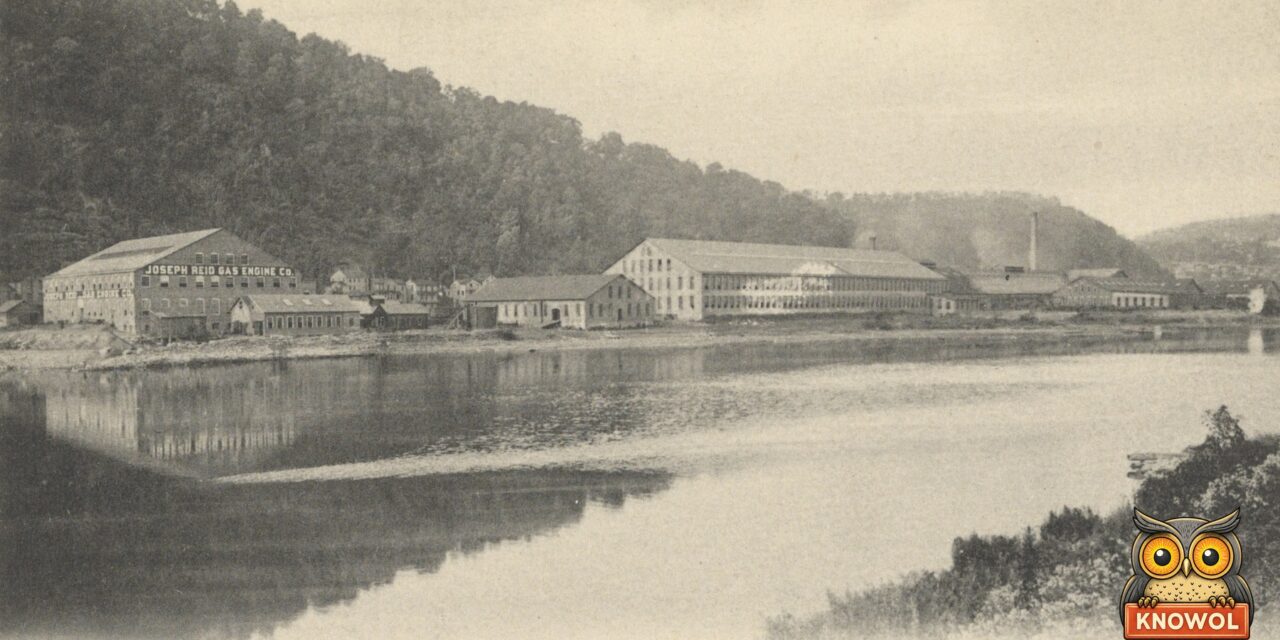
Thanksgiving week of 1906 brought three visitors to Versailles, Missouri. D. P. Kahle, E. C. Kahle and T. McWaters had come all the way from Oil City, Pennsylvania, “to look over our county,” the Morgan County Republican said. D. P. Kahle already owned “some Morgan county dirt near Barnett.” Dirt was the editor’s word for land, and Barnett was a little town in the same county.
But the paper was most excited about something else. Mr. Kahle, it said, “is the inventer of a new monkey wrench, which is automatic and instantaneous in its operation, and a wonderful improvement over the old style wrench.” That’s the paper’s own spelling of inventor. And it printed the news before the United States Patent Office had even said yes.
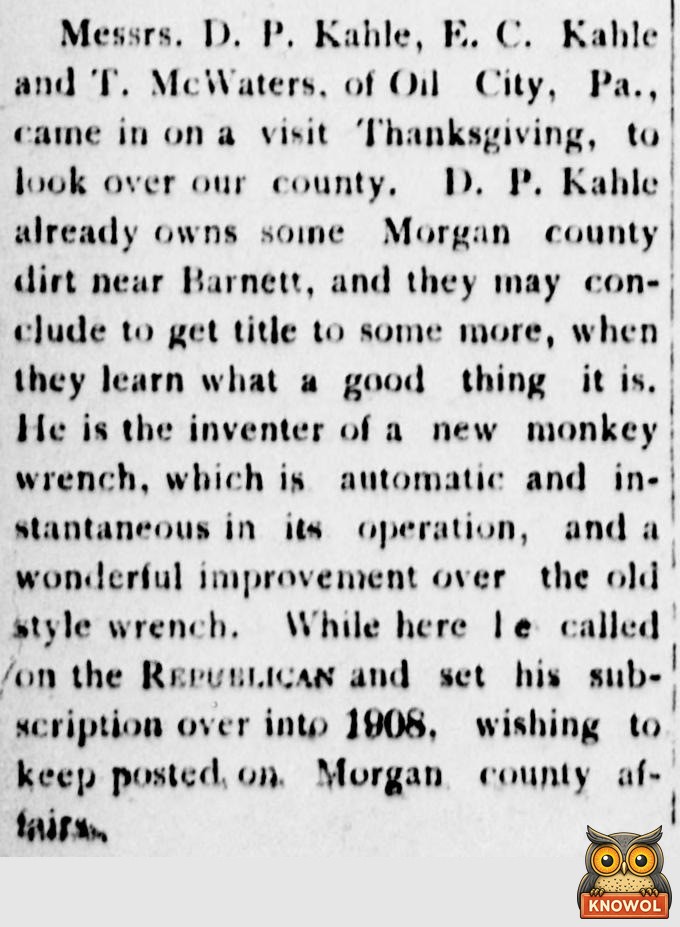
The visit from Oil City, in the Local News column. Morgan County Republican, Versailles, Missouri, December 6, 1906, page 5. Library of Congress, Chronicling America. Click the clipping to read it full size.
The trouble with the old wrench
A monkey wrench has two jaws. One is fixed at the top. The other one slides up and down, so the wrench can grab a big nut or a small one. On the old style, you moved that jaw by turning a little nut on the handle. Turn, turn, turn. If the jaw was wide open and the bolt was small, that took a while.
There was a second problem. A paper in Aberdeen, Washington, explained it in 1905: “In the ordinary monkey-wrench the movable jaw has a tendency to slip out of the position in which it is adjusted.” That meant you had to set it all over again, almost every time you used it.
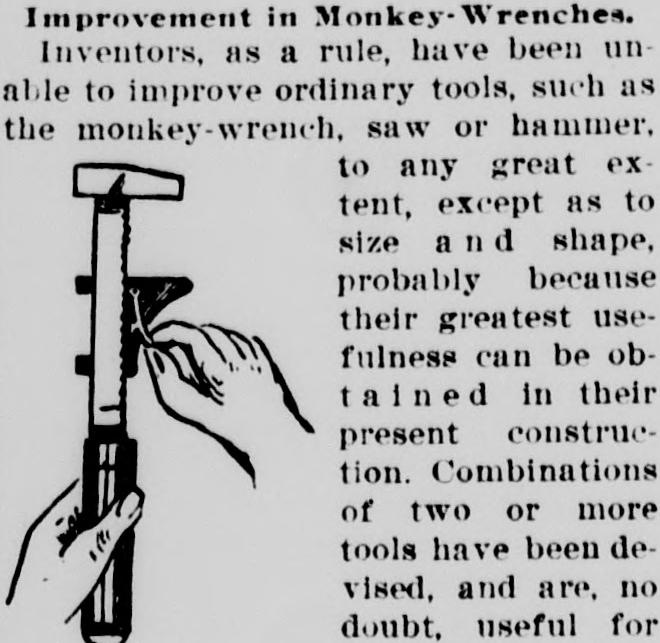
“Improvement in Monkey-Wrenches.” Aberdeen Herald, Aberdeen, Washington, March 6, 1905, page 6. Library of Congress, Chronicling America. Click the clipping to read it full size.
The same paper said fixing an everyday tool was hard. “Inventors, as a rule, have been unable to improve ordinary tools, such as the monkey-wrench, saw or hammer,” it wrote. People kept trying anyway. That story was about Edward A. Renouf of Wellsville, Ohio, who had patented his own idea with a toothed lever.
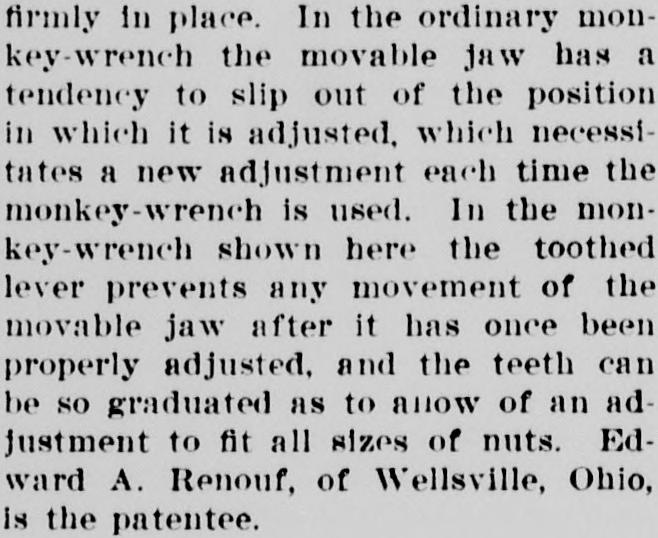
Why the old jaw had to be set again and again. Aberdeen Herald, Aberdeen, Washington, March 6, 1905, page 6. Library of Congress, Chronicling America. Click the clipping to read it full size.
How Kahle’s wrench worked
Kahle’s plan is written down in his patent. His full name was Dorsey P. Kahle, and he lived in Venus, Pennsylvania, in Venango County, the same county as Oil City. He filed for his patent on November 17, 1906. That was just 12 days before Thanksgiving, so his patent papers were brand new when he got to Missouri.
He said the wrench was “commonly styled a ‘monkey’ wrench,” and he wanted “a quick acting wrench.” Here is the trick. Inside a collar on the handle sat two small washers, like flat metal rings. Each one had threads on just one side, and a tiny spring pushed those threads tight against the threaded handle. That held the jaw in place, so it couldn’t slip.
To move the jaw fast, you squeezed two little knobs on the washers that stuck out of the collar. The washers let go of the threads, and the jaw slid freely, up or down, right to the nut. You let go of the knobs, and the springs snapped the washers back onto the threads. Then you gave the collar a small turn for a snug fit, just “similar to the sleeve or nut of an ordinary wrench.” Kahle hoped it would be “a simple and inexpensive wrench that can be easily and quickly manipulated.”
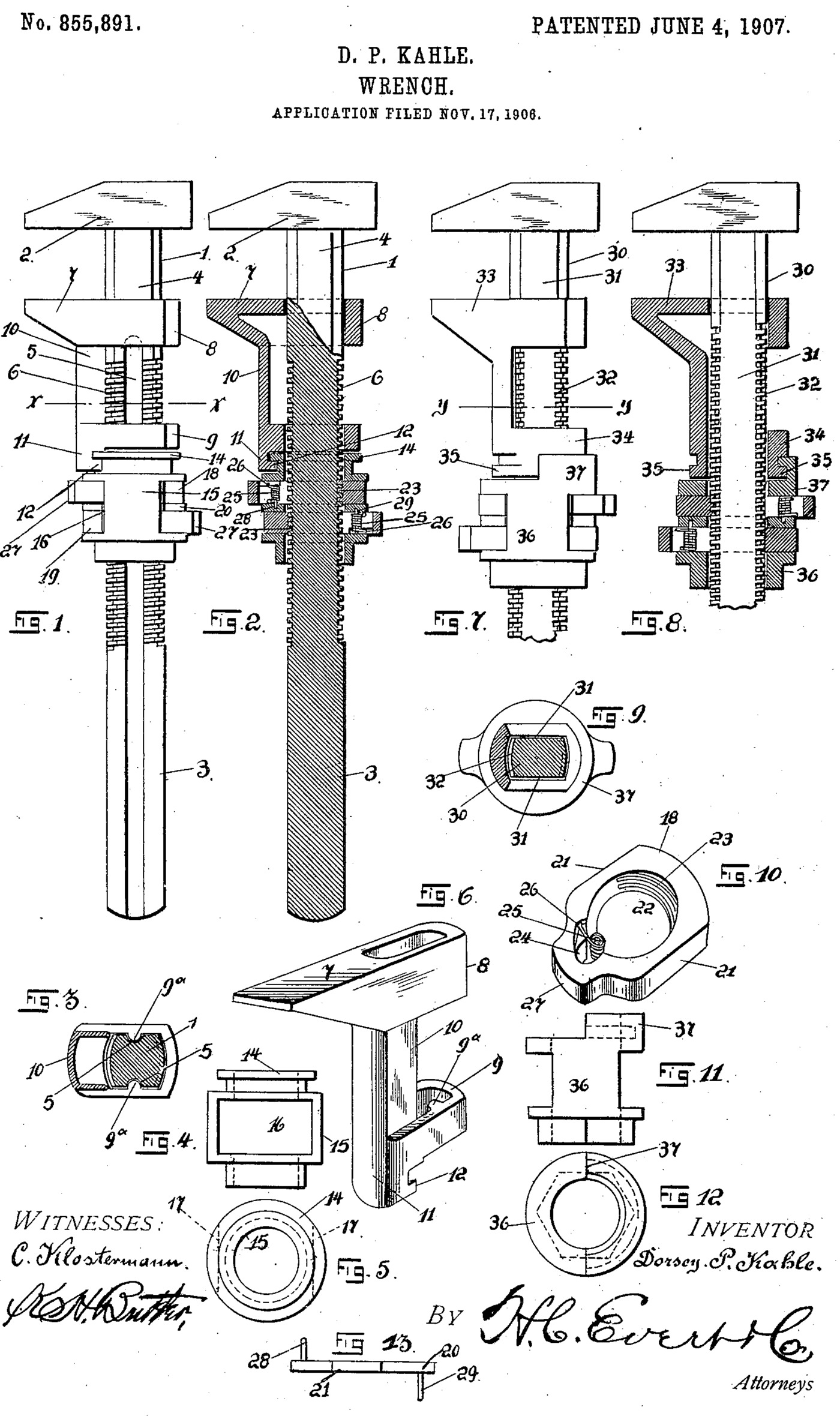
Dorsey P. Kahle’s wrench, from his patent drawing. The knobs that free the jaw stick out of the collar in Figures 1 and 10. United States Patent No. 855,891, filed November 17, 1906, granted June 4, 1907. United States Patent Office, public domain. Click the picture to see it full size.
What a wrench cost
A plain monkey wrench did not cost much. In February 1907, Smith’s 5-10-25c Store in Malvern, Arkansas, sold “8 in. Monkey Wrenches” for 25 cents. That was the same price as a rake or a roasting pan at the same store. A lamp chimney, the glass tube that sat on a kerosene lamp, was 5 cents.
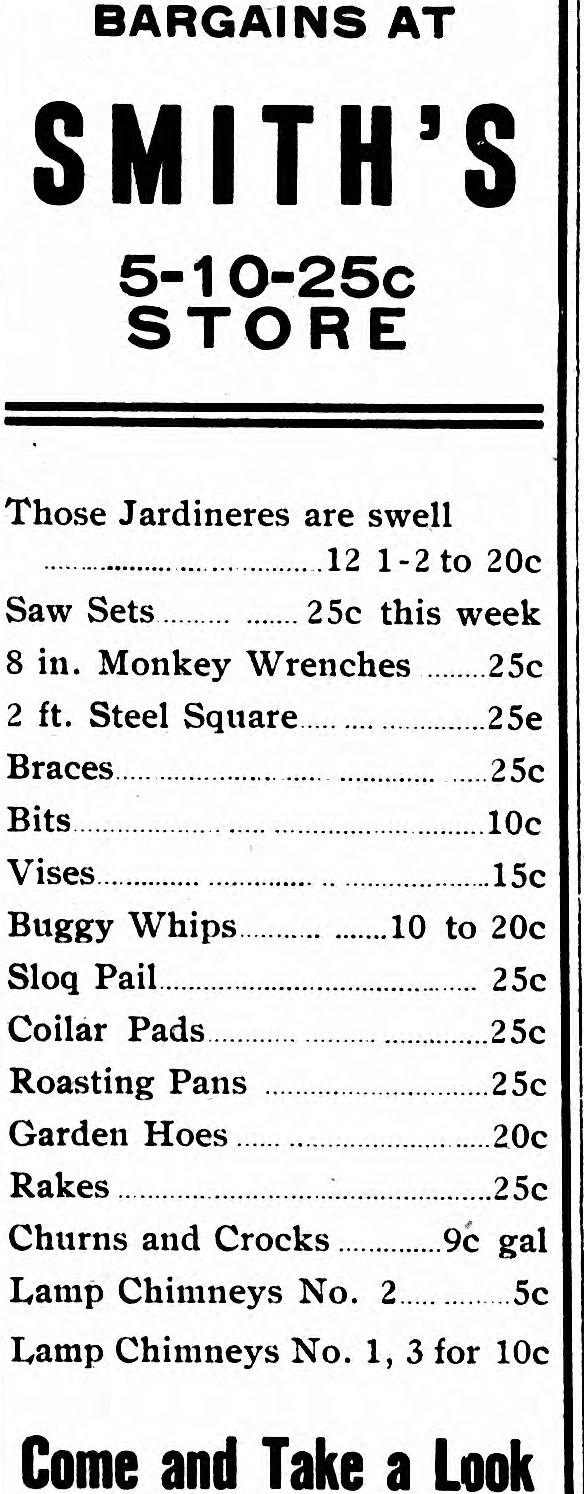
Monkey wrenches for 25 cents. The Times-Journal, Malvern, Arkansas, February 13, 1907, page 5. Library of Congress, Chronicling America. Click the clipping to read it full size.
The same week in Versailles
The visitors picked a lively week. A new railroad, the Versailles & Sedalia Railway, was being built to haul coal, and it wasn’t going smoothly. The paper said the railroad’s engine “finally got here last Saturday, but badly out of repair.” A good wrench would have come in handy.
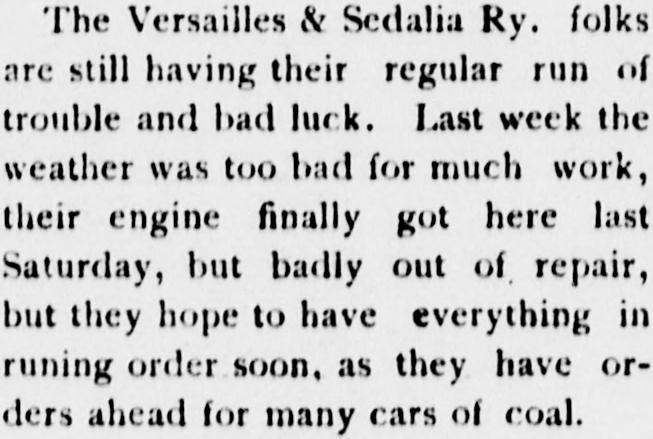
The new railroad’s engine arrives “badly out of repair.” Morgan County Republican, Versailles, Missouri, December 6, 1906, page 5. Library of Congress, Chronicling America. Click the clipping to read it full size.
The town’s electric lights were acting up too. They had “been going out at odd times lately,” so people had the “extra trouble of hunting up and lighting lamps.” And nobody went hungry. At the K. of P. banquet (the Knights of Pythias, a men’s club), the guests had plenty of Thanksgiving turkey. “There was a ton or so left,” the paper said.
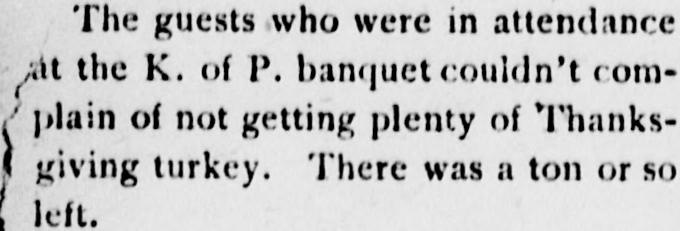
“A ton or so” of turkey left over. Morgan County Republican, Versailles, Missouri, December 6, 1906, page 5. Library of Congress, Chronicling America. Click the clipping to read it full size.
What happened next
The Patent Office said yes. On June 4, 1907, Kahle received Patent No. 855,891 for his wrench. He kept tinkering. In 1911 he got a second patent, No. 999,034, for a new version. It aimed “to simplify the construction of the wrench disclosed in my former patent,” and it could even grip a round pipe. The papers we found don’t say whether a hardware store ever sold one.
He kept coming back to Missouri, too. In October 1912 the Republican wrote that “Mr. Kahle, of Venus, Pa., who is interested in Morgan county lands,” had stopped off on his way home from Wyoming to look over his land. The editor added, “We acknowledge a pleasant visit.”
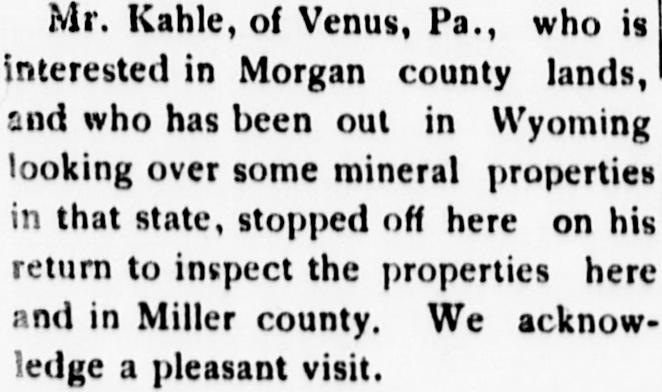
Kahle stops by again, six years later. Morgan County Republican, Versailles, Missouri, October 17, 1912, page 6. Library of Congress, Chronicling America. Click the clipping to read it full size.
The photo at the top of this story is a 1905 postcard of factories along the river in Oil City, the town the paper named as the visitors’ home. It’s a long way from there to Versailles. Still, back in 1906, before he left town, Kahle stopped at the newspaper office and renewed his paper all the way into 1908. He was “wishing to keep posted on Morgan county affairs.” An inventor with a new idea in his pocket and a patent on the way still wanted the news from a little Missouri town.
Sources
- Morgan County Republican (Versailles, Missouri): Local News, December 6, 1906, page 5; Mr. Kahle’s visit, October 17, 1912, page 6. Library of Congress, Chronicling America.
- “Improvement in Monkey-Wrenches,” Aberdeen Herald (Aberdeen, Washington), March 6, 1905, page 6. Library of Congress, Chronicling America.
- “Bargains at Smith’s,” The Times-Journal (Malvern, Arkansas), February 13, 1907, page 5. Library of Congress, Chronicling America.
- Dorsey P. Kahle, Wrench, U.S. Patent No. 855,891, filed November 17, 1906, granted June 4, 1907; Wrench, U.S. Patent No. 999,034, granted July 25, 1911. United States Patent Office, public domain.
- Pictures: “Factories along the River, Oil City, Pa.” (the cover; Rotograph Co. postcard, 1905), Library of Congress Prints and Photographs, no known restrictions on publication; the patent drawing, United States Patent Office, public domain.