On Wednesday, December 7, 1910, a little circus was due to open in Laredo, Texas. It came on its own train and put up its tent by the depot of the Texas Mexican Railway, the Tex-Mex. “Big Show Tonight,” the Laredo Weekly Times told its readers. The show was called the Great Raymond Shows, and its star was a horse.
“Especial attention is called to ‘Diamond Mart,'” the paper said, “who is the highest price performing animal on earth.” Out on the road that fall, the circus had put a number on him. Its ads called him “the $50.000 educated horse.”
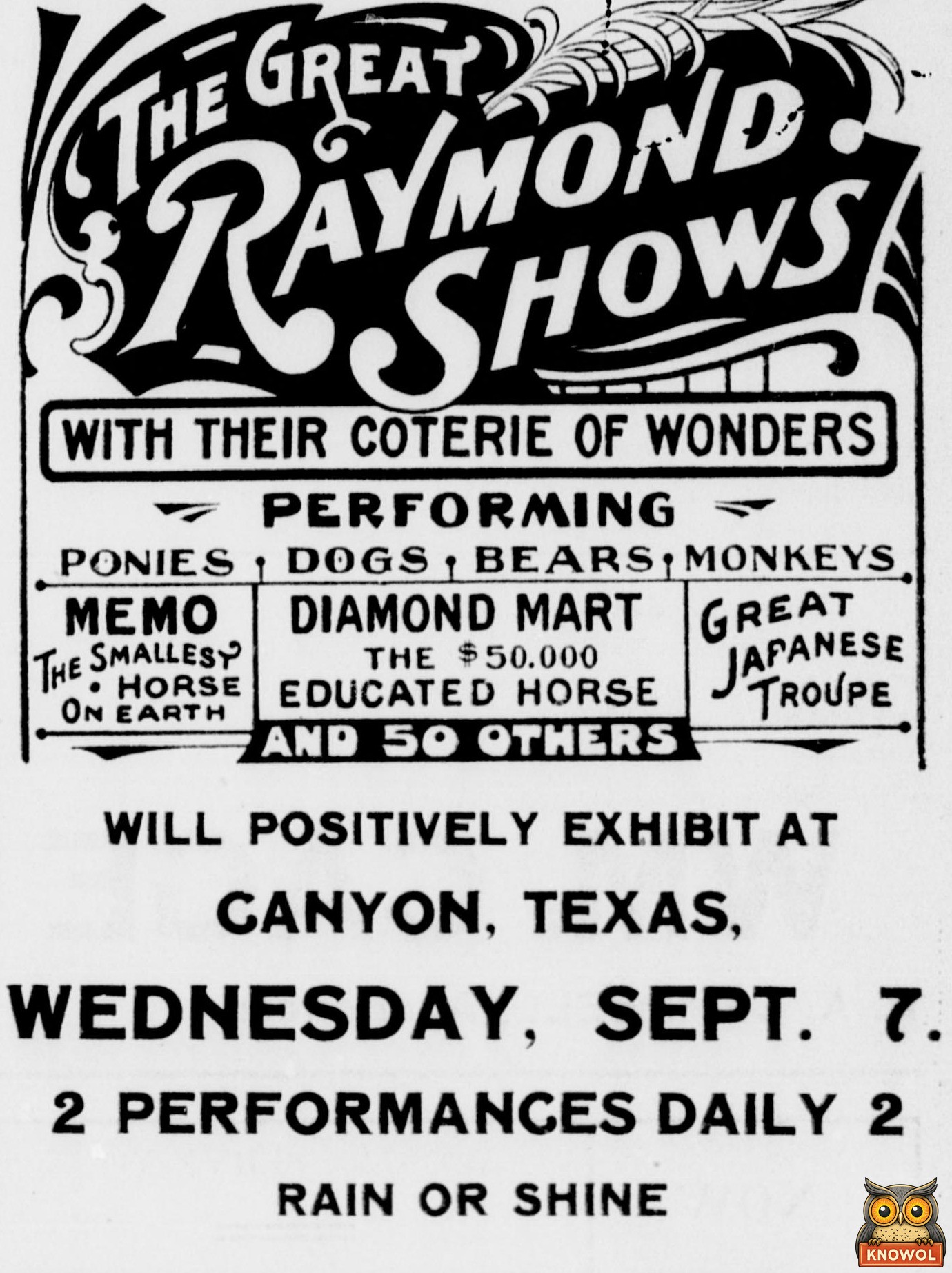
“Diamond Mart, the $50.000 educated horse.” The Great Raymond Shows ad in the Randall County News, Canyon, Texas, September 2, 1910, page 5. Library of Congress, Chronicling America. Click the clipping to read it full size.
What the Circus Said Diamond Mart Could Do
In Chickasha, Oklahoma, the Chickasha Daily Express printed the circus story on September 17, 1910. It said Diamond Mart “does everything but talk.” He was “a clean limbed bay horse scarcely three years old.” A bay is a reddish-brown horse with a black mane and tail.
Then came the list. The paper said he “now does such things as dress himself, undress and retire, play ball, pray, shoot a pistol and a lot more things too numerous to mention.” To retire meant to go to bed. So this horse would get dressed, get undressed, go to bed and kneel to say his prayers.
His trainer was “Prof. Hayes.” The story said Hayes “uses no cues or whip, but simply tells the horse what he wishes him to do and he does it.” Cues are secret signals. “All that is lacking in ‘Diamond Mart’ to make him as intelligent as the average human being,” the story went on, “is a voice.”
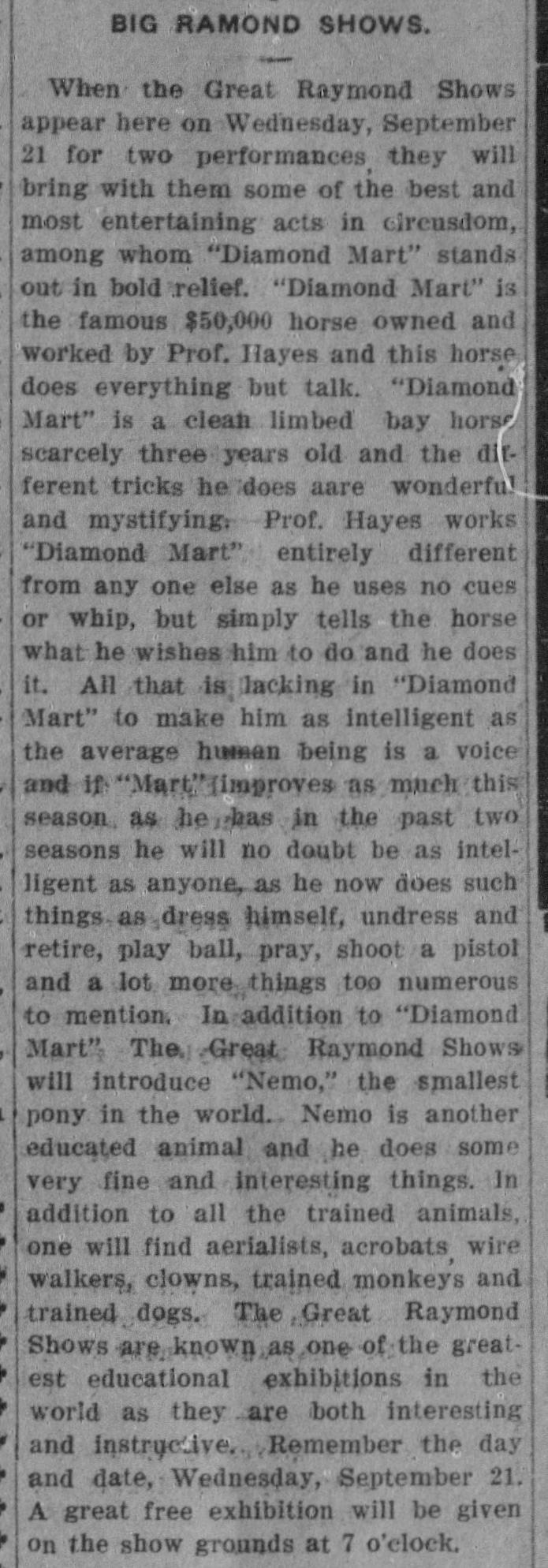
“Big Raymond Shows.” Chickasha Daily Express, Chickasha, Oklahoma, September 17, 1910, page 4. Library of Congress, Chronicling America. Click the clipping to read it full size.
The show had a tiny horse, too. The Chickasha story called him “Nemo,” “the smallest pony in the world.” An ad in Canyon, Texas, spelled his name “Memo” and called him “the smallest horse on earth.”
A Little Circus From Dallas, Texas
The Great Raymond Shows got ready for the road in the summer of 1910 at Cycle Park in Dallas, Texas. The Billboard, a weekly paper for show people, reported on August 6 that the show was being “rapidly whipped into shape for the annual tour in Texas and Oklahoma.” It was set to open on August 15 in Sherman, Texas, at the Old Settlers’ Reunion.
After that, the local papers give its dates. It was booked for Canyon on September 7, Anadarko, Oklahoma, on September 20, and Chickasha the next day. Laredo came in December.
The show by the numbers:
- 3 railroad cars, each 70 feet long: “1 sleeper and 2 baggage cars”
- 50 performers, said The Billboard. The Laredo paper said “one hundred and fifty people.”
- 1 big tent, a round top 70 feet across, made longer with “three 40-foot middle pieces”
- 110 feet: the ladder of Prof. Strahl, the high diver
- $50,000: the price on Diamond Mart
The Same Words in Every Town
In Laredo, Texas, the December circus story sounded like the September ones. “Everything in circusdom is to be seen in the Great Raymond Shows,” the Laredo paper said. Circusdom meant the whole world of the circus. The Chickasha paper had printed the same sentence three months earlier. Both papers also promised acrobats who made you “wonder” whether “they have bones or not.”
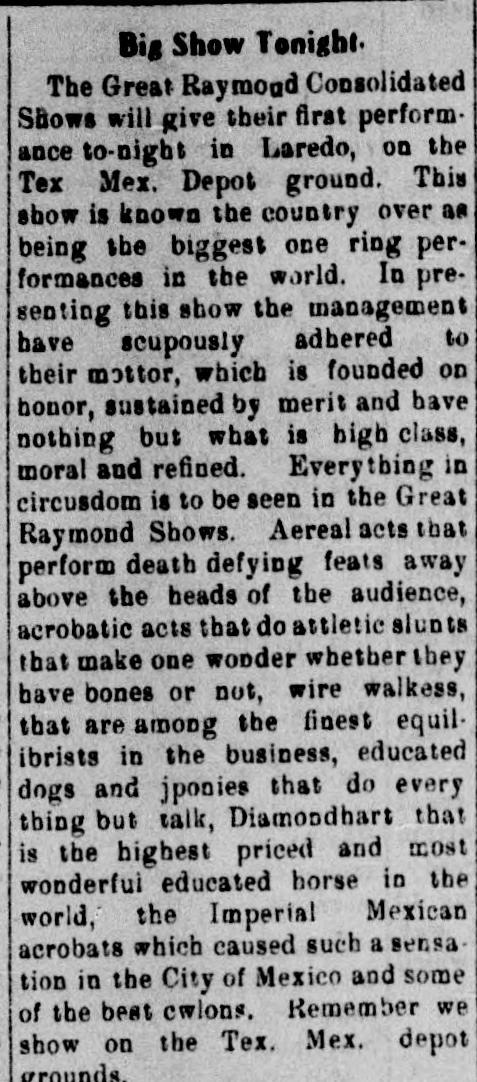
“Big Show Tonight.” Laredo Weekly Times, Laredo, Texas, December 11, 1910, page 4. Library of Congress, Chronicling America. Click the clipping to read it full size.
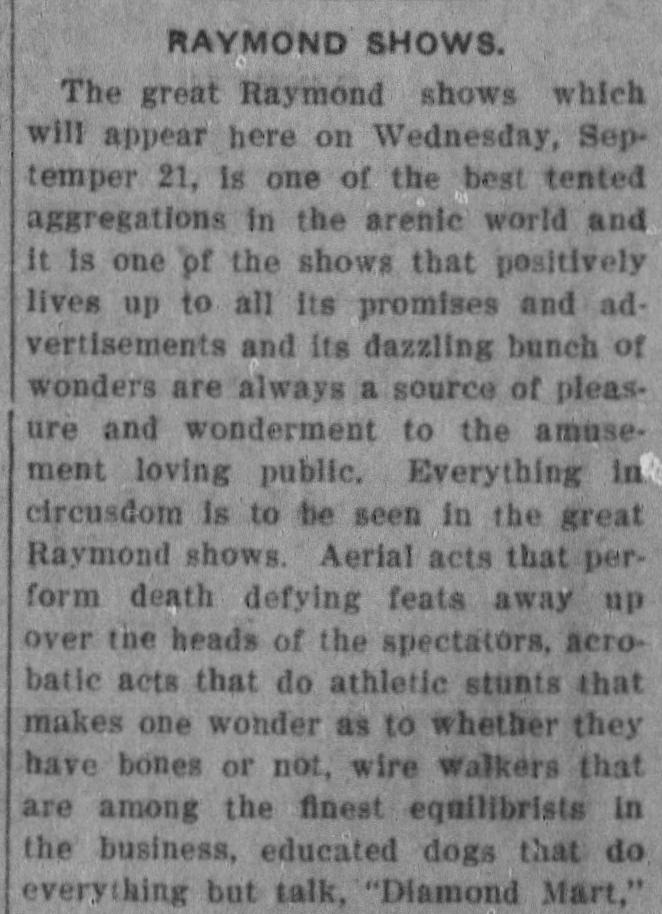
The same words three months earlier: “Raymond Shows,” Chickasha Daily Express, Chickasha, Oklahoma, September 17, 1910, page 6. Library of Congress, Chronicling America. Click the clipping to read it full size.
The words matched because they came from the circus itself. You can catch it in the Laredo story’s last line: “Remember we show on the Tex. Mex. depot grounds.” A newspaper does not say “we show.” A circus does. The Laredo story even spelled the star a new way: “Diamondhart.”
Circus Day for a Small Boy in Anadarko, Oklahoma
In Anadarko, Oklahoma, the circus story on September 19, 1910, knew just who would be the most excited. “The small boy for days ahead will be pestering the life out of” his family, it said, begging them to wake him up early. He wanted to be at the show lot, the empty field where the tent would go, “to get a chance to earn a free pass and also to see the wonders of a circus before the vast white top is up.” A free pass got you in without a ticket, and earning one meant working for it.
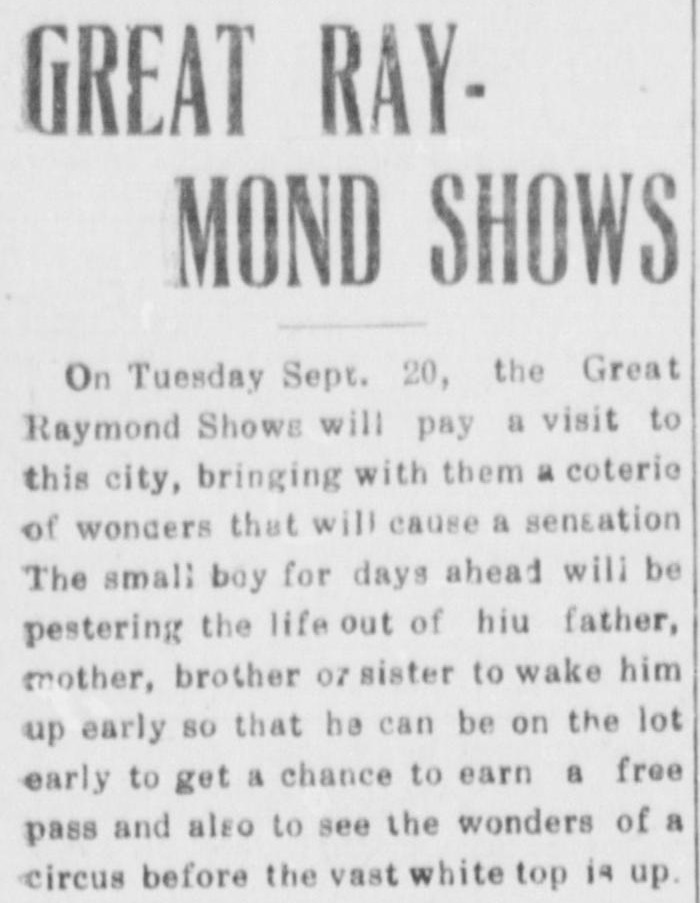
“Great Raymond Shows.” Anadarko Daily Democrat, Anadarko, Oklahoma, September 19, 1910, page 4. Library of Congress, Chronicling America. Click the clipping to read it full size.
The same story owned up to rainy days, when the performers had to parade through the muddiest streets in town and “an occasional grumble is heard.” It also promised Prof. Strahl, “the world’s greatest high diver,” who “will climb a 110 foot ladder and dive that distance into a net barely 12 feet in size.” That ladder was about as tall as a 10-story building. The dive was free, out on the lot, at 7 o’clock.
The Secret of the Educated Horse
In Jamestown, Virginia, in 1907, another “educated horse,” Princess Trixie, had her own building at an amusement park. Her sign called her “Queen of all Educated Horses” and bragged of “$50,000.00 Profit” at a fair in Portland, Oregon.
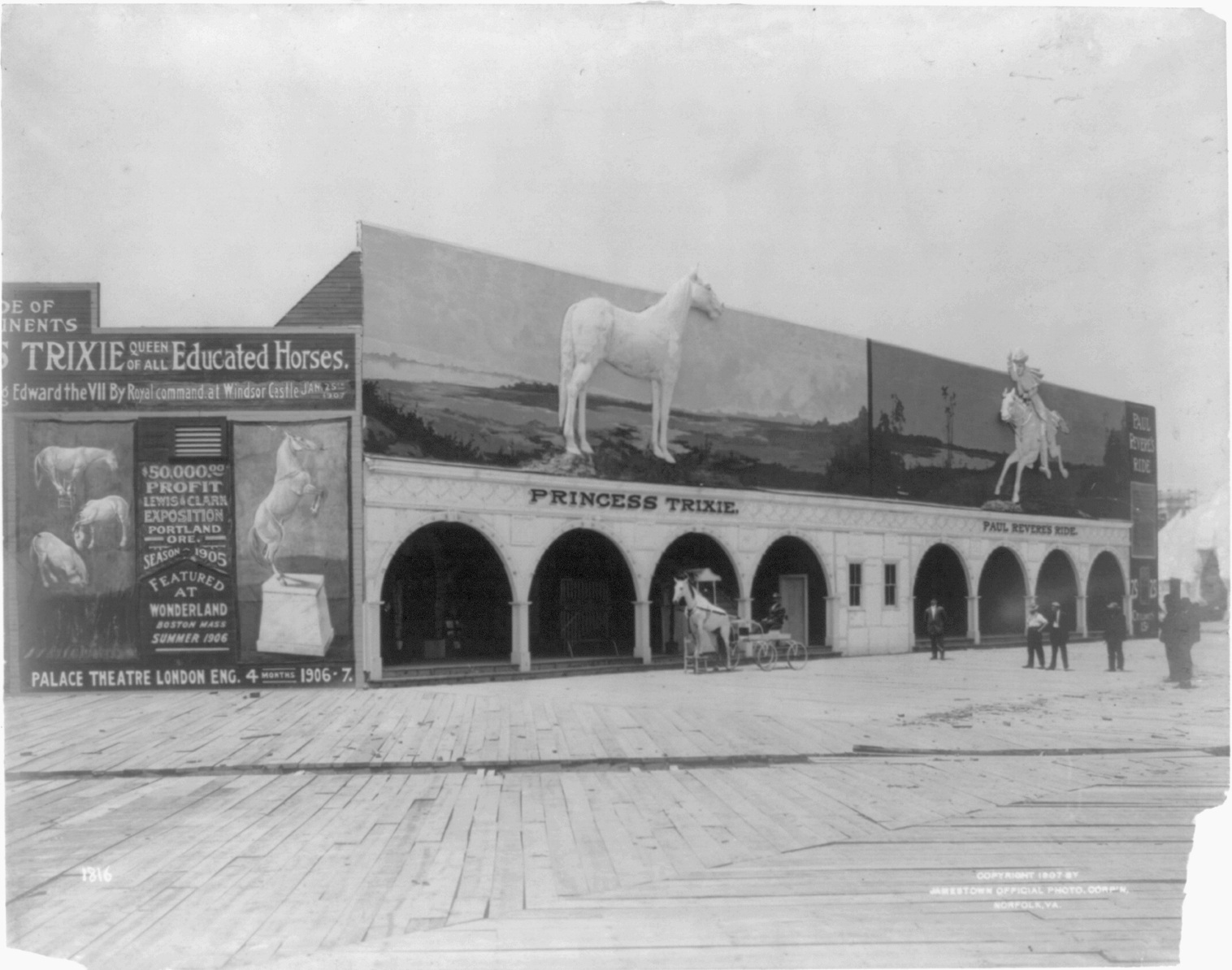
Princess Trixie, “Queen of all Educated Horses,” in front of her building in Jamestown, Virginia, 1907. Jamestown Official Photo Corp., Library of Congress. Click the picture to see it full size.
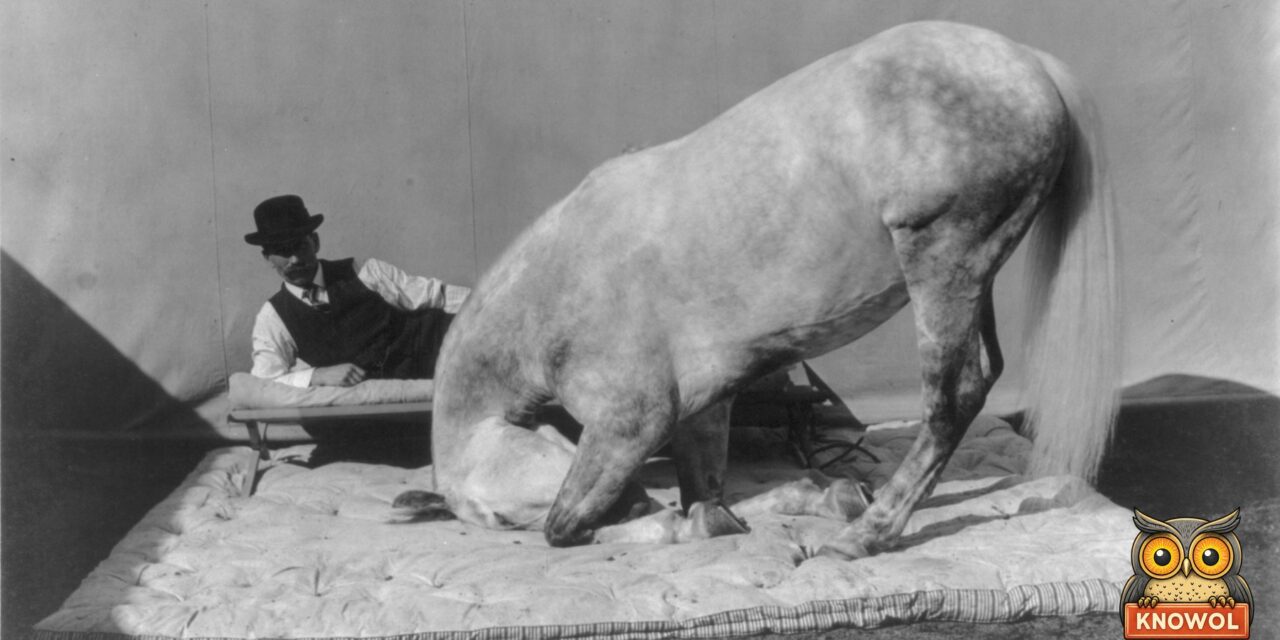
In Riverside, California, a dappled gray horse named Prince Albert posed for photographs in 1909. In one, he faces a blackboard with a sum chalked on it, while a girl points to cards with numbers. The picture at the top of this page is Prince Albert, too, kneeling on a mattress beside a man on a cot. It is the kind of bedtime trick the Raymond ads promised. No photograph of Diamond Mart has turned up.
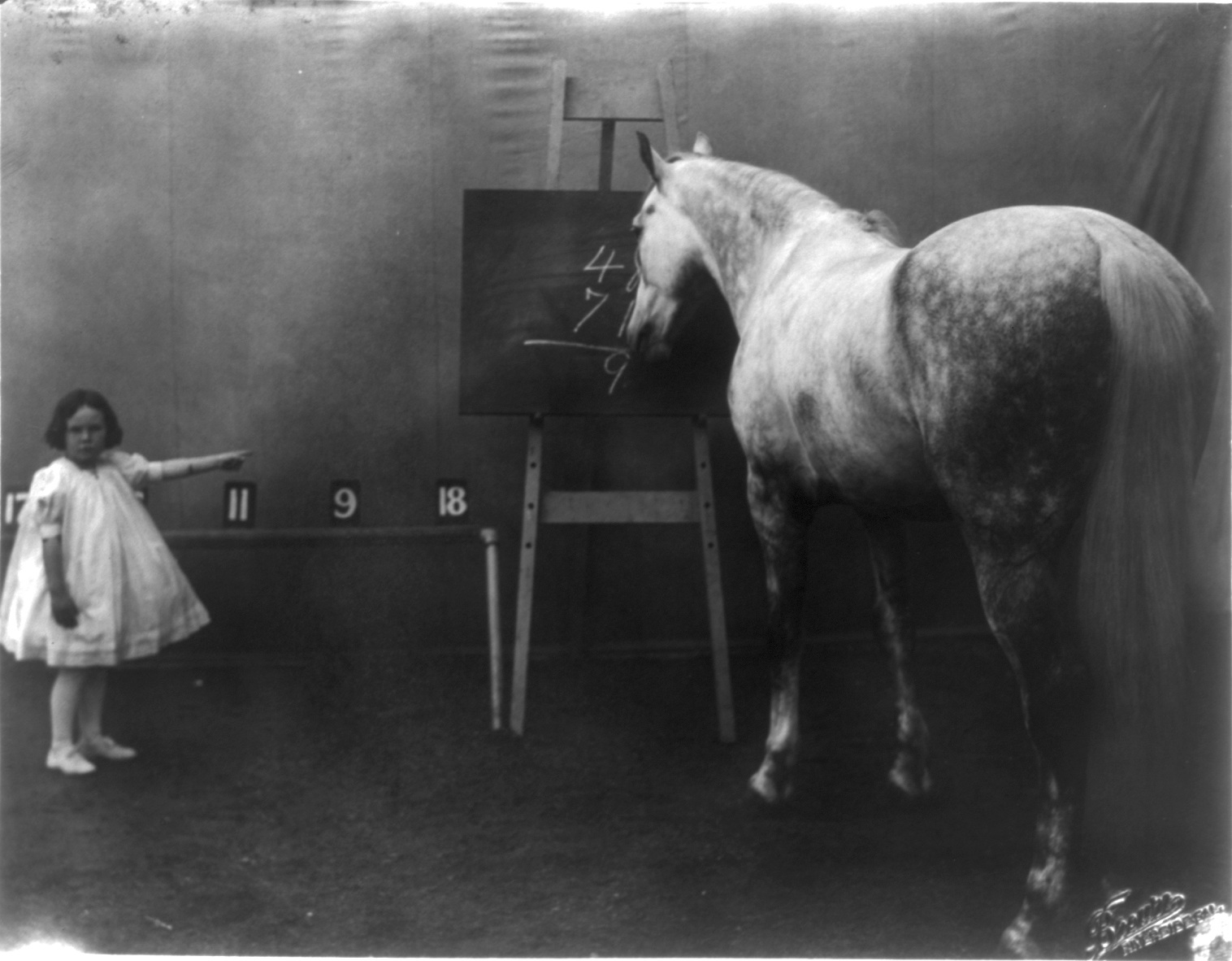
“See what Prince will do for me.” Prince Albert at a blackboard, Riverside, California, 1909. Photo by Brown, Library of Congress. Click the picture to see it full size.
The most famous educated horse lived in Berlin, Germany. Clever Hans tapped out answers to arithmetic problems with his hoof, and in 1904 scientists studied him. “Thousands of spectators, horse-fanciers, trick-trainers of first rank,” one of them wrote, could not find any signal. “That was the riddle. And its solution was found in the unintentional minimal movements of the horse’s questioner.”
A young scientist, Oskar Pfungst, worked it out. His book came out in English in 1911. When a person gave Hans a problem, the person leaned forward a tiny bit without knowing it, and Hans began to tap. When Hans reached the right number, “the questioner would make a slight upward jerk of the head.” Hans stopped. The horse was not doing arithmetic. He was reading people.
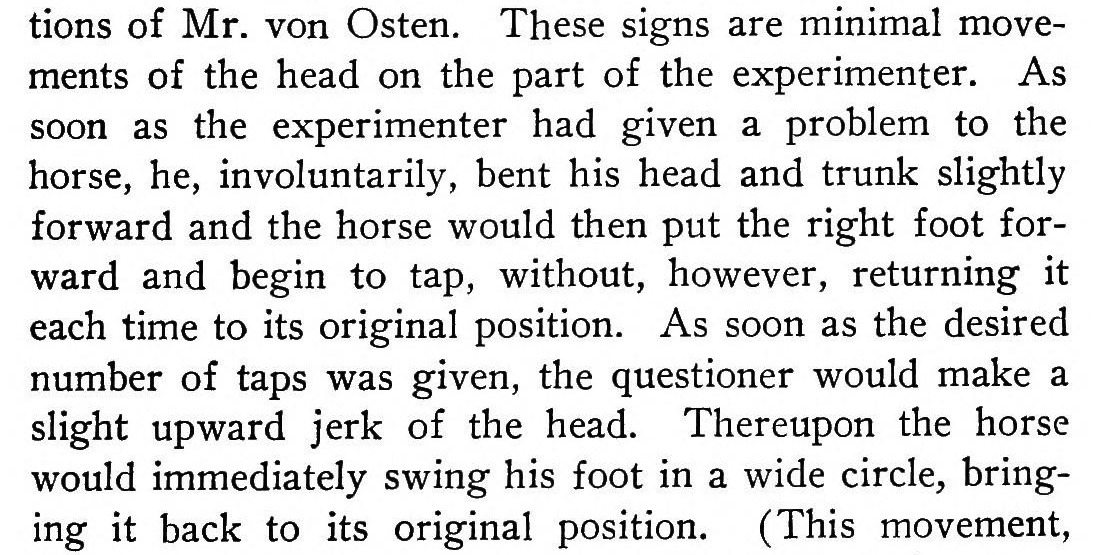
How Clever Hans knew when to stop. Oskar Pfungst, Clever Hans, New York, 1911, page 47. Internet Archive, public domain. Click the clipping to read it full size.
Nobody wrote down how Prof. Hayes taught Diamond Mart his bedtime act. The Raymond story bragged that Hayes used “no cues.” The Clever Hans book showed that a horse can spot cues a trainer does not even know he is giving.
Three Days in Laredo, Texas
In Laredo, Texas, the Times said the circus would stay three days, starting December 7, with “two performances daily.” The high diver was gone from the stories by then. In October, the circus had put an ad in The Billboard: “Also want high diver in net; we have complete outfit.” The same ad said the “show never closes.” It meant to keep traveling all winter.
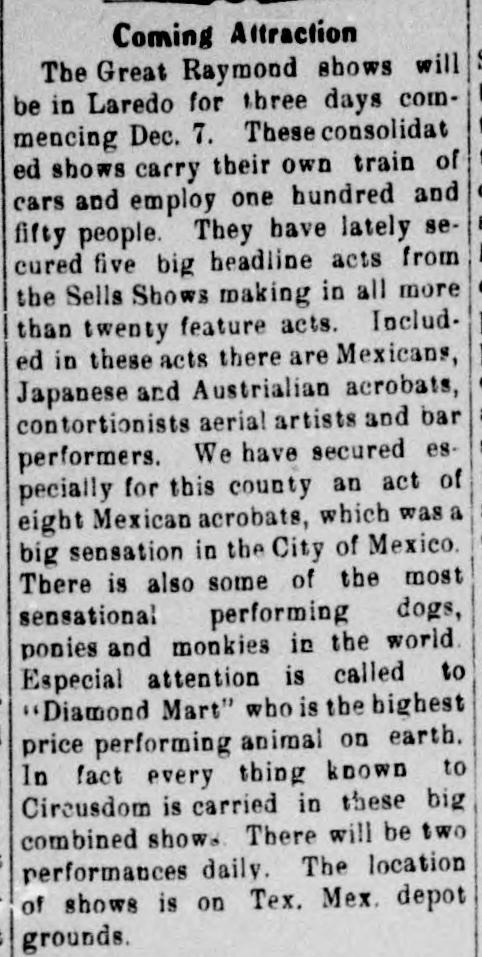
“Coming Attraction.” Laredo Weekly Times, Laredo, Texas, December 4, 1910, page 12. Library of Congress, Chronicling America. Click the clipping to read it full size.
We found no Laredo report on how the show went, and in the newspapers we searched, Diamond Mart’s name never shows up again. So nobody can say if he knelt and “prayed” on the Tex-Mex depot grounds. But for one fall, from the Texas Panhandle to the Rio Grande, a little circus on three railroad cars carried a horse that was worth $50,000, at least in the newspapers, and small boys begged to be woken up early to see him.
Sources
- “Big Show Tonight,” Laredo Weekly Times (Laredo, Texas), December 11, 1910, page 4 and “Coming Attraction,” December 4, 1910, page 12. Library of Congress, Chronicling America.
- The Great Raymond Shows ad and a local note, Randall County News (Canyon, Texas), September 2, 1910, page 5. Library of Congress, Chronicling America.
- “Big Raymond Shows,” Chickasha Daily Express (Chickasha, Oklahoma), September 17, 1910, page 4. Same issue, page 6, “Raymond Shows.” Library of Congress, Chronicling America.
- “Great Raymond Shows,” Anadarko Daily Democrat (Anadarko, Oklahoma), September 19, 1910, page 4. Library of Congress, Chronicling America.
- “The Great Raymond Shows,” The Billboard, August 6, 1910 (Internet Archive, sim_billboard_1910-08-06_22_32), and the Great Raymond Shows want ad, The Billboard, October 22, 1910. Internet Archive.
- Oskar Pfungst, Clever Hans (the Horse of Mr. Von Osten), translated by Carl L. Rahn, introduction by C. Stumpf, Henry Holt and Company, New York, 1911. Cornell University Library copy, Internet Archive.
- Anything for my master, Prince Albert, Cuthbertson’s famous educated horse, photo by Brown, Riverside, California, 1909 (the picture at the top of this page) and See what Prince will do for me, Prince Albert, Cuthbertson famous educated horse, 1909. Library of Congress Prints and Photographs Division. No known restrictions on publication.
- Princess Trixie, Queen of all educated horses, posed before her amusement park pavilion, Jamestown, Virginia, 1907, Jamestown Official Photo Corp. Library of Congress Prints and Photographs Division. No known restrictions on publication.
- The newspapers, magazines, book and photographs were all published before 1931 and are in the public domain.