One day in late February 1896, James J. Cassin walked down Bank Street in Waterbury, Connecticut, with a campaign button pinned to the lapel of his coat. Cassin was the city comptroller, the official who kept track of Waterbury’s money and paid its workers. He was a Democrat, and he thought his new button showed the most famous Democrat in the land, President Grover Cleveland. It didn’t. It showed the face of Thomas B. Reed, one of the most powerful Republicans in the country.
Bank Street noticed. “Old time democrats looked at him in astonishment and republicans smiled,” the Waterbury Democrat reported. Cassin “seemed to be in a serious mood,” though, so “no one questioned him.” Some people guessed he had lost a bet on the Fitzsimmons-Maher prize fight, a big boxing match fought near Langtry, Texas, on February 21. Maybe, they figured, wearing the button “was the penalty.”
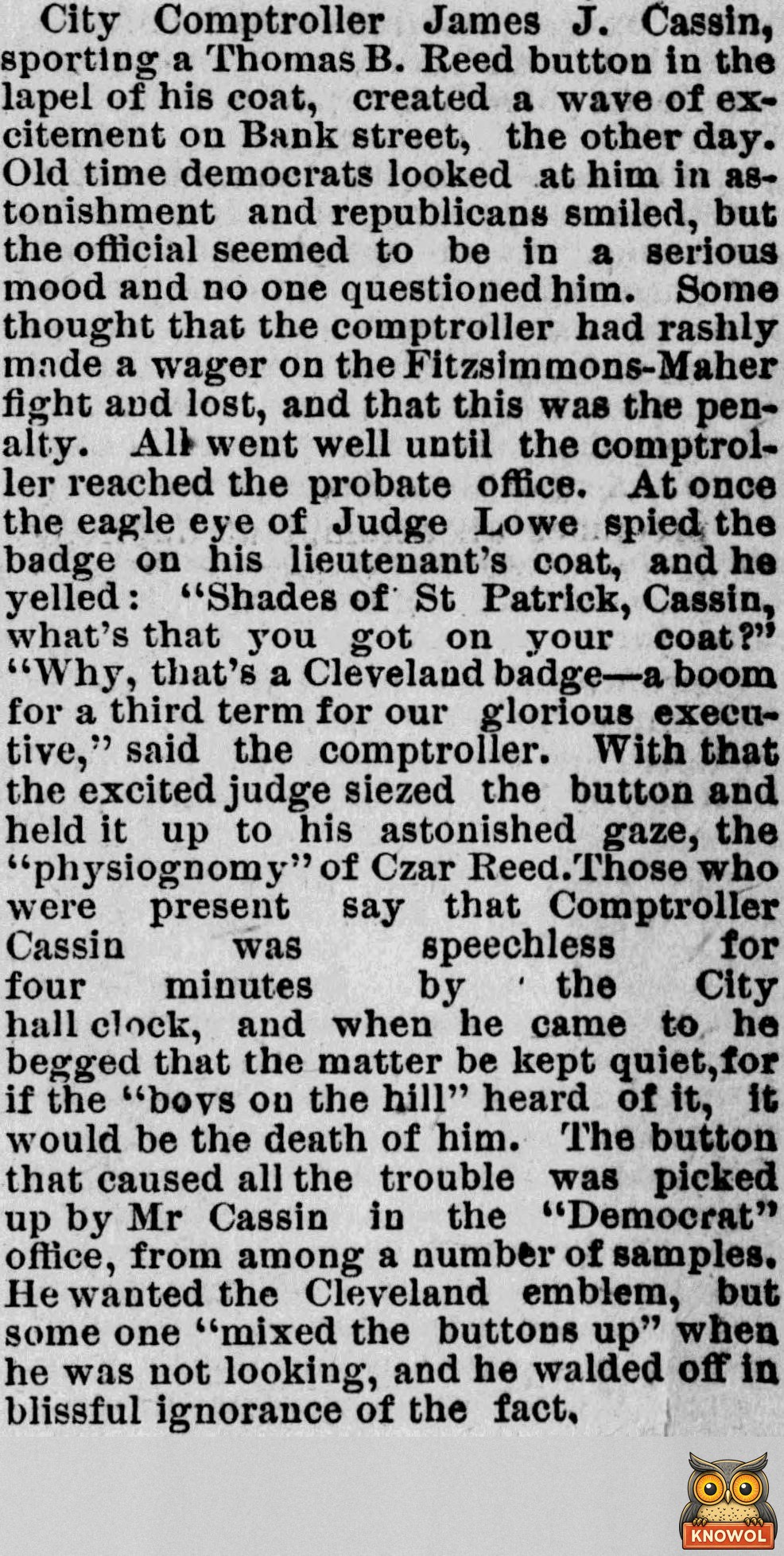
“City Comptroller James J. Cassin, sporting a Thomas B. Reed button in the lapel of his coat, created a wave of excitement on Bank street.” The Waterbury Democrat, Waterbury, Connecticut, February 29, 1896, page 4, in the column “As You Like It.” Library of Congress, Chronicling America. Click the clipping to read it full size.
The photo at the top of this page shows the corner of South Main and Bank streets in Waterbury on a postcard from 1905, nine years later. It’s the same busy downtown that Cassin strolled through with Reed on his coat.
Two Faces, Two Parties
In Waterbury, Connecticut, as everywhere else, 1896 was a year to elect a president. President Grover Cleveland, a Democrat, was near the end of his second term. Some Democrats wanted him to run again, for a third term. A push like that was called a “boom,” and badges and buttons helped spread it.
Thomas B. Reed of Maine was the Speaker of the House, the leader of the U.S. House of Representatives. He was a Republican, and he hoped his party would choose him for president. Reed ran the House so firmly that his opponents called him “Czar Reed,” after the all-powerful emperors of Russia. For a loyal Democrat, wearing Reed’s face was like wearing the other team’s cap to the big game.
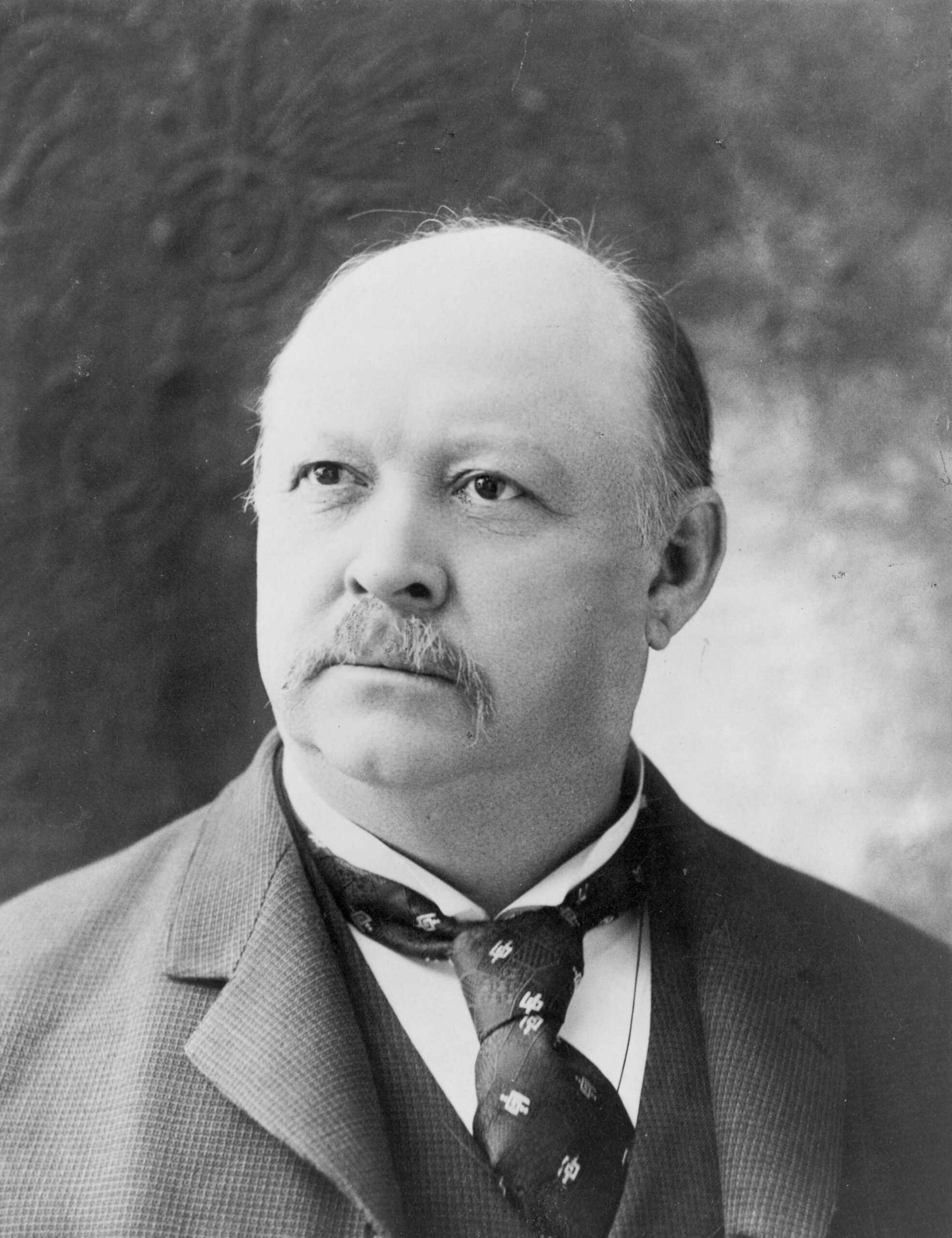
Thomas B. Reed of Maine, the Speaker of the House, about two years before the button mix-up in Waterbury. Photograph by Elmer Chickering, Boston, 1894. Library of Congress Prints and Photographs Division. Click the picture to see it full size.
“Shades of St Patrick” at the Waterbury Probate Office
Cassin’s walk through Waterbury, Connecticut, went fine “until the comptroller reached the probate office.” The probate court handles wills and the property people leave to their families. Its judge was Robert A. Lowe, and the paper called Cassin the judge’s “lieutenant,” meaning his right-hand man. A story the next year shows Cassin at work in the probate court as the judge’s clerk.
Judge Lowe had what the paper called an “eagle eye.” He spotted the button at once and yelled, “Shades of St Patrick, Cassin, what’s that you got on your coat?” Shades of St. Patrick was an old way of saying “Good heavens!” by calling on Ireland’s patron saint.
Cassin was proud of his button. “Why, that’s a Cleveland badge,” he said, “a boom for a third term for our glorious executive.” The executive was the president. So the judge grabbed the button and held it up in front of Cassin’s eyes. There, the paper said, was the “physiognomy” of Czar Reed. Physiognomy is a fancy word for a person’s face.
Four Minutes by the Waterbury City Hall Clock
People who were there in Waterbury, Connecticut, said Cassin was “speechless for four minutes by the City hall clock.” When he could talk again, he begged everyone to keep it quiet. If the “boys on the hill” ever heard about it, he said, “it would be the death of him.” That was just a saying, the way someone today might groan, “I’ll never hear the end of it.”
The clock that timed his silence was a big one. When Waterbury built its City Hall in 1869, it put a town clock in the tower. Howard & Son of Boston built it, and it was “set going” on November 25, 1869. A history of the town printed in 1896 says the clock’s bell weighed 3,027 pounds, more than a ton and a half. Its pendulum was ten feet long, as long as a basketball hoop is high.

Waterbury’s City Hall and its clock tower on a 1905 postcard. The card calls it the Town Hall, because the town and the city shared the building. The Rotograph Co., Library of Congress Prints and Photographs Division. Click the picture to see it full size.
The Mix-Up Started at a Waterbury Newspaper
The best part of the joke in Waterbury, Connecticut, came from the newspaper itself. Cassin had picked up the button at the Waterbury Democrat’s own office, “from among a number of samples.” He wanted the Cleveland one. But “some one ‘mixed the buttons up’ when he was not looking,” the paper said, and Cassin walked off “in blissful ignorance of the fact.” In other words, he had no idea. The paper never said who that “some one” was.
Cassin had begged for silence. The newspaper printed the whole story anyway, on Saturday, February 29, 1896, a leap day. It ran in a column of short local items called “As You Like It,” with the words “Stray Leaves From a Reporter’s Note Book” under its name.
Waterbury, Connecticut, Was a Button Town
The mix-up was extra funny in Waterbury, Connecticut, because the city knew buttons better than almost anyone. Its 1896 history book says Waterbury’s rise as a factory town began with a gilt button company in the 1820s. An old Waterbury man remembered a New Haven newspaper of 1822 or 1823 praising one local firm, Leavenworth, Hayden & Scovill, because it made “twenty gross of gilt buttons a day.” A gross is 144, so that’s 2,880 shiny gold-colored buttons every day. In 1824, the same firm gave the Marquis de Lafayette, the French hero of the American Revolution, “a full set of buttons of solid gold.”
Waterbury made campaign buttons long before 1896, too. In 1840, when William Henry Harrison ran for president, the Benedict & Burnham company made the Harrison “Log Cabin” button. It shows a little log cabin with a barrel by the door.
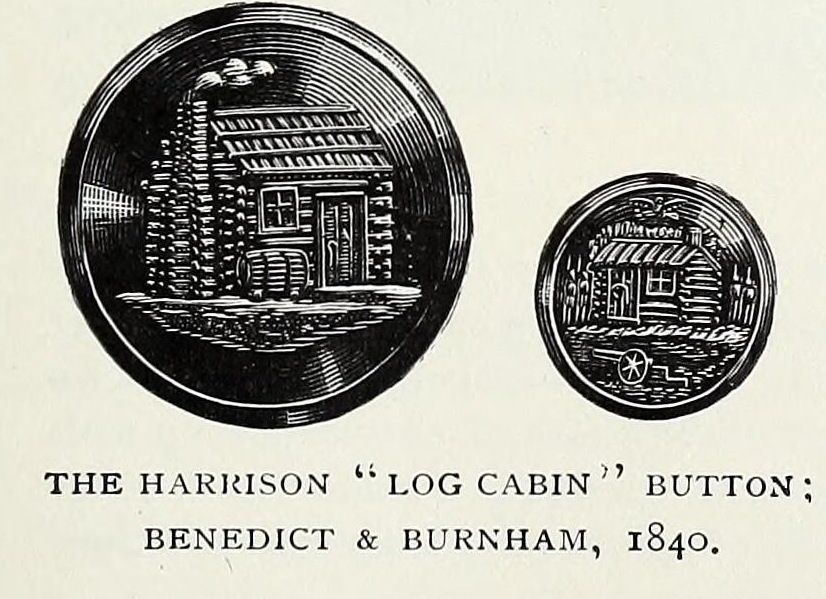
The Harrison “Log Cabin” button, made in Waterbury by Benedict & Burnham in 1840, as pictured in The Town and City of Waterbury, Connecticut (1896), volume 2, page 297. Public domain, Internet Archive. Click the picture to see it full size.
By the spring of 1896, buttons were a big part of the race for president. In April, John Addison Porter of Hartford wrote to William McKinley’s supporters all over Connecticut, asking them to help pay for the campaign. He said he had “paid out hundreds of dollars” on the campaign, “chiefly in the way of McKinley buttons,” and that the demand for them “continues to be great.”

“Porter’s Appeals.” The Waterbury Democrat, Waterbury, Connecticut, April 30, 1896, page 5. Library of Congress, Chronicling America. Click the clipping to read it full size.
How It Ended in Waterbury, Connecticut
In the end, neither man on the two buttons from Waterbury, Connecticut, made it onto the ballot. In June 1896, the Republicans met in St. Louis and chose William McKinley of Ohio on the very first ballot. Connecticut’s delegates split, with “five votes for Reed and seven for McKinley.” In July, the Democrats chose William Jennings Bryan of Nebraska, so Cleveland’s third-term boom went nowhere, too.

How Connecticut voted at the Republican convention in St. Louis. The Waterbury Democrat, Waterbury, Connecticut, June 19, 1896, page 1. Library of Congress, Chronicling America. Click the clipping to read it full size.
Cassin kept both of his jobs, and Judge Lowe kept teasing him. On November 9, 1897, the ladies of St. Francis Xavier parish in Waterbury sent Cassin a present: a comforter, which is a thick, puffy bed quilt. Three men carried “the big bundle into the probate court” and tossed it onto the table beside him.
“Glory be to God, what’s that?” asked Judge Lowe. Cassin thanked the ladies with a speech of one sentence: “Tell those good ladies that I feel deeply grateful for their kind remembrance of me.”
Then the judge got going. “Cassin, you have no spunk if you don’t find out who the donors are and put the question to the handsomest one in the crowd before Thanksgiving,” he said. To put the question meant to ask someone to marry you. “I haven’t danced a step in years,” the judge went on, “but I’ll attend your wedding and act as master of ceremonies if you go ahead.”

“Judge Lowe Wants to Dance.” The Waterbury Evening Democrat, Waterbury, Connecticut, November 9, 1897, page 1. Library of Congress, Chronicling America. Click the clipping to read it full size.
The paper’s headline that day was “Judge Lowe Wants to Dance.” As for Cassin, “The clerk kept on writing and never pretended he heard a word of Mr Lowe’s speech.” The paper said the quilt would keep a man warm all winter, “supposing he bunked outdoors.” This time, at least, Cassin knew exactly what he had in his hands.
Sources
- “As You Like It: Stray Leaves From a Reporter’s Note Book,” The Waterbury Democrat (Waterbury, Connecticut), February 29, 1896, page 4. Library of Congress, Chronicling America.
- The Waterbury Democrat, February 22, 1896, page 1: the Fitzsimmons-Maher fight at Langtry, Texas, the day before. Library of Congress, Chronicling America.
- The Waterbury Democrat, January 17, 1896, page 4, and February 21, 1896, page 5: Comptroller Cassin paying the city’s workers and checking its accounts. Library of Congress, Chronicling America.
- “Porter’s Appeals,” The Waterbury Democrat, April 30, 1896, page 5. Library of Congress, Chronicling America.
- “Only One Ballot for Each,” The Waterbury Democrat, June 19, 1896, page 1: McKinley’s nomination and Connecticut’s votes. Library of Congress, Chronicling America.
- The Waterbury Democrat, July 11, 1896, page 1: Bryan’s nomination at Chicago. Library of Congress, Chronicling America.
- “Judge Lowe Wants to Dance,” The Waterbury Evening Democrat, November 9, 1897, page 1. Library of Congress, Chronicling America.
- The Cambria Freeman (Ebensburg, Pennsylvania), January 31, 1896, page 2: an opposing paper’s jabs at “Czar Reed” and the way he ran the House. Library of Congress, Chronicling America.
- Register and Manual of the State of Connecticut, 1897: Waterbury’s city officers, among them Mayor Edward G. Kilduff and Comptroller James J. Cassin, and Robert A. Lowe, judge of probate for the Waterbury district. Internet Archive.
- Joseph Anderson, editor, The Town and City of Waterbury, Connecticut, volume 2 (1896): the City Hall of 1869 (page 41), the gilt buttons and Lafayette’s gold buttons (page 276), and the Harrison “Log Cabin” button (page 297, shown here from the second Internet Archive copy). Internet Archive.
- Joseph Anderson, editor, The Town and City of Waterbury, Connecticut, volume 3 (1896), page 689: the City Hall clock, its bell and its pendulum. Internet Archive.
- The Rotograph Co., “South Main and Bank Sts., Waterbury, Conn.,” postcard, 1905 (the cover). Library of Congress Prints and Photographs Division. No known restrictions on publication.
- The Rotograph Co., “Town Hall, Waterbury, Conn.,” postcard, 1905. Library of Congress Prints and Photographs Division. No known restrictions on publication.
- Elmer Chickering, portrait of Thomas Brackett Reed, 1894. Library of Congress Prints and Photographs Division. No known restrictions on publication.
- The newspapers, books, postcards and photograph above were all published or made before 1931 and are in the public domain.