
Old Menotomy, the Mill Brook town where Captain Cooke built a mill in 1637, where the hardest fighting of April 19, 1775 took place, and where Spy Pond once filled ice houses and fed the earliest peas in the Boston market.
Then and now
The same town 142 years apart. Click either map to look closer.
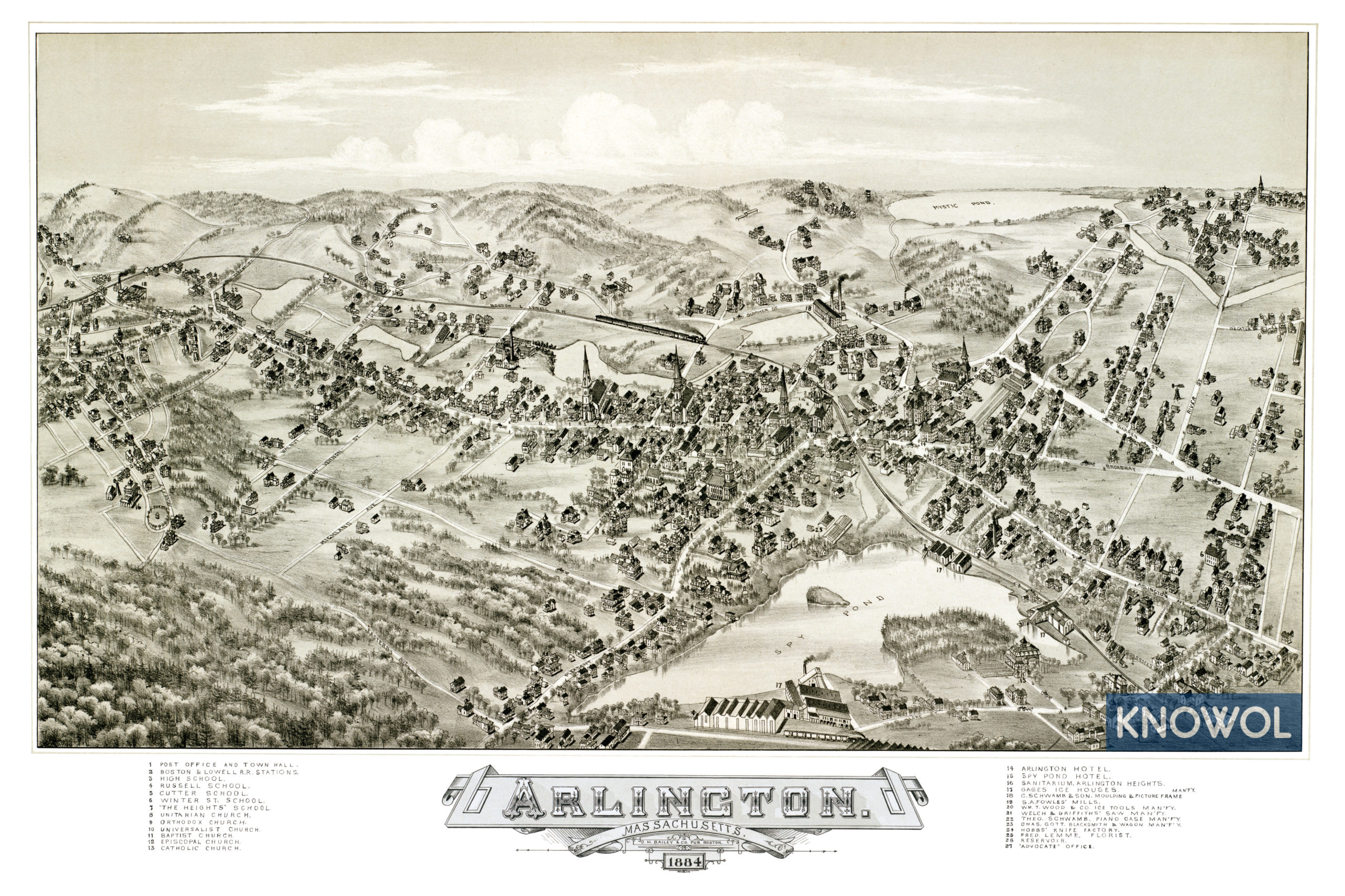
The bird's-eye view
By O.H. Bailey
Arlington drawn from the south, looking north across Spy Pond and the center of the village, with the Boston & Lowell Railroad stations, the Arlington Hotel, the Spy Pond Hotel, Gage's Ice Houses, the Schwamb Piano Case Manufactory, Hobb's Knife Factory and the Advocate office.4
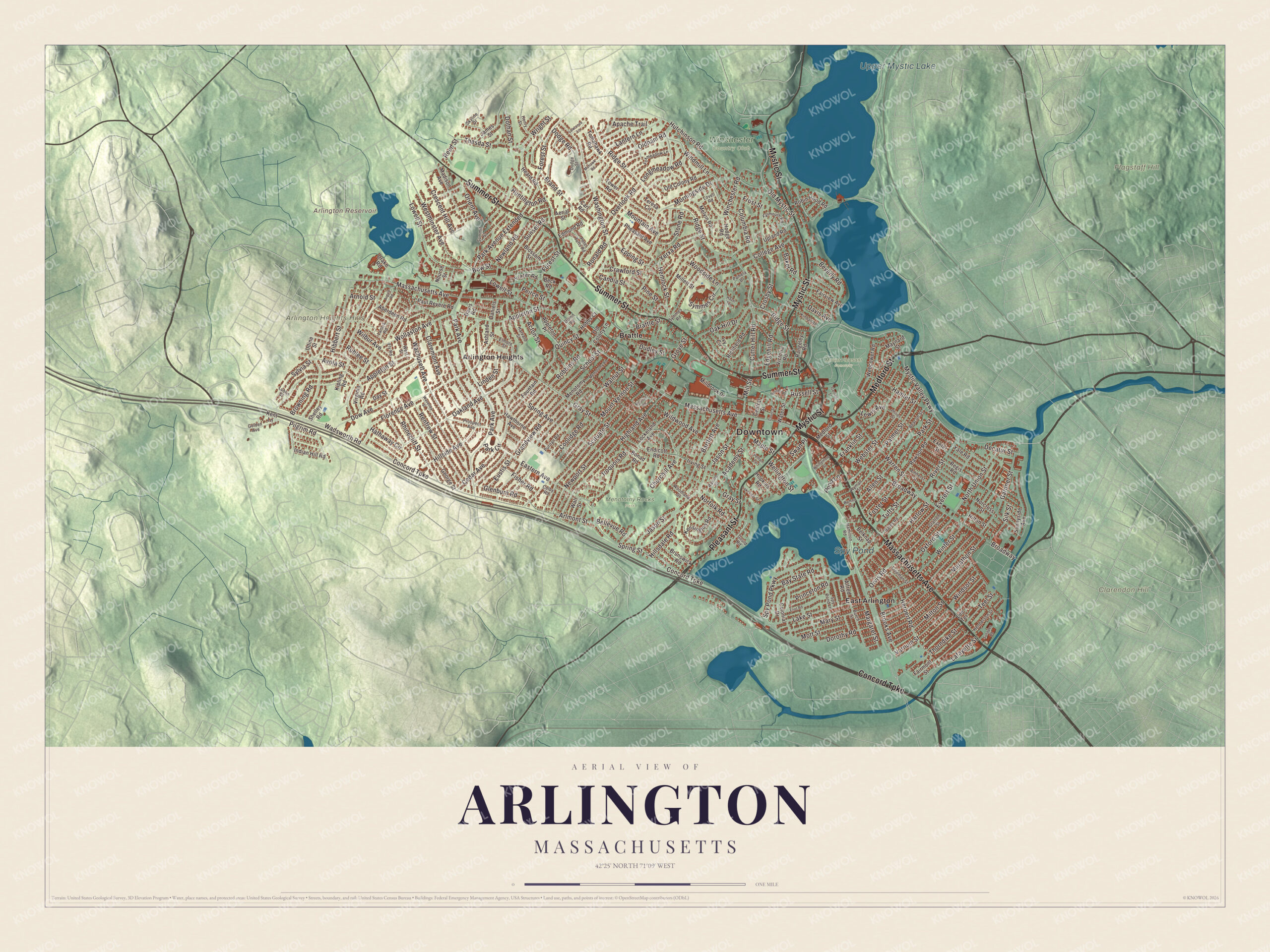
Arlington today
By KNOWOL
Shaded terrain with Spy Pond, Upper Mystic Lake, the Arlington Reservoir, Clarendon Hill and Flagstaff Hill, and Massachusetts Avenue, once the Concord Road, meeting Pleasant Street, mostly the old Watertown Road, where Jason Russell's farm stood.5
The story of Arlington
Mother Batherick and Captain Whittemore
Two of the best stories of April 19, 1775 belong to old people. By Spy Pond, six fleeing grenadiers met an old woman named Batherick digging dandelions and surrendered to her. She handed them over to the local men and told them to tell King George that an old woman took six of his grenadiers. The joke went around the English opposition papers. The town's 1880 history admits many thought the story was too good to be true. Captain Samuel Whittemore's is better documented. Shot and bayoneted that day, he was carried to Cooper's Tavern, where surgeons dressed fourteen wounds. He recovered and lived until 1793, dying at 98. In 1878 a tablet went up where the tavern stood.678
The mills of Mill Brook
Mill Brook drops across Arlington, and settlers put it to work early. Captain George Cooke, who came over in 1635 registered as a servant so he could leave England more easily, built the first mill about 1637, and the lane to it is Water Street today. Later came a wool mill that ran 72 spindles until the peace of 1815 flooded the market with British cloth, then Boston saw makers in 1832. Theodore Schwamb and his four brothers started making piano cases in 1853, and John S. Hobbs made leather-splitting knives. In 1864 Charles and Frederick Schwamb bought an old mill to turn oval picture frames. It still runs as a museum.291011121314
Peas, ice and a new name
By the 1800s the sandy fields around Spy Pond had been worked into rich market gardens. The town's 1880 history says the Hill family had perhaps no equal for the earliest green peas, the largest tomatoes and the best peaches in the Boston market. The pond itself turned out to be worth even more, and its ice houses could hold a year's stock in case a winter brought no ice. The writer J. T. Trowbridge moved here for the pond, and Longfellow, walking its shore, asked him why he'd never written a poem about it. In 1867 West Cambridge became Arlington. The 1880 history says the name was picked as a clear post office name, though one minister had begged the town to keep the old one.151617181
Through the years
25 moments from 1635 to today.
- 1635Cambridge grants farms in Menotomy, the land that's now Arlington.19
- 1636A weir to catch alewives is built on the Menotomy River, today's Alewife Brook.19
- 1637Captain George Cooke builds the first mill, on Mill Brook.2
- 1638A mill lane is laid out to Cooke's mill. It's Water Street today.10
- 1639The Squaw Sachem deeds the lands of Cambridge and Watertown to the colonists.1
- 1681A dam goes up at the mill site that's now the Old Schwamb Mill.14
- 1706About this year John Fowle builds the saltbox that's now the oldest structure in Arlington.20
- 1766Samuel Wilson, later linked to the name Uncle Sam, is born in Menotomy.21
- 1775On April 19 minutemen ambush the British retreat in Menotomy, and 25 Americans die here.1
- 1775Captain Samuel Whittemore is shot and bayoneted. He recovers and lives to 1793, carrying fourteen wounds.7
- 1790The Baptist Society Meeting House is built, and a milestone is carved eight miles from Boston.22
- 1807Menotomy becomes the town of West Cambridge on February 27.1
- 1812Abner Stearns runs a 72-spindle wool mill. The peace of 1815 puts it out of business.11
- 1832Boston saw makers William Welch and Charles Griffiths lease a burned mill site on the brook.12
- 1853Theodore Schwamb and his four brothers start turning, sawing and making piano cases.13
- 1864Charles and Frederick Schwamb buy the old mill to make round and oval picture frames.14
- 1864The Rev. S. A. Smith pleads that the town's name never be changed.18
- 1867West Cambridge is renamed Arlington.1
- 1878A tablet marks the site of Cooper's Tavern, where two men were killed on April 19, 1775.8
- 1884O.H. Bailey publishes his bird's-eye view of Arlington.4
- 1892The Robbins Memorial Library is built in Arlington Center.23
- 1900The sculptor Cyrus Dallin moves to Arlington, where he lives the rest of his life.24
- 1923The Arlington Historical Society buys the Jason Russell House.25
- 1930The last ice house on Spy Pond burns.1
- 1979Bob Frankston and Dan Bricklin develop VisiCalc in an Arlington attic.1
Places to see
Places worth a visit in Arlington today.
- Jason Russell House7 Jason Street. Site of the day's largest clash.Visit their website
- Old Schwamb Mill17 Mill Lane. Frames still hand-turned here.Visit their website
- Cyrus Dallin Art MuseumArlington Center. The sculptor's work, in town.Visit their website
- Robbins LibraryArlington Center. Historic free children's library inside.Visit their website
- Old Burying GroundPleasant Street. Resting place of 1775's dead.
- Regent TheatreMedford Street. Built for vaudeville in 1916.Visit their website
- Spy PondBeside the Minuteman Bikeway. A 103-acre glacial kettle hole.
- Elizabeth IslandIn Spy Pond. Two acres, conserved since 2010.
- Upper Mystic LakeNorth edge of town. Shared with Winchester and Medford.
- Arlington ReservoirArlington Heights. Printed on the 2026 map.
On the National Register
20 of the 63 places in Arlington on the National Register of Historic Places that still stand today, oldest first, and why each one matters. See the full list of National Register places in Arlington.3
-
Butterfield-Whittemore House
Possibly the town's oldest house, begun by Jonathan Butterfield about 1695 and sold in 1749 to Samuel Whittemore III. It sits askew to Massachusetts Avenue because it follows the road's early 1700s line.26
-
Fowle-Reed-Wyman House
The oldest structure in Arlington and the best preserved of its three First Period houses, a saltbox owned by the Wyman family from 1775 to 1924.20
-
Capt. Benjamin Locke House
Home of Benjamin Locke, a captain of the Menotomy minutemen, near a skirmish of April 19, 1775. A Baptist congregation met here from 1780 to 1790, and the house figured in a lawsuit over church and state.27
-
Arlington Center Historic District
The civic and commercial heart of town, with the Old Burying Ground (oldest marked grave 1735), where dead of both sides of April 19, 1775 lie, the 1892 Robbins Memorial Library, the 1912 Town Hall and the octagonal Central Fire Station of 1926.23
-
Jason Russell House
On April 19, 1775 the day's largest clash took place on Jason Russell's farm, and at least twenty-one colonial fighters died in and around the house. The Arlington Historical Society bought it in 1923 and runs it as a museum.25
-
Wayside Inn
The only Georgian half-house of its period left in Arlington, possibly once a stagecoach stop. The Wayside Inn name came only in the 1900s.28
-
Baptist Society Meeting House
The town's oldest surviving church building, on Brattle Street between the center and Arlington Heights. It's homes now.22
-
Milestone
Carved in 1790 to mark eight miles from Boston on the old road to Concord. The road was moved in 1811, leaving the stone behind.29
-
Jefferson Cutter House
Built for Jefferson Cutter, a turner and millwright who likely carved its front door himself. It now holds the Cyrus Dallin Art Museum.30
-
Pleasant Street Congregational Church
Built for members who left the First Parish when it turned Unitarian, a pattern-book Greek Revival church whose steeple fell in 1871 and was damaged again in the 1938 hurricane.31
-
Old Schwamb Mill
It claims the oldest continuously used mill site in the United States, back to about 1684. Charles and Frederick Schwamb bought it in 1864 to make round and oval picture frames, and it's now a living history museum.14
-
Mystic Dam
Built by the Charlestown Water Commission at the narrows between the Mystic Lakes, with its west end in Arlington and its east end in Medford. A new spillway and fish ladder were added in 2010 to 2012.32
-
Prince Hall Mystic Cemetery
The burial ground of the Prince Hall Grand Lodge, deeded in 1864 and dedicated in 1868, and perhaps the last cemetery of Prince Hall Masons. Forgotten for decades, it was found again in 1987 and rededicated in 1990.33
-
Mystic Valley Parkway
Designed in 1894 and 1895 by the Olmsted Brothers, with Charles Eliot in the lead, as a pleasure road of Boston's Metropolitan Park System. In Arlington it follows the Mystic River and the shore of Lower Mystic Lake.34
-
Taylor-Dallin House
Home of the sculptor Cyrus E. Dallin from 1899 until his death in 1944. His studio stood behind the house.35
-
Arlington Gaslight Company
Built for the Arlington Gas Company on the site of the Welch and Griffith saw factory, which burned in 1913. Its tall gas tank once carried the word ARLINGTON and an arrow pointing north, an early aid to fliers. It's the town yard now.36
-
Calvary Methodist Church
A wooden near copy of Boston's King's Chapel. Its belfry, designed by Charles Bulfinch for Boylston Market, was saved from a Charlestown brewery and given to the church in 1921.37
-
Arlington Reservoir
The Park Circle Water Tower, a Classical Revival tank built by the Metropolitan Water Works to store water for Lexington and the high parts of Belmont and Arlington.38
-
Highland Hose House
A Georgian Revival fire station by George Ernest Robinson with a grasshopper weathervane like Faneuil Hall's and a bronze relief by Cyrus Dallin.39
-
US Post Office-Arlington Main
A Colonial Revival post office best known for its lobby mural, painted in 1938 by William C. Palmer.40
In their words
“If you ever live to get back, you tell King George that an old woman took six of his grenadiers prisoners.”
History of the town of Arlington, 1880, on Mother Batherick at Spy Pond, April 19, 17756
“As the Second Precinct of Cambridge, we hold an honorable place in history; who would alienate that inheritance?”
The Rev. S. A. Smith, 1864, quoted in the History of the town of Arlington, 188018
“It was the lovely Spy Pond which impelled J. T. Trowbridge to take up his habitation in Arlington, for no landscape is complete to him without water.”
Old paths and legends of New England, 190917
Nearby towns
Sources
- Arlington, Massachusetts, Wikipedia
- History of Middlesex County, Massachusetts (1880), on Arlington, Internet Archive
- National Register of Historic Places listings in Arlington, Massachusetts, Wikipedia
- Bird's-eye view of Arlington, Massachusetts from 1884, restored by KNOWOL
- Map of Arlington, Massachusetts in 2026, KNOWOL (USGS elevation, Census Bureau roads)
- History of the town of Arlington, Massachusetts (1880), on Mother Batherick, Internet Archive
- History of the town of Arlington, Massachusetts (1880), on Capt. Samuel Whittemore, Internet Archive
- History of the town of Arlington, Massachusetts (1880), on Cooper's Tavern, Internet Archive
- History of the town of Arlington, Massachusetts (1880), on Capt. George Cooke, Internet Archive
- History of the town of Arlington, Massachusetts (1880), on Cooke's mill lane, Internet Archive
- History of the town of Arlington, Massachusetts (1880), on the Stearns wool mill, Internet Archive
- History of the town of Arlington, Massachusetts (1880), on the saw factory, Internet Archive
- History of Middlesex County, Massachusetts (1890), on the mills of Arlington, Internet Archive
- Old Schwamb Mill, Wikipedia
- History of the town of Arlington, Massachusetts (1880), on the Hill market gardens, Internet Archive
- History of the town of Arlington, Massachusetts (1880), on the Spy Pond ice houses, Internet Archive
- Old paths and legends of New England (1909), on Arlington, Internet Archive
- History of the town of Arlington, Massachusetts (1880), on the name Arlington, Internet Archive
- History of the town of Arlington, Massachusetts (1880), on the first grants, Internet Archive
- Fowle-Reed-Wyman House, Wikipedia
- Samuel Wilson, Wikipedia
- Baptist Society Meeting House, Wikipedia
- Arlington Center Historic District, Wikipedia
- Cyrus Dallin, Wikipedia
- Jason Russell House, Wikipedia
- Butterfield-Whittemore House, Wikipedia
- Capt. Benjamin Locke House, Wikipedia
- Wayside Inn (Arlington, Massachusetts), Wikipedia
- Milestone (Arlington, Massachusetts), Wikipedia
- Cyrus Dallin Art Museum (Jefferson Cutter House), Wikipedia
- Pleasant Street Congregational Church, Wikipedia
- Mystic Dam, Wikipedia
- Prince Hall Mystic Cemetery, Wikipedia
- Mystic Valley Parkway, Wikipedia
- Taylor-Dallin House, Wikipedia
- Arlington Gaslight Company, Wikipedia
- Calvary Methodist Church, Wikipedia
- Park Circle Water Tower, Wikipedia
- Highland Hose House, Wikipedia
- United States Post Office (Arlington, Massachusetts), Wikipedia