
A lake town in the hills east of the Connecticut River, called Chatham until 1915, where Middle Haddam once launched ocean-going ships and the village by Lake Pocotopaug made so many bells it became Belltown.
Then and now
The same town 146 years apart. Click either map to look closer.
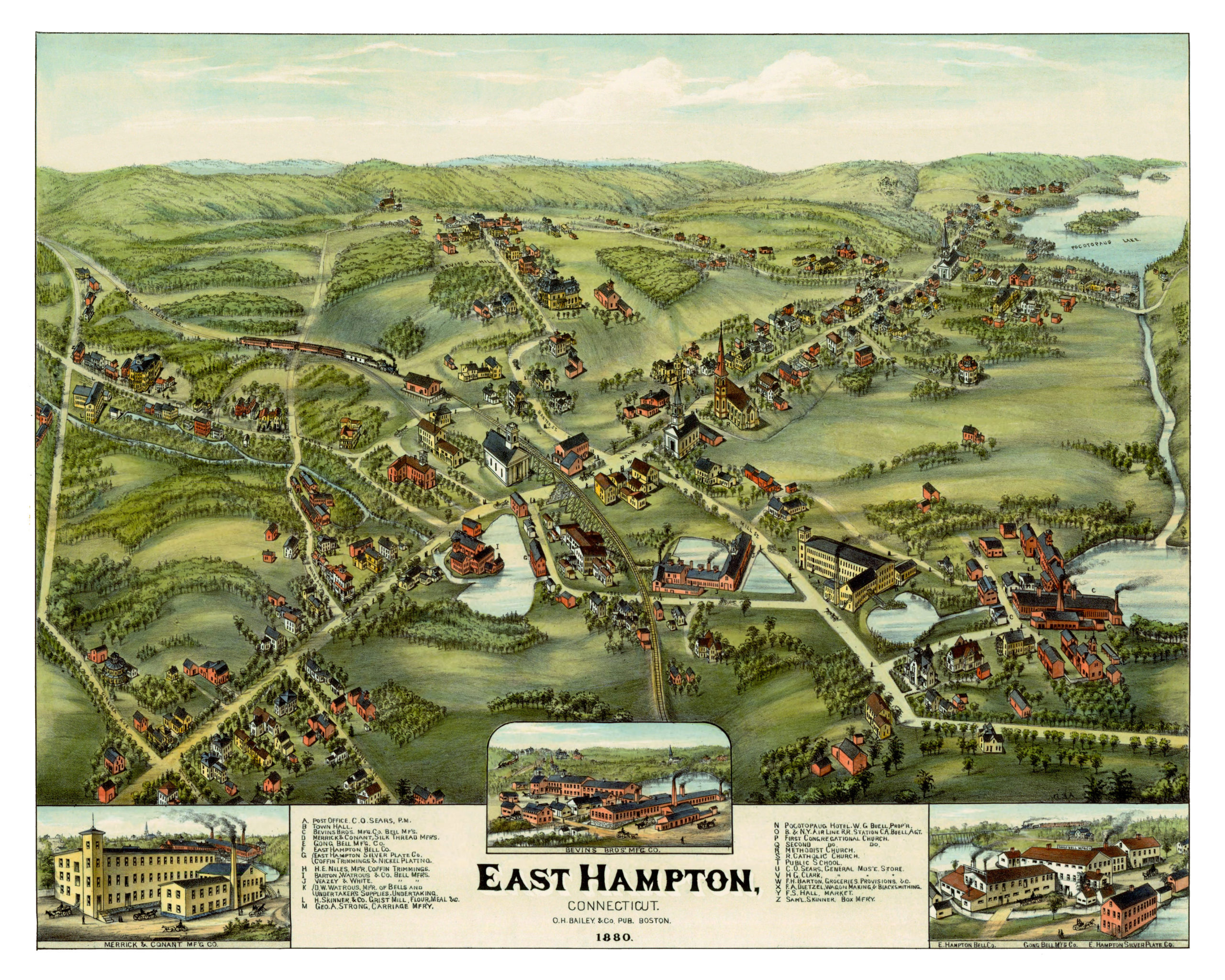
The bird's-eye view
By O.H. Bailey
East Hampton drawn as if from the sky toward the end of the 1800s, with the town hall, George A. Strong's carriage factory, H.E. Niles' coffin trimmings shop, the Pocotopaug Hotel and the East Hampton Bell Company.4
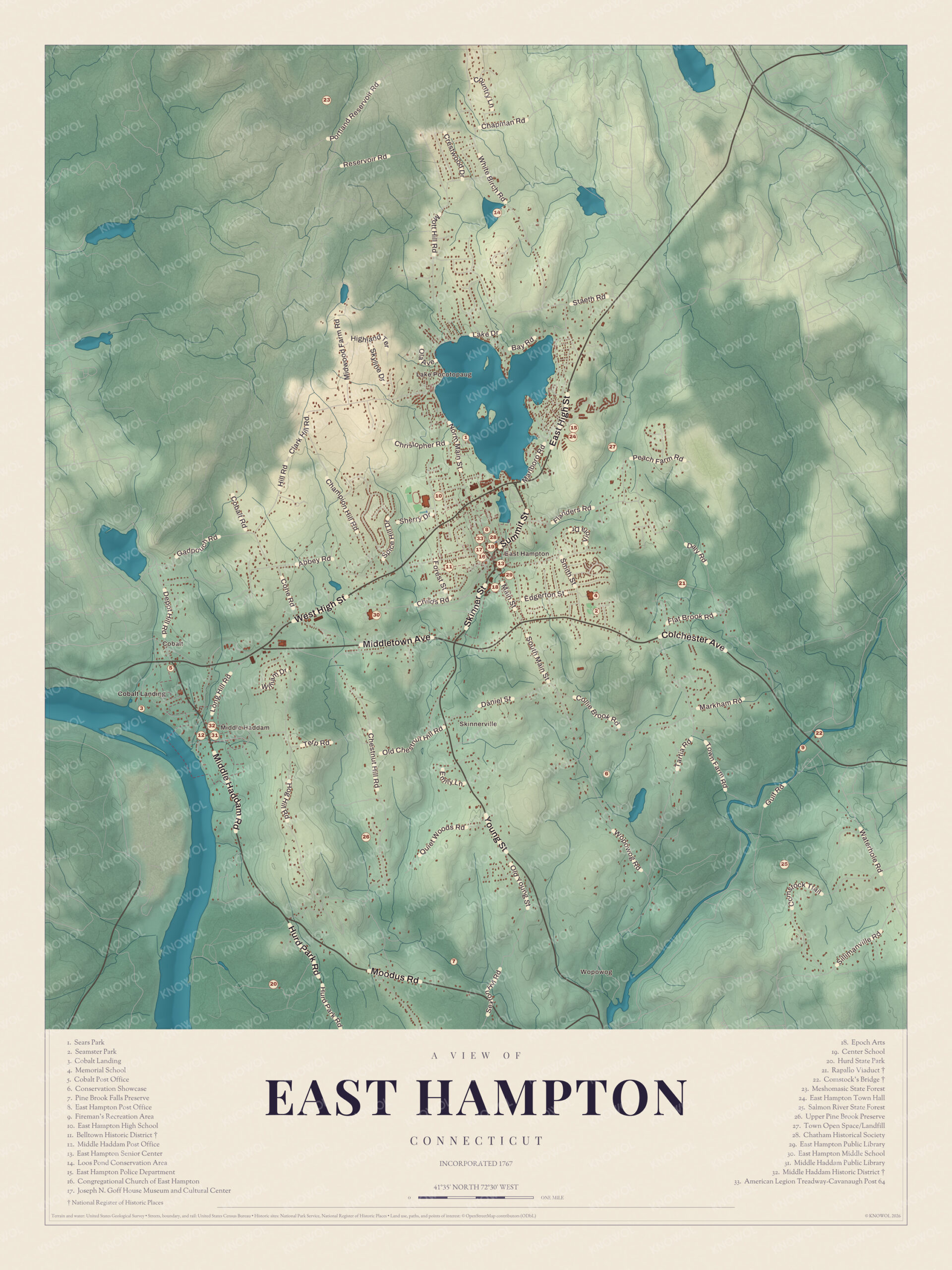
East Hampton today
By KNOWOL
Shaded hills from the high ground around Lake Pocotopaug down to the Connecticut River at Middle Haddam, every street, the villages of Cobalt and Wopowog, and a guide of 33 numbered landmarks with the National Register sites marked.2
The story of East Hampton
The town that rang
William Barton came to East Hampton in 1808 and made hand bells and sleigh bells, and he taught the trade to his neighbors. His very first bell was sealed under the cornerstone of the Congregational Church in 1852. By the 1880s a state review said nearly every sleigh bell in North America was made here, and the rest were made by men from East Hampton. The Gong Bell company made the first revolving chimes on wheels in 1872. After the Great Chicago Fire, Bevin Brothers melted part of the ruined courthouse bell into thousands of little souvenir bells. And the biggest bell ever cast in town still hangs in Asylum Hill Congregational Church in Hartford.156789
Ships at Middle Haddam
Long before the bells, the river was the business. The first ship was launched from the Middle Haddam yards in 1763, and at one time more than two hundred men worked there. Even in the long decline from 1805 to 1838 the yards turned out 111 vessels, most of them ships and brigs built for the open sea. Thomas Child, one of the river's famous master builders, oversaw 237 vessels in his life, most of them here. The village's minister, Benjamin Boardman, went off to the Revolution as a chaplain, and the British nicknamed him the Great Gun of the Gospel for his voice. A writer in 1927 called Middle Haddam the most magical of all the river villages.1011121314
Rattlesnakes, cobalt and the Governor's Ring
The hills of old Chatham had their own legends. Meshomasic Mountain was so thick with rattlesnakes that the early towns paid sixpence a tail. Great Hill was called the Governor's Ring, because people believed Governor John Winthrop got enough gold from its rocks to make a ring. About 1762 a German doctor opened a cobalt mine at its foot, and the village of Cobalt took its name from that mineral. One manager planned to sail to China with 20 tons of ore. In 1818 a New Hampshire company spent about $20,000 there, only to learn in England that their cobalt was mostly nickel. Down by the river, Hog Hill got its name from the settlers' hogs, found shut under the meetinghouse one Sunday by their grunting.151617718
Through the years
24 moments from 1661 to today.
- 1661Middletown grants Governor John Winthrop land around Great Hill to search for mines.19
- 1739The first settlers arrive by sea from Eastham, Massachusetts.1
- 1740The church of Middle Haddam is organized, with Benjamin Bowers as its first minister.13
- 1743A forge goes up near the outlet of Lake Pocotopaug.20
- 1746The settlers name their community Easthampton parish, after Eastham.1
- 1762About this year Dr. John Sebastian Stephawney opens a cobalt mine at the foot of Great Hill.16
- 1763The first ship is launched from the Middle Haddam yards.10
- 1767The General Assembly makes the town of Chatham, set off from Middletown.1
- 1786Christ Church is built in Middle Haddam, near the Landing.21
- 1804Middle Haddam gets its post office.22
- 1808William Barton arrives and begins making hand bells and sleigh bells.1
- 1818A New Hampshire company reopens the cobalt mine and spends about $20,000 on ore that proves to be mostly nickel.16
- 1828Thaddeus Tibbals starts making oakum on the Cobalt stream.23
- 1838Shipbuilding at Middle Haddam comes to an end.11
- 1841East Middletown parish leaves Chatham and becomes the town of Portland.1
- 1852Barton's first bell is sealed under the cornerstone of the new Congregational Church.6
- 1872The Gong Bell company starts making revolving chimes on wheels, a first.8
- 1873The Rapallo Viaduct is finished on the new Air Line railroad.24
- 1880O.H. Bailey publishes his bird's-eye view of East Hampton.4
- 1903Meshomasic becomes the first State Forest in Connecticut.2
- 1913The Rapallo Viaduct is buried in sand by the railroad, which keeps it safe to this day.24
- 1915Chatham takes the name East Hampton.1
- 1930The Middle Haddam School is built.25
- 2012Fire destroys the old Bevin Brothers bell shop, and the company carries on in a new building in town.1
Places to see
The numbers match the landmark guide printed on the 2026 map.
- 1Sears ParkLake Pocotopaug. Swimming and boating for residents.
- 11Belltown Historic DistrictThe village. The old bellmaking heart of town.
- 16Congregational Church of East HamptonThe village. Congregational church in the village.
- 17Joseph N. Goff House Museum and Cultural CenterThe village. Museum and cultural center.
- 20Hurd State ParkOn the river. Primitive camping for river boaters.Visit their website
- 21Rapallo ViaductAir Line Trail. An iron trestle buried since 1913.
- 22Comstock's BridgeSalmon River. Covered bridge, open to walkers.
- 23Meshomasic State ForestWest of the lake. Connecticut's first State Forest, 1903.
- 28Chatham Historical SocietyThe village. Still carries the old town name.Visit their website
- 32Middle Haddam Historic DistrictMiddle Haddam. The Federal-era river port village.
On the National Register
All 5 places in East Hampton on the National Register of Historic Places that still stand today, oldest first, and why each one matters.3
-
Middle Haddam Historic District
The village center of Middle Haddam, an important river port between about 1730 and 1880 with shipyards building ocean-going vessels. Its 58 historic buildings, most built before 1835, give it a Federal look, and the oldest date to 1732.26
-
Belltown Historic District
The commercial and industrial heart of East Hampton, which grew rich in the 1800s making bells after William Barton brought the trade to town. It covers 145 acres with 145 contributing buildings, including the bell makers' mill complexes and four churches.5
-
Rapallo Viaduct
A wrought iron railroad trestle named for Charles A. Rapallo, a director of the railroad. Buried in sand in 1912 and 1913, it survives under the Air Line Trail, and it and the Lyman Viaduct are the only surviving bridges in the state from the first generation of wrought iron bridge construction.24
-
Comstock's Bridge
First built in 1840 and entirely replaced in 1873, it's one of only three historical covered bridges in Connecticut. A Civilian Conservation Corps crew restored it in the 1930s, and it's open to people on foot.27
-
Middle Haddam School
A red brick Colonial Revival school that served Middle Haddam as a school and community center from 1930 to 1980. Villagers fought off plans to turn it into condominiums and later raised money to buy it.25
In their words
“In this small place, nestled among the bold and rugged hills of the granite formation, is made nearly every sleigh-bell which now tinkles throughout North America.”
The historical, statistical and industrial review of the state of Connecticut, 18847
“Shut off by wide water and by climbing woods, it rests like a pearl in a setting of green.”
Odell Shepard, The harvest of a quiet eye, 1927, on Middle Haddam14
“With a record to be proud of, with natural beauty that will compare favorably with any portion of New England, the town of Chatham has within its bounds an abundance of interest.”
The Connecticut magazine, 189928
Nearby towns
Sources
- East Hampton, Connecticut, Wikipedia
- Map of East Hampton, Connecticut in 2026, KNOWOL (USGS elevation, Census Bureau roads)
- National Register of Historic Places listings in Middlesex County, Connecticut, Wikipedia
- Bird's-eye view of East Hampton, Connecticut from 1880, restored by KNOWOL
- Belltown Historic District, Wikipedia
- The Connecticut magazine (1899), on William Barton's bells, Internet Archive
- The historical, statistical and industrial review of the state of Connecticut (1884), on Chatham, Internet Archive
- History of Middlesex County, Connecticut (1884), on the Gong Bell Manufacturing Company, Internet Archive
- History of Middlesex County, Connecticut (1884), on Bevin Brothers and the Chicago bell, Internet Archive
- Historic towns of the Connecticut River valley (1906), on the first ship at Middle Haddam, Internet Archive
- Historic towns of the Connecticut River valley (1906), on the Middle Haddam yards, Internet Archive
- History of Middlesex County, Connecticut (1884), on shipbuilding at Middle Haddam, Internet Archive
- The two hundredth anniversary of the First Congregational Church of Haddam (1902), on the Middle Haddam church, Internet Archive
- The harvest of a quiet eye, Odell Shepard (1927), on Middle Haddam, Internet Archive
- History of Middlesex County, Connecticut (1884), on Chatham's hills and lake, Internet Archive
- History of Middlesex County, Connecticut (1884), on the cobalt mines, Internet Archive
- Historic towns of the Connecticut River valley (1906), on the cobalt mine, Internet Archive
- History of Middlesex County, Connecticut (1884), on Hog Hill, Internet Archive
- The Connecticut River and the valley of the Connecticut (1906), on the Governor's Ring, Internet Archive
- History of Middlesex County, Connecticut (1884), on the forge at the lake, Internet Archive
- Historic towns of the Connecticut River valley (1906), on the Middle Haddam churches, Internet Archive
- History of Middlesex County, Connecticut (1884), on Chatham's post offices, Internet Archive
- History of Middlesex County, Connecticut (1884), on the Tibballs oakum works, Internet Archive
- Rapallo Viaduct, Wikipedia
- Middle Haddam School, Wikipedia
- Middle Haddam Historic District, Wikipedia
- Comstock's Bridge, Wikipedia
- The Connecticut magazine (1899), on the town of Chatham, Internet Archive