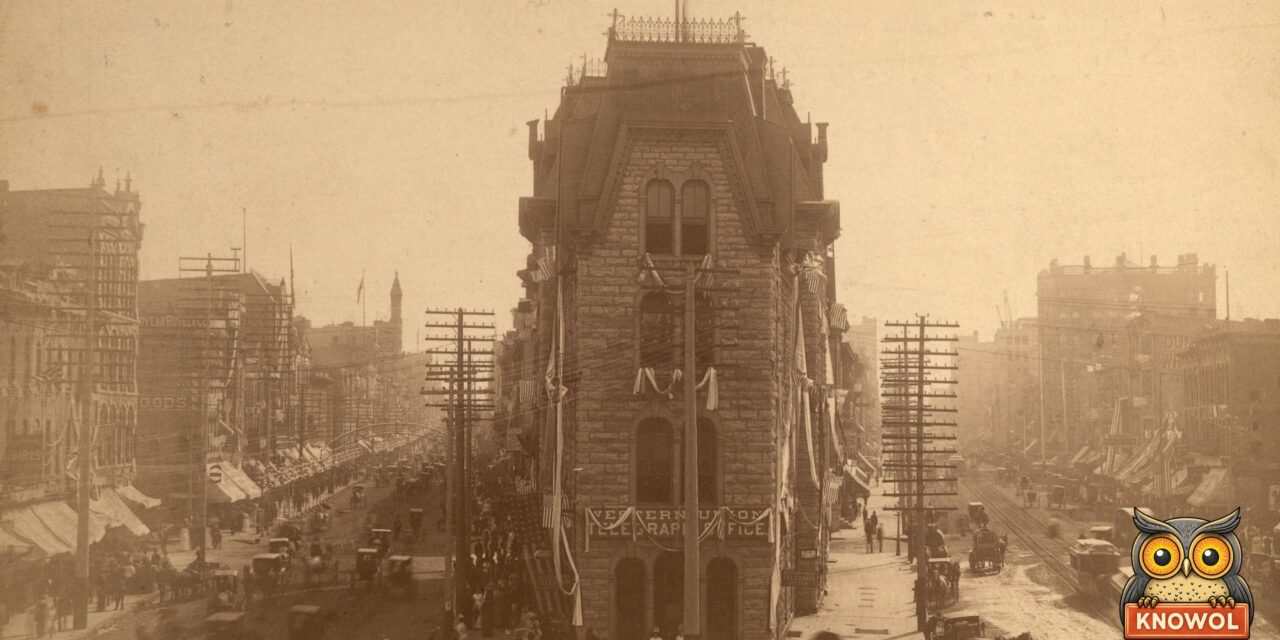
On Wednesday, November 21, 1888, a wheelbarrow covered in flags set out from 323 Twentieth Avenue North in Minneapolis, Minnesota. Riding in it was Harvey N. Thompson, who sold flour and feed. M. D. Swensen, a well-known North Minneapolis saloonkeeper, had lost an election bet. Now he owed Thompson a ride to the city hall and back.
There was a problem. “Mr. Thompson is a very heavy man and the distance is over three miles,” the St. Paul Daily Globe reported the next day. So Swensen got some help. A pony was hitched to the front of the wheelbarrow, and it “furnished most of the motive power.” Motive power is whatever makes a thing go. In plain words, the pony did most of the work.
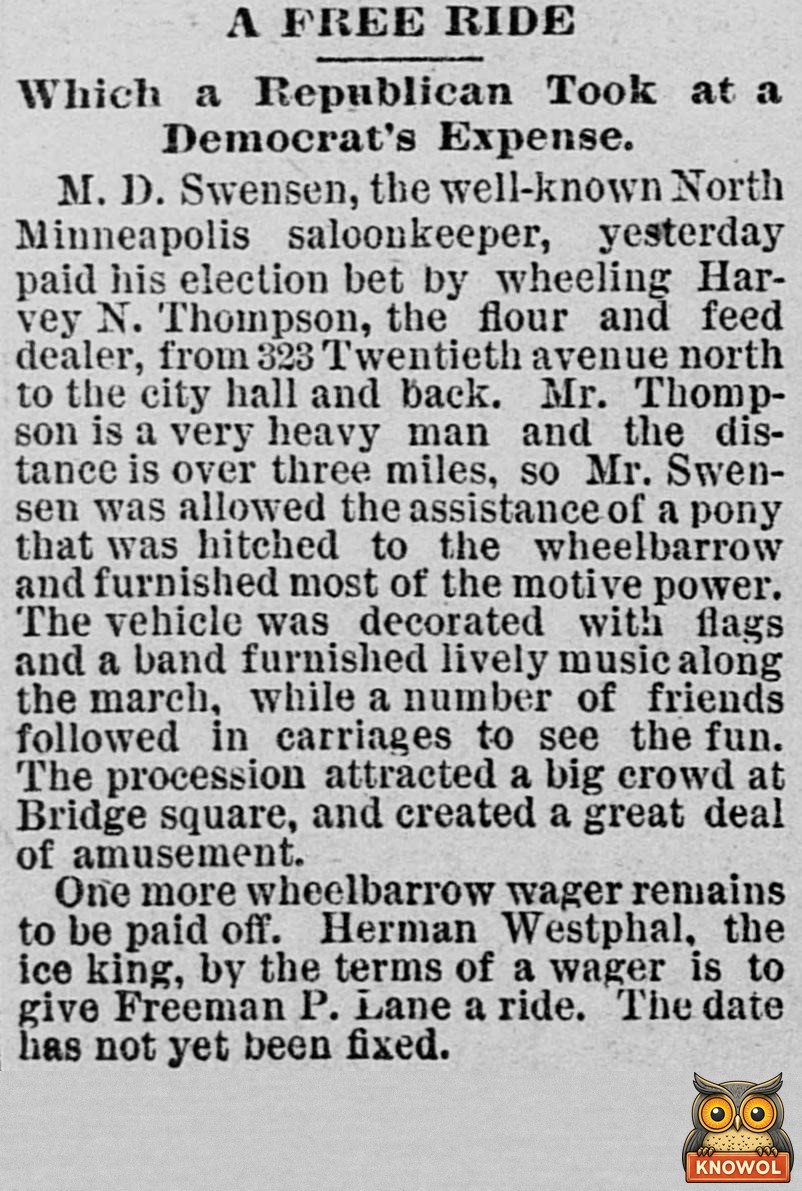
“A Free Ride: Which a Republican Took at a Democrat’s Expense,” St. Paul Daily Globe, Saint Paul, Minnesota, November 22, 1888, page 3 (the Minneapolis page). Library of Congress, Chronicling America. Click the clipping to read it full size.
Why Minneapolis Men Were Pushing Wheelbarrows
Minneapolis voted for president with the rest of the country on Tuesday, November 6, 1888. President Grover Cleveland, a Democrat, wanted four more years. Benjamin Harrison, a Republican, wanted his job. Harrison won.
Before the vote, lots of Minneapolis men made bets. Some bet money. Others bet a show. If your man lost, you did something silly in public, and the whole town got to watch. The favorite was the wheelbarrow ride: the loser pushed the winner through the busiest streets, often with a band out in front.
The Globe was a St. Paul paper, but it printed a page of Minneapolis news too. A week after the election, that page ran a column called “Election Bets.” The line under it said it all: “Victims Being Held to Their Agreements.”
A Dead Rooster on Nicollet Avenue
The first ride in that column happened in Minneapolis on Monday, November 12. George Crockett sold sewing machines at the corner of Fifth Street and Nicollet Avenue. He wheeled F. R. Crang, the manager of the New Home sewing machine, “down Nicollet to Bridge square, to Sixth street, to the New Home office.” The wheelbarrow was trimmed with bunting, the bright cloth people hang up for parades. A drum corps marched ahead, and “a big crowd followed the novel outfit.”
Crockett also “carried a dead rooster on his back.” In 1888, people got that joke right away. The rooster was a symbol of the Democrats, the way the donkey is today. A Virginia paper that fall described a Democratic club marching with “a large rooster, the democratic emblem of the club.” Crockett was a Democrat, so his bird was done for. Still, the Globe gave him credit. He “carried out the agreement to the letter, and never stopped to rest once.”
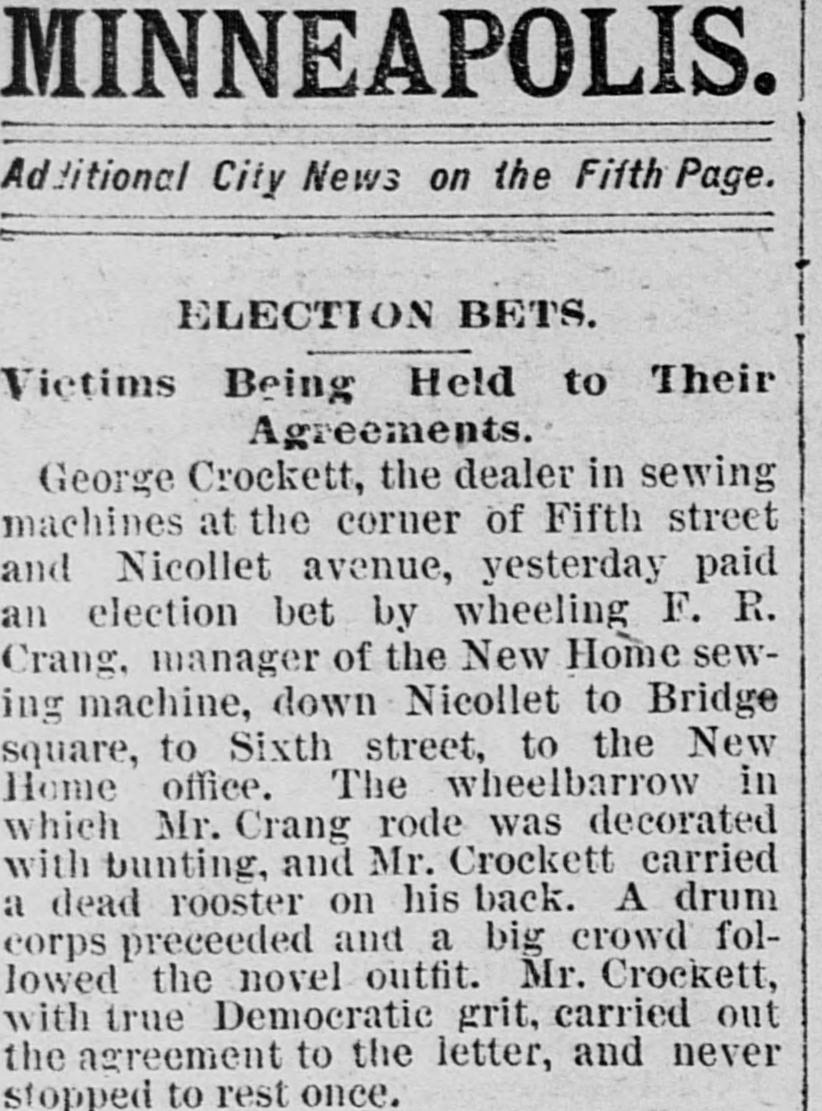
“Election Bets: Victims Being Held to Their Agreements,” St. Paul Daily Globe, November 13, 1888, page 3. Library of Congress, Chronicling America. Click the clipping to read it full size.
A Live Eagle on Hennepin Avenue
That same Monday evening in Minneapolis, George L. Tuffts wheeled Alex Premo from Seventh Street down Nicollet to Bridge Square, then up Hennepin Avenue to Seventh Street. Premo wore the uniform of the flambeau club. Flambeau is French for torch. That October, the Minneapolis Flambeau club had been named first in line for a big Republican parade. Four of Premo’s “brother members with torches” walked along with him.
Premo “carried aloft a live American eagle.” The eagle made a good answer to the Democrats’ rooster. A Republican in West Virginia put the two birds side by side in a letter to his paper that fall. He hoped “the American eagle will soon be seen with his broad-spread pinions standing out to the breeze where the bantering Democratic rooster is now seen.” Pinions are wing feathers.
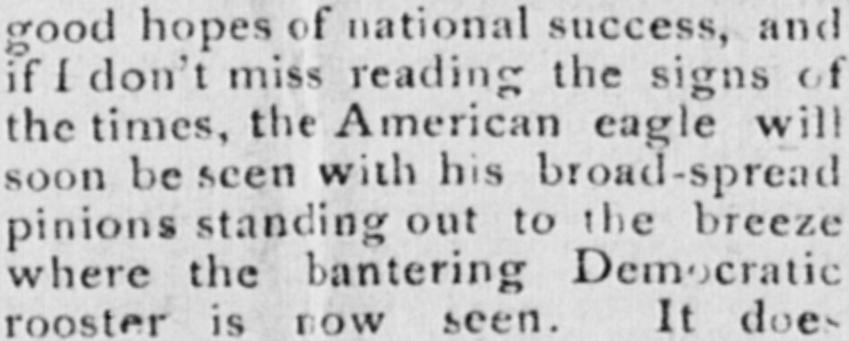
The eagle and the rooster, in a letter from Shiloh, West Virginia. Ceredo Advance, Ceredo, West Virginia, October 31, 1888, page 2. Library of Congress, Chronicling America. Click the clipping to read it full size.
Tuffts had a costume too. He wore a hat labeled “Borrowed” and a sash labeled “This is a horse on me.” That was old slang: a “horse” on somebody was a joke on them. A drum corps led the way, “a tin horn brigade brought up the rear,” and the paper said the parade “created a great deal of amusement.”
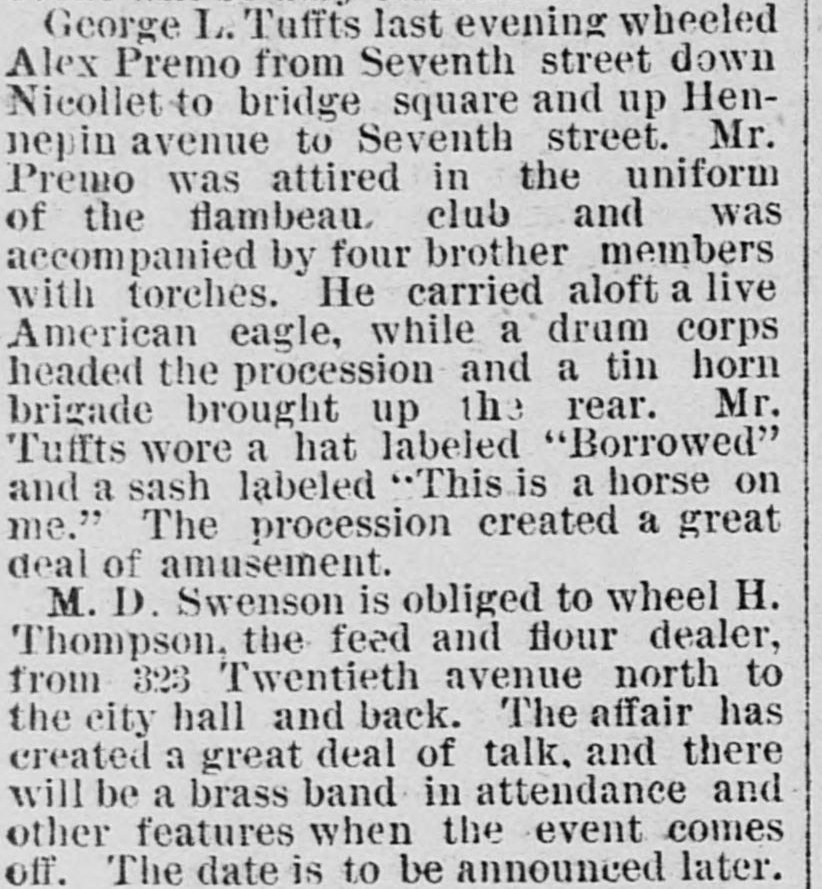
The live eagle, the “Borrowed” hat and the promise of a brass band. St. Paul Daily Globe, November 13, 1888, page 3. Library of Congress, Chronicling America. Click the clipping to read it full size.
The Bet That Wasn’t a Ride
Not every Minneapolis bet ended in a wheelbarrow. Miss May Voight, a Republican, had made a bet with John Conlair, “the rash Democratic real estate dealer.” The paper said it was “his bet that he is to marry her before Christmas.” John now said the bet was only “in fun.” May said she had “witnesses that it was in earnest.” The Globe printed her answer for the whole city to read: “if he is a man and a Democrat, as she is a woman and a Republican, he will not try to back down.”
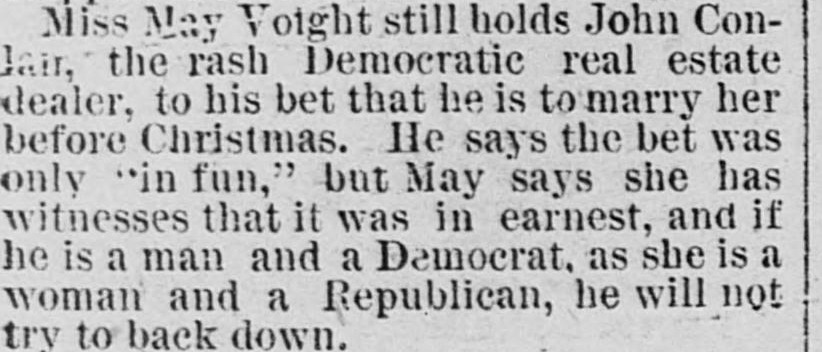
Miss May Voight and her bet. St. Paul Daily Globe, November 13, 1888, page 3. Library of Congress, Chronicling America. Click the clipping to read it full size.
Twentieth Avenue North to City Hall
The last item in that November 13 column was the one Minneapolis was talking about. M. D. Swensen “is obliged to wheel H. Thompson, the feed and flour dealer, from 323 Twentieth avenue north to the city hall and back.” The Globe added that “there will be a brass band in attendance and other features when the event comes off. The date is to be announced later.”
In 1888 the Minneapolis city hall stood in Bridge Square, where Nicollet and Hennepin avenues came together near the bridge over the Mississippi River. It went up in 1873 and came down in 1912. That’s the building at the top of this story, dressed in flags for a celebration around 1886.
On November 21, the big day came. “A band furnished lively music along the march, while a number of friends followed in carriages to see the fun.” The pony pulled, Thompson rode, and Swensen paid his bet. The parade “attracted a big crowd at Bridge square, and created a great deal of amusement.”
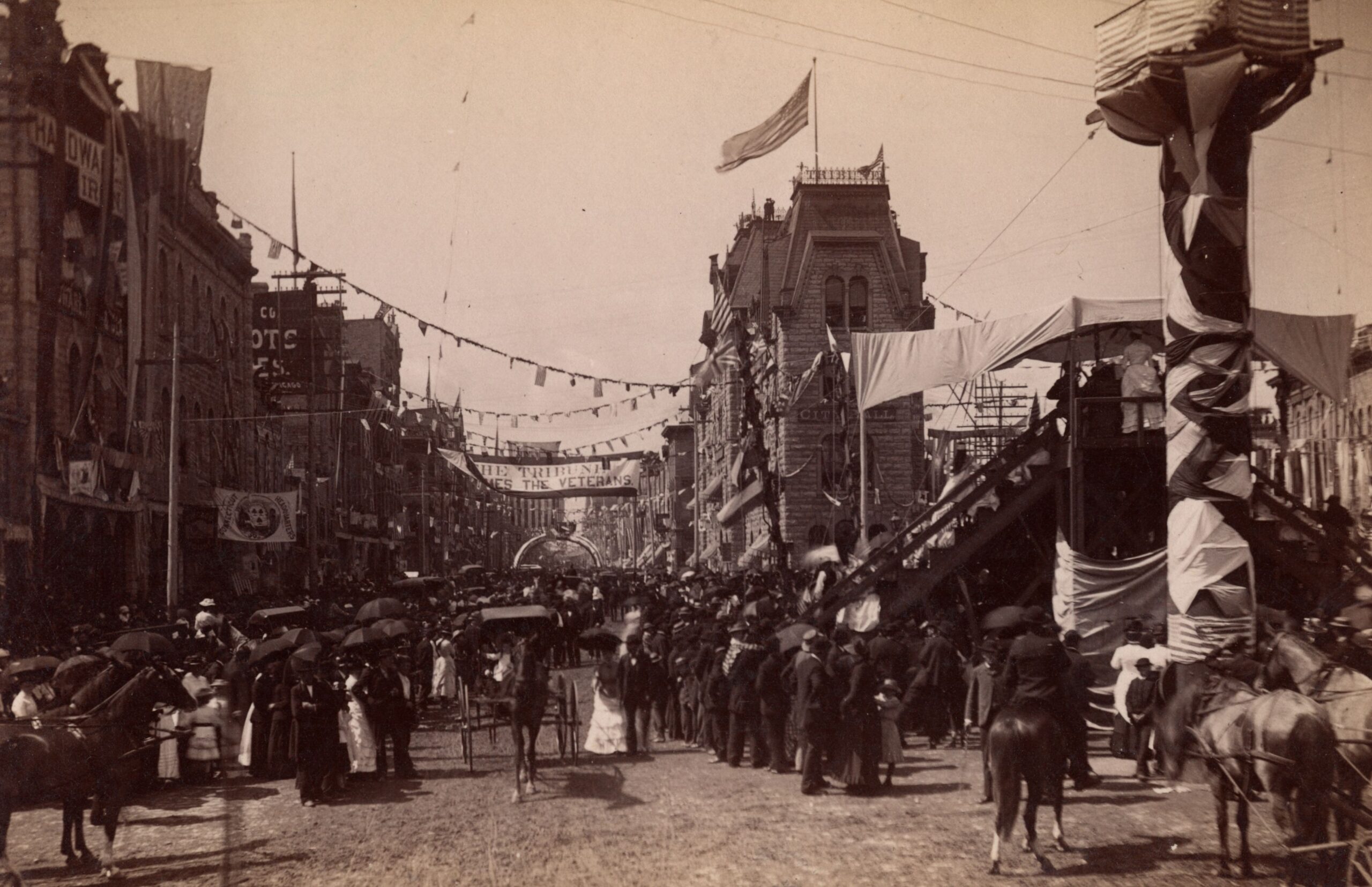
A crowd fills Bridge Square in Minneapolis for a parade on July 23, 1884, four years before the election bets. The old City Hall stands in the middle with its “City Hall” sign. Photo by Schlatman Bros., Hennepin County Library. Click the picture to see it full size.
Thirteen Mules and Two Signs
A week later, on Wednesday, November 28, Minneapolis saw its biggest payoff parade yet. John G. Swensen, the Globe teased, “labored under the hallucination that Cleveland was going to be elected.” So he “gracefully held the handles of a scraper,” while Charles Dahlberg, a Harrison man, “triumphantly rode.” A scraper was a big iron scoop that teams of animals dragged to move dirt for roads. The paper didn’t say if he was kin to M. D. Swensen.
Six mules pulled the scraper. Park Commissioner Johnson served as chief marshal, the boss of the parade, and rode a mule. Two more marshals on mules guarded the scraper “on either side.” Then came “a coal wagon drawn by four mules, filled with friends.” The mules wore ribbons, the Normanna band played, and the parade went from the court house to the city hall and back.
The best part was two signs. The winner wore one on his back that said: “I won, but I don’t crow.” The loser’s said: “I was whipped, but I don’t kick.” To crow is to brag, like a rooster. To kick is to complain, like a mule. Count them up and there were 13 mules in that parade, so the loser’s sign had plenty of company.
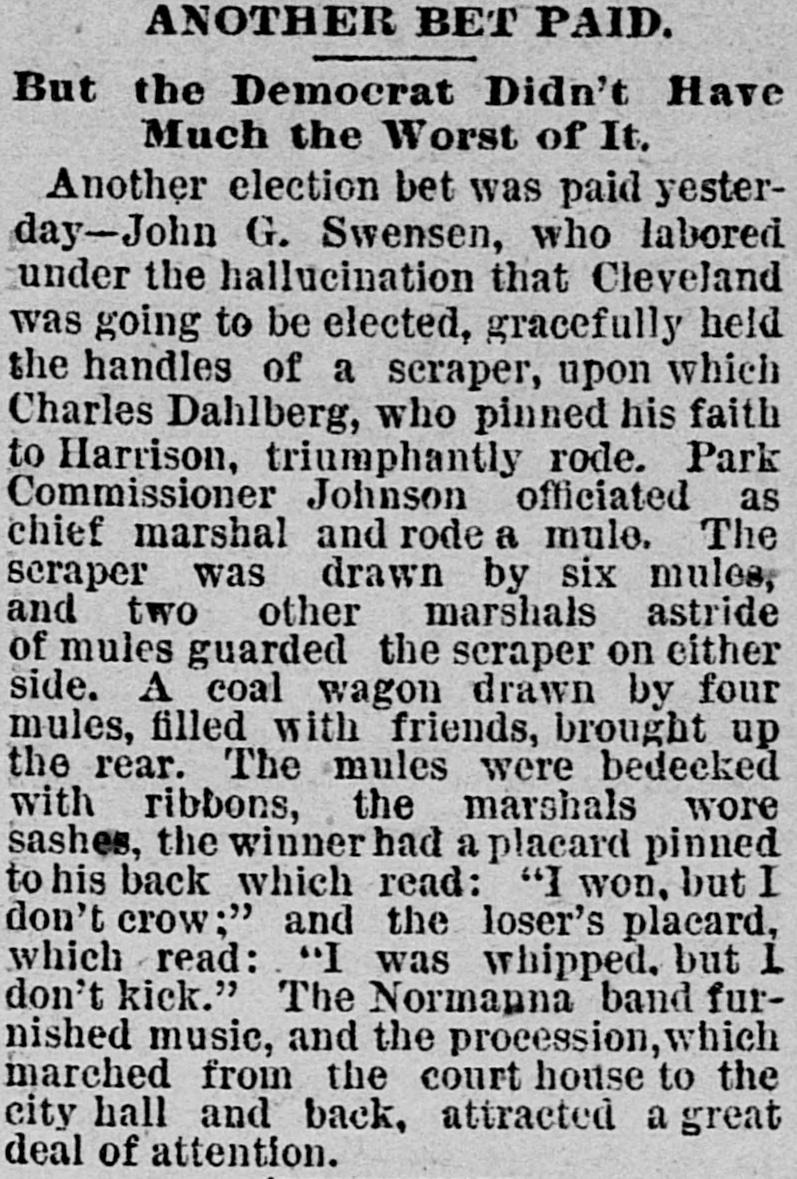
“Another Bet Paid: But the Democrat Didn’t Have Much the Worst of It,” St. Paul Daily Globe, November 29, 1888, page 3. Library of Congress, Chronicling America. Click the clipping to read it full size.
By the Numbers: Minneapolis, November 1888
- 1 dead rooster, carried on a Democrat’s back down Nicollet Avenue
- 1 live American eagle, held up high in a wheelbarrow
- More than 3 miles of wheelbarrow ride, most of it pulled by 1 pony
- 13 mules in one parade: 6 on the scraper, 4 on the coal wagon, 3 under the marshals
- 1 boot shine: a man the paper called “Free Trade” Kennedy was to black Stiles Gray’s boots on Wednesday, November 14, at 7 p.m. in front of the Adams school
The Paper That Scolded, Then Laughed
The St. Paul Daily Globe had a funny way of covering all this. On November 7, the day after the election, it ran a stern little editorial called “Election Bets.” It began: “The man who bet and lost is the one that will now lend a willing ear to a sermon on the evil of betting on elections.” It warned that by the next election the country would be “as much a nation of gamblers as it is to-day.”
Then, for the next few weeks, the same paper cheerfully reported every wheelbarrow, rooster, eagle and mule in Minneapolis. Bets like these were a habit all over the country. In 1908 a barber pushed a man in a silk hat through Hammond, Indiana, the same way.
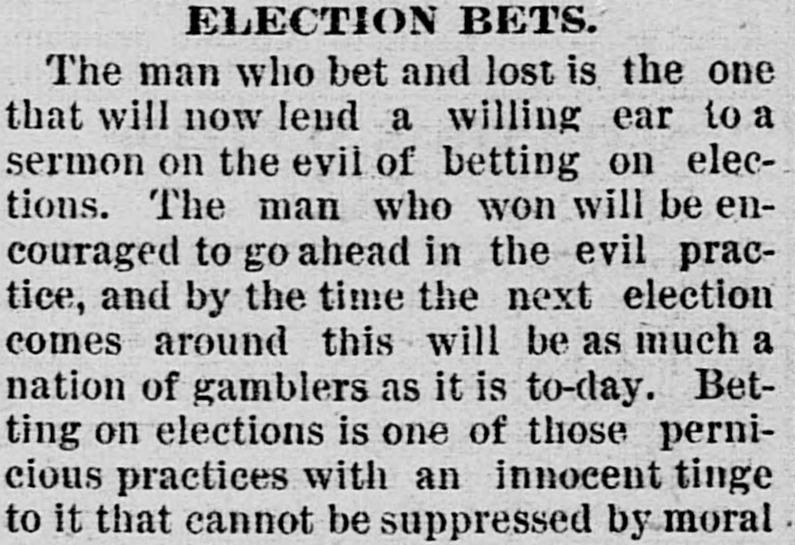
The Globe’s own sermon against election bets. St. Paul Daily Globe, November 7, 1888, page 4. Library of Congress, Chronicling America. Click the clipping to read it full size.
How It Ended in Minneapolis
When the Globe told about the pony ride, it added one more bet still owed. Herman Westphal, “the ice king,” was “to give Freeman P. Lane a ride. The date has not yet been fixed.” The paper never said when that ride happened, or whether John Conlair married May Voight before Christmas.
But it did print the best advice of the whole season, pinned to two men’s backs in a parade of mules. A hard election was over. One side had won and one had lost, and Minneapolis laughed about it together in the street. “I won, but I don’t crow.” “I was whipped, but I don’t kick.”
Sources
- “A Free Ride,” St. Paul Daily Globe (Saint Paul, Minnesota), November 22, 1888, page 3. Library of Congress, Chronicling America.
- “Election Bets: Victims Being Held to Their Agreements,” St. Paul Daily Globe, November 13, 1888, page 3. Library of Congress, Chronicling America.
- “Another Bet Paid,” St. Paul Daily Globe, November 29, 1888, page 3. Library of Congress, Chronicling America.
- “Election Bets” (editorial), St. Paul Daily Globe, November 7, 1888, page 4. Library of Congress, Chronicling America.
- “Republicans in Council,” St. Paul Daily Globe, October 16, 1888, page 4 (the Minneapolis Flambeau club in the Republican parade). Library of Congress, Chronicling America.
- Letter from Shiloh, W. Va., Ceredo Advance (Ceredo, West Virginia), October 31, 1888, page 2. Library of Congress, Chronicling America.
- “Democratic Meeting,” Alexandria Gazette (Alexandria, Virginia), October 25, 1888, page 2. Library of Congress, Chronicling America.
- Cover: Minneapolis City Hall in Bridge Square decorated for Exposition Week, photo by Arthur Rugg, dated 1886. Hennepin County Library, via the Digital Public Library of America and Wikimedia Commons. No Copyright, United States.
- Photo: Grand Army of the Republic Parade at Bridge Square, July 23, 1884, Schlatman Bros. Hennepin County Library, via the Digital Public Library of America and Wikimedia Commons. No Copyright, United States.
- City hall dates (built 1873, torn down 1912): Old Minneapolis City Hall at Bridge Square, Hennepin County Library record.
- The newspapers and photographs above were all published or made before 1931 and are in the public domain.