On Sunday night, April 18, 1920, a man named W. E. Butt wrapped himself in a buffalo robe and lay down to sleep in the cemetery in Viroqua, Wisconsin. He wasn’t sick. He wasn’t lost. He was going to earn $10, and he was going to prove he wasn’t afraid of ghosts.
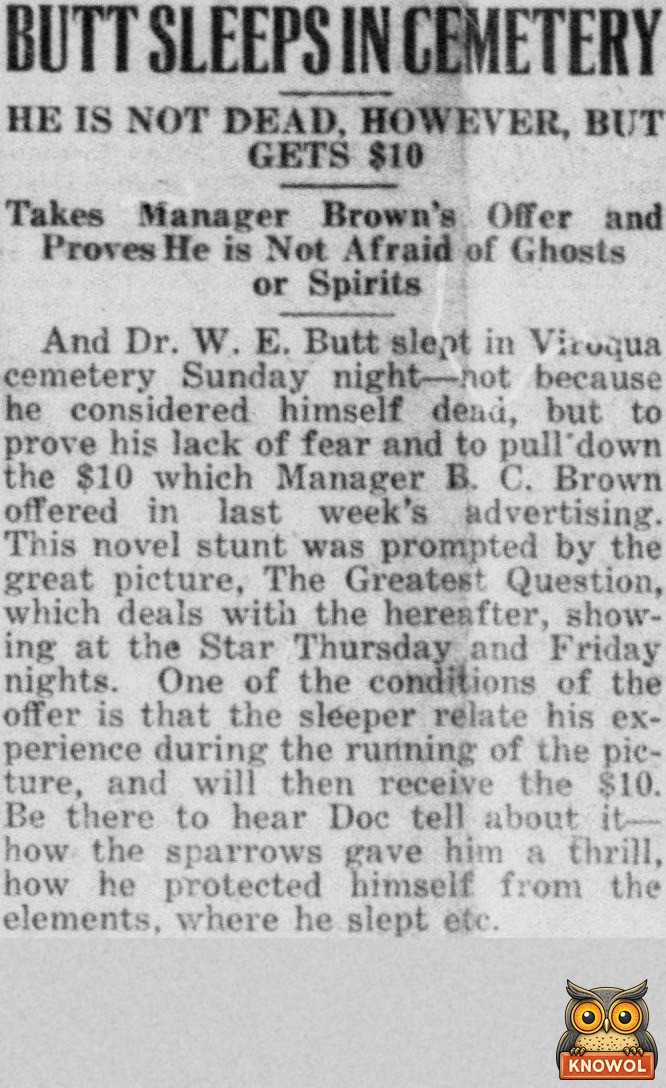
“Butt Sleeps in Cemetery.” Vernon County Censor, Viroqua, Wisconsin, April 21, 1920, page 1. Library of Congress, Chronicling America. Published 1920, public domain. Click the clipping to read it full size.
His home paper, the Vernon County Censor, put it on the front page three days later. The headline said it all: “BUTT SLEEPS IN CEMETERY.” And right under it, just so nobody worried: “HE IS NOT DEAD, HOWEVER, BUT GETS $10.”
A Movie House in Viroqua Makes a Dare
The dare came from the Star Theatre, the movie house in Viroqua. Viroqua was the county seat of Vernon County, a farm town in the hills of southwest Wisconsin. The Star’s manager, B. C. Brown, needed a way to get the whole town talking about his next picture.
On April 14, 1920, two little notes showed up among the store ads on the Censor’s front page. One said: “One night in a grave yard will make you famous, and earn $10. Apply Star Theatre.” The other was sneakier. “Do you believe in ghosts? Then you are liable to reject the liberal offer to anyone who will sleep alone all night in the grave yard, next Sunday, Monday or Tuesday.”
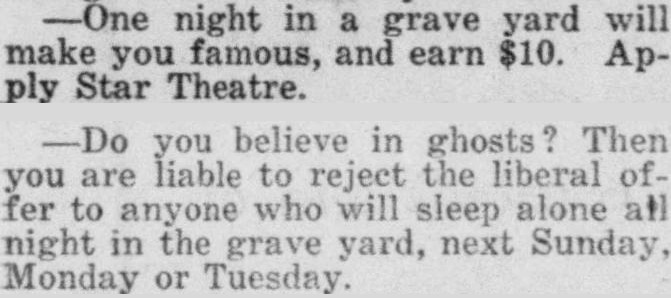
The Star Theatre’s two dares. Vernon County Censor, Viroqua, Wisconsin, April 14, 1920, page 1. Library of Congress, Chronicling America. Published 1920, public domain. Click the clipping to read it full size.
“Liable to reject” means you’d probably say no. “Liberal” meant generous. So the note was poking at the whole town: here’s easy money, unless you’re scared.
Why the Star Theatre in Viroqua Wanted a Ghost Story
The Star had a reason. The next week it was showing a movie called The Greatest Question, made by D. W. Griffith, one of the most famous movie directors of the day. The Censor’s April 14 front page also said “Lillian Gish coming at the Star next week.” She was one of the biggest stars of silent movies.
The Censor said the movie “deals with the hereafter,” which is an old word for what happens after you die. So a man who’d spend a night with the graves was the perfect way to sell tickets.
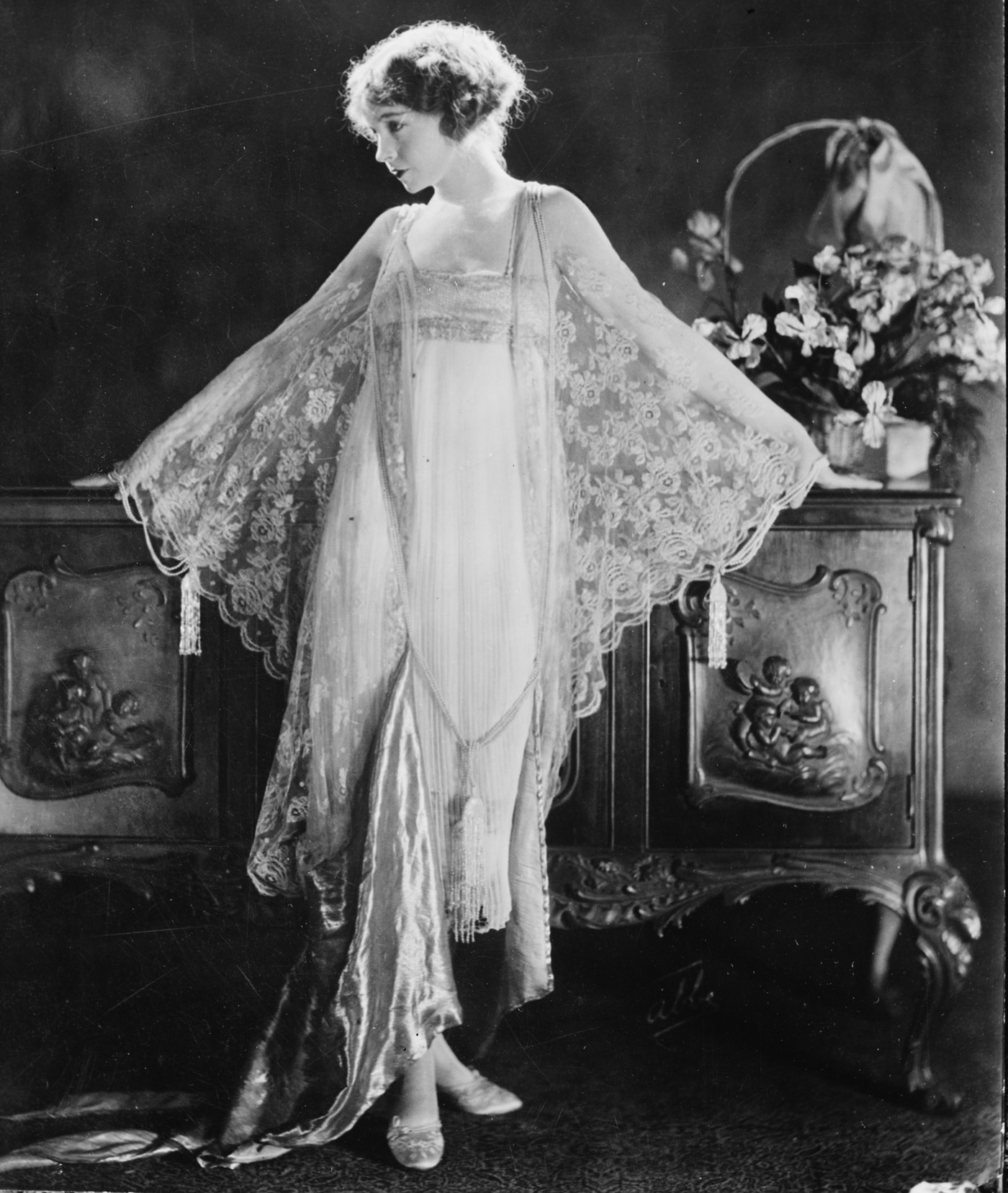
Lillian Gish, the movie star the Censor promised for the Star that week, photographed for the Bain News Service about 1920. Bain News Service, Library of Congress. Click the picture to see it full size.
Doc Butt Takes the Dare in Viroqua
W. E. Butt said yes. The Censor called him “Dr. W. E. Butt” and, in a friendlier mood, just “Doc.” He went out to the Viroqua cemetery on Sunday night, the first of the three nights the Star had named.
The paper said he slept there “not because he considered himself dead, but to prove his lack of fear and to pull down the $10 which Manager B. C. Brown offered in last week’s advertising.” To “pull down” money is old slang for earning it.
Doc didn’t sleep in a tent or a sleeping bag. He wrapped up in a buffalo robe. That was a big, heavy blanket made from a whole bison hide with the thick fur still on it. Families had used them for years to stay warm on cold rides in sleighs and buggies. The Grant County Herald, a weekly in Lancaster, Wisconsin, said he was “securely wrapped in a buffalo robe to keep out the chill of a spring night.” April nights in Wisconsin can drop near freezing, so that robe was smart.
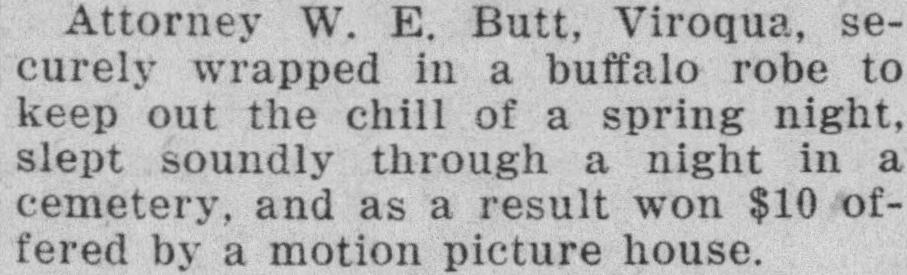
The buffalo robe. Grant County Herald, Lancaster, Wisconsin, May 5, 1920, page 7. Library of Congress, Chronicling America. Published 1920, public domain. Click the clipping to read it full size.
What Scared Doc Butt in the Viroqua Cemetery
No ghost made the paper. But something did. The Censor told readers to come hear “Doc tell about it,” including “how the sparrows gave him a thrill, how he protected himself from the elements, where he slept etc.”
Sparrows. Small birds tucked into the cemetery trees, rustling and fluttering in the night. To a man lying alone among the gravestones, a sudden flap of wings in the dark would sound a lot bigger than a sparrow. That’s the only scare the paper ever reported. “The elements” means the weather: the cold, the dew and the wind.
And by morning, he’d done it. The Herald said he “slept soundly through a night in a cemetery.”
The Star Theatre Puts Doc in the Ad
There was one more rule, and it was the clever one. Doc didn’t get paid at the cemetery gate. The Censor explained that “the sleeper relate his experience during the running of the picture, and will then receive the $10.” In other words, to collect his money, Doc had to stand up at the Star and tell the crowd about his night.
Manager Brown wasted no time. The same April 21 paper carried a big Star Theatre ad, and the top of it wasn’t the movie at all. It was “Doc Butt Sleeps in the Graveyard,” with “HE IS NOT AFRAID OF GHOSTS!!!!” underneath. Four exclamation points. Then a giant question mark.
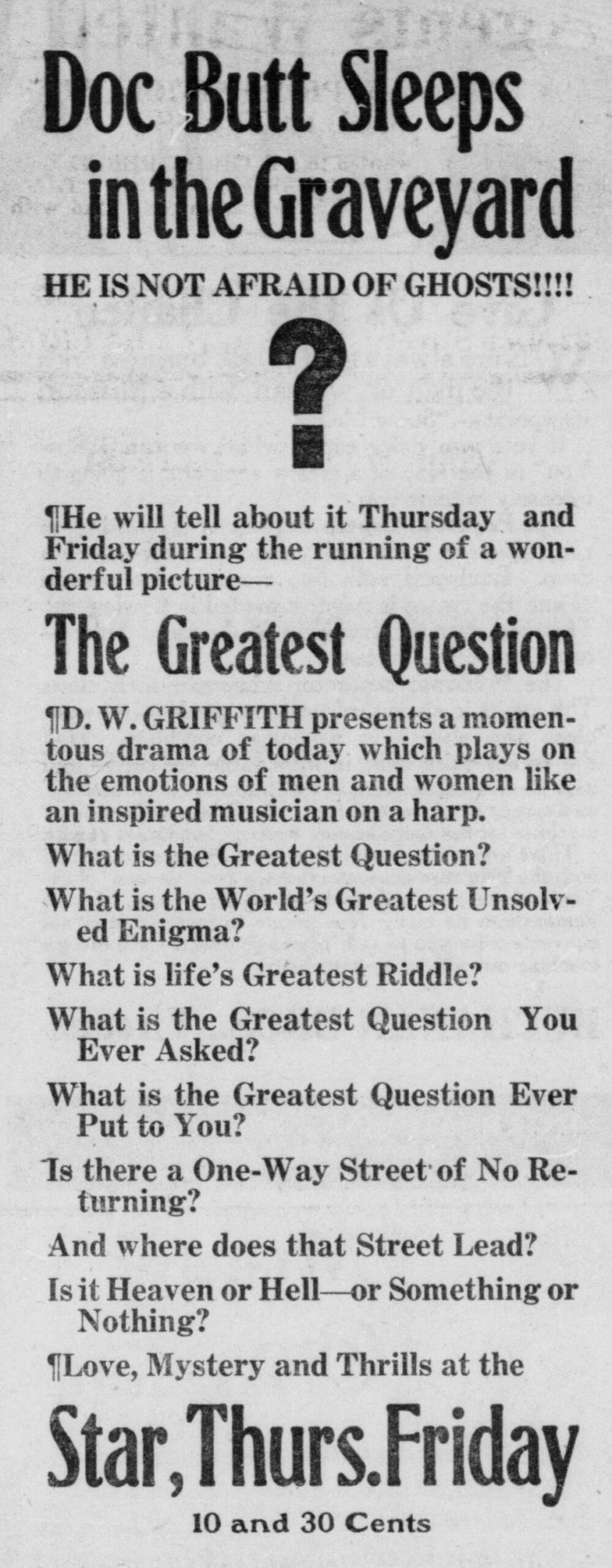
The Star Theatre’s ad, starring Doc Butt. Vernon County Censor, Viroqua, Wisconsin, April 21, 1920, page 5. Library of Congress, Chronicling America. Published 1920, public domain. Click the clipping to read it full size.
The ad promised that Doc “will tell about it Thursday and Friday during the running of a wonderful picture.” It asked big questions in big type, like “Is there a One-Way Street of No Returning?” Then it got down to business: “Love, Mystery and Thrills at the Star,” for “10 and 30 Cents.” A ticket cost a dime or 30 cents. Doc’s $10 was the same as 100 dime tickets.
How the Viroqua Graveyard Story Traveled
A good story never stays home. Ten days after Doc’s night, the news went out from La Crosse, Wisconsin, the nearest big city, and papers far away picked it up. On April 28, 1920, the Seattle Star in Washington State put it on its front page under a headline that was a joke all by itself: “PROBABLY USED ROBE FOR FEET.”
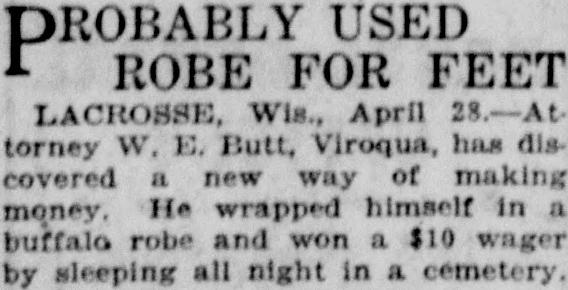
The story reaches Seattle. The Seattle Star, Seattle, Washington, April 28, 1920, page 1. Library of Congress, Chronicling America. Published 1920, public domain. Click the clipping to read it full size.
The Seattle paper said Doc “has discovered a new way of making money” and “won a $10 wager by sleeping all night in a cemetery.” That was more than 1,500 miles from Viroqua. Seattle readers didn’t know Doc. They just liked a man who called a dare’s bluff.
Somewhere along the way the story changed a little. The out-of-town papers, including the Seattle Star and the Herald in Lancaster, Wisconsin, called him “Attorney W. E. Butt,” a lawyer. His home paper called him “Dr.” Even the people who passed the story along weren’t sure who he was. They knew he had $10 and a buffalo robe.
What Doc Butt Said at the Viroqua Picture Show
The Star planned for Doc Butt to speak in Viroqua on Thursday and Friday, April 22 and 23, 1920. But the Censor never printed what he said. We looked at the next week’s paper and didn’t find a word about it. So what Doc said to that crowd, with the movie flickering behind him, is lost.
That might be the best part. Every person in that theater got a different version, told by a man standing in the light of the screen. Some heard about cold toes. Some heard about the sparrows.
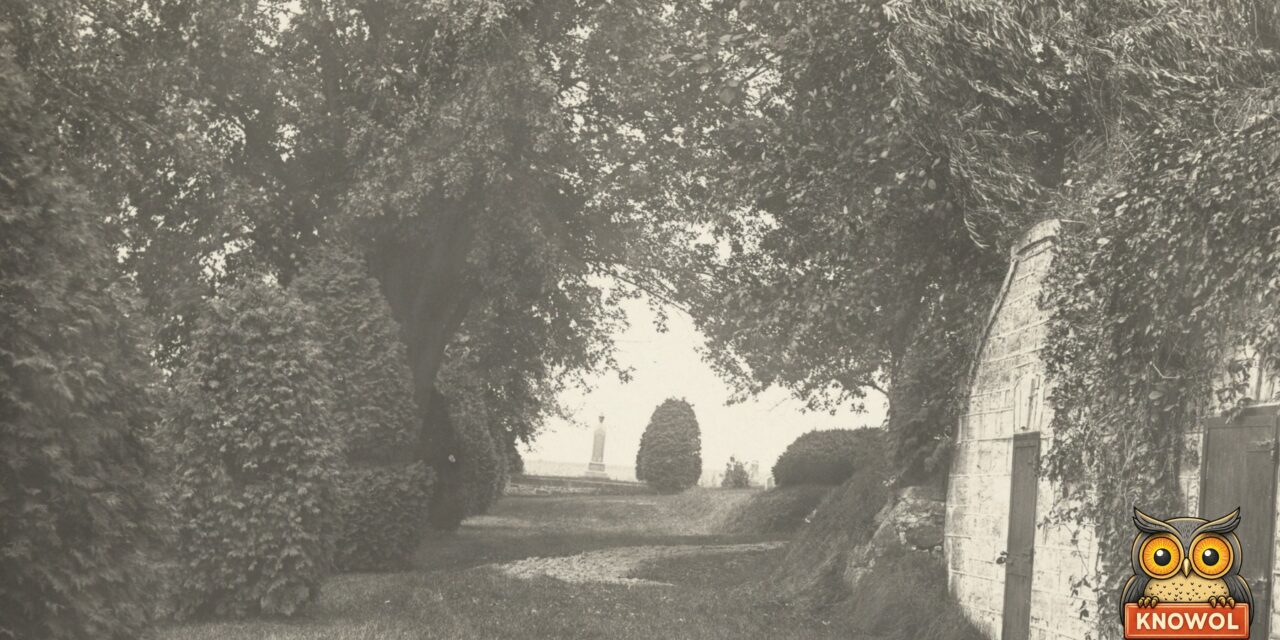
The picture at the top of this story isn’t the Viroqua cemetery. It’s a 1912 photo postcard called “Scene in the Cemetery, Mauston, Wis.,” made by the Northern Photo Co. of Wausau. Mauston, Wisconsin, is about 45 miles northeast of Viroqua. It shows the kind of quiet, tree-shaded country cemetery where Doc spent his night.
The Star Theatre got its crowd. The town got a story it could tell for years. And Doc Butt got his $10 the hard way, one sparrow at a time.
Sources
- “One night in a grave yard will make you famous” and “Do you believe in ghosts?” Vernon County Censor, Viroqua, Wisconsin, April 14, 1920, page 1. Library of Congress, Chronicling America
- “Butt Sleeps in Cemetery.” Vernon County Censor, Viroqua, Wisconsin, April 21, 1920, page 1. Library of Congress, Chronicling America
- Star Theatre ad, “Doc Butt Sleeps in the Graveyard.” Vernon County Censor, Viroqua, Wisconsin, April 21, 1920, page 5. Library of Congress, Chronicling America
- “Probably Used Robe for Feet.” The Seattle Star, Seattle, Washington, April 28, 1920, page 1. Library of Congress, Chronicling America
- Grant County Herald, Lancaster, Wisconsin, May 5, 1920, page 7. Library of Congress, Chronicling America
- Viroqua as the Vernon County seat: Wisconsin State Gazetteer and Business Directory, 1895-96, page 1039. Internet Archive
- Cover: “Scene in the cemetery, Mauston, Wis.,” photo postcard, Northern Photo Co., Wausau, Wisconsin, 1912. Library of Congress Prints and Photographs. Published 1912, public domain.
- “Lillian Gish,” Bain News Service. Library of Congress Prints and Photographs. No known restrictions on publication.
- Newspaper pages printed in 1920 are in the public domain.