
A town built between two lakes north of Boston, the old First Parish of Reading and then South Reading, which in 1868 took the name of Cyrus Wakefield, whose rattan works on the old mill stream once employed a thousand people.
Wakefield then and now
The same town 144 years apart. Click either map to look closer.
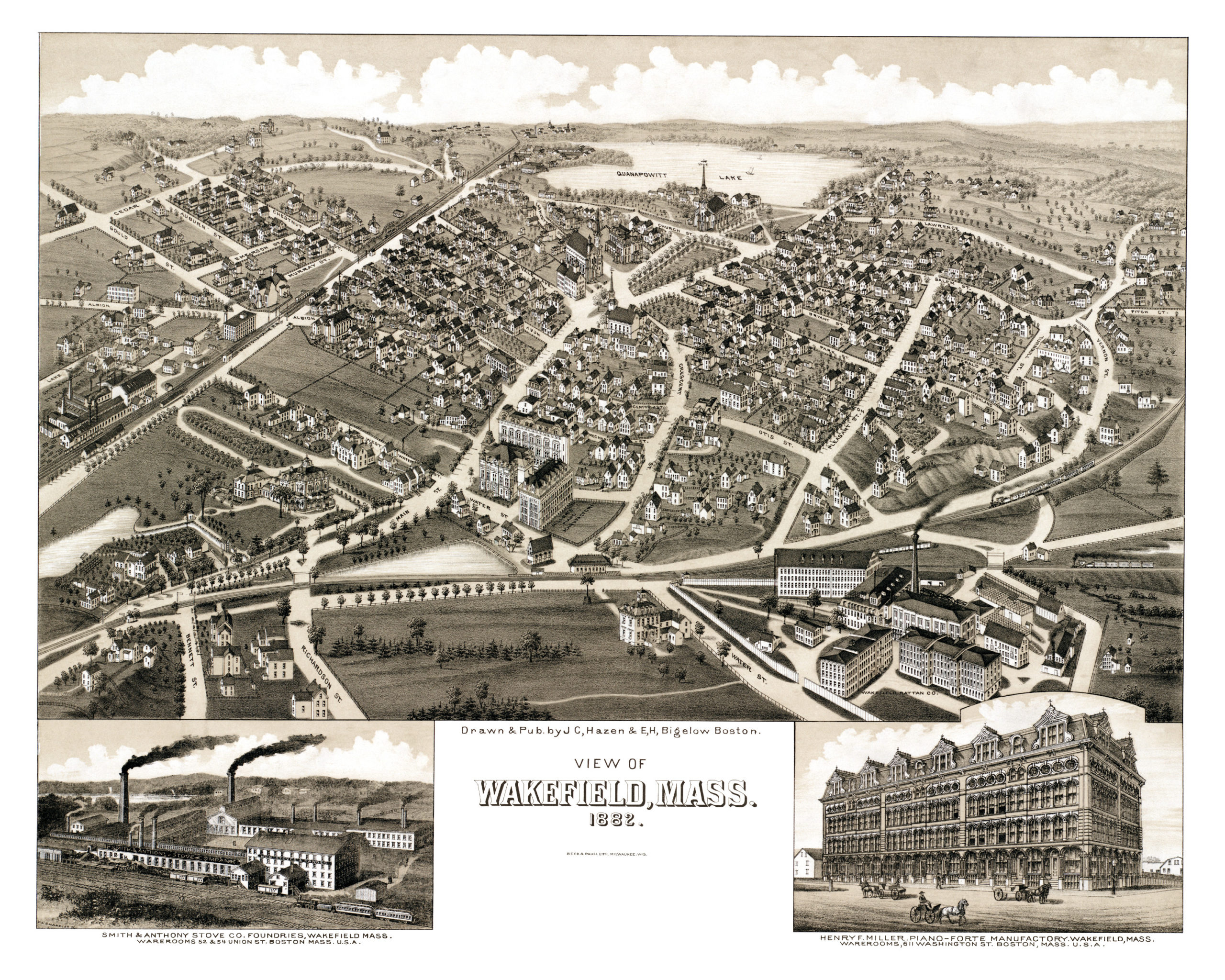
Wakefield in 1882
By J.C. Hazen
Wakefield as J.C. Hazen drew it in 1882, with its street names and old landmarks, among them Miller's Piano Factory, the Smith and Anthony Stove Company foundry, the Wakefield Rattan Company, Lake Quannapowitt and the Boston and Maine Railroad station.5
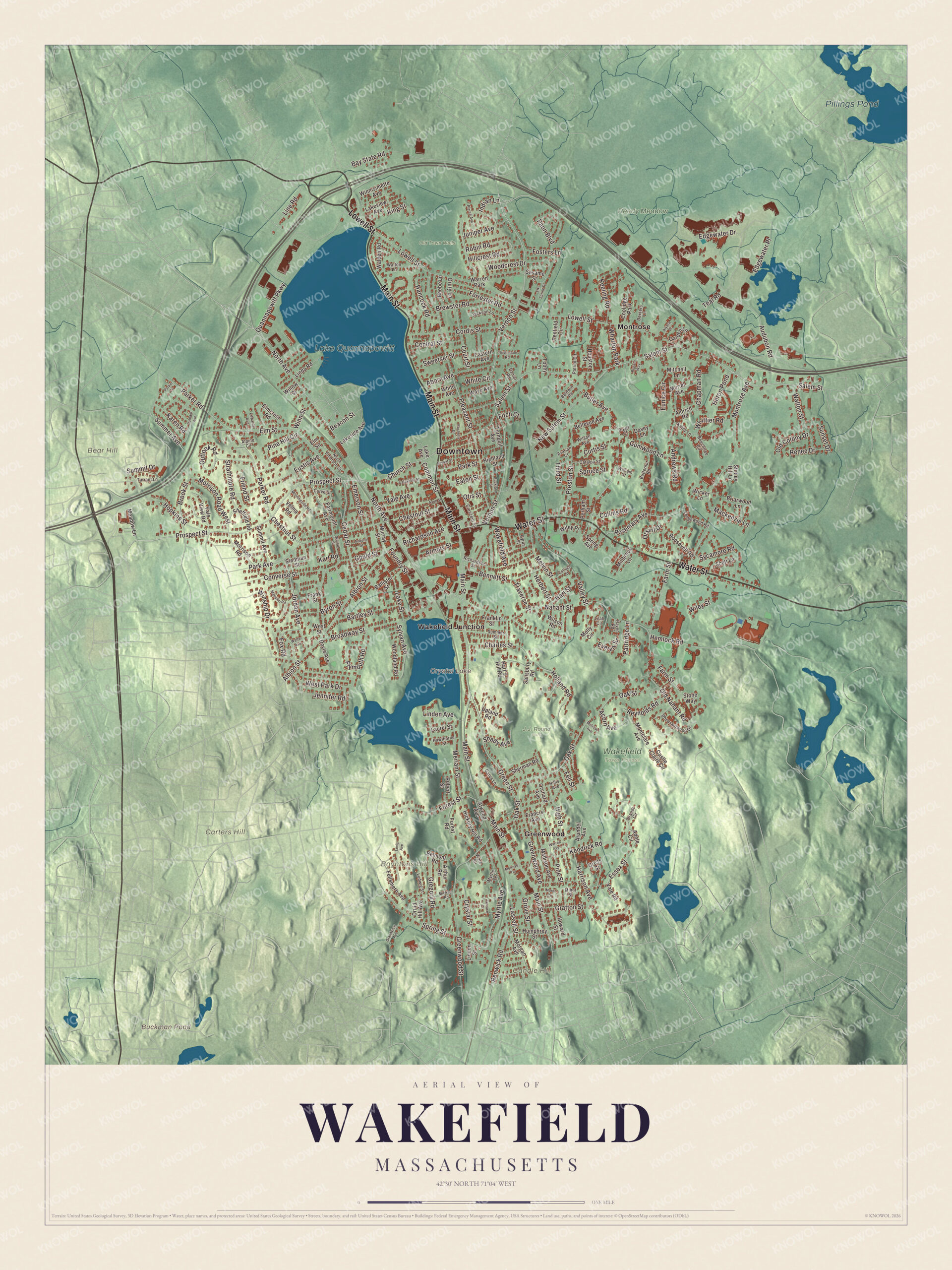
Wakefield today
By KNOWOL
Main Street, Water Street, Lowell Street, Salem Street, Vernon Street and Prospect Street from Downtown and Greenwood out to Montrose and Wakefield Junction, with Lake Quannapowitt, Crystal Lake, Buckman Pond, Pillings Pond, Reedy Meadow, Bear Hill, Boyntons Hill and Candle Hill named on the map.6
The history of Wakefield, Massachusetts
Winthrop, South Reading or Wakefield
Until 1812 this was the Old Parish of Reading, where the first settlers had built between the two lakes. It broke away as South Reading mostly over politics: the Old Parish was Republican and for the war with Britain, the other two parishes Federalist and against it. In 1846 a town meeting voted for a new name, and Winthrop led with 71 votes, but the Legislature let the petition drop. In 1868 Cyrus Wakefield offered the town a new town hall, and the voters answered by taking his name. On July 4 bells and cannon opened the day, dinner was served in a mammoth tent on the Common, there were races on the lake, and the night ended with fireworks. The hall was dedicated on February 22, 1871.78910
Rattan thrown off a ship
Cyrus Wakefield was a Boston grocer in 1844 when he saw rattan cane thrown off a ship as nearly worthless. He bought it, sold it for chair seats, and built a trade in cane from Canton. In 1856 he started his works on Water Street in South Reading, by the little Mill River where John Pool had run the town's first corn mill in 1644. He began with reeds for hoop skirts, then made chair seats, carpets and furniture, and he insisted on spelling it rattan, not ratan. Near the end of his life a thousand men and women worked in his factories. The company that followed made cradles, car seats, children's carriages and even burial caskets. He had hoped to found a college in Wakefield for the children of the poor.11212131
Black Hawk, the Yale and the Johnson pumps
The town's first fire engine, bought early in the 1800s, was called the Republican Extinguisher and lived in a little engine house in the old burying ground. Next came Black Hawk, a dark, homely tub kept in the basement of the old town hall. In 1852 the town bought a double-decker engine from Pawtucket, finished in rosewood and polished brass, and named it the Yale Engine for a big gift from Burrage Yale. Yale had first walked into town about 1810 as a barefoot tin peddler and ended up with a hundred peddlers on the road. In 1882 came a steam engine and sixty hydrants, and soon fifty little Johnson pumps sat in houses all over town. By 1927 Wakefield claimed to be the first town in the state with a fully motorized fire department.1415161718
Wakefield, Massachusetts through the years
24 moments from 1639 to today.
- 1639Settlers from Lynn start building homes between the two lakes, in what's called Lynn Village.19
- 1644Lynn Village becomes the town of Reading, with its first church and a corn mill.1
- 1690About this year the settlers start burying their dead in the Old Burial Ground by Lake Quannapowitt.20
- 1775On April 19 the First Parish alarm company marches to the fight at Merriam's Corner, with Reuben Eaton close behind.21
- 1790Elias Boardman builds a house on Salem Street so fancy that people call it Boardman's Folly.22
- 1805Thomas Emerson, twenty years old, starts the shoe business that becomes the town's leading firm.23
- 1812On February 25 the Old Parish of Reading becomes the town of South Reading.1
- 1829The Baptists build the South Reading Academy, later the town's high school.24
- 1844Cyrus Wakefield, a Boston grocer, buys a lot of rattan thrown off a ship and goes into the rattan trade.11
- 1845The railroad to Boston opens through town. A promoter had promised thirty passengers a day.25
- 1846A town meeting votes to rename the town Winthrop, but the Legislature lets the petition drop.8
- 1846Lakeside Cemetery is laid out on the west shore of Lake Quannapowitt and consecrated on October 15.26
- 1851Young men in the packing room of Thomas Emerson's Sons start the Richardson Light Guard.27
- 1852The town buys the Yale Engine, named for the tin dealer Burrage Yale.15
- 1856Cyrus Wakefield starts his rattan works, and the public library opens.1
- 1861On April 19 the old town bell rings at noon, and the Richardson Light Guard leaves for the war.28
- 1868South Reading becomes Wakefield and celebrates its new name on the Fourth of July.9
- 1871The town hall given by Cyrus Wakefield is dedicated on February 22.10
- 1873Cyrus Wakefield dies suddenly in his chair one Sunday morning; his Wakefield Rattan Company carries on.13
- 1882J.C. Hazen draws his map of Wakefield.5
- 1883Water from Crystal Lake starts flowing through pipes to Wakefield and Stoneham.29
- 1890Elizabeth E. Boit and Charles N. Winship bring the Harvard Knitting Mill from Cambridge.30
- 1902The Soldiers' Monument, a gift of Harriet N. Flint, is dedicated on June 17.31
- 1923The Lucius Beebe Memorial Library is dedicated on April 15.32
Places to see in Wakefield, Massachusetts
Places worth a visit in Wakefield today.
- Lake QuannapowittNorth of the center. Source of the Saugus River.
- Crystal LakeSouth of the center. Once Smith's Pond, town water since 1883.
- DowntownBetween the two lakes. The central village of the old parish.
- Water StreetEast of Main Street. Where the rattan works stood on Mill River.
- Salem StreetNortheast of the center. Home of Boardman's Folly, built 1790.
- Prospect StreetWest side. The West Ward School of 1847.
- Vernon StreetNorth, by the Saugus River. The Green House, among the oldest in town.
- GreenwoodSouth, toward Melrose. Had its own depot and chapel by 1890.
- MontroseEast, toward Lynnfield. Had a chapel, school and station by 1890.
- Wakefield JunctionNorth of the center. Where the railroad lines met.
Wakefield on the National Register of Historic Places
21 of the 91 places in Wakefield on the National Register of Historic Places that still stand today, oldest first, and why each one matters. See the full list of National Register places in Wakefield.4
-
Capt. William Green House
One of Wakefield's oldest buildings. Its oldest part is thought to have been built about 1680 in Lynnfield. William Green moved it here about 1750 and enlarged it, and his son Caleb moved it to this lot running down to the Saugus River in 1790. It was listed twice, under this name in 1989 and as the Green House in 1990.33
-
Samuel Gould House
Built about 1735 by Samuel Gould, whose family came here in the late 1600s, it is one of the oldest houses in Wakefield and the only one of its period left with a story-and-a-half gambrel roof.34
-
Michael Sweetser House
A Georgian timber-frame house built about 1755 by Michael Sweetser, an early settler of the area. Its front door surround was added in the Greek Revival years of the mid-1800s.35
-
Nathaniel Cowdry House
Built about 1764 by a member of the Cowdry family, early settlers of the town, it is one of Wakefield's oldest buildings.36
-
Woodward Homestead
Its story-and-a-half north side was probably built before 1765, when John Woodward is the first known occupant. The Greek Revival south part was added in the 1830s, so the house shows two styles side by side.37
-
E. Boardman House
Elias Boardman, a builder who had worked in Boston, put up this three-story Federal house in 1790. Its trim was so fancy for what was then a farming parish that people called it Boardman's Folly.22
-
Beebe Homestead
A Federal house overlooking Lake Quannapowitt, called one of Wakefield's most imposing landmarks. General Benjamin Brown sold the old Brown family farm in 1798, the house probably dates from the dozen years after, and it later became the home of Lucius Beebe, for whom the town library is named.38
-
South Reading Academy
Built in 1828 and 1829 by the Baptists as an academy and meetinghouse on Academy Hill, it became the town's public high school in 1847. It was moved here in 1891 and later housed a Grand Army of the Republic post, a Methodist congregation and the Fraternal Order of Eagles.24
-
West Ward School
Built in 1847, as the railroad brought new families to town, it is the only one of the town's four Greek Revival district schools still standing. A second-story classroom was added in 1858, children were taught here until 1998, and the local historical society now keeps it as a museum.39
-
Center Depot
A small hip-roofed station on Water Street, on the old line to Salem that served the Wakefield Rattan Company and the L. B. Evans shoe factory. It was made into a restaurant by 1962, and its outside was restored to the red and white colors of a 1917 postcard.40
-
Wakefield Upper Depot
The Boston and Maine built this Panel Brick station in 1889 to replace the old wooden depot, when the town had six stations and up to 60 trains a day. A fire gutted it in 1974, but its 16-inch brick walls survived and it was rebuilt by 1977.41
-
Elizabeth Boit House
Elizabeth Boit, co-founder of the Harvard Knitting Mills, built this English Cottage style compound of three stucco houses on Cowdry's Hill, designed by Wakefield architect Harland Perkins. She is believed to have been the only woman in a top executive job in the American textile industry in 1923, and she gave her workers health care and profit bonuses.42
-
Lakeside Cemetery Chapel
A stone chapel of 1913 in Lakeside Cemetery, built to look like an English country church, with a steep slate roof and buttressed walls. It is one of the few Neo-Gothic buildings in town.43
-
Massachusetts State Armory
Built by the state in 1913, two years after the town's 1894 armory on Main Street burned, it stands for a militia history that runs back to Reading's first company of 1644. The town took it over in 1975 and made it a community center.44
-
US Post Office-Wakefield Main
Built in 1936 as a Depression-era public works project, this brick and limestone Classical Revival post office stands on Main Street between the former YMCA and the Lucius Beebe Memorial Library.45
-
Church-Lafayette Streets Historic District
Church Street, just south of the lake, was laid out in the late 1600s and is lined with Federal period houses around its oldest, the Hartshorne House of about 1681. Lafayette Street, laid out in 1824, has Greek Revival houses from the 1830s.46
-
Deacon Thomas Kendall House
Federal on the outside, but its massive central chimney points to an older house, probably rebuilt with salvaged materials after a fire in 1786. It carries the name of Deacon Thomas Kendall, an early settler, selectman and deacon, whose wife Rebecca had 175 grandchildren and great-grandchildren by the time she died.47
-
Yale Avenue Historic District
Eight houses, most of them from the 1860s and 1870s, built largely for Boston businessmen after the railroad came. They mark the start of Wakefield's change into a suburb.48
-
Common District
The town common just south of Lake Quannapowitt has been the civic and religious center of the community since Old Reading set it aside in the 1640s. The 25-acre district takes in the churches around it, among them the Universalist church of 1839, the Lucius Beebe Memorial Library of 1923, the 1936 post office, and a Town Hall that was built as a high school and restyled in 1938.49
-
Wakefield Park
J. S. Merrill laid out Wakefield Park in 1888 on old farmland west of the center, with deed rules to keep it a neighborhood of fine homes, and in the 1890s it was sold as a healthy garden suburb. The district keeps sixteen of its properties on Park Avenue and nearby.50
-
Breakheart Reservation Parkways-Metropolitan Park System of Greater Boston
The roads of Breakheart Reservation, a 652-acre state park shared with Saugus. The state bought the old Breakheart Hill Forest in 1934, the Civilian Conservation Corps built its roads and trails, and it opened to the public in 1936.51
Wakefield in their words
“It lies as if at rest in the heart of a vast amphitheatre, for it is nearly surrounded by hills and has two beautiful lakes”
Massachusetts of today, 189252
“Our invitation is, 'Come, dwell In Wakefield, and be blest!'”
The poem for the day South Reading became Wakefield, July 4, 1868, as printed in the History of Middlesex County, 188053
“A centre of intelligence, virtue and enterprise, a place of beauty, a city of homes.”
Chester W. Eaton, History of Middlesex County, 1890, on what Wakefield hoped to be54
Towns near Wakefield, Massachusetts
Sources for the history of Wakefield
- Wakefield, Massachusetts, Wikipedia
- History of Middlesex County, Massachusetts (1890), on the rattan works by Mill River, Internet Archive
- History of Middlesex County, Massachusetts (1890), on the town's Civil War soldiers, Internet Archive
- National Register of Historic Places listings in Wakefield, Massachusetts, Wikipedia
- Beautifully restored map of Wakefield, Mass from 1882, restored by KNOWOL
- Map of Wakefield, Massachusetts in 2026, KNOWOL
- History of Middlesex County, Massachusetts (1890), on why South Reading split from Reading in 1812, Internet Archive
- History of Middlesex County, Massachusetts (1890), on the 1846 vote for the name Winthrop, Internet Archive
- History of Middlesex County, Massachusetts (1890), on the new name and the celebration of July 4, 1868, Internet Archive
- History of Middlesex County, Massachusetts (1890), on the town hall dedicated in 1871, Internet Archive
- History of Middlesex County, Massachusetts (1890), on how Cyrus Wakefield got into rattan, Internet Archive
- History of Middlesex County, Massachusetts (1890), on what the Wakefield Rattan Company made, Internet Archive
- History of Middlesex County, Massachusetts (1890), on Cyrus Wakefield's plans and death, Internet Archive
- History of Middlesex County, Massachusetts (1890), on the early fire engines, Internet Archive
- History of Middlesex County, Massachusetts (1890), on the Yale Engine of 1852, Internet Archive
- History of Middlesex County, Massachusetts (1890), on Burrage Yale, Internet Archive
- History of Middlesex County, Massachusetts (1890), on the steam engine and the Johnson pumps, Internet Archive
- Middlesex County and its people; a history (1927), on the motorized fire department, Internet Archive
- History of Middlesex County, Massachusetts (1890), Chester W. Eaton's Wakefield chapter, on the first settlers, Internet Archive
- History of Middlesex County, Massachusetts (1890), on the Old Burial Ground, Internet Archive
- History of Middlesex County, Massachusetts (1890), on Reuben Eaton and April 19, 1775, Internet Archive
- E. Boardman House, Wikipedia
- History of Middlesex County, Massachusetts (1890), on Thomas Emerson's shoe business, Internet Archive
- South Reading Academy, Wikipedia
- History of Middlesex County, Massachusetts (1890), on the railroad and its passengers, Internet Archive
- History of Middlesex County, Massachusetts (1890), on Lakeside Cemetery, Internet Archive
- History of the Richardson Light Guard of Wakefield, Mass. (1901), on how the company began, Internet Archive
- History of Middlesex County, Massachusetts (1890), on April 19, 1861, Internet Archive
- History of Middlesex County, Massachusetts (1890), on the Crystal Lake water supply, Internet Archive
- History of Middlesex County, Massachusetts (1890), on the Harvard Knitting Mill, Internet Archive
- Middlesex County and its people; a history (1927), on the Soldiers' Monument, Internet Archive
- Middlesex County and its people; a history (1927), on the Lucius Beebe Memorial Library, Internet Archive
- Capt. William Green House, Wikipedia
- Samuel Gould House, Wikipedia
- Michael Sweetser House, Wikipedia
- Nathaniel Cowdry House, Wikipedia
- Woodward Homestead, Wikipedia
- Beebe Homestead, Wikipedia
- West Ward School, Wikipedia
- Center Depot, Wikipedia
- Wakefield Upper Depot, Wikipedia
- Elizabeth Boit House, Wikipedia
- Lakeside Cemetery Chapel, Wikipedia
- Massachusetts State Armory, Wikipedia
- US Post Office-Wakefield Main, Wikipedia
- Church-Lafayette Streets Historic District, Wikipedia
- Deacon Thomas Kendall House, Wikipedia
- Yale Avenue Historic District, Wikipedia
- Common District, Wikipedia
- Wakefield Park, Wikipedia
- Breakheart Reservation Parkways-Metropolitan Park System of Greater Boston, Wikipedia
- Massachusetts of today: a memorial of the state, historical and biographical (1892), on Wakefield, Internet Archive
- History of Middlesex County, Massachusetts (1880), on the poem of July 4, 1868, Internet Archive
- History of Middlesex County, Massachusetts (1890), the close of the Wakefield chapter, Internet Archive