
A shoemaking town of hills and ledges nine miles north of Boston, once the far end of Charlestown, where Governor Winthrop named Spot Pond in 1632 and ate a lunch of nothing but cheese on Bear Hill.
Stoneham then and now
The same town 148 years apart. Click either map to look closer.
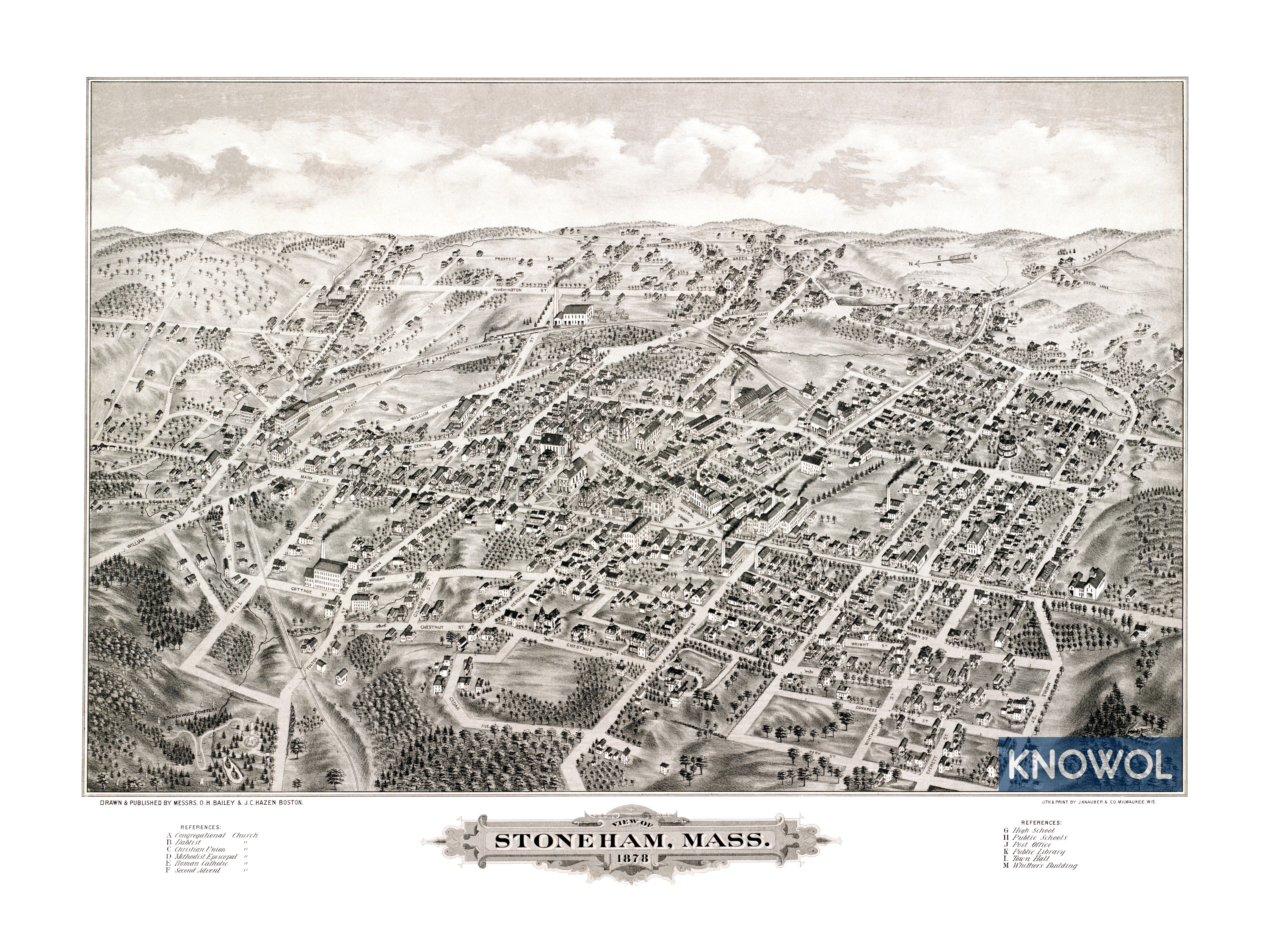
Stoneham in 1878
By O. H. Bailey and J. C. Hazen
A bird's eye view of Stoneham with its street names and old landmarks: the Town Hall, the Public Library, the Lowell and Nashua Railroad, Lindenwood Cemetery, Whittier's Building, the public schools and the town's churches.5
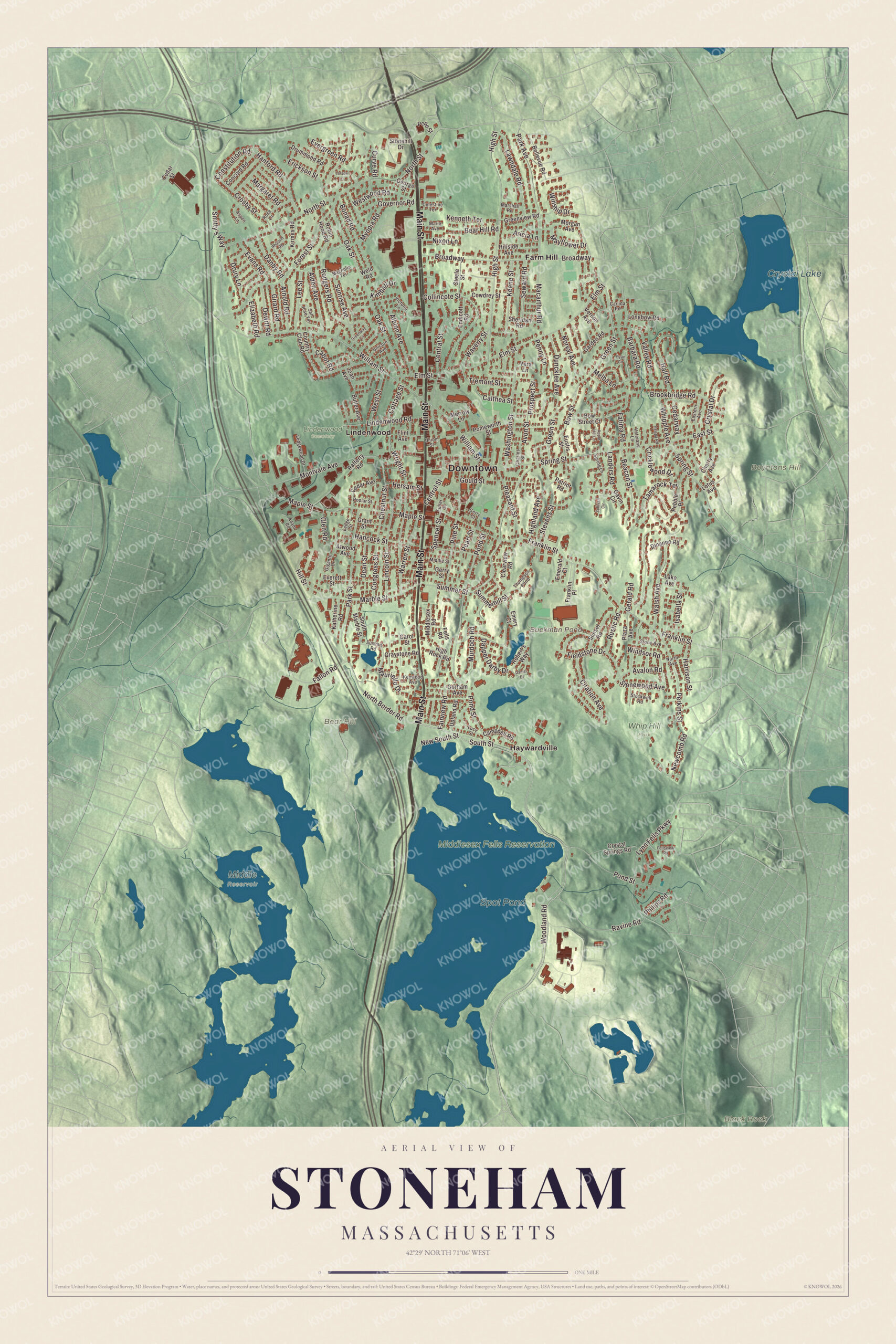
Stoneham today
By KNOWOL
Main Street, Woodland Road, South Street, Warren Street, William Street and Wright Street across town, with Spot Pond, Crystal Lake, Bear Hill, Farm Hill, Haywardville and Lindenwood, drawn from USGS elevation data and Census Bureau streets.6
The history of Stoneham, Massachusetts
Cheese Rock, wolves and the Spot Pond dam
On February 7, 1632, Governor Winthrop's party walked around a great frozen pond full of rocks and little islands and named it Spot Pond. Half a mile northwest they climbed a high rock to eat, but the governor's man had forgotten to pack the bread, so they had only cheese and called the place Cheese Rock. It's the north end of Bear Hill, which Silas Dean's 1843 history of the town says was named for the bears that lived there. Wolves ran here too. A settler named Gerry, caught out at dusk with an axe, braced against a tree, and next morning he found four dead wolves. Timothy Sprague dammed the pond to flood its meadows, and Jabez Allen kept rowing out to pull the dam apart. When Sprague came to stop him, Allen fired buckshot and wounded him.78910
The week they moved the town house
Stoneham built a town house in 1826, but as families settled closer to the turnpike, today's Main Street, the public buildings were left on the outskirts. On March 4, 1833, town meeting voted to move it. The other side called a new meeting for the 12th to undo the vote, leaving the movers seven days to buy a lot and move it. They scoured the country for oxen and gathered forty or fifty yoke. The ground was frozen and covered with snow and ice, so the house went on runners, and rum was handed out from inside to the crowd. Thomas Gould's apple trees were cut to make a straight path. The chains broke once, were mended, and the team pulled the house onto its new lot. On the 12th, the other side could only meet and go home.1112
A shoemaker's shop at every house
About 1804 Stoneham began making children's shoes, and within a few years it was the town's main work. Many farmers made shoes in the winter months, and for years a shoemaker's shop stood at almost every house. In the year ending April 1, 1837, a town of 932 people made 380,100 pairs worth $184,717, and more than half the people worked at it. By the custom of the time, shoemakers in North Malden, now Melrose, carried their finished shoes on their backs to Stoneham for pay and fresh stock. Luther Hill started making shoes at eighteen with twenty dollars. The 1891 town history says his firm, John Hill and Company, was the first to run shoemaking by power, first horses and then steam, and in 1858 it built the big factory that still stands at 426 Main Street.132141516
Stoneham, Massachusetts through the years
24 moments from 1632 to today.
- 1632Governor Winthrop's party names Spot Pond and eats a lunch of cheese on a height they call Cheese Rock, now Bear Hill.7
- 1634Colonists first settle here, in the far northern part of Charlestown.1
- 1692About now Patrick Hay, a Scot, moves to Charlestown End, where he becomes one of the largest landowners.17
- 1725The General Court sets Stoneham off from Charlestown on December 17.1
- 1726The first meetinghouse goes up, its lime burned from a marble pit near Bear Hill.18
- 1728Lieutenant Timothy Wright dies; his is the oldest dated stone in the Old Burying Ground.19
- 1748Hay, the Scot who first cleared the town center, dies in his 91st year.20
- 1775On April 19, Captain Samuel Sprague's company heads for Lexington, and a British bullet passes between Edward Bucknam's ear and skull.21
- 1792A snuff mill is built near the site of the later Hayward rubber works; it goes on to make satinet cloth.22
- 1804Town meeting votes $40 for bass viols to help the church singing, and about this time Stoneham starts making children's shoes.23
- 1812A mill on the later grounds of the Hayward rubber works begins grinding spices and medicines.24
- 1819Jacob Gould is killed by robbers at his home near Spot Pond on the night of November 25.25
- 1833Forty or fifty yoke of oxen drag the town house on runners to a new lot near the turnpike.11
- 1837A town of 932 people makes 380,100 pairs of shoes in a year.2
- 1840The meetinghouse burns during Sunday service on January 5; the church that still stands on Main Street is dedicated October 22.26
- 1858John Hill and Company build a large steam-powered shoe factory on Main Street.15
- 1861On April 19, Captain John H. Dike is shot leading the Stoneham Light Infantry through a mob in Baltimore.27
- 1861The Stoneham Branch Railroad opens as far as Farm Hill.28
- 1869The town puts up a granite soldiers' monument at Lindenwood Cemetery.29
- 1885Stoneham's 34 shoe factories employ about 1,300 people.30
- 1894Fanny Foster Tudor gives Virginia Wood, the first gift the Trustees of Public Reservations accepted, and the Middlesex Fells Reservation takes it in.31
- 1904The public library, paid for by Andrew Carnegie, is built at Main and Maple streets.32
- 1905The Middlesex Fells Zoo is founded; it is renamed the Stone Zoo in 1969.6
- 1916The brick fire station with its four-story hose tower is built off Central Square.33
Places to see in Stoneham, Massachusetts
Places worth a visit in Stoneham today.
- Spot PondSouth end, in the Fells. Named by Governor Winthrop in 1632.
- Bear HillSouthwest of the center. Winthrop's Cheese Rock of 1632.
- HaywardvilleSpot Pond Brook, south end. Named for the Hayward Rubber Works.
- Middlesex Fells ReservationSouth and west of town. State park around Spot Pond and Bear Hill.Visit their website
- Stone ZooPond Street. Opened in 1905 as the Middlesex Fells Zoo.Visit their website
- Old Burying GroundPleasant and William streets. The town burying ground since 1726.
- Central SquareMain and Central streets. Commercial hub framed by Second Empire blocks.
- John Hill's shoe factory426 Main Street. The town's first major factory, 1858.
- Fire stationCentral and Emerson streets. 1916 station, home of the Nine O'Clock Horn.
- Stoneham Public LibraryMain and Maple streets. Carnegie library built in 1904.Visit their website
Stoneham on the National Register of Historic Places
22 of the 67 places in Stoneham on the National Register of Historic Places that still stand today, oldest first, and why each one matters. See the full list of National Register places in Stoneham.4
-
Spot Pond Archeological District
Mill sites along Spot Pond Brook, in the Virginia Woods section of the Middlesex Fells, worked from the 17th century into the 19th. The Hayward Rubber Works stood here in the mid-1800s and gave the area the name Haywardville, and a park trail passes the remains.34
-
Jonathan Green House
A First Period house built about 1700 to 1720 and one of the oldest buildings in Stoneham. It began as a single room, and the space east of its chimney was used as a stable.35
-
Millard-Souther-Green House
Built about 1700, it is one of the oldest buildings in Stoneham, a two-story timber-frame house with an uneven four-bay front.36
-
Old Burying Ground
Established in 1726, it is the only surviving element of Stoneham's original town center, which also included a meeting house and school. It contains about 450 stones and fragments, with grave markers dating from 1728 to 1924.37
-
Locke-Baldwin-Kinsley House
Built about 1744 on Locke family land, this two-story timber-frame house has an ell on its south side that its early 19th-century owners used as a shoe shop.38
-
Elisha Knight Homestead
Built about 1750, it is the only house of its period in Stoneham that keeps a rural setting. Its decorated entry hood dates from a renovation of about 1870.39
-
First Congregational Church
The congregation was organized in 1729. This, its third meetinghouse, was built in 1840 after the second one burned, and it's a fine local example of Greek Revival architecture and a landmark of the town center.40
-
Warren Sweetser House
One of the finest Greek Revival houses in Stoneham, built in 1842 by Warren Sweetser on Main Street. It was moved here in 2003 after it was threatened with demolition.41
-
John Bottume House
Built about 1849, this granite house is the only survivor of about half a dozen summer houses built along the shore of Spot Pond. It now houses the visitors center of the Middlesex Fells Reservation.42
-
William Bryant Octagon House
Built in 1850, it is the best-preserved of three such houses built in the town in the 1850s. It was listed on the National Register of Historic Places in 1984.43
-
Shoe Shop-Doucette Ten Footer
A ten footer, the small backyard shop, about ten feet square, where New England shoemakers worked before the big shoe factories. It stands behind the Stoneham Historical Society and Museum at 36 William Street.44
-
Almshouse
Built in 1852, it is one of the few surviving buildings of this type in the Greater Boston area. It is now part of the Stoneham Senior Center, and was listed on the National Register of Historic Places in 1984.45
-
Central Square Historic District
Stoneham's commercial center grew up along the Andover-Medford Turnpike, now Main Street. The district takes in John Hill's 1858 shoe factory, the town's first major industrial building, the Second Empire Dow Block, Oddfellows Building and Chase Block, and the First Congregational and First Unitarian churches.16
-
Nobility Hill Historic District
A neighborhood of high quality houses around Chestnut and Maple streets and Cedar Avenue, a cross section of fashionable housing built between 1860 and 1920.46
-
Dow Block
Built in 1864, it is the first of three mid-19th century buildings that define Central Square, and is a fine example of Second Empire architecture. The building was listed on the National Register of Historic Places in 1984, and was included in the Central Square Historic District in 1990.47
-
Amasa Farrier Boardinghouse
Built about 1865 by Amasa Farrier, the town surveyor, as a boarding house for workers in Stoneham's shoe factories, it is the only boarding house of its time left in town.48
-
Oddfellows Building
Built in 1868, it is one of three Second Empire buildings that give downtown Stoneham its character, despite some exterior alterations. It was added to the National Register of Historic Places in 1984, and was included in the Central Square Historic District in 1990.49
-
Middlesex Fells Reservation Parkways
The roads inside and around the Middlesex Fells Reservation, one of the oldest parks in Greater Boston's Metropolitan Park System, created in 1894. Its border roads follow landscape designer Charles Eliot's idea that a park road should mark the park's bounds and give its neighbors pleasing views.50
-
Boston and Maine Railroad Depot
Built in 1895 by the Boston and Maine Railroad on the site of an 1863 station, it is one of two surviving train stations in town and the only one still where it was built.51
-
Middlesex Fells Reservoirs Historic District
It encompasses a portion of the Middlesex Fells Reservation, a state park managed by the Massachusetts Department of Conservation and Recreation (DCR). The principal features of the district are three reservoirs and their associated gate houses and pumping stations, which were developed by the Metropolitan District Commission (MDC, predecessor organization to the DCR) starting in the late 19th century.52
-
Stoneham Public Library
The library was founded in 1859. Its Classical Revival building of 1904, paid for with a $15,000 grant from Andrew Carnegie, is the heart of today's library at Main and Maple streets.32
-
Stoneham Firestation
The two-story red brick Renaissance Revival building was built in 1916, and continues to serve as the town's central fire station. Its most prominent feature is its four-story hose drying tower, which is reminiscent of Italian Renaissance-era towers.33
Stoneham in their words
“At Lexington she was in the vanguard of the army which founded the Republic. At Baltimore and Washington she led the hosts that saved the Union.”
William B. Stevens, History of Stoneham, 1891, on the town's soldiers of 1775 and 186153
“Tell the adjutant-general that I shall be at the state-house with my full command by eleven o'clock to-day.”
Captain John H. Dike to the governor's messenger, April 17, 1861, in History of Middlesex County, 188027
“We were a typical New England manufacturing town, just emerging from the country life of our grandfathers, commencing in a small way, and laying the foundations for a larger future.”
William B. Stevens, History of Stoneham, 1891, on the town after the Civil War54
Towns near Stoneham, Massachusetts
Sources for the history of Stoneham
- Stoneham, Massachusetts, Wikipedia
- A brief history of the town of Stoneham (1870), on the shoes made in 1837, Internet Archive
- History of Middlesex County, Massachusetts (1880), Stoneham chapter, on Stoneham's men in the Civil War, Internet Archive
- National Register of Historic Places listings in Stoneham, Massachusetts, Wikipedia
- Beautifully detailed map of Stoneham, MA from 1878, restored by KNOWOL
- Map of Stoneham, Massachusetts in 2026, KNOWOL
- History of Stoneham, Massachusetts (1891), on Governor Winthrop's visit and Cheese Rock, Internet Archive
- A brief history of the town of Stoneham, Mass., by Silas Dean (1870), on Bear Hill, Internet Archive
- A brief history of the town of Stoneham (1870), on Gerry and the wolves, Internet Archive
- A brief history of the town of Stoneham (1870), on Timothy Sprague's dam and Jabez Allen, Internet Archive
- History of Stoneham, Massachusetts (1891), on moving the town house in 1833, Internet Archive
- A brief history of the town of Stoneham (1870), on the town house of 1826, Internet Archive
- History of Middlesex County, Massachusetts (1880), Stoneham chapter, on the first shoemaking, Internet Archive
- Massachusetts of today (1892), on Levi S. Gould carrying shoes to Stoneham, Internet Archive
- History of Stoneham, Massachusetts (1891), on Luther Hill and John Hill and Company, Internet Archive
- Central Square Historic District, Wikipedia
- History of Stoneham, Massachusetts (1891), on Patrick Hay, Internet Archive
- History of Middlesex County, Massachusetts (1880), Stoneham chapter, on the marble pit, Internet Archive
- A brief history of the town of Stoneham (1870), on the oldest gravestone, Internet Archive
- A brief history of the town of Stoneham (1870), on the old Scotchman Hay, Internet Archive
- A brief history of the town of Stoneham (1870), on April 19, 1775, Internet Archive
- A brief history of the town of Stoneham (1870), on the 1792 snuff mill, Internet Archive
- History of Middlesex County, Massachusetts (1880), Stoneham chapter, on 1804, Internet Archive
- History of Middlesex County, Massachusetts (1880), Stoneham chapter, on the mills by the rubber works, Internet Archive
- History of Middlesex County, Massachusetts (1880), Stoneham chapter, on the Gould murder of 1819, Internet Archive
- History of Middlesex County, Massachusetts (1880), Stoneham chapter, on the meetinghouse fire of 1840, Internet Archive
- History of Middlesex County, Massachusetts (1880), Stoneham chapter, on Captain Dike and April 1861, Internet Archive
- History of Stoneham, Massachusetts (1891), on the street railroad and the Stoneham Branch, Internet Archive
- History of Middlesex County, Massachusetts (1880), Stoneham chapter, on the soldiers' monument, Internet Archive
- A gazetteer of the state of Massachusetts (1890), on Stoneham, Internet Archive
- Annual report of the Trustees of Public Reservations (about 1901), on Virginia Wood, Internet Archive
- Stoneham Public Library, Wikipedia
- Stoneham Firestation, Wikipedia
- Spot Pond Archeological District, Wikipedia
- Jonathan Green House, Wikipedia
- Millard-Souther-Green House, Wikipedia
- Old Burying Ground, Wikipedia
- Locke-Baldwin-Kinsley House, Wikipedia
- Elisha Knight Homestead, Wikipedia
- First Congregational Church, Wikipedia
- Warren Sweetser House, Wikipedia
- John Bottume House, Wikipedia
- William Bryant Octagon House, Wikipedia
- Shoe Shop-Doucette Ten Footer, Wikipedia
- Almshouse, Wikipedia
- Nobility Hill Historic District, Wikipedia
- Dow Block, Wikipedia
- Amasa Farrier Boardinghouse, Wikipedia
- Oddfellows Building, Wikipedia
- Middlesex Fells Reservation Parkways, Wikipedia
- Boston and Maine Railroad Depot, Wikipedia
- Middlesex Fells Reservoirs Historic District, Wikipedia
- History of Stoneham, Massachusetts (1891), on Stoneham at Lexington and Baltimore, Internet Archive
- History of Stoneham, Massachusetts (1891), on the town after the Civil War, Internet Archive