
A valley town on the French River where Huguenot refugees planted gardens around a stone fort in 1687, an army brigade camped on Camp Hill in 1799, and Clara Barton was born and laid to rest.
Oxford, Massachusetts on the map
Click the map to look closer.
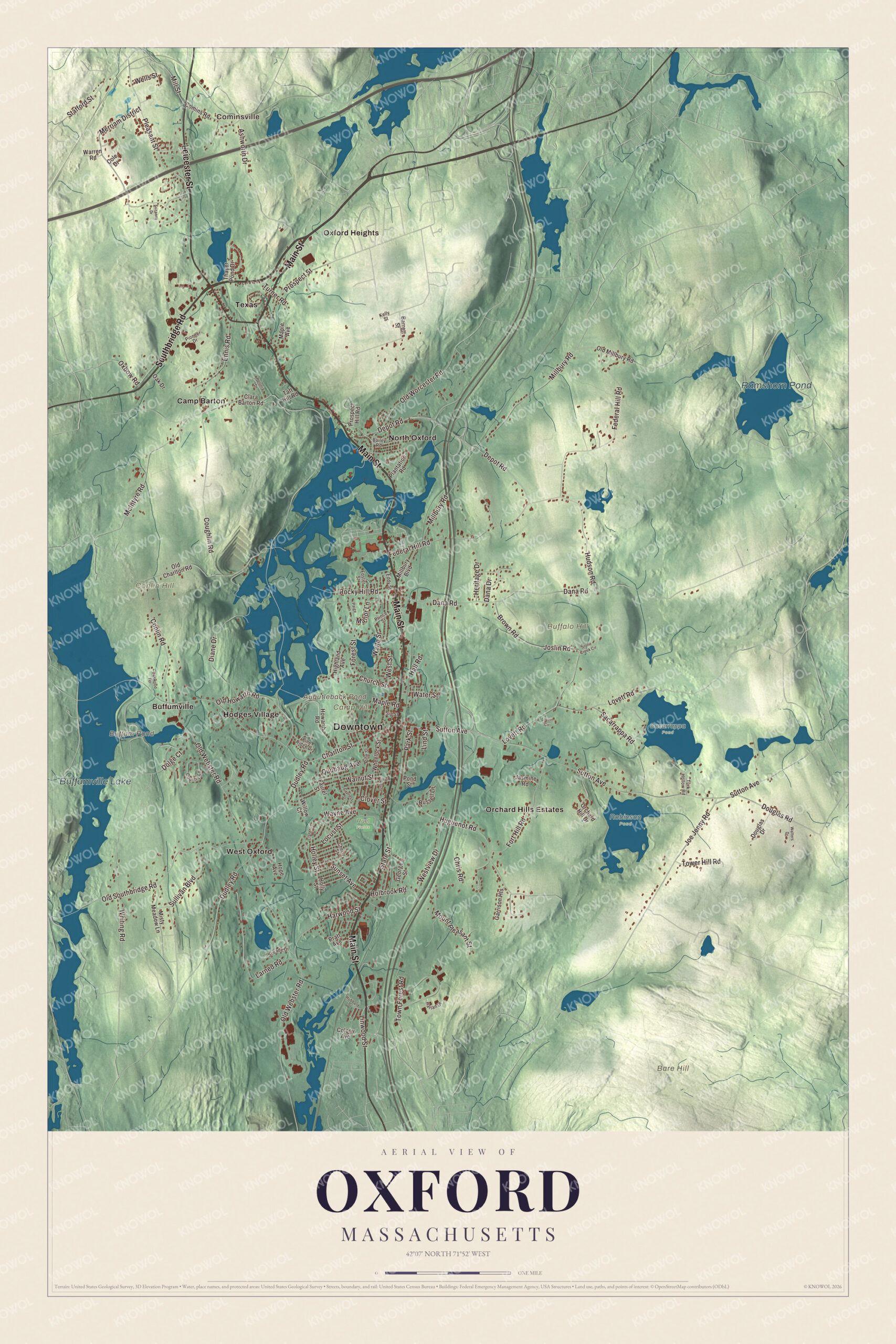
Oxford today
By KNOWOL
Main Street, Southbridge Road, Leicester Street, Linwood Street, Joe Jenny Road and Douglas Road, with Buffumville Lake, Buffum Pond, Ramshorn Pond, Bare Hill and Buffalo Hill, and the villages from Cominsville and Hodges Village to North Oxford and Texas, given the look of an old atlas.4
The history of Oxford, Massachusetts
The French gardens on Fort Hill
The French Protestants who settled Oxford in 1687 built their main fort on a hill southeast of today's village. An 1879 county history measures it at one hundred feet by seventy-five, of unhewn stone, around a house and a well. John Mayo, who later owned the farm on the hill, described a garden on its west side with asparagus, grapes, plums, cherries and gooseberries, and more than ten acres tilled around it. A mile east of Main Street, the dam of a Huguenot mill, some sixty feet long, still stood almost whole in 1880. The vines outlived the colony. In 1819 grapes, currants and roses nearly formed a hedge along the line of the fort, and in 1822 the poet Lydia Sigourney sent Rev. Abiel Holmes a leaf from the vine.5678
The summer the army camped on Camp Hill
In the fall of 1799, with war against France feared, regiments of the new Provisional Army gathered at Oxford under Col. Nathan Rice and camped on the high ground west of the village street. Officers made their headquarters at the taverns, and the rise has been Camp Hill ever since. When news came that George Washington had died, Rice held funeral honors here and invited the townspeople to take part. In June 1800, with the army being disbanded, Gen. Alexander Hamilton came to Oxford. He reviewed the brigade and gave its officers a dinner under a colonnade flying the national flag, and when they drank to Washington's memory, tears came to every eye. At seven the next morning he spoke to the troops, drawn up in a hollow square, for about half an hour.291011
Clara Barton comes home
Stephen Barton built a Cape-style house in the north part of town in 1818, and his daughter Clara was born there on Christmas Day, 1821. She taught for 11 years in schools in and around Oxford, cared for the wounded at Antietam and Fredericksburg, and in 1881 became president of the American branch of the Red Cross. When she died in 1912, she came home to Oxford by train and was laid to rest in the Barton lot in North Cemetery, overlooking the hills she had loved as a child. One tribute that year said she had long planned to be buried simply, without parade, in her native town. The next summer, during Oxford's two hundredth anniversary, the First Congregational Church dedicated a memorial window to her. Her birthplace has been a museum since 1921.1241314
Oxford, Massachusetts through the years
24 moments from 1674 to today.
- 1674About 60 Nipmuc people live at Manchaug, a praying town whose bounds take in present Oxford.1
- 1682Black James signs the deed that sells the land of present Oxford to Joseph Dudley, Robert Thompson and other investors.1
- 1687A group of 52 French Huguenots brought over by Robert Thompson begins the settlement.1
- 1690Gabriel Bernon's grist mill for the French settlers is finished.10
- 1694The Huguenots build their fort on Fort Hill.15
- 1696The first French settlement is abandoned after four of its people are killed.1
- 1704The second French settlement, begun in 1699, is abandoned during Queen Anne's War.1
- 1713English families settle for good and Oxford is incorporated as a town.1
- 1720About this year William Hudson builds the oldest part of the Hudson House.16
- 1771Josiah Wolcott sets a milestone at Sigourney corner, where the Sutton road meets the village street.17
- 1799Regiments of the army under Col. Nathan Rice camp on the hill west of the village, named Camp Hill ever after.2
- 1800Gen. Alexander Hamilton comes to Oxford, reviews the brigade and says farewell to the troops.11
- 1818Stephen Barton builds his house in the north part of town.12
- 1821Clara Barton is born there on Christmas Day.4
- 1826The Oxford Woolen Company buys the Nichols mill at what becomes Hodges Village, and its broadcloths win a name across the country.18
- 1845The North Oxford Optical Works is formed to make spectacles near the Texas mill site.19
- 1846George Hodges buys the woolen mill; by 1879 it turns out fifty thousand yards of flannel a month.18
- 1861The DeWitt Guards drill at Sanford's Hall before leaving for camp at Worcester in June.20
- 1873Memorial Hall, the town's memorial to its Civil War soldiers, is dedicated on November 19.21
- 1889Bartlett's Bridge, a granite arch, is built over the French River.22
- 1903The Charles Larned Memorial Library goes up on Main Street.23
- 1912Clara Barton is laid to rest in the Barton lot in North Cemetery.13
- 1913Oxford marks two hundred years with a pageant, and a memorial window to Clara Barton is dedicated.14
- 1959The Army Corps of Engineers builds the Hodges Village Dam on the French River.4
Places to see in Oxford, Massachusetts
Places worth a visit in Oxford today.
- Huguenot FortOff Huguenot Road. Stone remains of the French fort of 1694.
- Hudson HouseHudson Road. Believed to be Oxford's oldest building.
- Main StreetOxford Center. Route 12, the old village street.
- Clara Barton Homestead60 Clara Barton Road. Clara Barton's birthplace, a museum since 1921.Visit their website
- Barton Center for Diabetes EducationNorth Oxford. Summer camp for children with diabetes.Visit their website
- Bartlett's BridgeClara Barton Road. Granite arch over the French River, 1889.
- Hodges Village DamHodges Village. Flood control dam on the French River, 1959.
- Midstate TrailHodges Village. Long-distance footpath through the dam lands.Visit their website
- Buffumville LakeBuffumville. Managed with the Hodges Village Dam lands.
Oxford on the National Register of Historic Places
All 5 places in Oxford on the National Register of Historic Places that still stand today, oldest first, and why each one matters.3
-
Huguenot Fort
The remains of the fort the French Huguenot settlers built in 1694, off Huguenot Road and marked by a nineteenth-century monument. Lydia Sigourney's poem Huguenot Fort, published in 1845, is about this place.15
-
Hudson House
Part of this First Period house was probably built about 1720 by William Hudson, one of the first English settlers of Oxford, and it was later widened from three bays to five. It stayed in the Hudson family until about 1960 and is believed to be the town's oldest standing building.16
-
Oxford Main Street Historic District
The 95-acre historic center of Oxford along Main Street, mostly 19th-century Greek Revival houses. It takes in the John Wetherell Store of about 1817, the 1793 Universalist church, the 1829 First Congregational Church, the town hall, two schools and the 1903 Charles Larned Memorial Library.23
-
Clara Barton Homestead
Stephen Barton built this Cape-style house in 1818, and his daughter Clara, founder of the American Red Cross, was born here in 1821 and lived here until 1853. Since 1921 it has been a museum, restored to her years here, on the grounds of the Barton Center for Diabetes Education.12
-
Bartlett's Bridge
A granite arch built in 1889 to replace a wooden span, at the request of Edwin Bartlett, who owned the textile mills in North Oxford. He had asked for an iron truss, but the town chose stone, and Worcester masons finished it in six months for $2,200.22
Oxford in their words
“There are twenty village streets in Massachusetts as beautiful as ours, but very few, we think, can boast our hidden charms.”
Official program of Oxford's two hundredth anniversary celebration, 191324
“As we traced the ruins of the first rude fortress erected by our ancestors, the present seemed almost to yield in reality to the past.”
Lydia Huntley Sigourney after a visit to the Huguenot fort, in a letter printed in Abiel Holmes's memoir of the French Protestants of Oxford, 18268
“Her plan long ago was to be laid away in simplicity, without parade, in the hill on the edge of the wild-wood in her native Oxford in our old Commonwealth of Massachusetts.”
A tribute to Clara Barton printed in her memorial book, 191213
Towns near Oxford, Massachusetts
Sources for the history of Oxford
- Oxford, Massachusetts, Wikipedia
- History of the town of Oxford, Massachusetts (1892), on Camp Hill, Internet Archive
- National Register of Historic Places list, Wikipedia
- Map of Oxford, Massachusetts in 2026, KNOWOL
- History of Worcester County, Massachusetts (1879), on the Huguenot fort, Internet Archive
- The records of Oxford; including chapters of Nipmuck, Huguenot and English history (1894), on the French garden, Internet Archive
- The Huguenots in the Nipmuck country or Oxford prior to 1713 (1880), on the upper mill dam, Internet Archive
- A memoir of the French Protestants, who settled at Oxford, in Massachusetts (1826), on the vines at the fort and Lydia Sigourney's letter, Internet Archive
- The records of Oxford; including chapters of Nipmuck, Huguenot and English history (1894), on the army camp, Internet Archive
- Celebration of the Town of Oxford, Massachusetts, 1713-1913: official program (1913), on the army at Oxford and the rise of industries, Internet Archive
- History of the town of Oxford, Massachusetts (1892), on Alexander Hamilton's visit, Internet Archive
- Clara Barton Homestead, Wikipedia
- Clara Barton: memorial addresses and funeral tributes, at the main funeral in Oxford, Massachusetts (1912), Internet Archive
- Celebration of the Town of Oxford, Massachusetts, 1713-1913: official program (1913), on the Clara Barton window, Internet Archive
- Huguenot Fort, Wikipedia
- Hudson House, Wikipedia
- The records of Oxford, Mass. (1894), on the milestone at Sigourney corner, Internet Archive
- History of Worcester County, Massachusetts (1879), on Hodges Village and the Oxford Woolen Company, Internet Archive
- History of the town of Oxford, Massachusetts (1892), on the North Oxford Optical Works, Internet Archive
- History of the town of Oxford, Massachusetts (1892), on the DeWitt Guards, Internet Archive
- History of the town of Oxford, Massachusetts (1892), on Memorial Hall, Internet Archive
- Bartlett's Bridge, Wikipedia
- Oxford Main Street Historic District, Wikipedia
- Celebration of the Town of Oxford, Massachusetts, 1713-1913: official program (1913), on the town's hidden charms, Internet Archive