On Saturday, April 10, 1909, the day before Easter, somebody in Pensacola, Florida, paid a man the paper called Dr. Cushman with a half dollar. It looked just right. It had the right date, the right face and the right weight. It was a fake.
The next morning, Easter Sunday, the Pensacola Journal put it on page 3 under big black letters: “COUNTERFEIT HALF DOLLARS.” Counterfeit means fake money made to fool people. The paper said this one was “such a good imitation that it can be detected only by the ring when it is dropped on metal or a counter.”
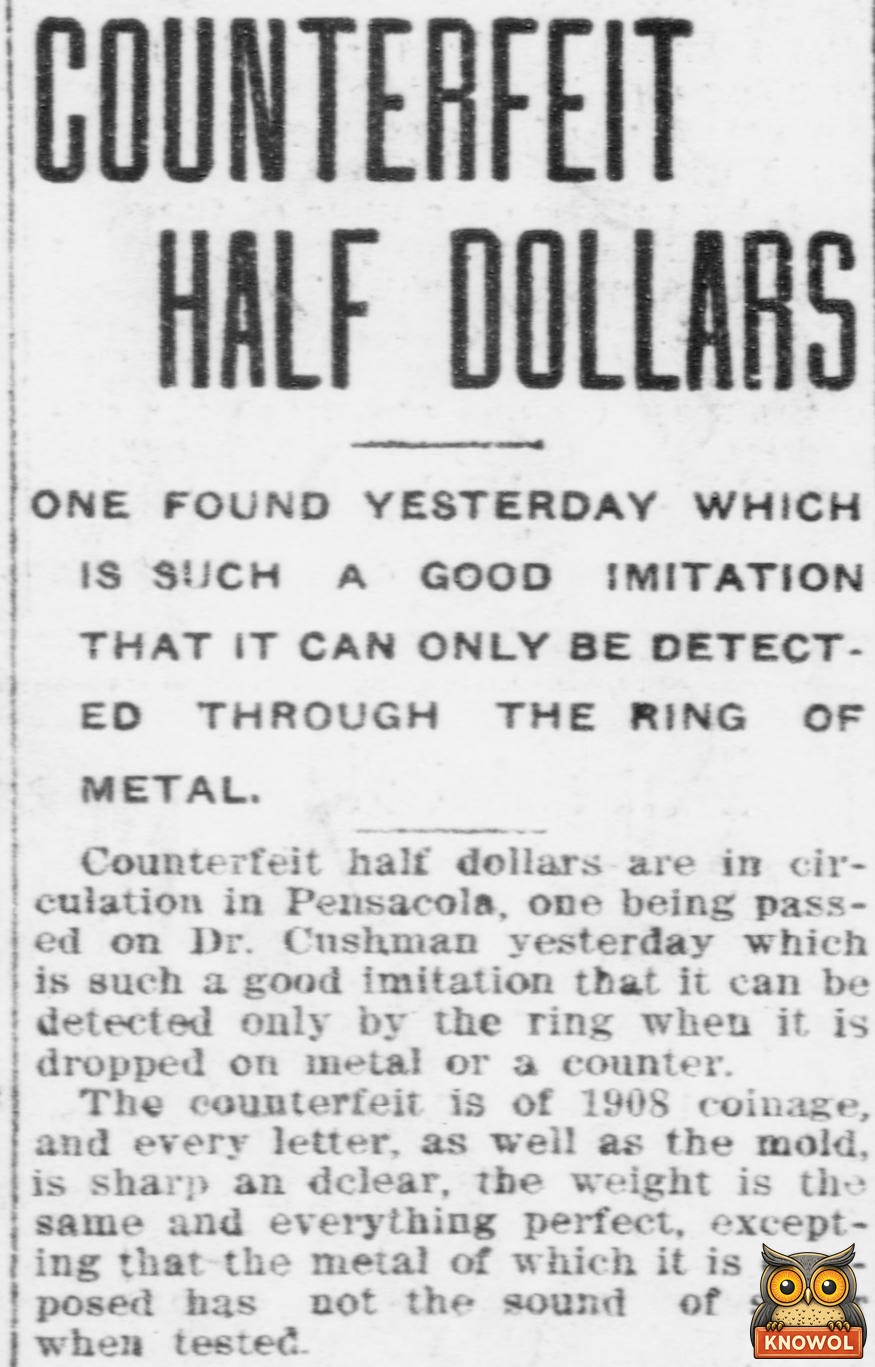
“Counterfeit Half Dollars.” The Pensacola Journal, Pensacola, Florida, Sunday, April 11, 1909, page 3. Library of Congress, Chronicling America. Click the clipping to read it full size.
A perfect fake, almost
The paper described the coin closely. It was marked 1908, the year it pretended to be made. Every letter “as well as the mold” was sharp. Nothing about its looks gave it away. Then came the one flaw: “the weight is the same and everything perfect, excepting that the metal of which it is composed has not the sound of silver when tested.” So the eyes said yes, and the ears said no.
A real half dollar in 1909 was a heavy silver coin, the same size as a half dollar today. It showed the head of Liberty on one side and an eagle on the other. It was made of nine parts silver to one part copper, and that silver is what made it sing.
How a coin could talk
Silver is hard and springy. Drop a silver coin on a hard counter and it shivers for a moment, like a tiny bell. You hear a clear, bright ring that hangs in the air. Cheaper metals, like lead, are soft. They swallow the shiver, so the sound dies right away in a dull clunk.
That’s why people in 1909 dropped coins on purpose. A clerk who wasn’t sure about a coin gave it a flip onto the counter and listened. It was a test you could do in one second, with no tools at all.
A writer named Drake Watson put it plainly in the Columbus Journal of Columbus, Nebraska, that same April. “You would not accept a lead dollar, simply because it was new and bright,” he wrote, because “its dull tone as it dropped on the counter would prove it counterfeit, and worthless, except as a material for bullets, sinkers and lead pipe.” Sinkers are the little weights that pull a fishing line down into the water.
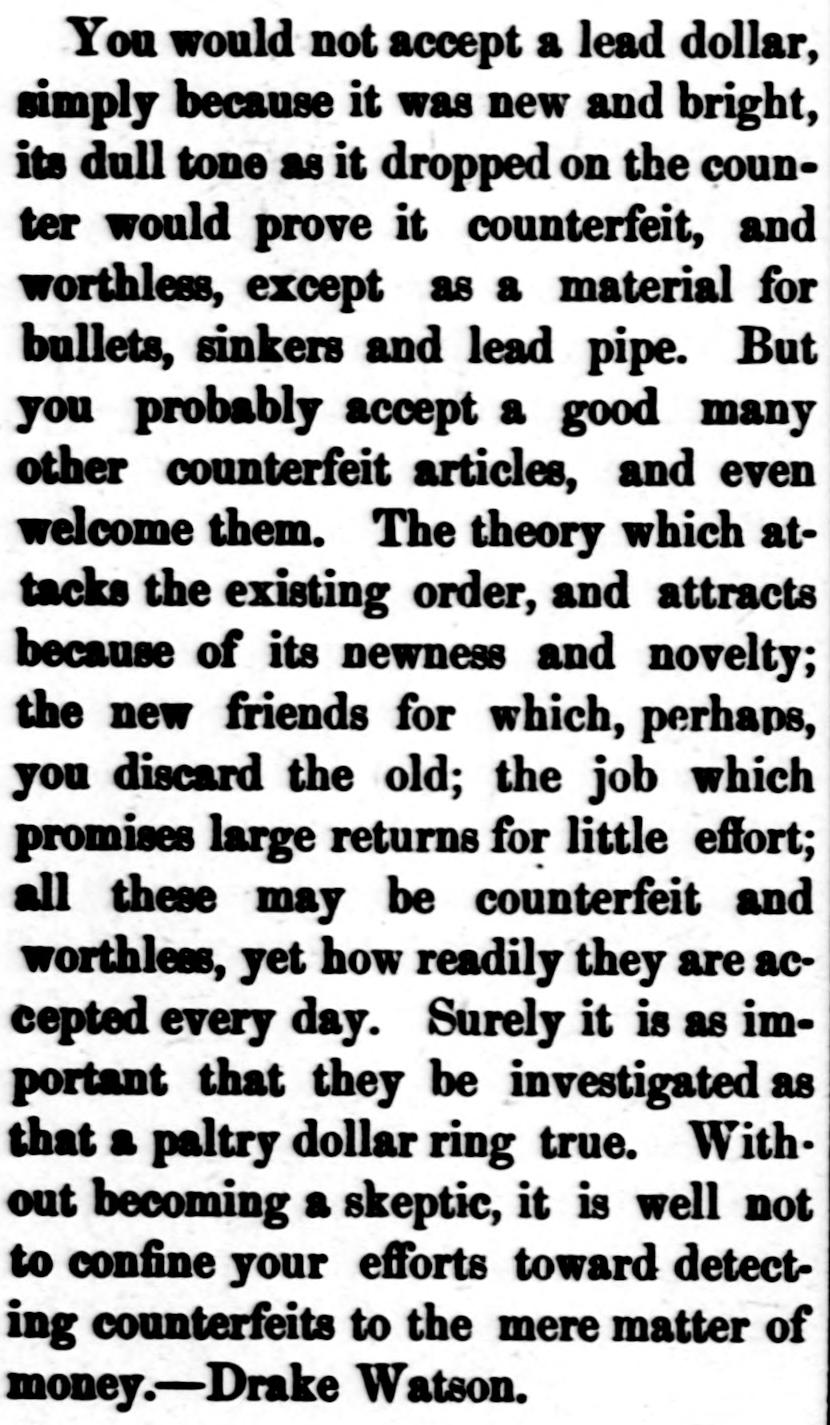
“Its dull tone as it dropped on the counter would prove it counterfeit.” The Columbus Journal, Columbus, Nebraska, April 28, 1909, page 4. Library of Congress, Chronicling America. Click the clipping to read it full size.
Other towns listened too
Pensacola wasn’t alone. In January 1909, in Bisbee, Arizona, the ticket seller at the Royal Theatre caught a fake quarter by accident. The Bisbee Daily Review said the ticket seller “happened accidentally to drop one of them upon the cement walk. The ring of the piece did not sound quite true, and examination was made.” The coin was made of a soft alloy, which means a mix of metals, and “in everything but the ring resembled the best of silver.” City Marshal Stevens was told, and he started watching for whoever was passing them.
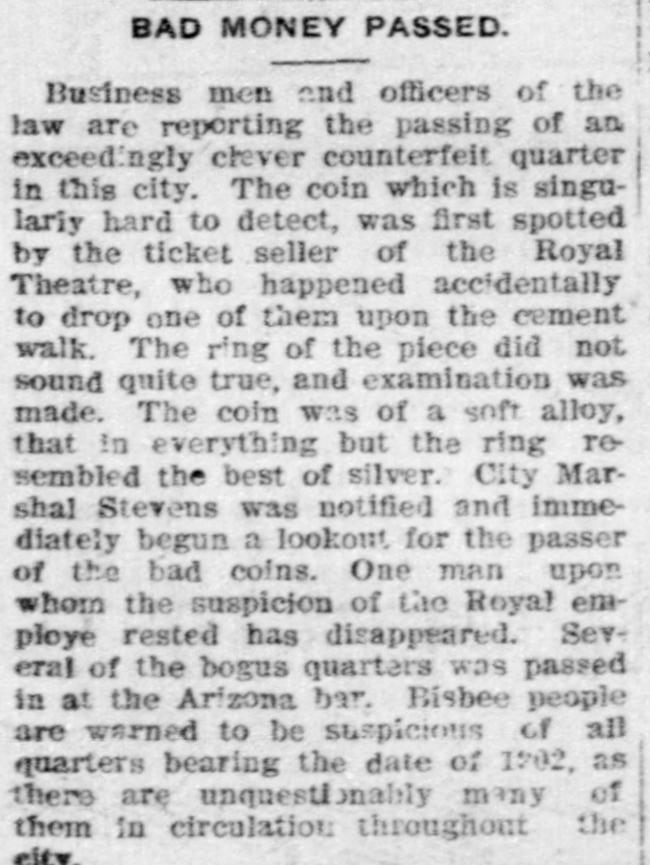
“Bad Money Passed.” The Bisbee Daily Review, Bisbee, Arizona, January 31, 1909. Library of Congress, Chronicling America. Click the clipping to read it full size.
In June 1909, store owners and bankers in Cheyenne, Wyoming, were warned about another fake half dollar. The Buffalo Voice of Buffalo, Wyoming, passed along the warning. “It is dated 1899 and has no mint mark,” the paper said. “The only way the general public can detect it is by the ring, which sounds much like a piece of glass.”
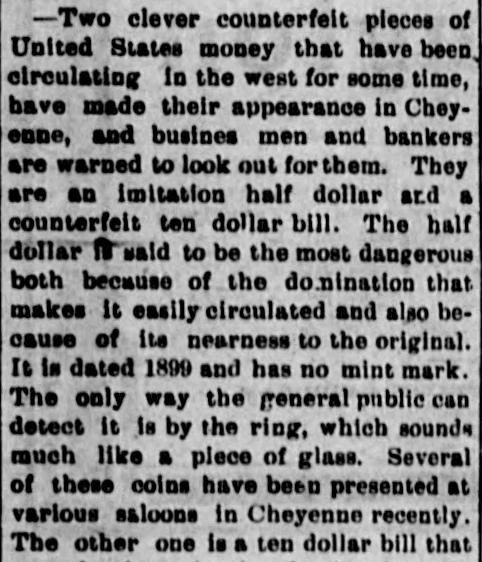
“Sounds much like a piece of glass.” The Buffalo Voice, Buffalo, Wyoming, June 19, 1909, page 3. Library of Congress, Chronicling America. Click the clipping to read it full size.
The strangest ring of the year came from England. A shopkeeper in the town of Sandwich took in a penny dated 1903. When he tried to spend it, the penny “was thought by its ring to be counterfeit.” So the owner broke it open. He “discovered to his astonishment that it contained a sixpence of the same date.” A small silver coin had been hiding inside a big copper one. The story ran in the Brownsville Daily Herald in Brownsville, Texas, in March 1909, under the headline “Finds Coin Within a Coin.”
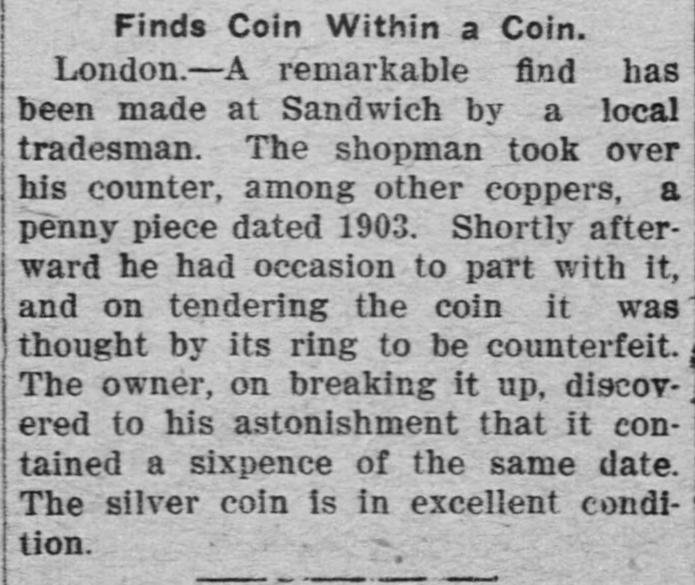
“Finds Coin Within a Coin.” The Brownsville Daily Herald, Brownsville, Texas, March 27, 1909. Library of Congress, Chronicling America. Click the clipping to read it full size.
What a half dollar bought in Pensacola
Fifty cents was real money in 1909, and that same page of the Pensacola Journal shows it. McMillan’s store had a Monday sale on ladies’ gauze vests “at 6 1-4 cents apiece,” so a half dollar bought eight of them. The newspaper sold “old newspapers tied up in neat bundles for sale, 5c a bundle,” so a half dollar bought ten bundles. A new Easter suit at the Standard Clothing Company cost $15 to $30. That’s 30 to 60 half dollars.
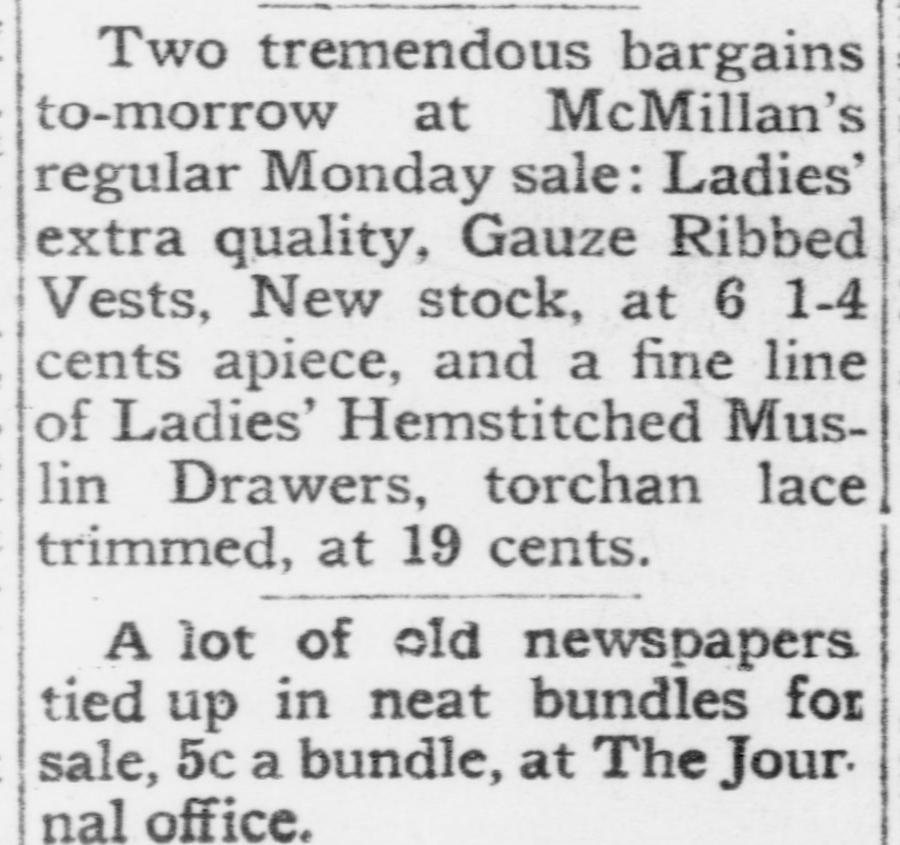
Monday bargains and old newspapers at 5 cents a bundle. The Pensacola Journal, April 11, 1909, page 3. Library of Congress, Chronicling America. Click the clipping to read it full size.
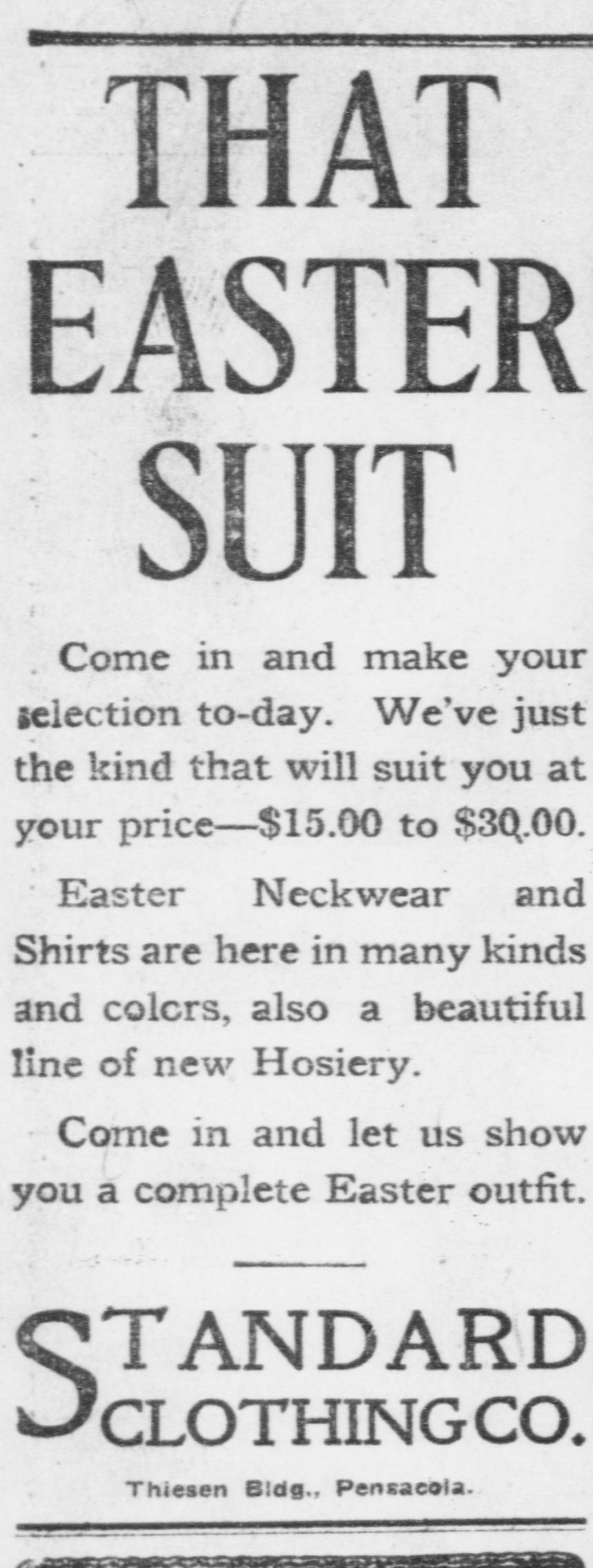
“That Easter Suit.” Standard Clothing Company ad, The Pensacola Journal, April 11, 1909, page 3. Library of Congress, Chronicling America. Click the clipping to read it full size.
Cars were brand new, too. A story on the same page said six new permits had been handed out that month, “bringing the number of machines owned in this city up to 52.” Car No. 52 went to F. L. Dusenberry.
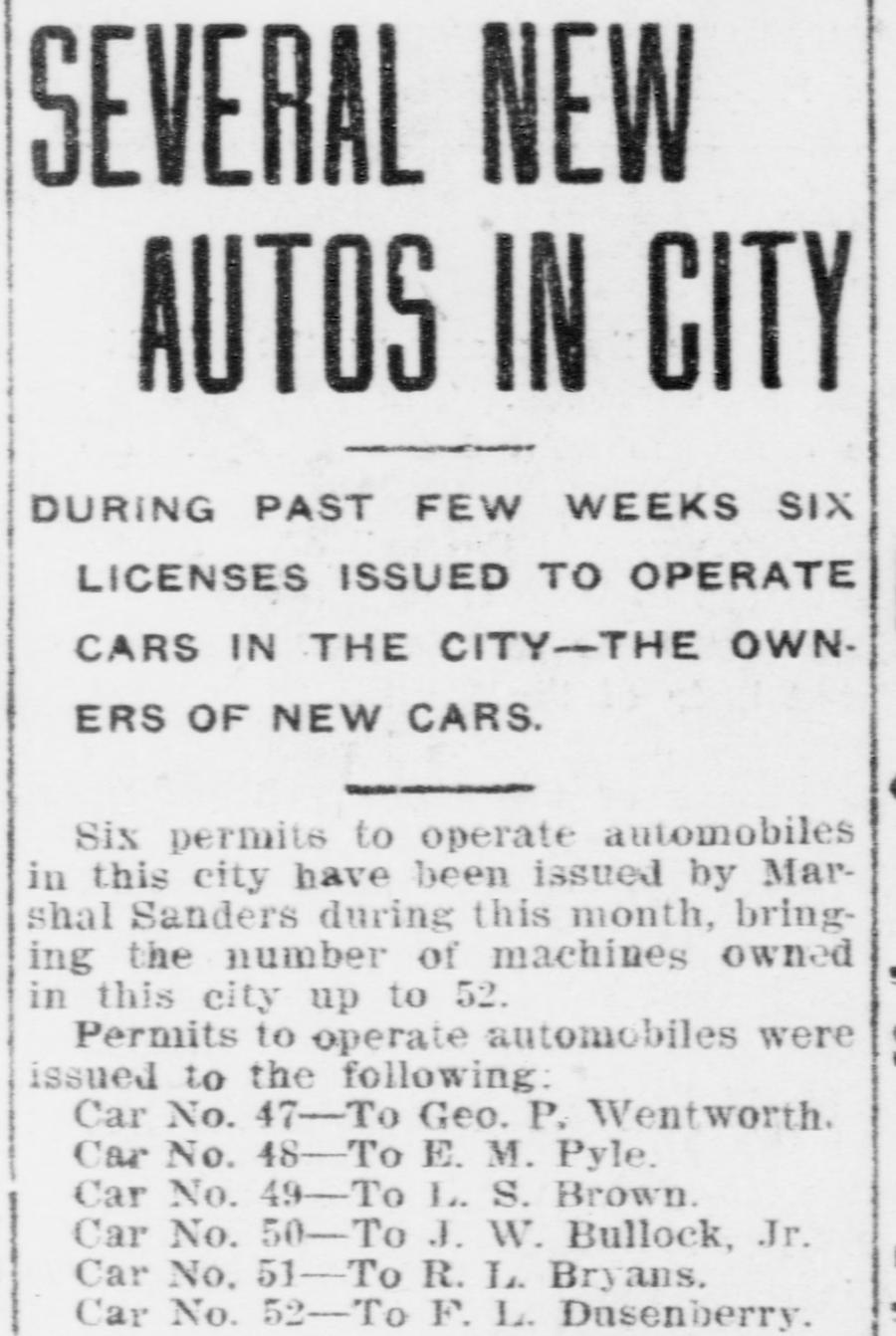
“Several New Autos in City.” The Pensacola Journal, April 11, 1909, page 3. Library of Congress, Chronicling America. Click the clipping to read it full size.
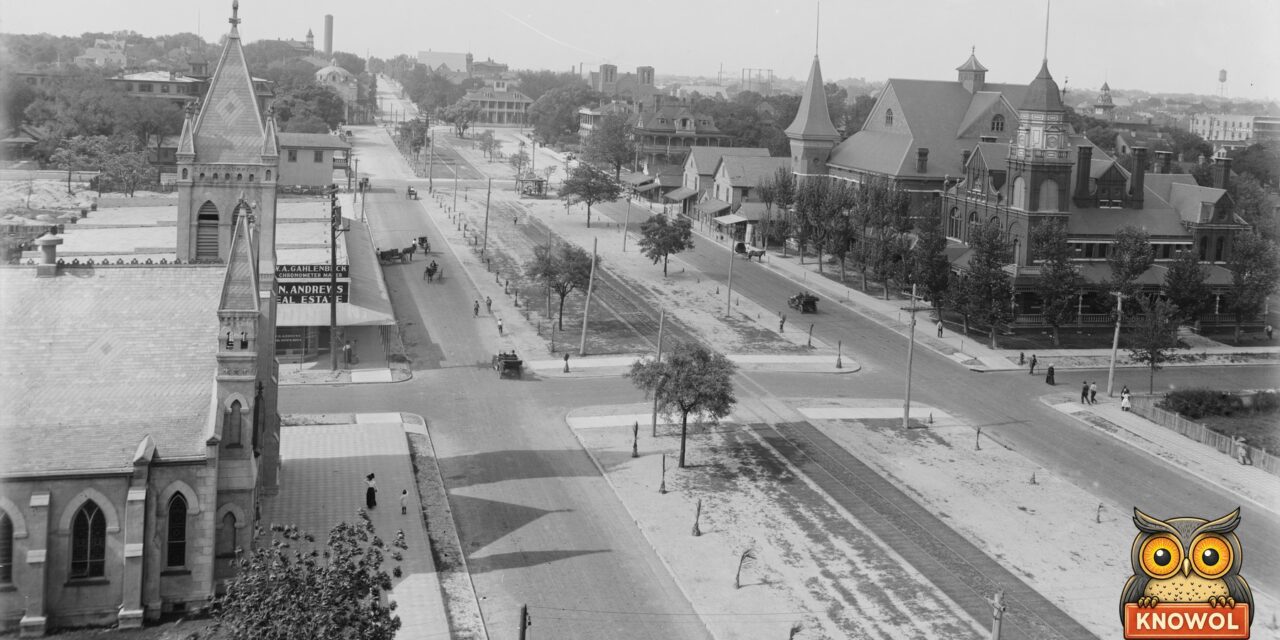
Half dollars crossed counters all over town, from the market on Palafox Street to the bank. The picture at the top of this story shows Palafox Street from a high window, looking north, with buggies, a few early cars and people walking. Many of the shops in that Sunday’s ads were on Palafox. The Detroit Publishing Company took the photo, and the Library of Congress dates it 1905.
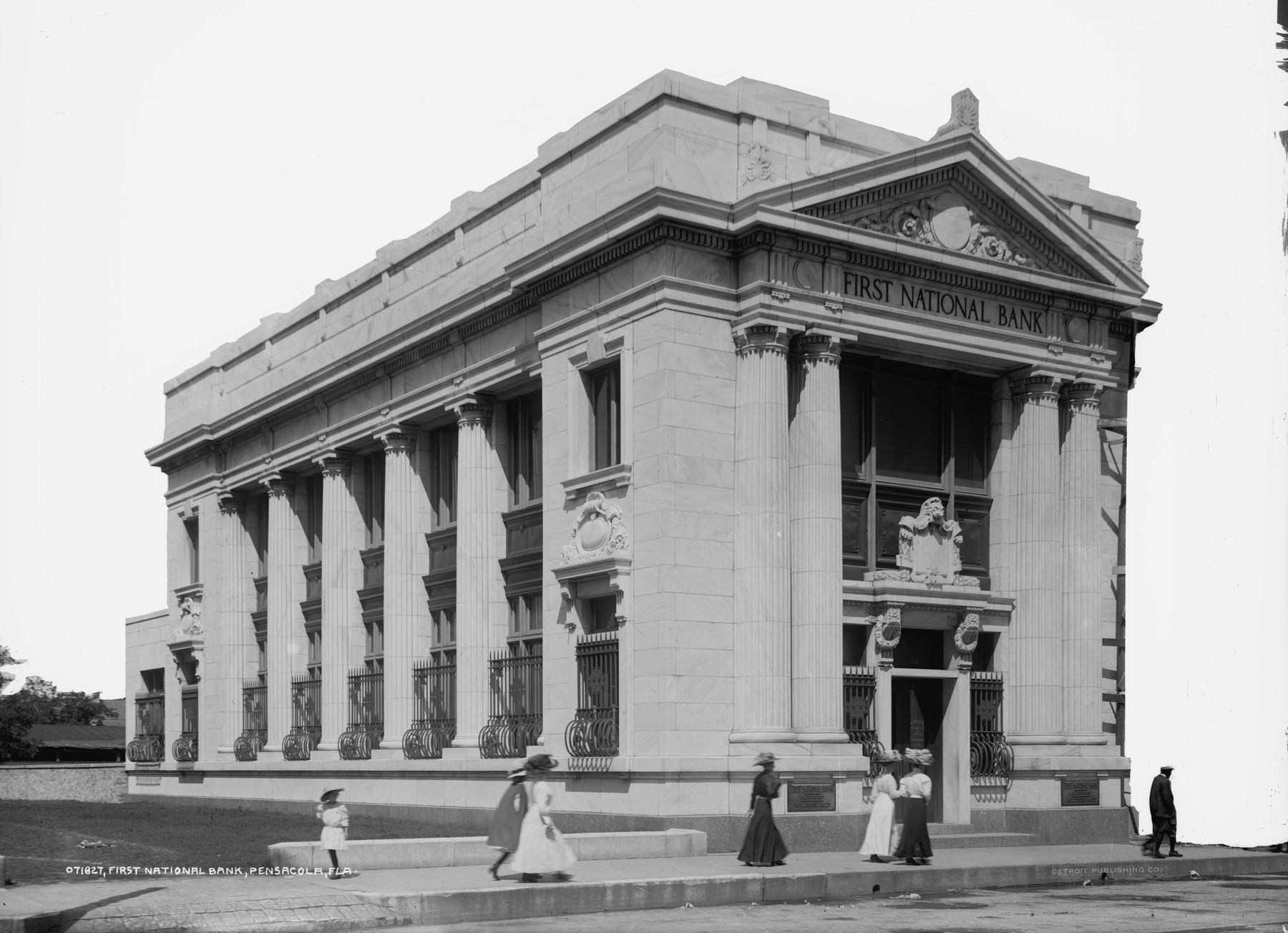
First National Bank, Pensacola, Florida. Detroit Publishing Company, dated 1905 by the Library of Congress. Click the picture to see it full size.
The coin that rang wrong
The Pensacola Journal never said who handed Dr. Cushman the fake, or how many more were out there. We found no later story about anyone being caught. The coin with the perfect face just slipped out of the news.
What lasted was the test. People still say a story “rings true” when it sounds honest. In 1909 those words were about coins. Drake Watson ended his little sermon in Nebraska that way, saying it was just as important to check other things in life “as that a paltry dollar ring true.” In Pensacola that Easter weekend, a fake half dollar had everything right but its voice.
Sources
- The Pensacola Journal (Pensacola, Florida): April 11, 1909, page 3 (“Counterfeit Half Dollars”; “Several New Autos in City”; the McMillan’s and Journal office notices; the Standard Clothing Company ad).
- The Bisbee Daily Review (Bisbee, Arizona): January 31, 1909 (“Bad Money Passed”).
- The Brownsville Daily Herald (Brownsville, Texas): March 27, 1909 (“Finds Coin Within a Coin”).
- The Columbus Journal (Columbus, Nebraska): April 28, 1909, page 4 (Drake Watson’s paragraph on the lead dollar).
- The Buffalo Voice (Buffalo, Wyoming): June 19, 1909, page 3 (the Cheyenne half dollar).
- “50 Cents, United States, 1908,” designed by Charles Barber, National Numismatic Collection: Smithsonian National Museum of American History.
- Photos: Detroit Publishing Company, “Looking north on Palafax St. [i.e. Palafox Street], Pensacola, Fla.” (Library of Congress) and “First National Bank, Pensacola, Fla.” (Library of Congress). No known restrictions on publication.
- All newspaper images: Library of Congress, Chronicling America. Published 1909.