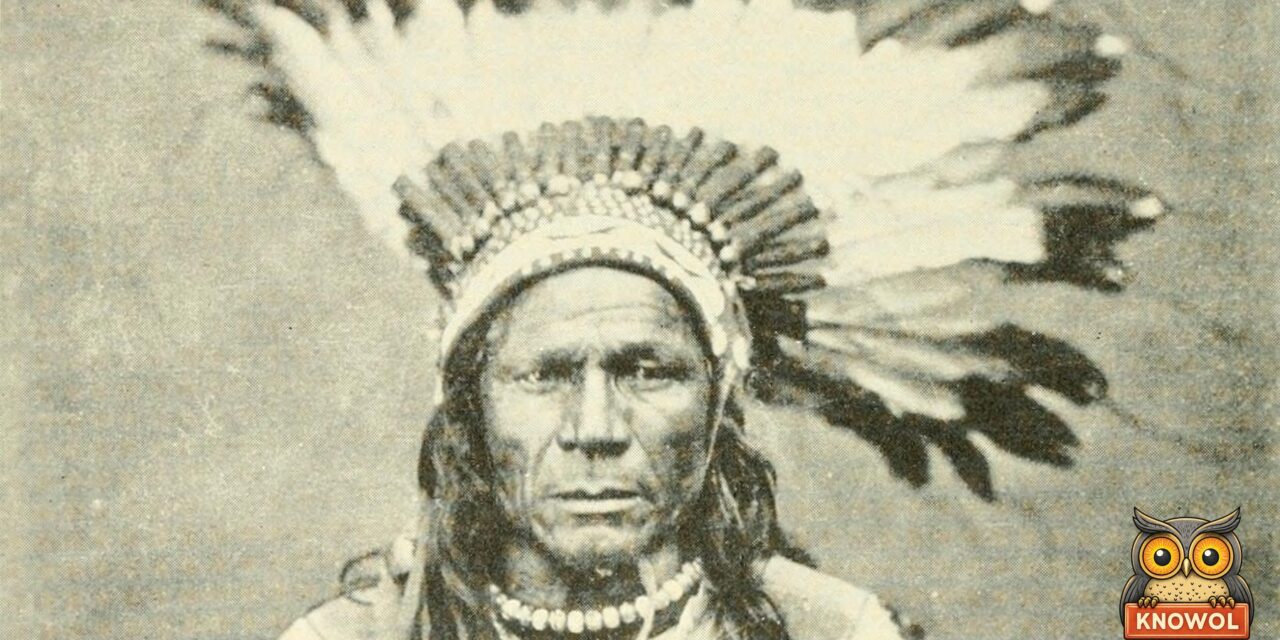
One winter day in late January 1899, a group of old chiefs came down to Bismarck, North Dakota, from the Fort Berthold Reservation up the Missouri River. They had come to see one man. Porter J. McCumber had just been picked as North Dakota’s new United States senator, and the chiefs wanted him on their side. They carried what the Bismarck Tribune called “a claim they have to present against the government.” They wanted a million dollars.
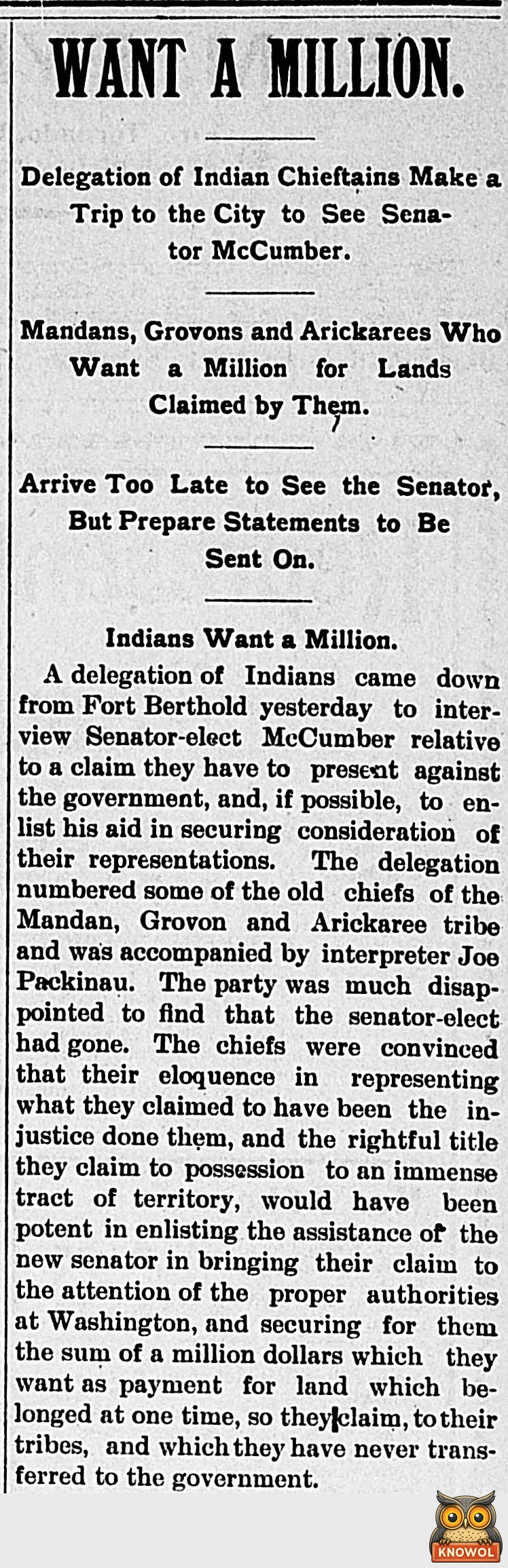
“Want a Million.” Bismarck Weekly Tribune, Bismarck, North Dakota, January 27, 1899. Library of Congress, Chronicling America. Click the clipping to read it full size.
The money was for land. The chiefs said it “belonged at one time, so they claim, to their tribes, and which they have never transferred to the government.” In plain words, they said it had never been sold.
The men came from three tribes that still share the Fort Berthold Reservation today: the Mandan, the Hidatsa and the Arikara. The paper spelled them the old way, “Mandan, Grovon and Arickaree.” Grovon was its try at Gros Ventre, an old French name for the Hidatsa. An interpreter named Joe Packinau came along to turn their words into English.
The senator had gone home
The chiefs had one problem before they said a word. The man they came to see was gone. The legislature had just elected McCumber, and he and his wife had already headed home to Wahpeton, North Dakota, clear across the state on the Minnesota line. The Tribune put it in one short line on its front page: “Mr. and Mrs. McCumber left last night for Wahpeton.”
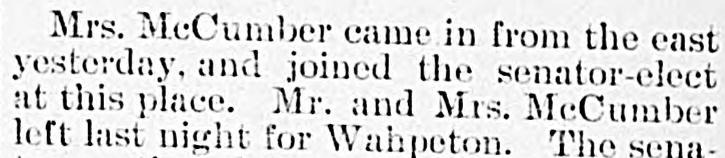
The senator-elect leaves town. Bismarck Weekly Tribune, Bismarck, North Dakota, January 27, 1899, page 1. Library of Congress, Chronicling America. Click the clipping to read it full size.
The paper said the chiefs were “deeply disappointed.” So they did the next best thing. They went to a man they already knew, “Receiver Satterlund of the land office.” A land office was the government office where settlers signed up for farms. He wrote down everything they said. “Their statements and claims were transcribed and will be forwarded to the senators,” the Tribune said.
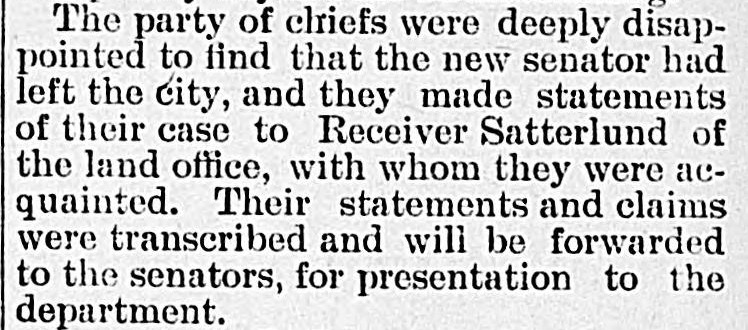
The chiefs’ words get written down. Bismarck Weekly Tribune, Bismarck, North Dakota, January 27, 1899. Library of Congress, Chronicling America. Click the clipping to read it full size.
The old chief
The Tribune said “the most interesting figure” in the group was Crow Flies High, “chief of the Grovon tribe, and an old man of nearly eighty years.” His hair was gray and his face was lined. But “his eye is still keen and bright,” the paper said. “He speaks no English but is earnest in talking through his interpreter.”
The face at the top of this page is Crow Flies High himself. The picture was taken in Bismarck itself, in 1881, eighteen years before this trip.
He had lived a story few people could match. Around 1870, after a quarrel over who should lead, Crow Flies High and about 140 followers left the big village at Fort Berthold. For close to 25 years they lived on their own along the Missouri River, out near Fort Buford. They hunted, grew small gardens of corn, beans and squash, and chopped firewood to sell to the steamboats. Away from the reservation they got no government rations, so they took care of themselves. They came back to the reservation in the spring of 1894. A Smithsonian study of his band’s old village tells that story.
A line of type
That night, Crow Flies High walked into the office of the Bismarck Tribune. The paper said he was “highly interested in the mechanical part of the institution.” One machine held him more than any other: the typesetting machine.
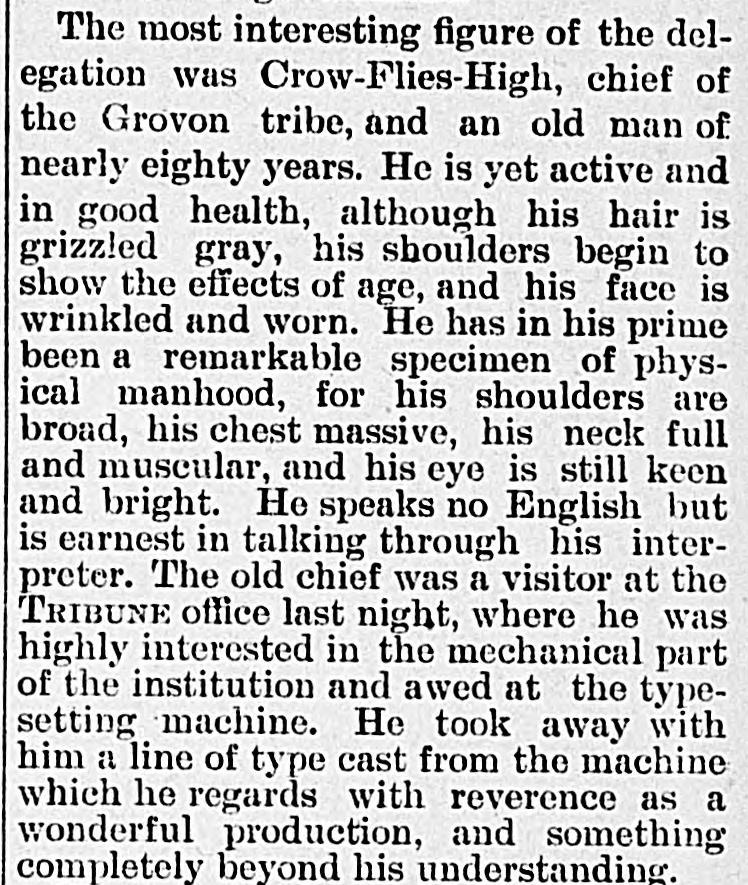
Crow Flies High at the Tribune office. Bismarck Weekly Tribune, Bismarck, North Dakota, January 27, 1899. Library of Congress, Chronicling America. Click the clipping to read it full size.
Here is why. For hundreds of years, printers built every line of a newspaper by hand, one tiny metal letter at a time, and plenty of small papers still did. The new machine had a keyboard. As a worker typed, little brass molds for each letter dropped into a row. Then the machine pushed in hot, melted metal. Out came one solid bar with a whole line of words standing up on top, ready to print. The best known of these machines was the Linotype. Its name means just what it made: a line of type.
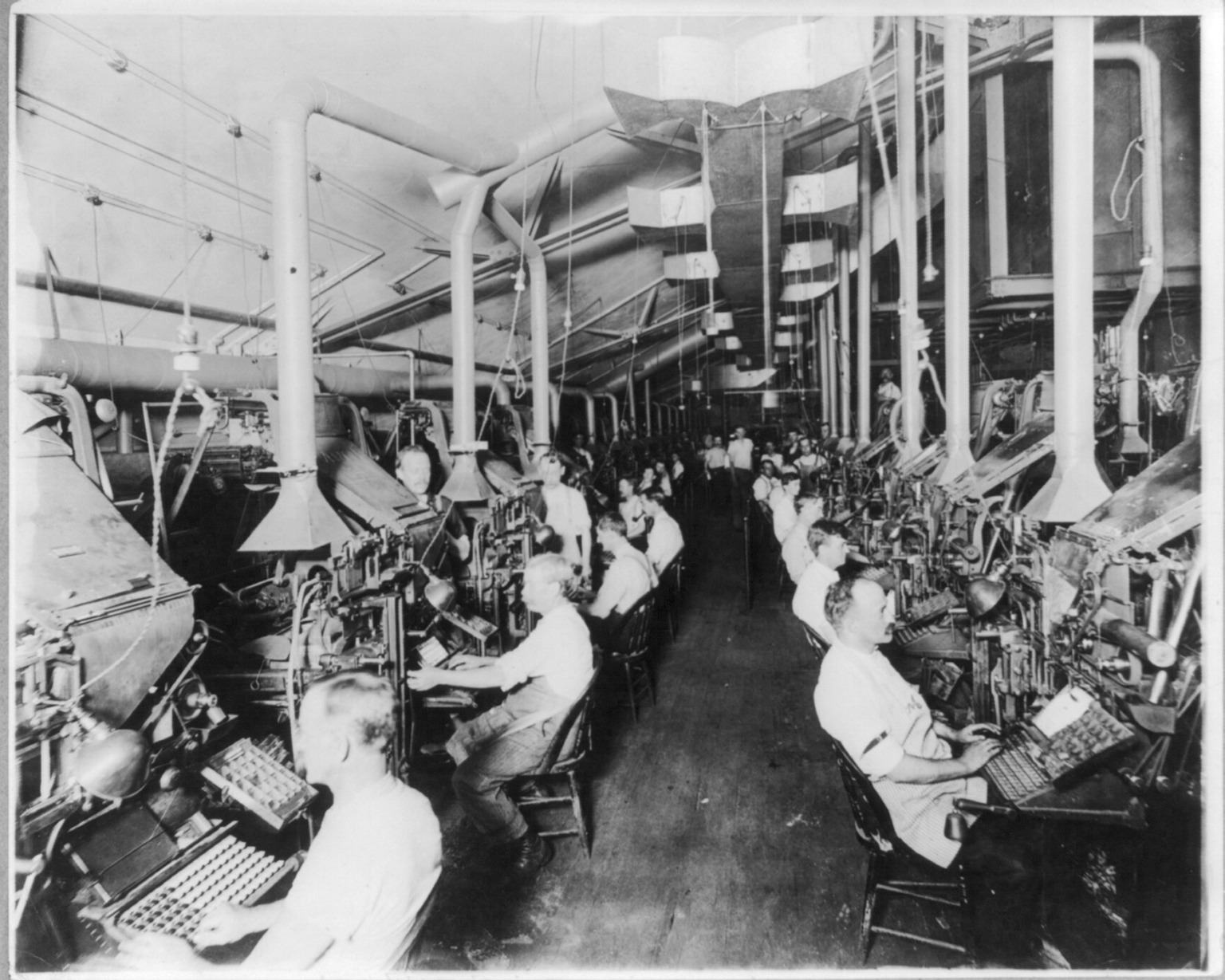
Linotype typesetting machines in the composing room of the New York Herald, New York City, 1902. Each operator sits at a keyboard. This is a big-city paper, not the Tribune. George Grantham Bain Collection, Library of Congress. Click the picture to see it full size.
Crow Flies High went home with one of those bars. “He took away with him a line of type cast from the machine which he regards with reverence as a wonderful production,” the Tribune wrote. The paper never said what words were on it.
Land under three towns
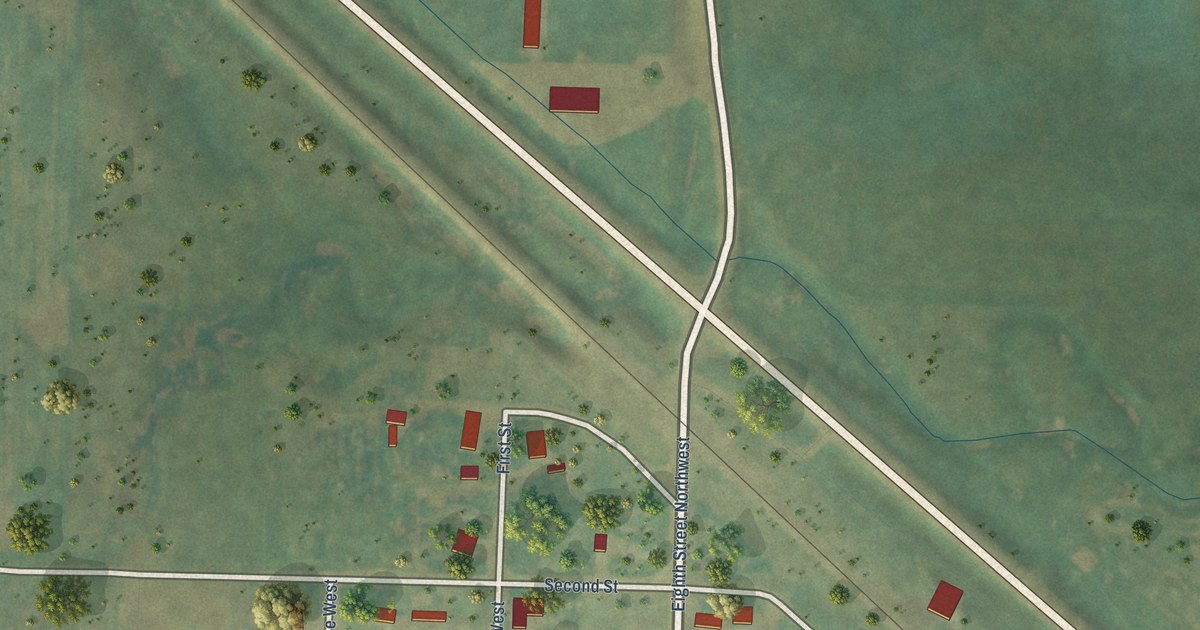
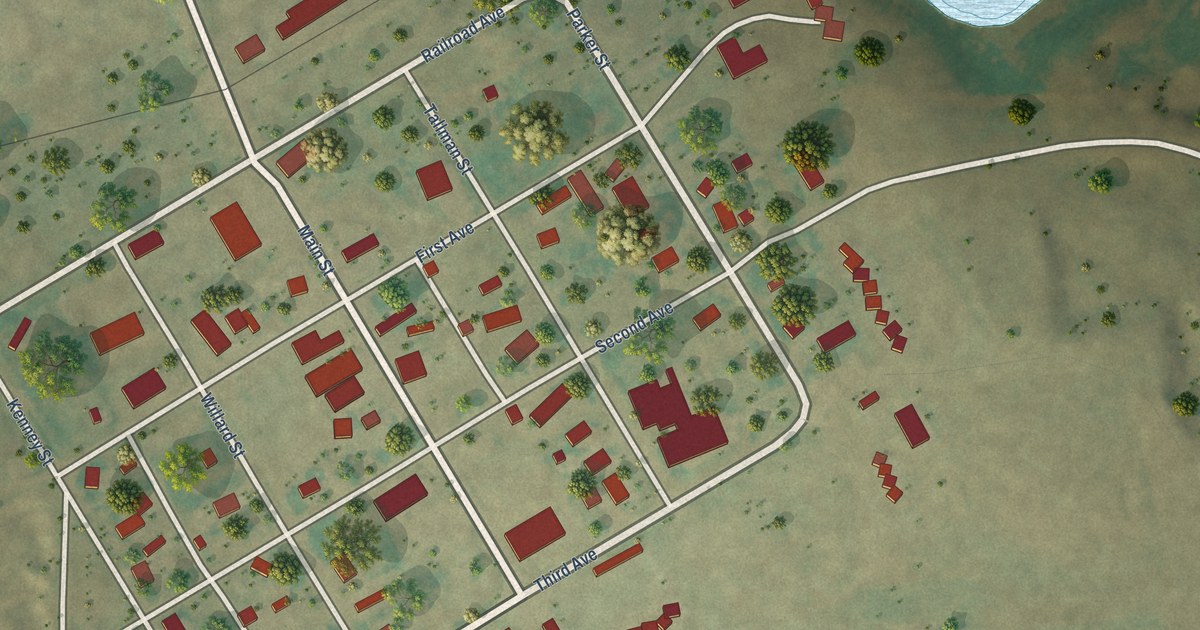
The paper named seven men in the group: “Crow Fly High, Sitting Bear, Old Dog, Bear’s Ghost, Black Hawk, Wounded Face and Charles Burr.” Their claim was huge. They said the borders of their land were set long ago by “a government commission that came up the river in boats.” Their land, they said, ran from the Little Heart River near Mandan, west to the Little Missouri, out to the Powder River and the Yellowstone, north to Canada, over toward White Earth and Minot, and back down to Bismarck.
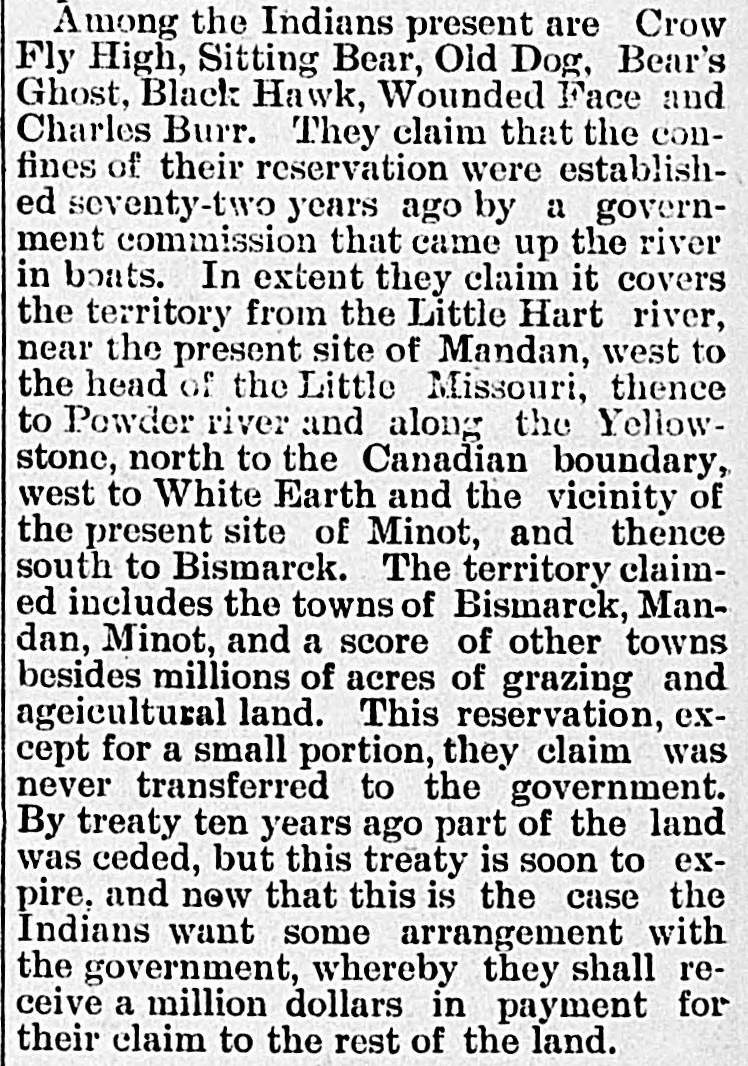
The seven men, and the land they named. Bismarck Weekly Tribune, Bismarck, North Dakota, January 27, 1899. Library of Congress, Chronicling America. Click the clipping to read it full size.
“The territory claimed includes the towns of Bismarck, Mandan, Minot, and a score of other towns,” the paper said. A score is twenty. So the very town the chiefs were visiting, newspaper office and all, sat on land they said was still theirs. So did Mandan, North Dakota, and Minot, North Dakota.
## By the numbers
- Nearly 80: Crow Flies High’s age, the Tribune said.
- 1,000,000 dollars: what the chiefs asked for in 1899.
- About 140: the people who left Fort Berthold with Crow Flies High around 1870.
- 20: “a score” of towns on the land they claimed, besides Bismarck, Mandan and Minot.
- 31 years: from the trip to Bismarck to the day the tribes won in court.
The answer came in 1930
The million dollars did not come in 1899. But the tribes kept at it. In 1920, the Arikara, Hidatsa and Mandan took a land case to the Court of Claims, a court in Washington where people can sue the United States.
In December 1930, they won. The Indian Leader, the newspaper of Haskell Institute, a school for Native students in Lawrence, Kansas, printed the news. The tribes had “won their 10-year fight to recover more than 2 million dollars.” The court agreed that land given to them in the Fort Laramie treaty of 1851 “had later been turned over to the Northern Pacific Railroad and settlers.” And it said where: “The lands involved lie along the Heart and Little Missouri Rivers.” That is the same corner of North Dakota the chiefs had named in Bismarck.
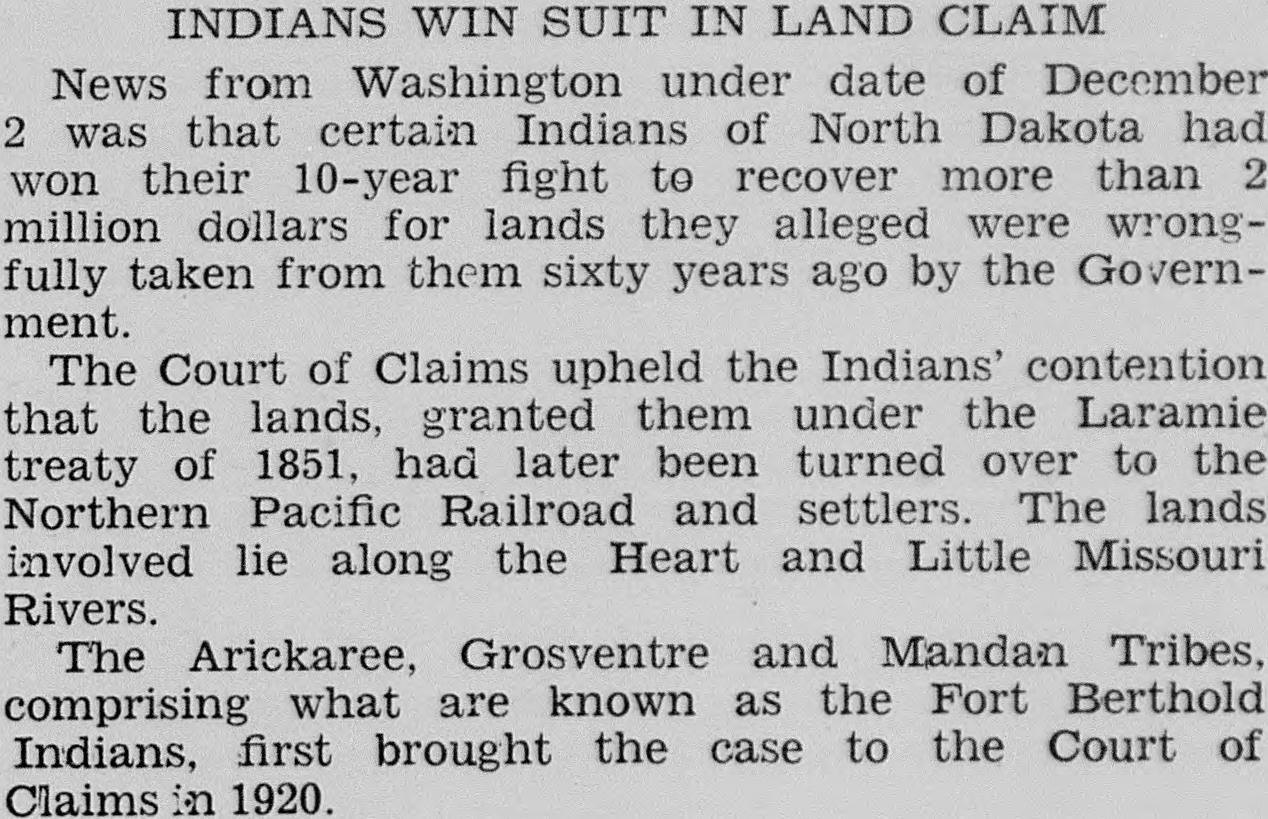
“Indians Win Suit in Land Claim.” The Indian Leader, Lawrence, Kansas, December 12, 1930, page 1. Library of Congress, Chronicling America. Click the clipping to read it full size.
Crow Flies High did not live to see it. He died in 1900, the year after his trip. But his people kept their claim alive, and in 1930 a court agreed with them, for more than twice the million dollars the chiefs had asked for in Bismarck. He took home a line of type. His people’s words took the long way, through Washington, and got there in the end.
Sources
- “Want a Million,” Bismarck Weekly Tribune (Bismarck, North Dakota), January 27, 1899, page 8 of the scan, and the McCumber items on page 1 of the same issue. Library of Congress, Chronicling America.
- “Indians Win Suit in Land Claim,” The Indian Leader (Lawrence, Kansas), December 12, 1930, page 1. Library of Congress, Chronicling America.
- Carling Malouf, “Crow-Flies-High (32MZ1), a Historic Hidatsa Village in the Garrison Reservoir Area, North Dakota,” River Basin Surveys Papers No. 29, Bureau of American Ethnology Bulletin 185 (Smithsonian Institution, 1963), pages 152 to 158: Crow Flies High’s band, the years near Fort Buford, the 1894 return, and the cover photo (plate 26, “From a photograph taken at Bismarck, Dakota Territory, 1881”). Scan by Smithsonian Libraries, Internet Archive. A U.S. government publication, public domain.
- Photo: “Newspaper publishing – N.Y. Herald: Composing room and linotype machines”, 1902, George Grantham Bain Collection, Library of Congress Prints and Photographs Division. No known restrictions on publication.