On Saturday, November 12, 1921, people came to Yellville, Arkansas, “from all parts of the county” for Sales Day, even though “the morning was very cold.” One of them was A. M. Mears, a farmer and cattleman from the Ozark hills of Marion County. He stopped to talk with the town paper, The Mountain Echo, and told it a story about a pig. Five days later the Echo put it on the front page under a headline that said it all: “Hog Did What Man Couldn’t.”
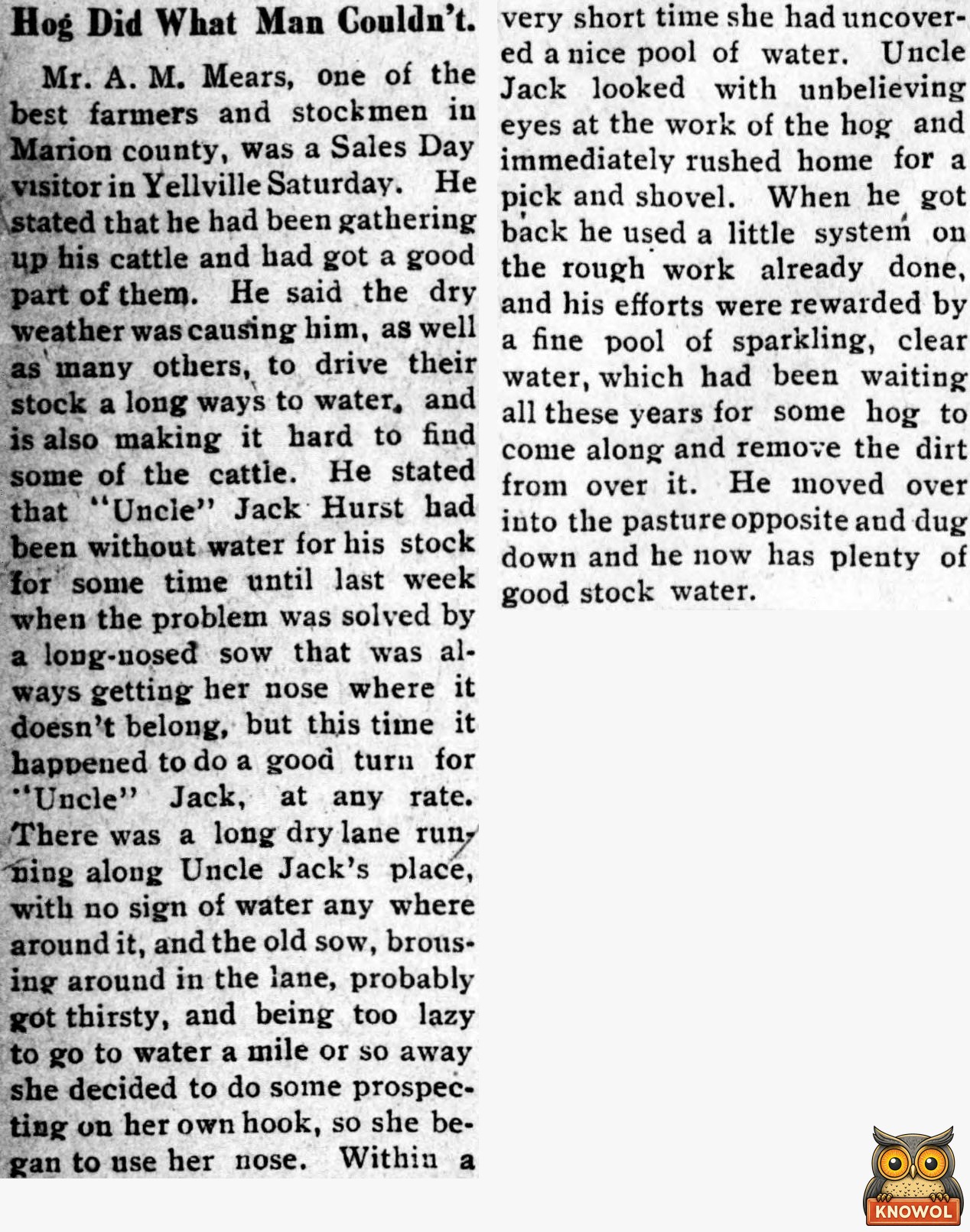
“Hog Did What Man Couldn’t.” The Mountain Echo, Yellville, Arkansas, November 17, 1921, page 1. Library of Congress, Chronicling America. Click the clipping to read it full size.
A very dry fall
The fall of 1921 was a thirsty one in Arkansas. Farm animals need water every day, and the creeks and ponds they drank from were drying up. Mears told the Echo the dry weather “was causing him, as well as many others, to drive their stock a long ways to water.” Stock means farm animals, like cows, horses and mules. The dry spell was also making some of his cattle hard to find.
It wasn’t just Marion County. In southwest Arkansas, a country writer for the De Queen Bee opened the news from the Mineral neighborhood with a laugh: “Dry, did you say? Well, I reckon!” In the Conway paper, a writer from the Bristol neighborhood said “some wells that have never failed to afford plenty of water have begun to fail.” In other words, wells that had always worked were running out.
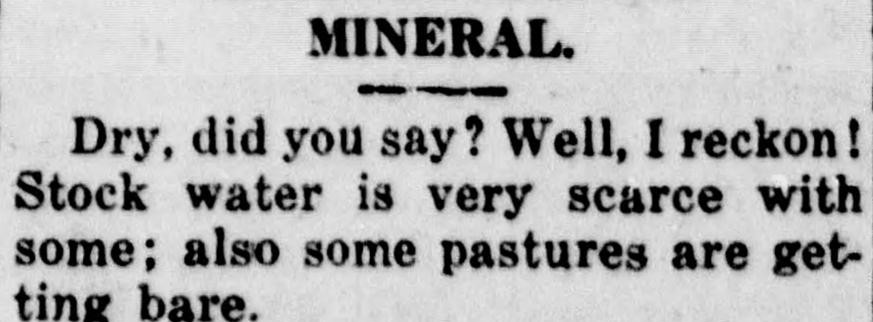
“Dry, did you say? Well, I reckon!” De Queen Bee, De Queen, Arkansas, November 11, 1921, page 3. Library of Congress, Chronicling America. Click the clipping to read it full size.
The pig with her nose in everything
Mears had a story about a farmer the Echo called “Uncle” Jack Hurst. Uncle Jack had been without water for his stock “for some time.” Then a pig fixed it.
She was “a long-nosed sow that was always getting her nose where it doesn’t belong.” A sow is a grown-up mother pig. Pigs dig with their noses. The tip of a pig’s snout is a tough, flat pad, and pigs push it into the dirt to look for roots and bugs to eat. Farmers call that rooting.
There was a long dry lane running along Uncle Jack’s place, “with no sign of water any where around it.” The old sow was poking around in that lane. The Echo guessed she got thirsty, and she was “too lazy to go to water a mile or so away.” So she decided “to do some prospecting on her own hook.” Prospecting is what gold miners do when they search the ground for treasure. “On her own hook” is an old way to say all by herself.
Her treasure was water. “Within a very short time she had uncovered a nice pool of water.”
Pick and shovel
You can picture what Uncle Jack did next, because the Echo told it: “Uncle Jack looked with unbelieving eyes at the work of the hog and immediately rushed home for a pick and shovel.”
He finished the job the pig had started. The Echo said he was rewarded with “a fine pool of sparkling, clear water, which had been waiting all these years for some hog to come along and remove the dirt from over it.” Then he crossed to the pasture on the other side of the lane and dug there too. The paper ended the story with the happy part: “he now has plenty of good stock water.”
The Echo didn’t say exactly where Uncle Jack lived, or what the pig’s name was, if she had one. It also didn’t say how she knew where to dig. Nobody asked her.
What was Sales Day?
Mears told his story on a special day. In August 1921 the store owners of Yellville decided to try a monthly Sales Day, a big trading day on the second Saturday of each month. They got the idea from Will Estes, who had helped make Sales Day a hit in nearby Harrison, Arkansas, where farmers loved it. The Echo’s big ad called the first one, on September 10, “the first MONTHLY SALES DAY ever held in the county.”
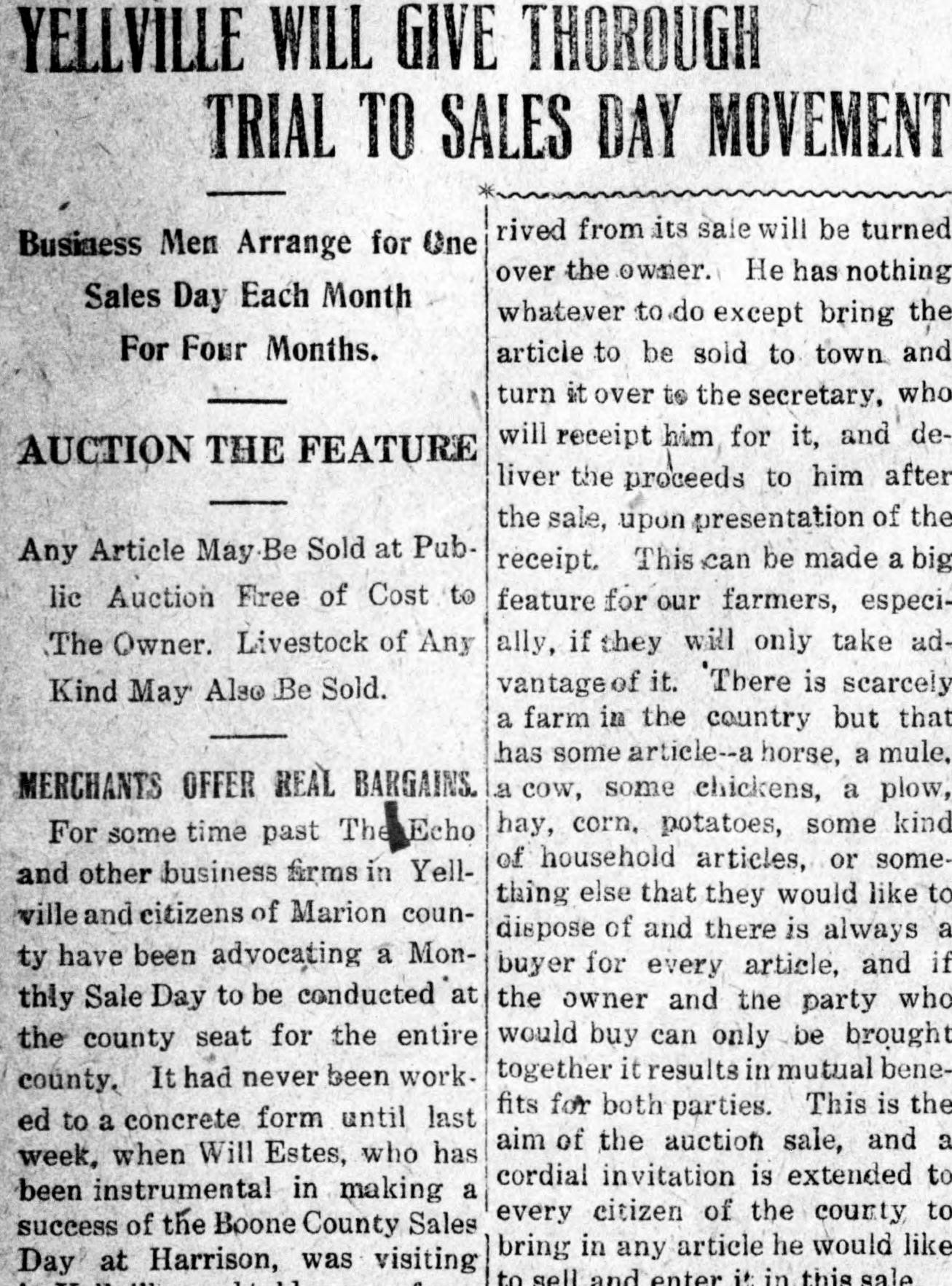
“Yellville Will Give Thorough Trial to Sales Day Movement.” The Mountain Echo, Yellville, Arkansas, August 25, 1921, page 1. Library of Congress, Chronicling America. Click the clipping to read it full size.
Here’s how it worked. Anybody could bring something to sell at a free public auction. An auctioneer named R. L. Berry called out for bids, and the highest bidder got it. The owner kept all the money. The Echo listed the kinds of things a farm might sell: “a horse, a mule, a cow, some chickens, a plow, hay, corn, potatoes.”
The stores had a rule, too. Each one put something on sale at what it cost the store, with no profit. To keep everybody honest, each store’s offer was “checked by the other merchants of the town to be sure that a real bargain is offered.”
What things cost
The first Sales Day ad shows what a little money bought in 1921. W. L. Young’s furniture store had a “PRACTICALLY NEW BICYCLE, cost $35 new” for $16, and a Graphaphone, an early record player, for $6. A. A. Thompson & Co. sold brooms for 40 cents and a 10-pound pail of sorghum, a thick, sweet syrup, for 75 cents. At the O. K. Barber Shop, a haircut was 30 cents.
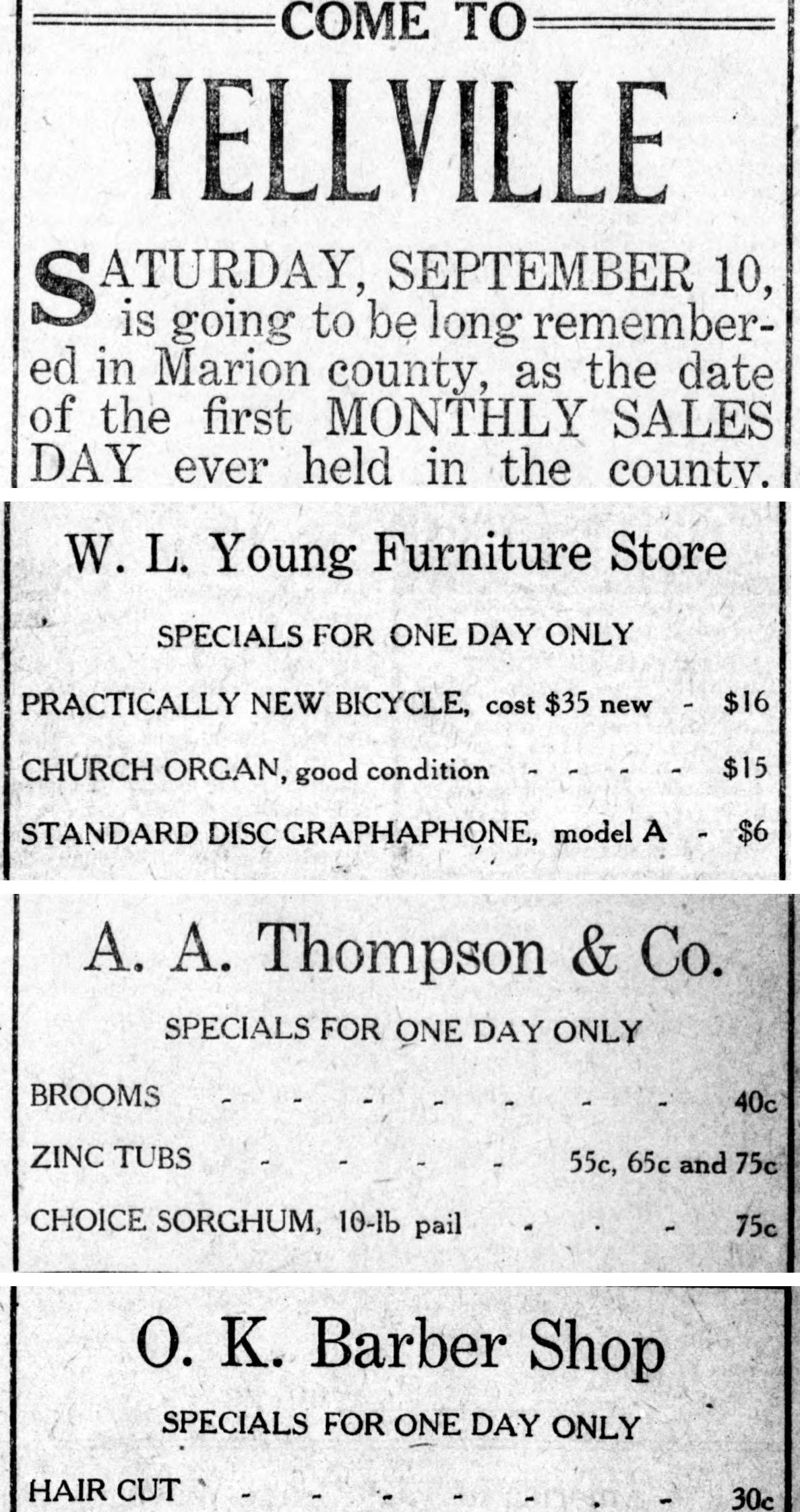
Sales Day specials “for one day only.” The Mountain Echo, Yellville, Arkansas, September 1, 1921, page 8. Library of Congress, Chronicling America. Click the clipping to read it full size.
Not everyone went thirsty
Rain is patchy in hill country. On the same front page as the pig, an Echo writer told about a night spent with Mr. and Mrs. Kinner Reed, about seven miles southeast of Yellville. Their part of the county got rain “just about when it was needed,” and the Reeds had a bumper crop. Supper was a feast: “We were fed on venison, coon and fresh pork.” Venison is deer meat, and coon is raccoon.
Other farmers were not so lucky. A month later, in December, the Echo thanked Fred Garver for a gift of turnips and said, “Owing to the continued drouth this fall, he was in luck to raise enough for his own use.” Drouth is the old way to spell drought.
The pig gets the credit
That dry fall, grown men drove their cattle a long way for a drink and watched good wells start to fail. The answer at Uncle Jack’s place turned out to be right under the lane the whole time. It took a pig who never minded her own business to find it. The Mountain Echo knew who deserved the credit, and it put her in the headline.
About the pictures
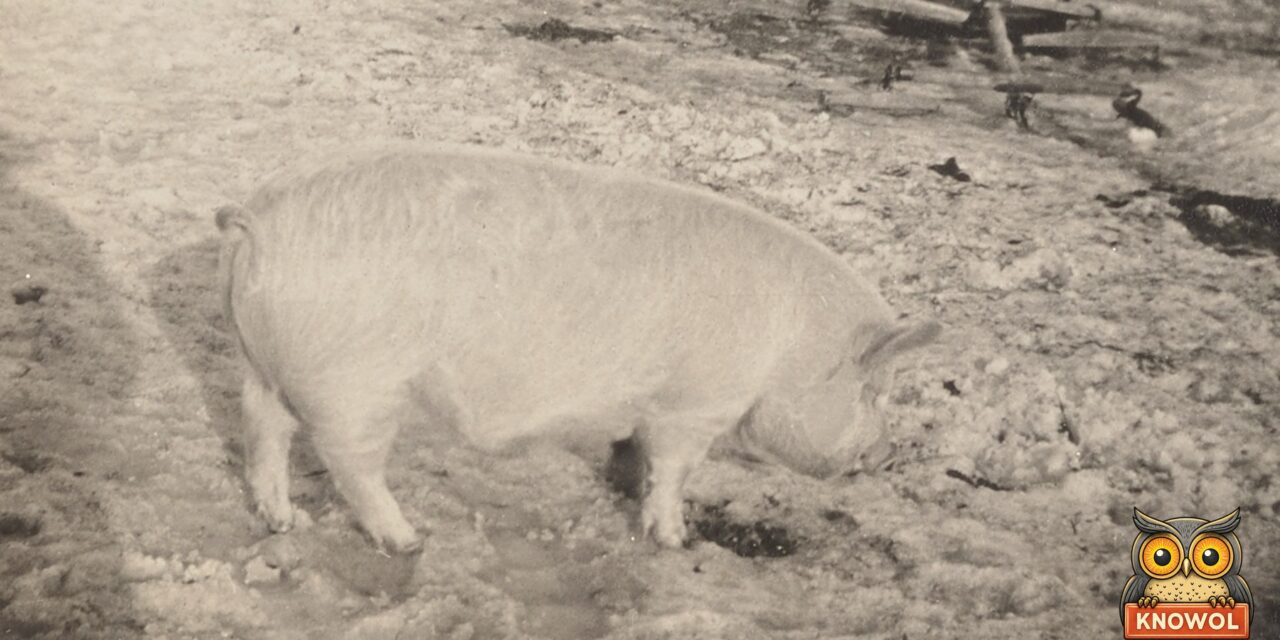
The cover photo shows a pig rooting in a farmyard in Washington, Massachusetts, sometime between about 1900 and 1930. It is not Uncle Jack’s pig, which nobody photographed, but it shows how a pig digs with her nose. The photo below is from the same Massachusetts farm collection.
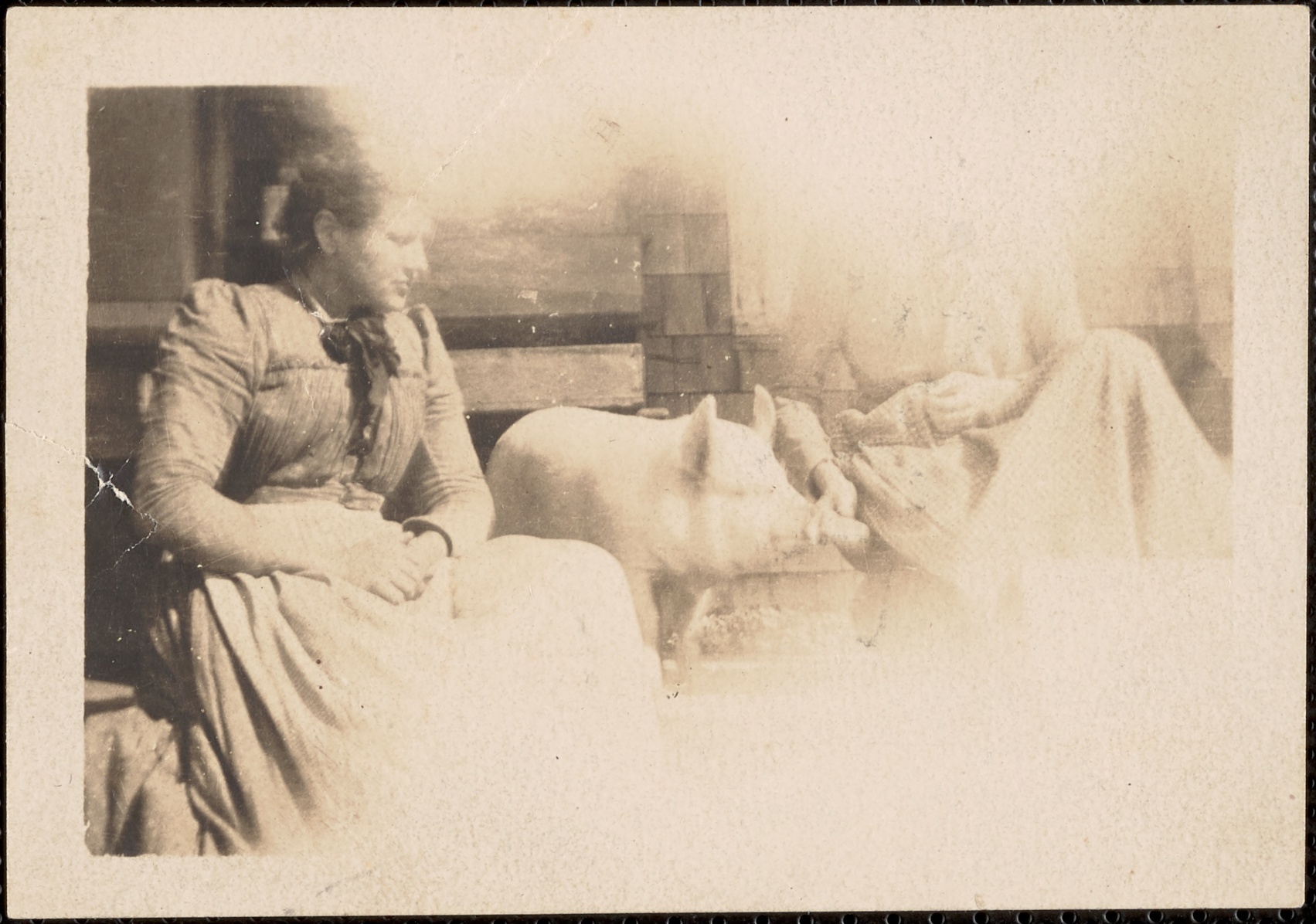
Two women and a farm pig, probably on the Messenger farm in Washington, Massachusetts, about 1900 to 1930. Messenger Collection, Washington Historical Commission, Digital Commonwealth. No known copyright restrictions. Click the picture to see it full size.
Sources
- The Mountain Echo (Yellville, Arkansas): November 17, 1921, page 1 (“Hog Did What Man Couldn’t,” “A Very Pleasant Visit,” “Another Good Sales Day Held Last Saturday”).
- The Mountain Echo: August 25, 1921, page 1 (“Yellville Will Give Thorough Trial to Sales Day Movement”); September 1, 1921, page 8 (the first Sales Day ad); December 15, 1921, page 5 (Fred Garver’s turnips).
- The Log Cabin Democrat (Conway, Arkansas): November 8, 1921, page 2 (“Bristol”).
- De Queen Bee (De Queen, Arkansas): November 11, 1921, page 3 (“Mineral”).
- All newspaper images: Library of Congress, Chronicling America. Published 1921.
- Photos: “Pig” (cover) and “Women and Pig,” Messenger Collection, Washington Historical Commission, about 1900 to 1930, Digital Commonwealth and Digital Commonwealth, no known copyright restrictions. They show Massachusetts, not Arkansas.