In June 1812, a new room opened at No. 18, Cheapside, a busy street in Providence, Rhode Island. R. Starkwather, who made and sold soda water, had fitted it up for women. His newspaper ad called it the “LADIES’ APARTMENT, FOR SODA AND MINERAL WATERS.”
Men could still buy a drink there. But the ad had a polite rule for them. “Gentlemen may be furnished with water from the same fountain, if those who are not accompanying ladies will have the goodness to retire immediately after drinking.” In plain words: if you came without a lady, drink up and go.
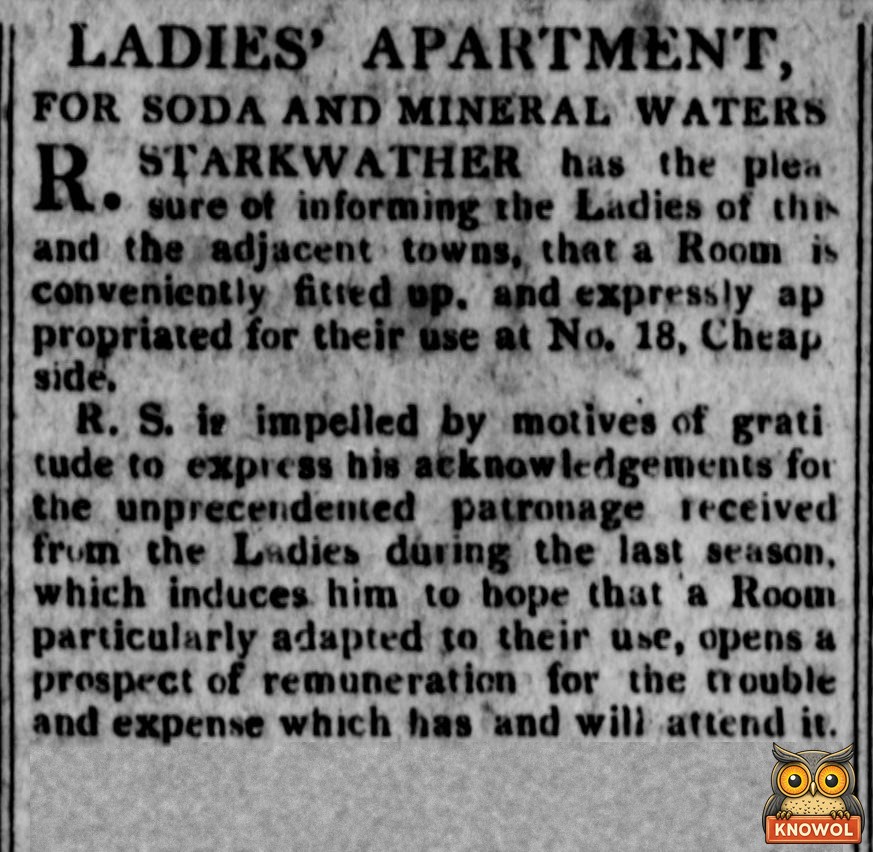
“Ladies’ Apartment, for Soda and Mineral Waters.” The Rhode-Island American, Providence, Rhode Island, June 12, 1812, page 1. Library of Congress, Chronicling America. Click the clipping to read it full size.
Why Providence Ladies Got Their Own Soda Room
R. Starkwather had sold soda water in Providence the summer before, and he wanted more ladies to come. “In the Southern States Ladies partake as freely of these waters as the other sex,” his ad said. In Providence, he wrote, “this salutary practice has not as yet prevailed,” probably because nothing had been set up to suit “New England habits.”
He was saying, politely, that a New England lady in 1812 would not sip a drink in a shop full of men. So he gave the ladies a room without the men.
“Now, tea is the only fluid to which ladies are generally attached,” he wrote, but tea came only at set times of day. At other times, “some succedaneum seems needful.” A succedaneum is a substitute. His was soda water, “exhilirating without intoxication.” It would cheer you up without making you drunk.
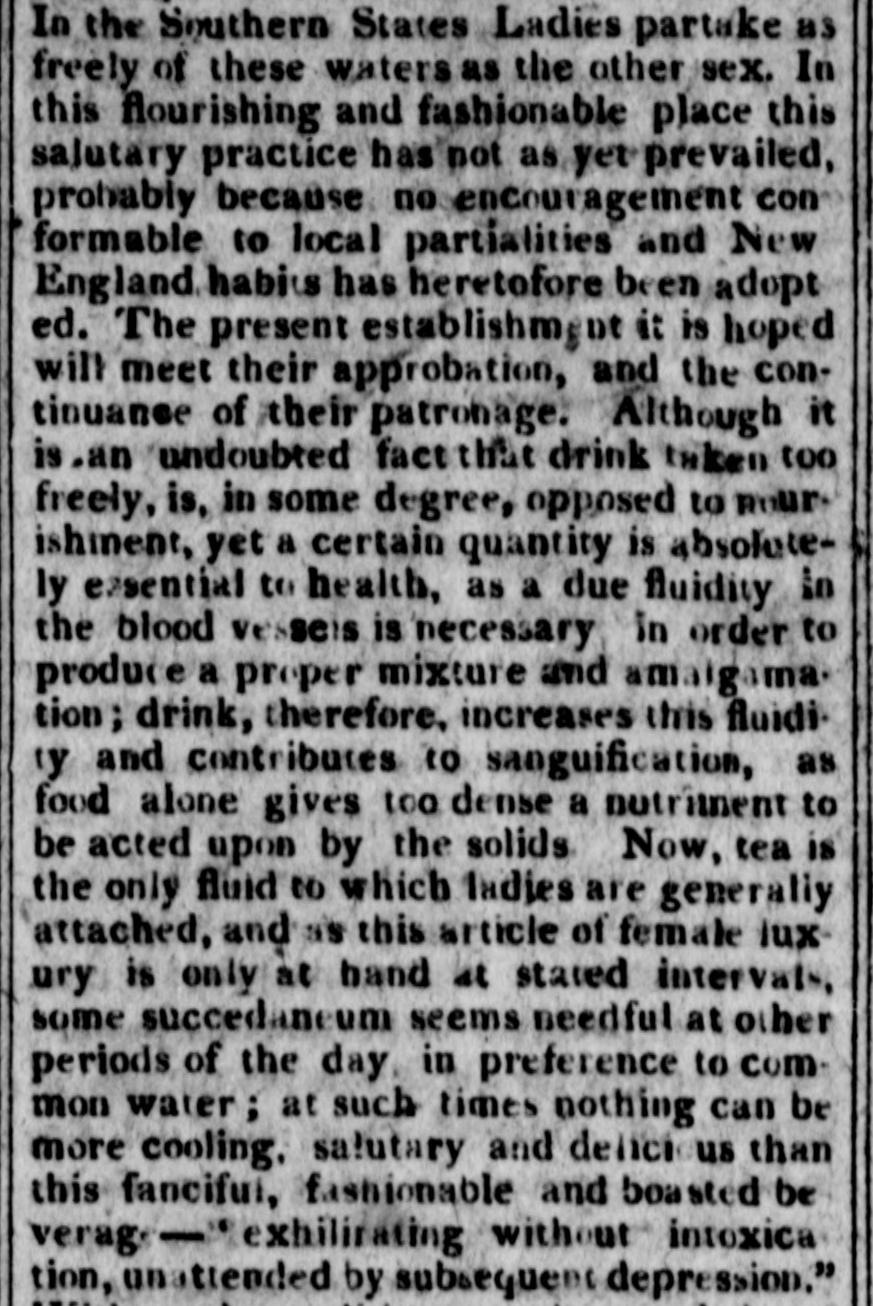
The Southern States, “New England habits” and tea. The Rhode-Island American, June 12, 1812, page 1. Library of Congress, Chronicling America. Click the clipping to read it full size.
Syrup and Soda Water at 5 in the Morning
Surely, the Providence ad went on, no lady “will conceive it any tax upon her time, her constitution or her property, occasionally to indulge in the innocent and healthful hilarity invariably attendant upon a glass of Syrup and Soda Water.” In short: treat yourself. Syrup and soda water was bubbly water with sweet syrup poured in, an early cousin of today’s soda pop.
The hours were long. The ladies’ room and Starkwather’s other soda room, across from the post office, opened “every morning, during the Summer, at 5 o’clock, and shut at 10 o’clock, in the evening, on week days.” On Sundays, both closed from 10 to noon and from 2 to 5, most likely so nobody would be sipping soda during church.
A second ad, dated June 9, 1812, asked for “a smart active Young Lad” to work in “the Ladies’ Apartment, which will be opened to-morrow.” He also had “One Box of fresh Oranges, very nice; and one ditto Lemons.” Ditto means “the same.”
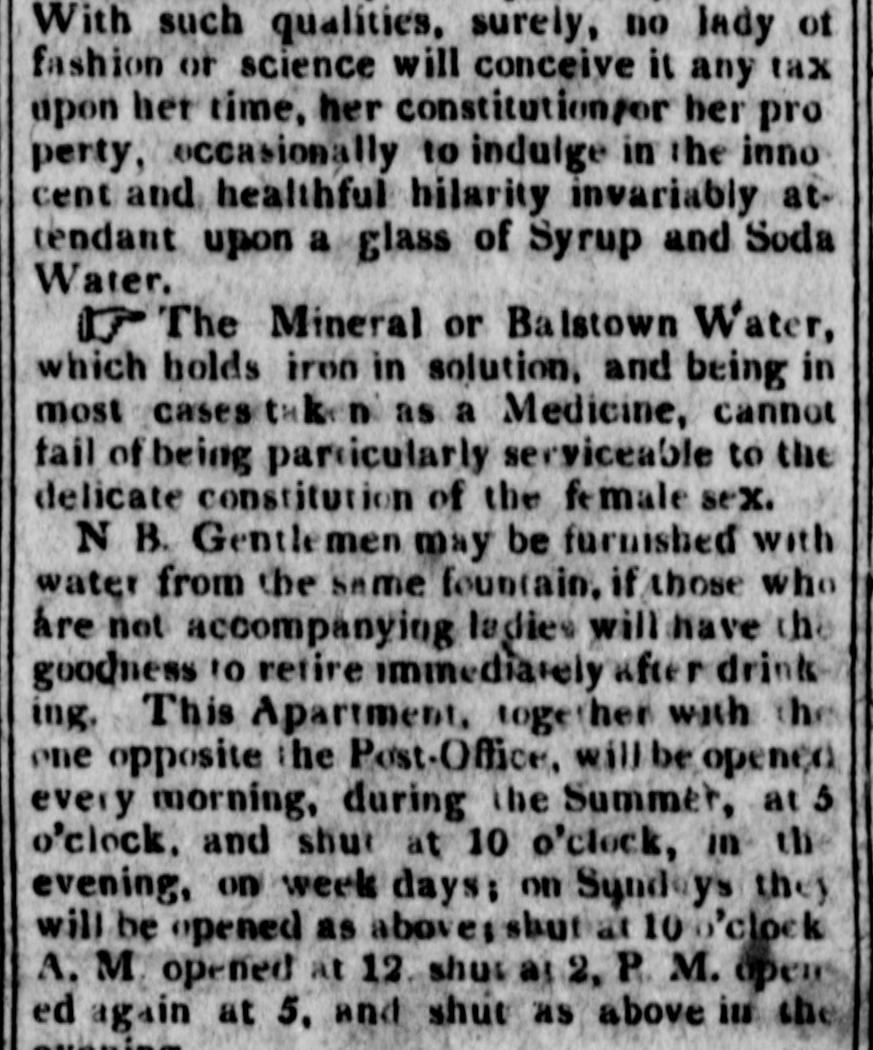
The rule for gentlemen, and the hours. The Rhode-Island American, June 12, 1812, page 1. Library of Congress, Chronicling America. Click the clipping to read it full size.
What Made Soda Water Fizz in 1812?
In September 1811, Starkwather told Providence that his water was “as highly charged with fixed air” as “the so much celebrated Soda Water of New-York.” Fixed air was the old name for the gas we now call carbon dioxide. A New York medical journal in 1809 called it “carbonic acid, or fixed air.” It’s the same gas that fizzes in soda today.
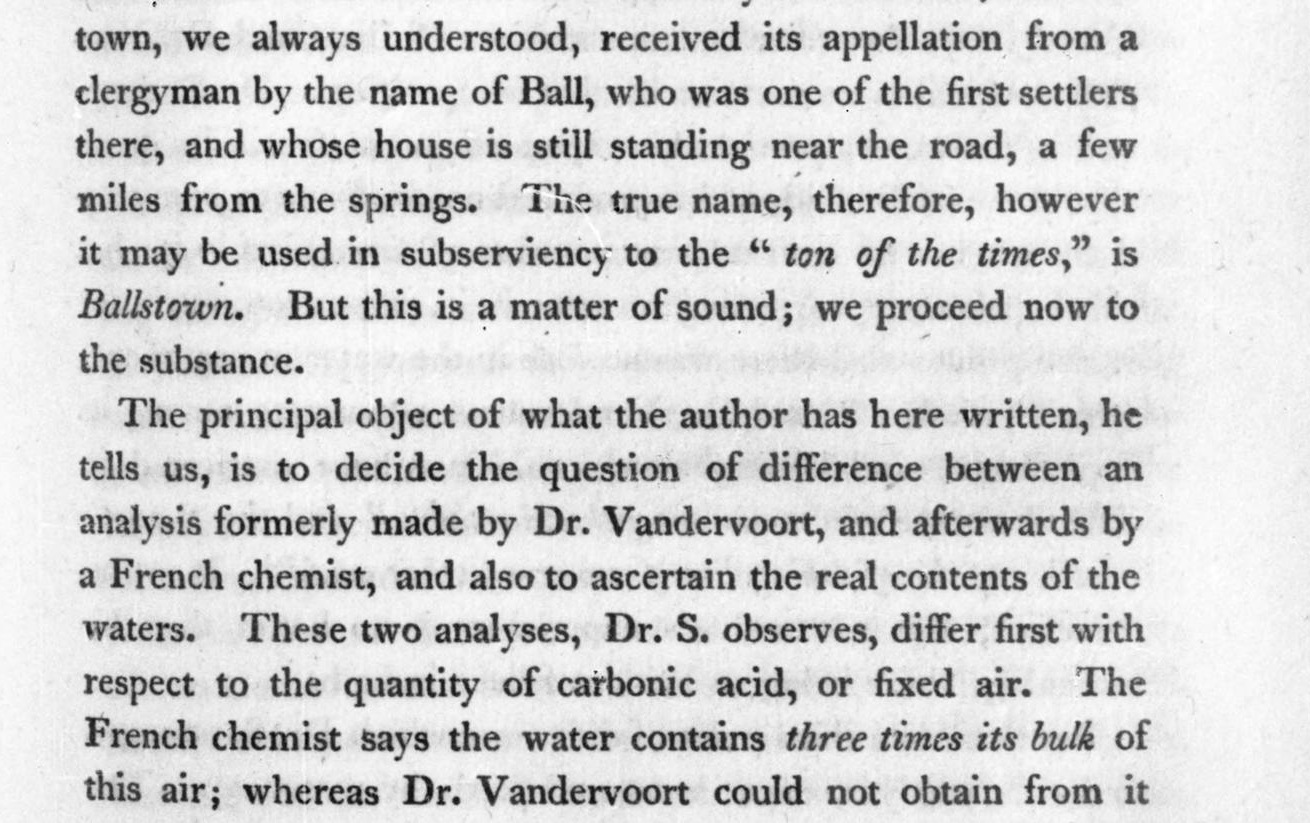
“Carbonic acid, or fixed air.” The New-York Medical and Philosophical Journal and Review, 1809, page 287. Internet Archive, public domain. Click the clipping to read it full size.
He also sold “Ballstown Water,” his own copy of the water from the mineral springs at Ballston, New York, near Saratoga. In Newport, Rhode Island, a medicine store sold his “Artificial Mineral Waters,” made “upon correct chemical principles, by R. STARKWATHER, of Providence.” The store’s ad said the Ballstown water “is perfectly clear and pellucid, and sparkles when poured into the glass.” Pellucid means clear enough to see through.
In those days, people drank mineral water as medicine as much as for fun. Two Providence doctors, Pardon Bowen and Levi Wheaton, praised his waters in 1811 “both as an agreeable beverage, and as a mild and useful medicine.” The ads promised help for all sorts of aches. No doctor today would promise that much from fizzy water.
Twenty Tickets for a Dollar in Providence, Rhode Island
Starkwather sold soda water like a punch card at a coffee shop. In Providence in 1811, it was “Twenty Tickets for One Dollar, each entitling the bearer to one Glass.” That’s 5 cents a glass. In Newport, one dollar bought a ticket “entitling the bearer to 25 glasses of Mineral Waters,” or you could pay for a “single glass 6 cts.” Buy ahead, and each glass cost 4 cents.
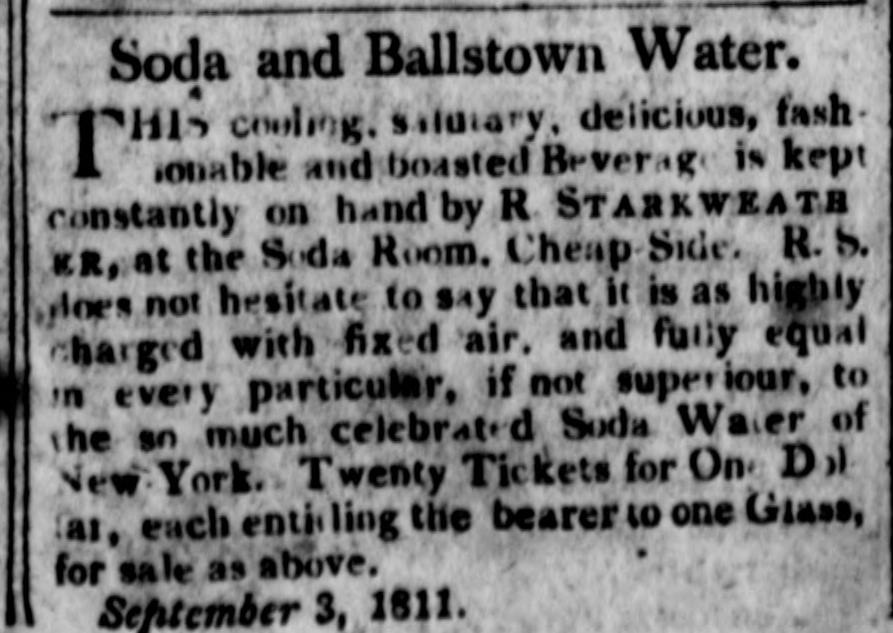
“Twenty Tickets for One Dollar.” The Rhode-Island American, September 3, 1811, page 3. The name is spelled Starkweather here. Library of Congress, Chronicling America. Click the clipping to read it full size.
Soda Water in Jugs for a Providence Winter
Soda water was a summer drink, but Starkwather didn’t quit in the cold. In November 1811, he asked “Ladies and Gentlemen who, during the winter, have a desire to drink either Soda or Ballstown Water” to find him at Mr. Thayer’s Boarding House in Providence. There he sold it “neatly put up in Jugs.” His soda business was closed until spring, he said, when it would be set up “in as complete a manner as any in New-York or any other place.”
The ladies’ room the next June was that promise kept.
War, Cigars and a New Owner in Providence
Eight days after the Providence ladies’ room opened, on June 18, 1812, the United States declared war on Great Britain. The War of 1812 had begun.
By fall, the soda water ad in Providence carried a new name. On September 29, 1812, Samuel Tufts announced he had “taken the Mineral Water Establishment for this place.” The paper doesn’t say why Starkwather stepped away. Tufts promised to “keep the best Cigarrs.” He kept “all the News-Papers which have usually been found there,” and if enough people signed up, “he intends opening a Reading-Room.” In a year of war news, the soda shop was a place to read the papers, too.
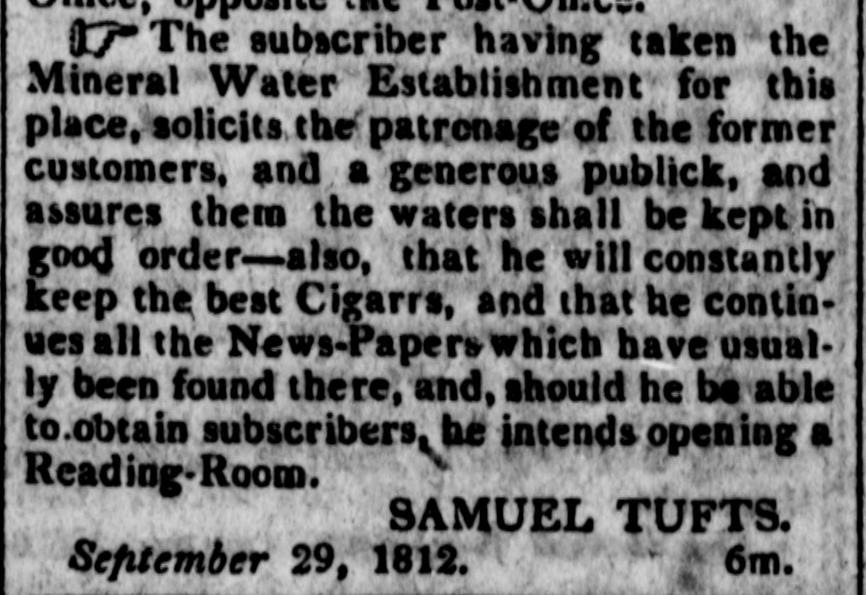
Samuel Tufts takes over. The Rhode-Island American, October 6, 1812, page 1. Library of Congress, Chronicling America. Click the clipping to read it full size.
Soda Water Upstairs on Market Square
In March 1813, Samuel Tufts said he had “purchased the right of vending Soda and Mineral Water in this place.” He moved to “the Chamber over Store No. 6, Market-Square, opposite the Market-House.” A chamber was an upstairs room. Gentlemen would find “Newspapers from the principal Towns and Cities in the United States.” He welcomed “the Ladies and Gentlemen of this town,” but he didn’t say if the ladies still had a room of their own.
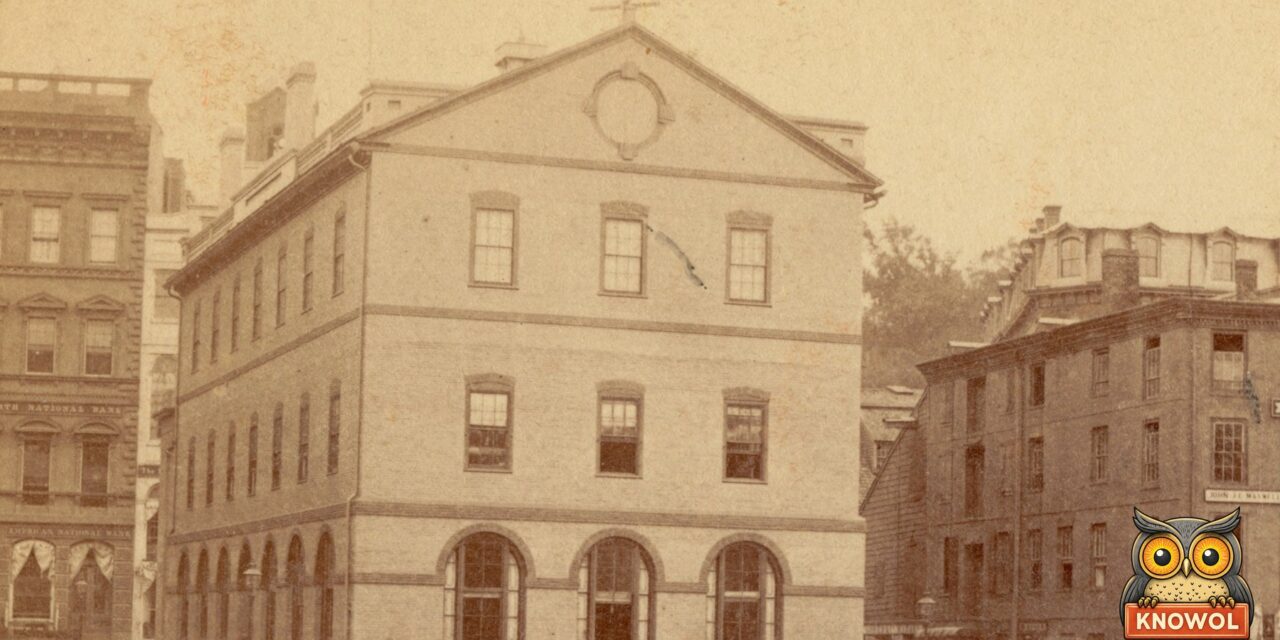
The Market House he faced is the building in the picture at the top of this page. Its cornerstone was laid in 1773. The photograph was taken many years after 1812, when the old Market House had become the city building.
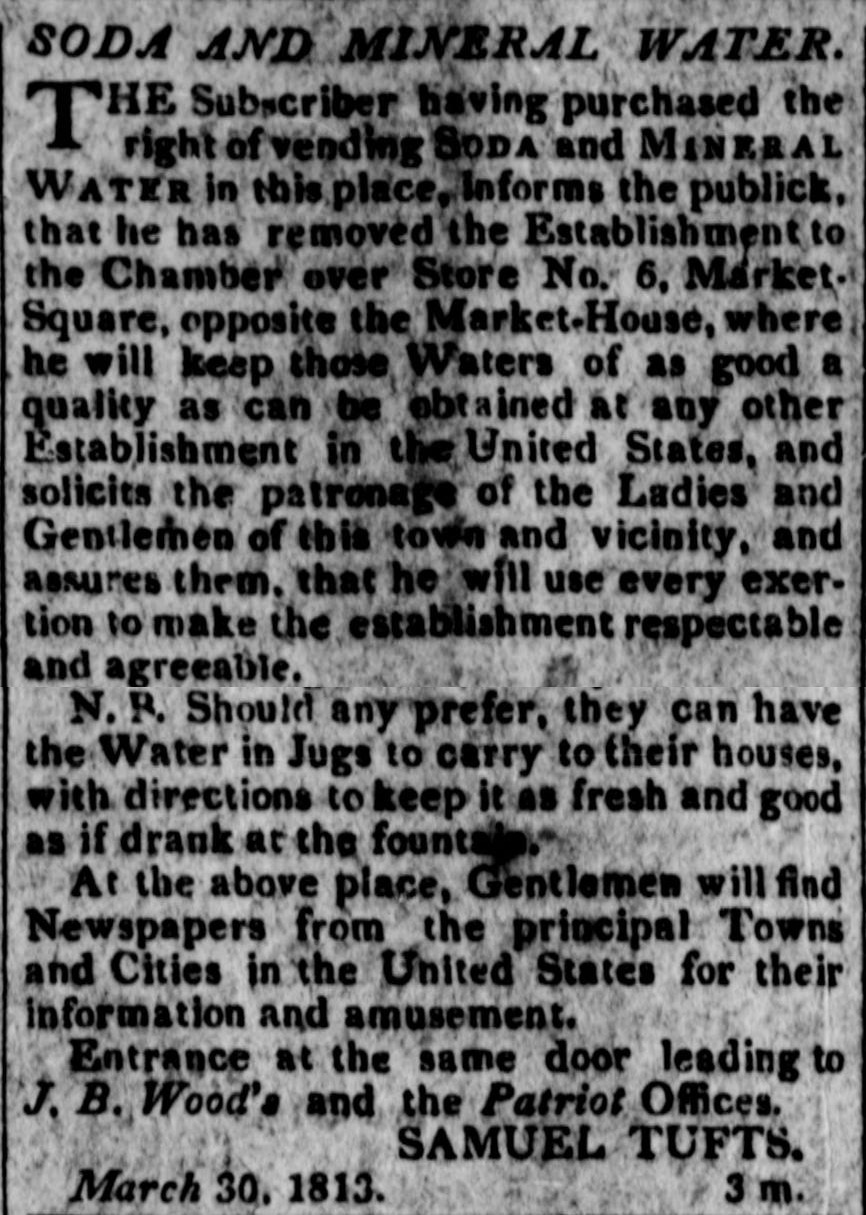
Upstairs on Market Square. The Rhode-Island American, April 2, 1813, page 1. Two parts of the ad are joined. Library of Congress, Chronicling America. Click the clipping to read it full size.
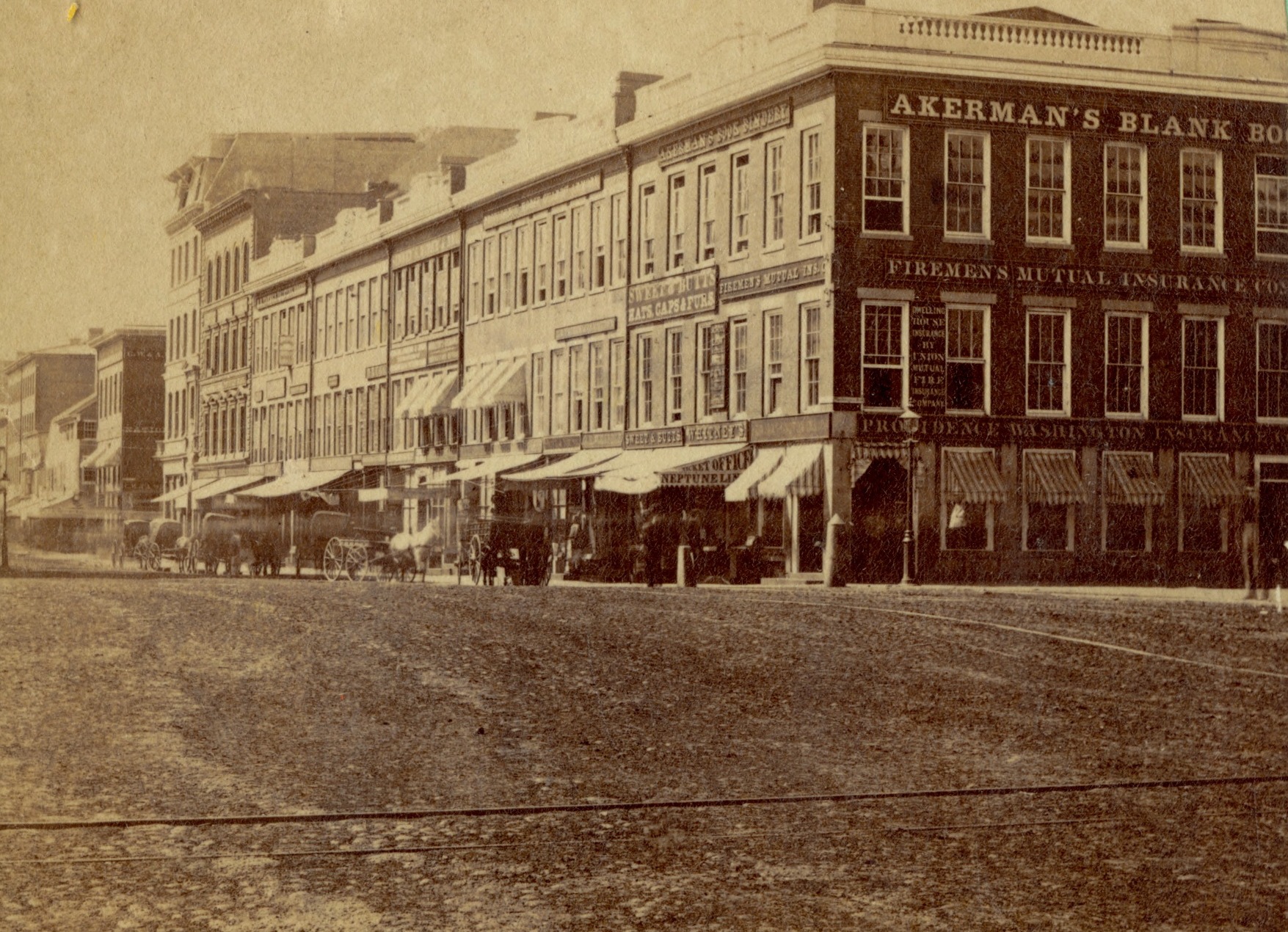
Westminster Street from Market Square, Providence, on a stereograph card made long after 1812. Boston Public Library. Click the picture to see it full size.
Ice Cream and Soda Water in Providence, 1814
By May 1814, Linard & Duval in Providence were selling “Confectionary, Ice-Cream and Soda Water.” They got their soda water from “the proprietor of the Soda Water Establishment,” and they welcomed “Ladies and Gentlemen who may wish to drink thereof.” They would even deliver: “Those who wish Ice Cream by the quantity, can, if they please, be supplied at their own houses.”
Nobody had yet dropped a scoop into the glass, though. The ice cream soda was still many years away.
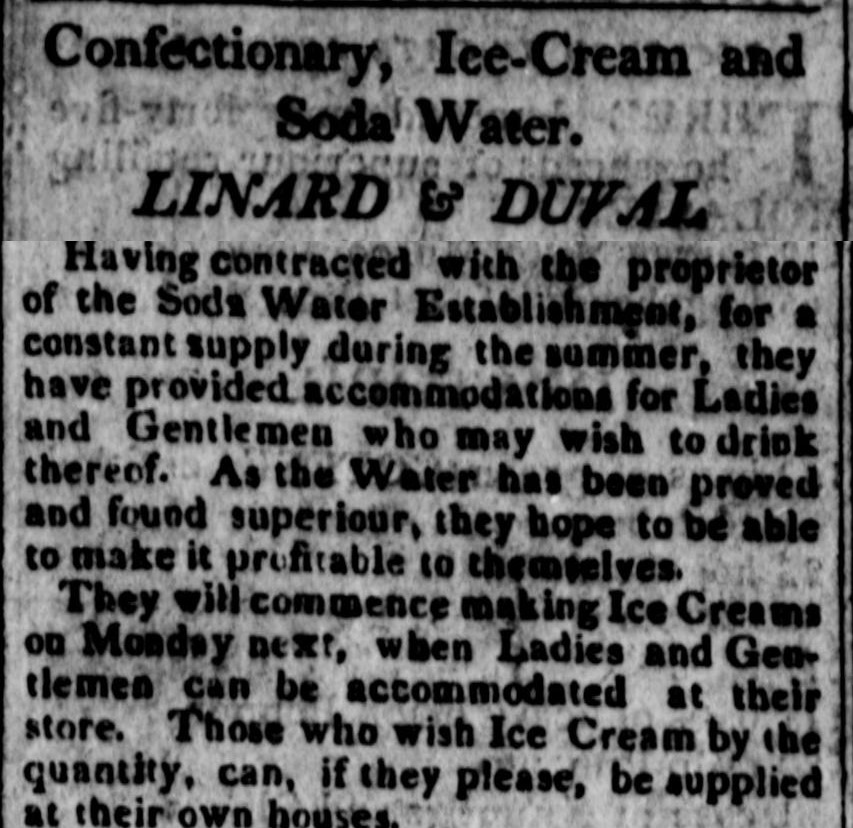
Ice cream and soda water. The Rhode-Island American, May 27, 1814, page 3. Two parts joined. Library of Congress, Chronicling America. Click the clipping to read it full size.
Then and Now: Soda Water in Providence, Rhode Island
In 1812, a glass of soda water in Providence cost about 5 cents, came with a health promise and was poured from 5 in the morning. Ladies got a room of their own, and men on their own were asked, very politely, to drink and leave.
Today, anybody can sit anywhere with a fizzy drink. But the bubbles are the same old fixed air.
Sources
- “Ladies’ Apartment, for Soda and Mineral Waters,” The Rhode-Island American (Providence, Rhode Island), June 12, 1812, page 1. Library of Congress, Chronicling America. The same ads first ran on June 9, 1812, page 3.
- “Soda and Ballstown Water,” The Rhode-Island American, September 3, 1811, page 3. Library of Congress, Chronicling America.
- “Artificial Mineral Waters,” The Rhode-Island Republican (Newport, Rhode Island), July 17, 1811, page 3. Library of Congress, Chronicling America.
- “Soda and Ballstown Water,” The Rhode-Island American, December 24, 1811, page 1. Library of Congress, Chronicling America.
- “An Act Declaring War,” The Rhode-Island American, June 26, 1812, page 3. Library of Congress, Chronicling America.
- Samuel Tufts, The Rhode-Island American, October 6, 1812, page 1. Library of Congress, Chronicling America.
- “Soda and Mineral Water,” Samuel Tufts, The Rhode-Island American, April 2, 1813, page 1. Library of Congress, Chronicling America.
- “Confectionary, Ice-Cream and Soda Water,” Linard & Duval, The Rhode-Island American, May 27, 1814, page 3. Library of Congress, Chronicling America.
- Review of Seaman on the Saratoga and Ballstown Waters, The New-York Medical and Philosophical Journal and Review, 1809, page 287. Internet Archive.
- Henry C. Dorr, The Planting and Growth of Providence, 1882, page 203: Nicholas Brown laid the Market House cornerstone on June 8, 1773; the book’s index calls it the Market House “(afterwards City Hall).” Internet Archive.
- Usher Parsons, Sketches of Rhode Island Physicians Deceased Prior to 1850, 1859: Dr. Pardon Bowen of Providence. Internet Archive.
- City building, Market Square, Providence, stereograph. Boston Public Library, Stereograph Collection, via Digital Commonwealth. No known copyright restrictions. The cover is a crop of one half of the card.
- Westminster St. from Market Square, Providence, stereograph. Boston Public Library, Stereograph Collection, via Digital Commonwealth. No known copyright restrictions.
- The newspapers and books were printed before 1931 and are in the public domain.