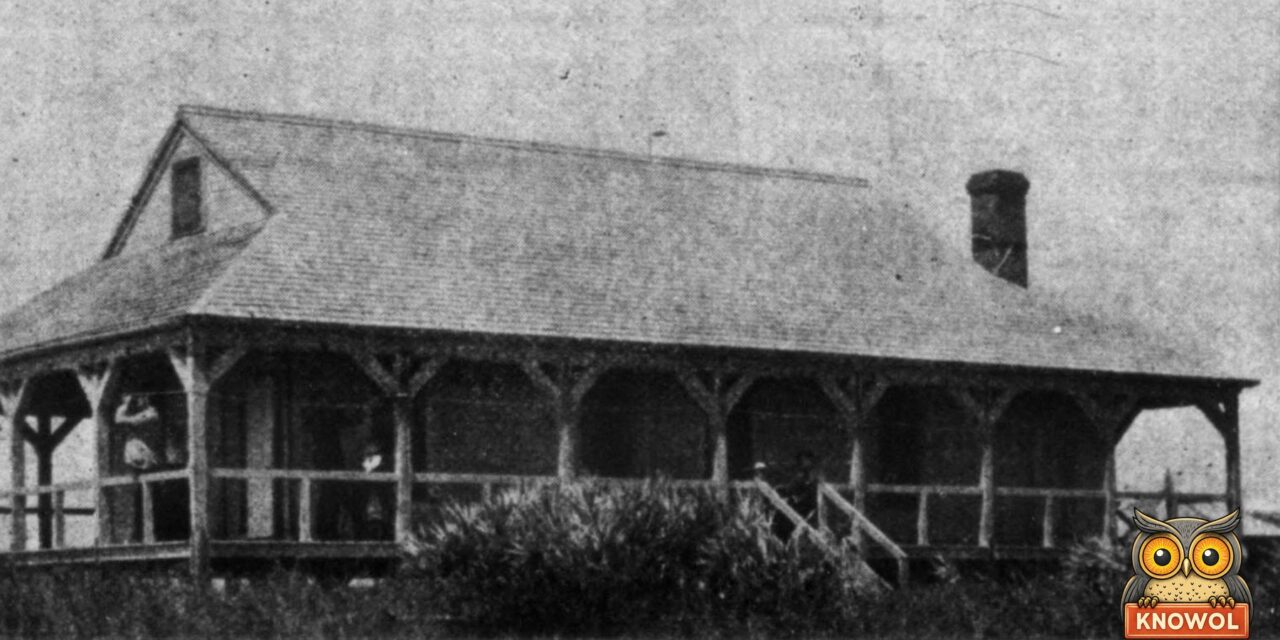
In December 1901, a short item in The Florida Star of Titusville, Florida, said a couple was about to leave their lonely home on the Florida coast. For more than ten years, Hubert W. Bessey and his wife had lived in a government house on the beach near Stuart, Florida. The house had beds and food for 25 shipwrecked sailors, and its name told you what it was for. It was the house of refuge at Gilbert’s Bar. A refuge is a safe place to go when you are in trouble.
“Mr. H. W. Bessey will give up charge of the house of refuge at Gilberts bar the first of the coming month, and will move to Stuart, where he will take charge of Danforth’s hotel for the coming season,” the paper said. The move would “place him right at his pineapple plantation, and will be an agreeable change to himself and wife from the lonesome location they have held for years.” Agreeable means pleasant.
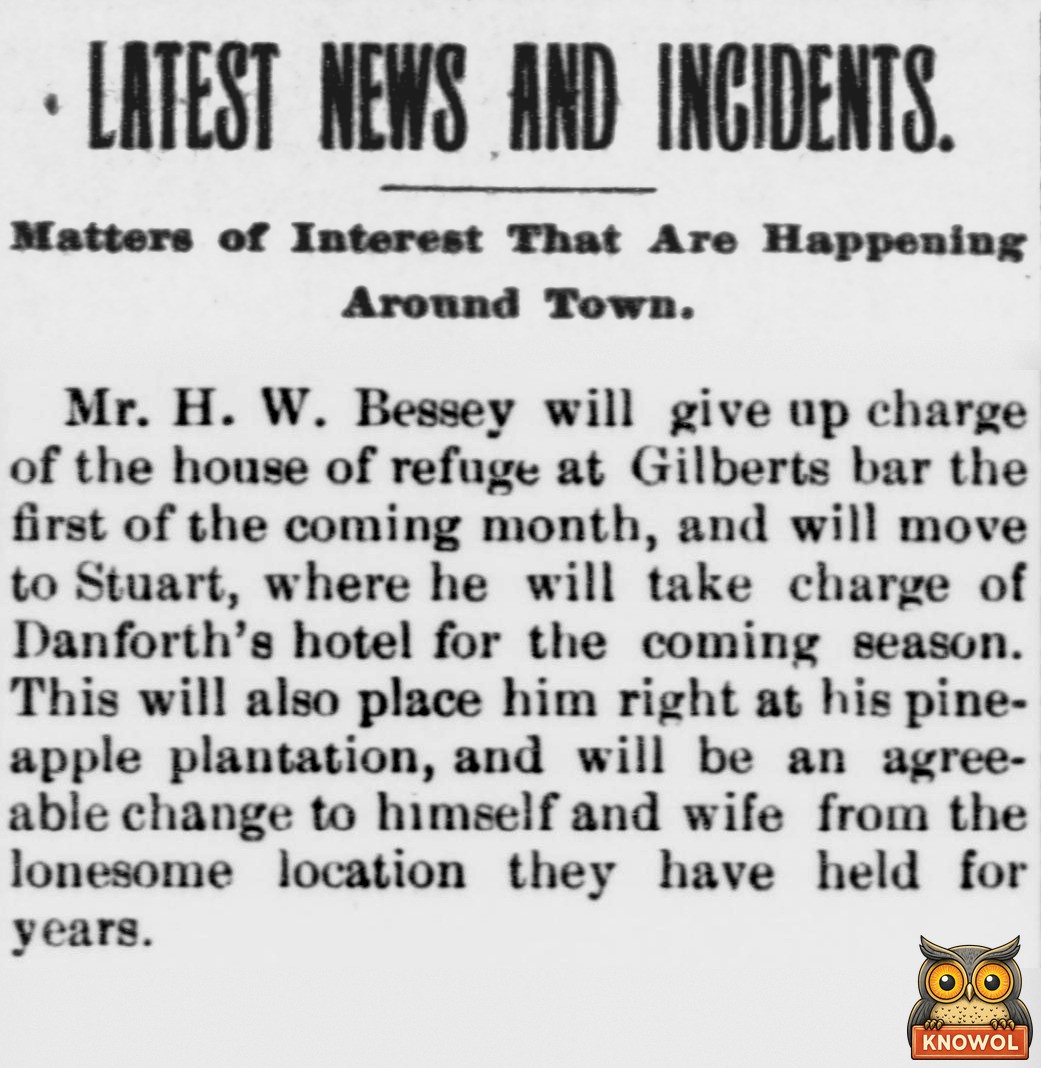
The Florida Star, Titusville, Florida, December 13, 1901, page 1. The column’s headline and the Bessey item, from the same column. Library of Congress, Chronicling America. Click the clipping to read it full size.
Why Florida Needed Houses of Refuge
In the 1890s, the U.S. Life-Saving Service ran ten houses of refuge along Florida’s east coast, spaced out along miles of empty beach. A magazine article about the Service, in Ainslee’s Magazine in 1898, explained why. If a ship broke up off this coast, the sailors who made it to shore were not safe yet. There was nobody around to feed them.
In the article’s words, “there is more danger of the shipwrecked perishing from starvation than from the anger of the waves, as the country is very thinly settled, especially along the low marshy grounds.” Thinly settled means very few people lived there.
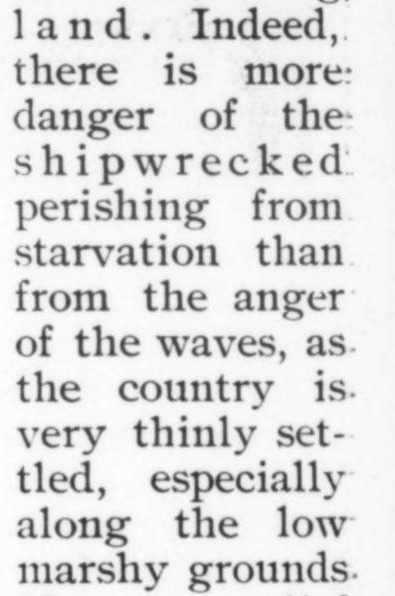
Ainslee’s Magazine, May 1898, page 357, from an article on the U.S. Life Saving Service. Internet Archive, public domain. Click the clipping to read it full size.
The same article said each house was simply a home for “the keeper and his family,” with “additional accommodations for about twenty-five persons, besides sufficient provisions to last such a number for ten days.” Provisions means food and supplies. Other lifesaving stations had crews of men who rowed boats out to wrecks, but the Florida houses did not. “No crews are employed at houses of refuge,” the article said, “but the keeper and his family are required to travel up and down the beach after a storm seeking for any who may be in need of help from shipwreck.”
Inside a House of Refuge Like the One at Gilbert’s Bar
In 1879, Popular Science Monthly printed a description of these Florida houses, built a few years earlier. The house at Gilbert’s Bar, near Stuart, Florida, opened in 1876. Each house sat “about six feet from the ground on light wood posts,” with “an ample veranda eight feet wide on three sides.” A veranda is a long, roofed porch.
The houses were about 37 feet long and 15 feet wide, with a loft upstairs and three rooms below. One detail fit the Florida coast exactly. “Instead of glass, the windows are fitted with wire-gauze mosquito netting.” Each house also had a boat-house with “a galvanized iron boat with sculls,” which are oars.
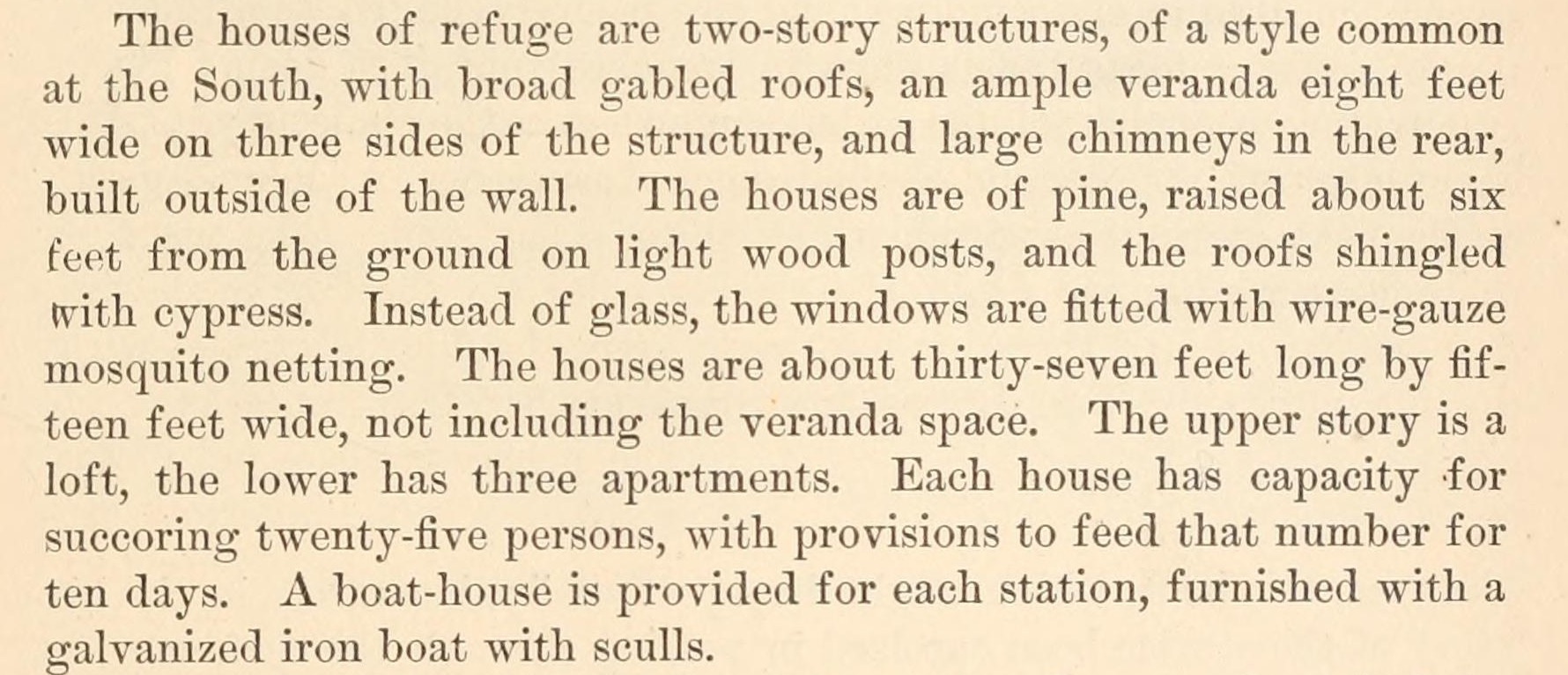
Popular Science Monthly, June 1879, page 183. Internet Archive, public domain. Click the clipping to read it full size.
Hubert Bessey’s Job at Gilbert’s Bar: Walk the Beach After Every Storm
Hubert W. Bessey was born in Ohio, and by July 1891, he was the keeper at Gilbert’s Bar, Florida. The Official Register of the United States, a thick book that listed government workers and their pay, shows him there that year at $600, and again in 1901. In the 1891 list, his name sits among the keepers of the other Florida houses and stations.
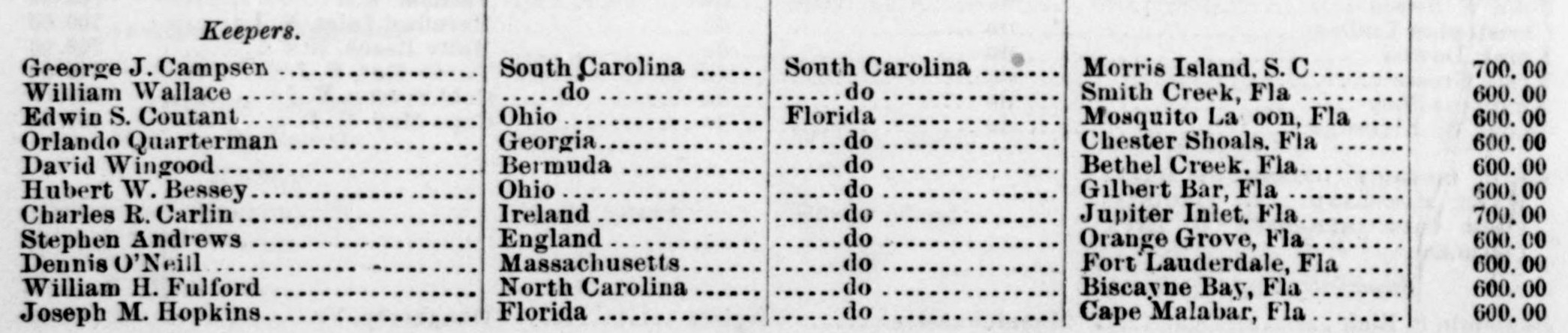
Part of the list of keepers in the Official Register of the United States, July 1891, with where each man was born, his station and his yearly pay. Bessey is the keeper at Gilbert Bar. Internet Archive, public domain. Click the clipping to read it full size.
In 1898, The Saturday Evening Post told its readers what a keeper did for that money. His pay was “six hundred dollars a year and the use of the house,” and “It is his business to make expeditions after every big storm for the purpose of ascertaining if anybody has been cast away and is in need of help.” Ascertaining means finding out. Anyone found on the beach was brought back to the house, “where there are a number of neat beds and medical supplies.” The Post also said the keeper’s family might go a whole year “not seeing half a dozen human beings.”
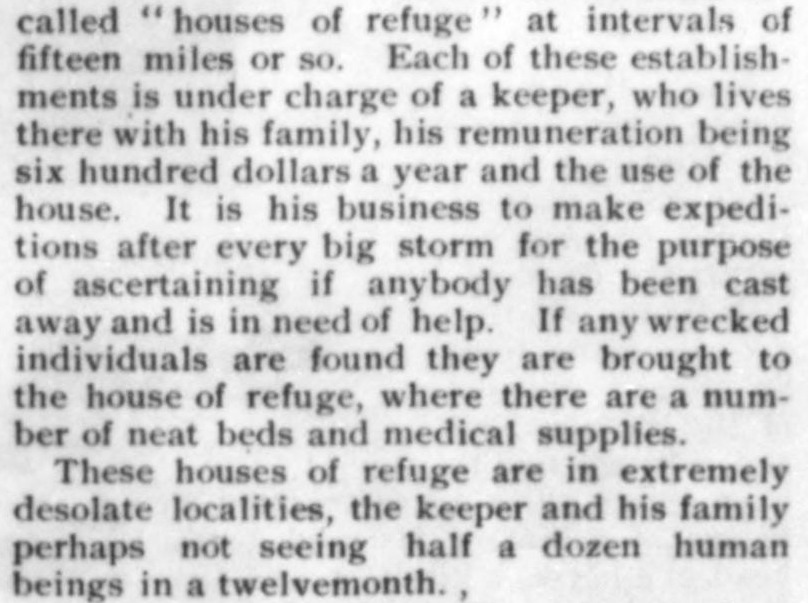
The Saturday Evening Post, October 22, 1898, page 266. Internet Archive, public domain. Click the clipping to read it full size.
A Yacht Club Half a Mile Down the Beach From the Besseys
At Gilbert’s Bar near Stuart, Florida, the Besseys were not quite that alone. They had neighbors at least once a month. In 1897, the outdoor weekly Forest and Stream described a sailing club whose clubhouse stood on “a narrow strip of land, with the ocean on one side and Indian River on the other.” It was “one-half mile south of Gilbert’s Bar House of Refuge.”
The club started in October 1895 with 18 members and had 45 by early 1897. “The club holds a field day every month, when there is a regatta and other amusements, followed by dancing in the evening,” the report said. A regatta is a day of sailboat races. On the club’s list of officers was “Capt. H. W. Bessey, Sewall’s Point, Fla.” He was the club’s measurer, the man who measured the boats so they could be sorted fairly for the races.
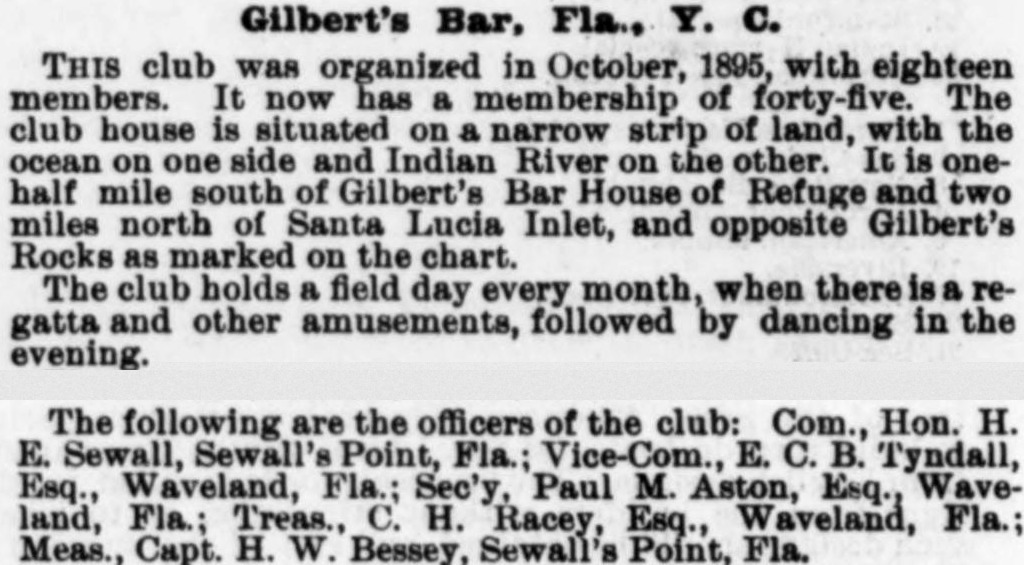
Forest and Stream, February 27, 1897. Two parts of one report, joined; the race results between them are left out. Internet Archive, public domain. Click the clipping to read it full size.
Pineapples Near Stuart, Florida
Bessey’s other work was on land. He grew pineapples, and so did many of his neighbors along this part of the Indian River. At Jensen Beach, Florida, just north of Stuart, a stereograph photo from 1894 shows a pineapple field running all the way back to the buildings in the distance.
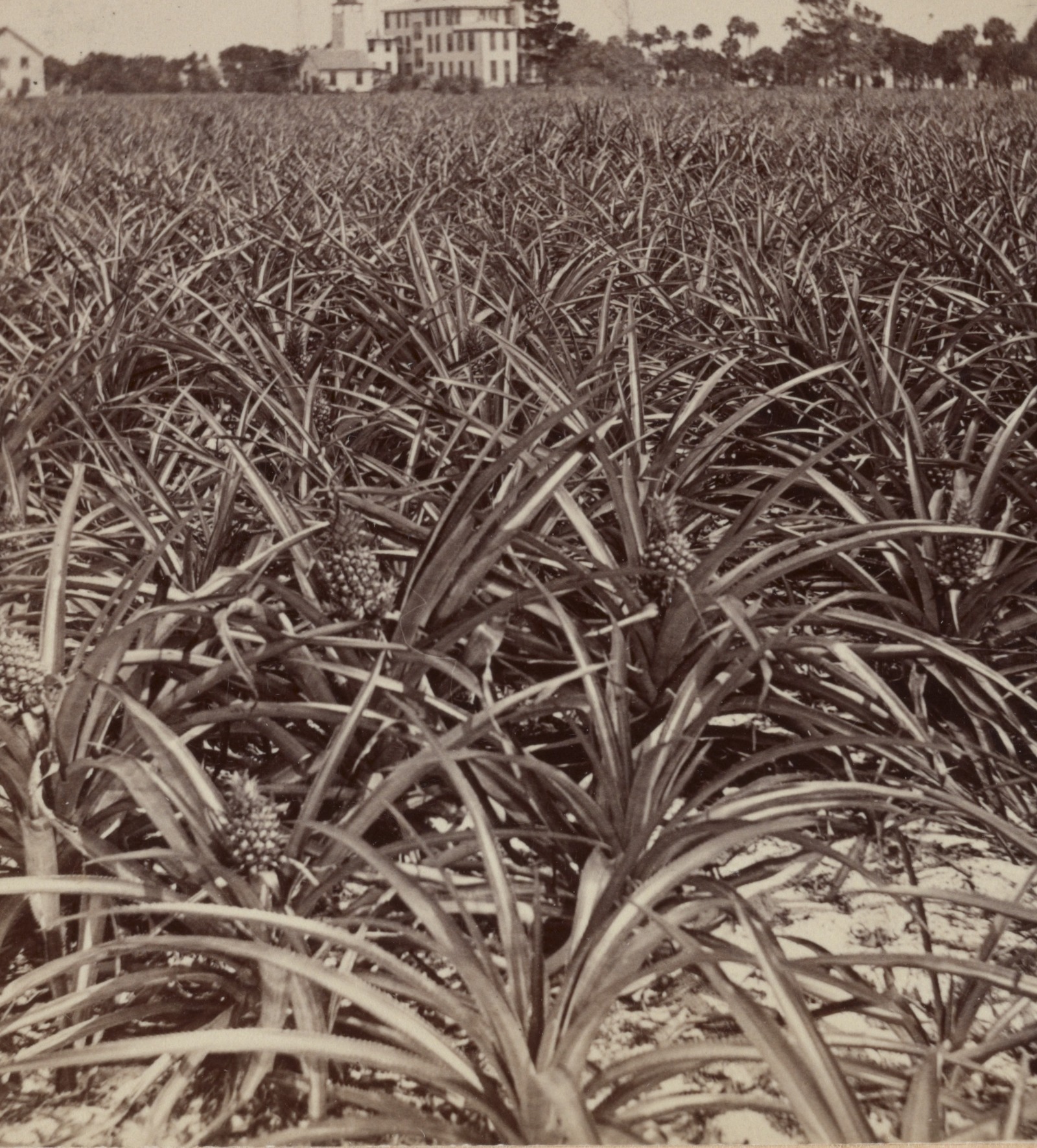
A pineapple plantation at Jensen, Florida, just north of Stuart, in 1894. Each plant grows one pineapple in the middle of its leaves. Stereograph by Geo. Barker, Library of Congress. Click the picture to see it full size.
The same page of The Florida Star that carried the Bessey news had pineapple ads. One sold posts for the sheds that some growers built over their plants. “We sell nothing but good, solid heart lightwood,” the seller promised. Lightwood is pine full of sticky sap, and the ad said its posts would “last 5 to 10 years longer” than sawn ones.
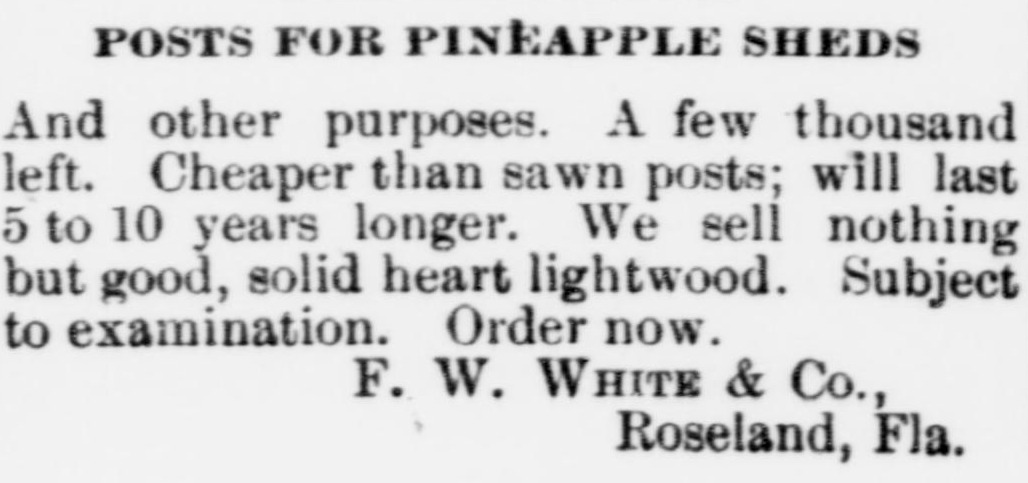
The Florida Star, Titusville, Florida, December 13, 1901, page 1. Library of Congress, Chronicling America. Click the clipping to read it full size.
Another ad offered a farm on Merritt Island with “14,000 pines.” On the Indian River, “pines” meant pineapples, and the farm’s last crop had included “135 crates pines.”
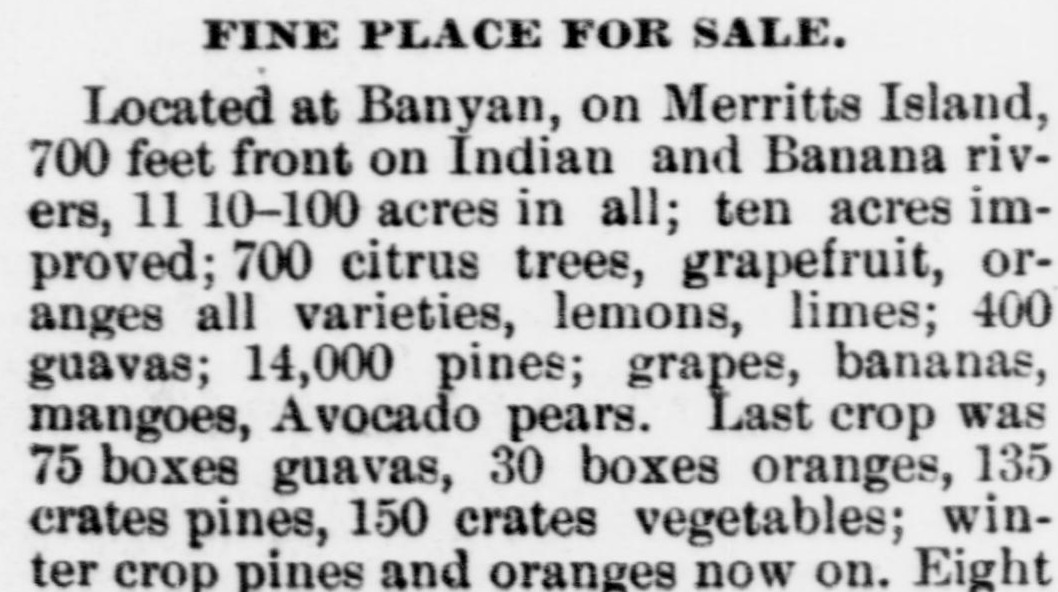
The Florida Star, Titusville, Florida, December 13, 1901, page 1. Library of Congress, Chronicling America. Click the clipping to read it full size.
A Couple From Titusville, Florida, Takes Over
The next keeper came from Titusville, Florida, the Star’s own town. On January 17, 1902, under the headline “Government Appointment,” the paper said, “Mr. Axle H. Johanson, of this place, was the fortunate one to secure the appointment as keeper of the house of refuge at Gilberts bar, vice Mr. H. W. Bessey, resigned.” Vice means in place of. The paper spelled his last name two different ways in the same item.
Moving day was by water. “Mr. and Mrs. Johansen left here the first of the week with the large sloop, owned by G. Gulbransen, loaded with their household effects, for their new location.” A sloop is a sailboat with one mast, and household effects are furniture and belongings. Before the job, Mr. Johansen had been in “the bakery business” in Titusville. His wife was born Miss Quarterman. “The government has selected a good man for the position,” the paper said.
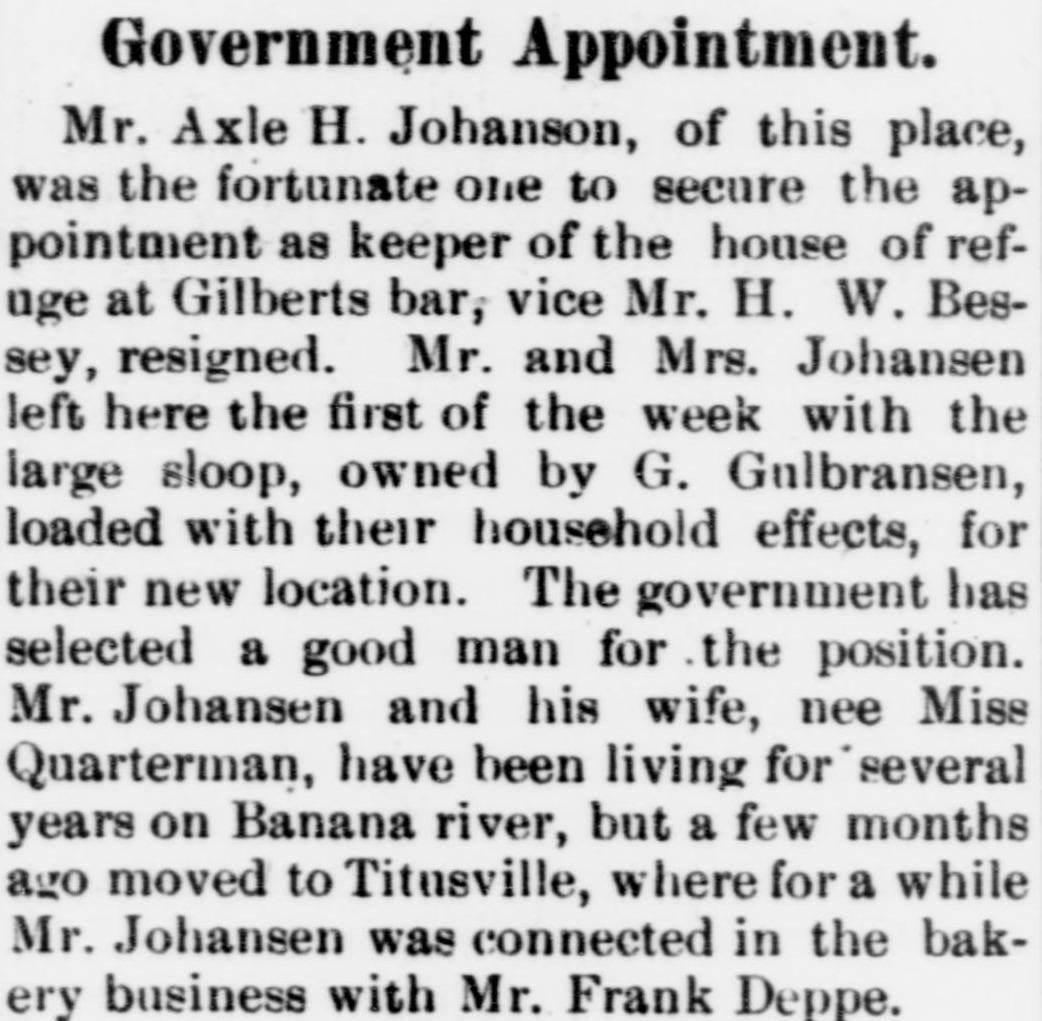
The Florida Star, Titusville, Florida, January 17, 1902, page 1. Library of Congress, Chronicling America. Click the clipping to read it full size.
The House of Refuge Near Stuart, Florida, Today
The Besseys stayed in Stuart. In 1912, a book about old hand-woven bedspreads showed a coverlet of “dark blue, white, green, and old rose,” “Woven in France three generations ago.” Under it was the line “Owned by Mrs. Hubert W. Bessey, Stuart, Fla.”
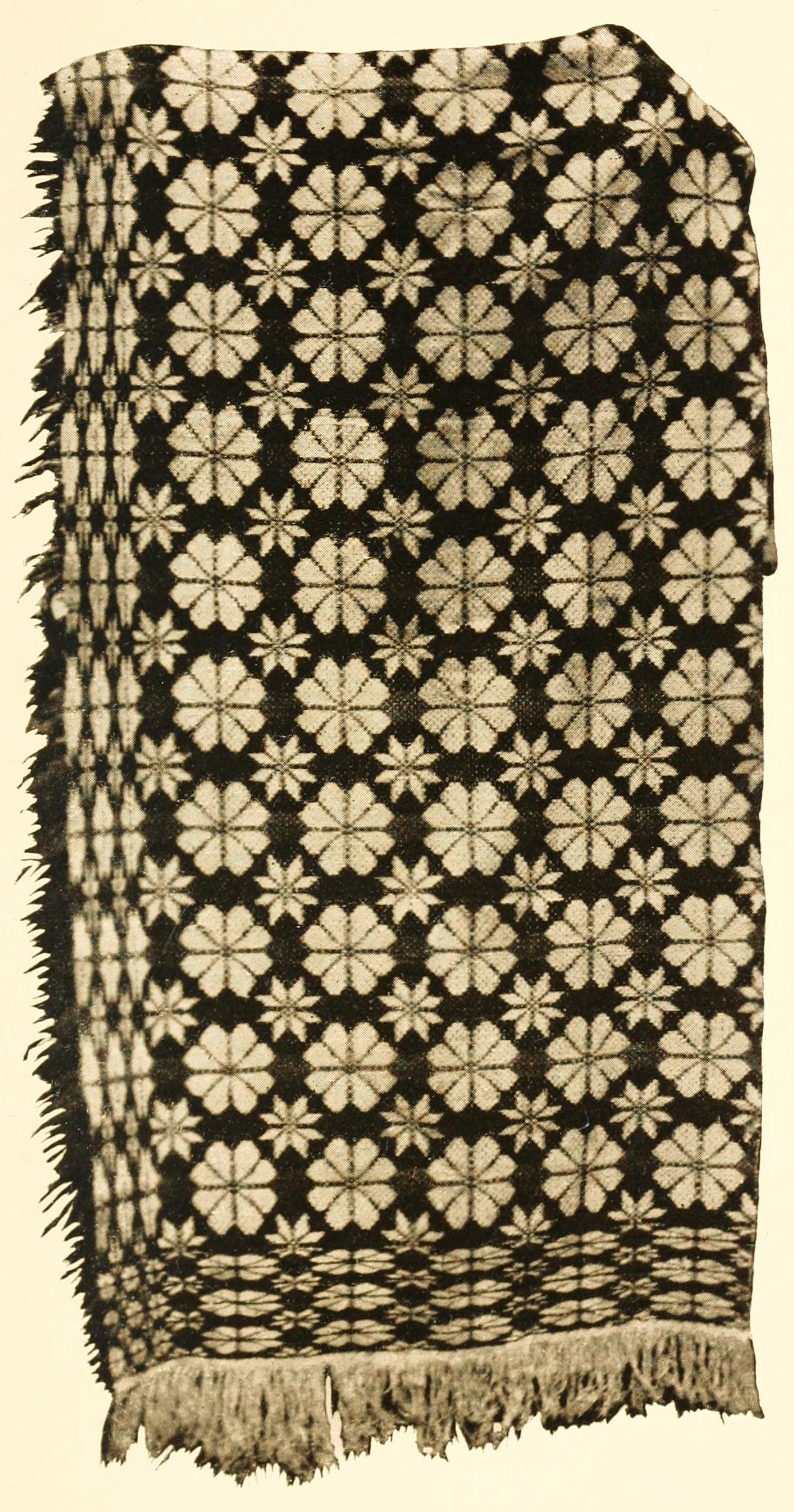
The La France coverlet owned by Mrs. Hubert W. Bessey of Stuart, Florida, from A Book of Hand-Woven Coverlets by Eliza Calvert Hall, 1912. Internet Archive, public domain. Click the clipping to read it full size.
The house at Gilbert’s Bar kept working. According to the State Archives of Florida, it served the Life-Saving Service until 1915, then the Coast Guard, and then the Navy during World War II. By 1955, it was the last house of refuge still standing. It became a museum, and in 1973, it was listed on the National Register of Historic Places.
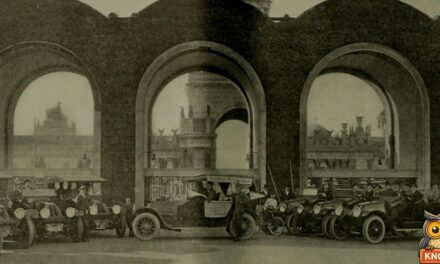
The photo at the top of this page is not Gilbert’s Bar. It shows the Mosquito Lagoon House of Refuge near Oak Hill, Florida, another of the ten Florida houses, as Ainslee’s Magazine printed it in 1898. In 1891, its keeper was Edwin S. Coutant, who was born in Ohio, like Bessey. After years of watching an empty beach for strangers who needed help, the Besseys moved to town to look after strangers who came on purpose.
Sources
- “Latest News and Incidents,” The Florida Star (Titusville, Florida), December 13, 1901, page 1, the Bessey item and the two pineapple ads. Library of Congress, Chronicling America.
- “Government Appointment,” The Florida Star, January 17, 1902, page 1. Library of Congress, Chronicling America.
- Joanna R. Nicholls-Kyle, “The U.S. Life Saving Service,” Ainslee’s Magazine, May 1898, page 357, and page 358. Internet Archive.
- René Bache, “Romance of the Sea Coast,” The Saturday Evening Post, October 22, 1898, page 266. Internet Archive.
- W. D. O’Connor, “The United States Life-Saving Service,” Popular Science Monthly, June 1879, page 183. Internet Archive.
- Official Register of the United States, July 1891, keepers of houses of refuge, and the July 1901 Register. Internet Archive.
- “Gilbert’s Bar, Fla., Y. C.,” Forest and Stream, February 27, 1897. Internet Archive.
- Eliza Calvert Hall, A Book of Hand-Woven Coverlets, 1912, the La France coverlet. Internet Archive.
- Florida, Pineapple plantation at Jensen, Geo. Barker, 1894. Library of Congress Prints and Photographs Division. No known restrictions on publication.
- A couple stands next to the wreck near Hutchinson Island’s Gilbert’s Bar House of Refuge, Stuart, Florida, with the archive’s note on the history of the house. Florida Memory, State Archives of Florida.
- The cover photo, the Mosquito Lagoon House of Refuge, Oak Hill, Florida, is from page 357 of the May 1898 Ainslee’s Magazine above.
- The newspapers, magazines, books and photographs above were all published before 1931 and are in the public domain.