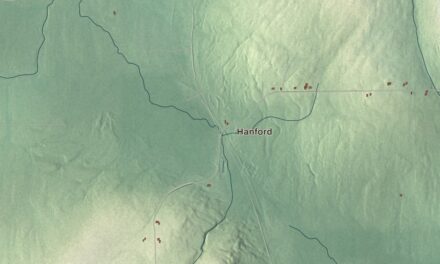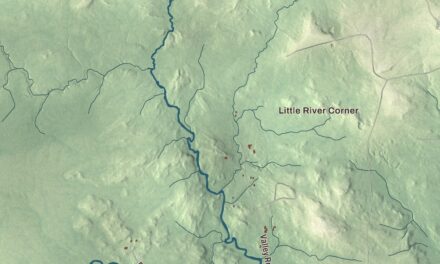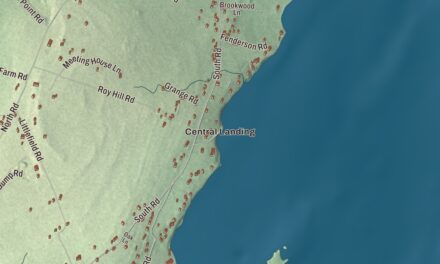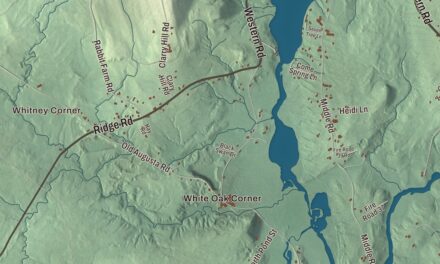
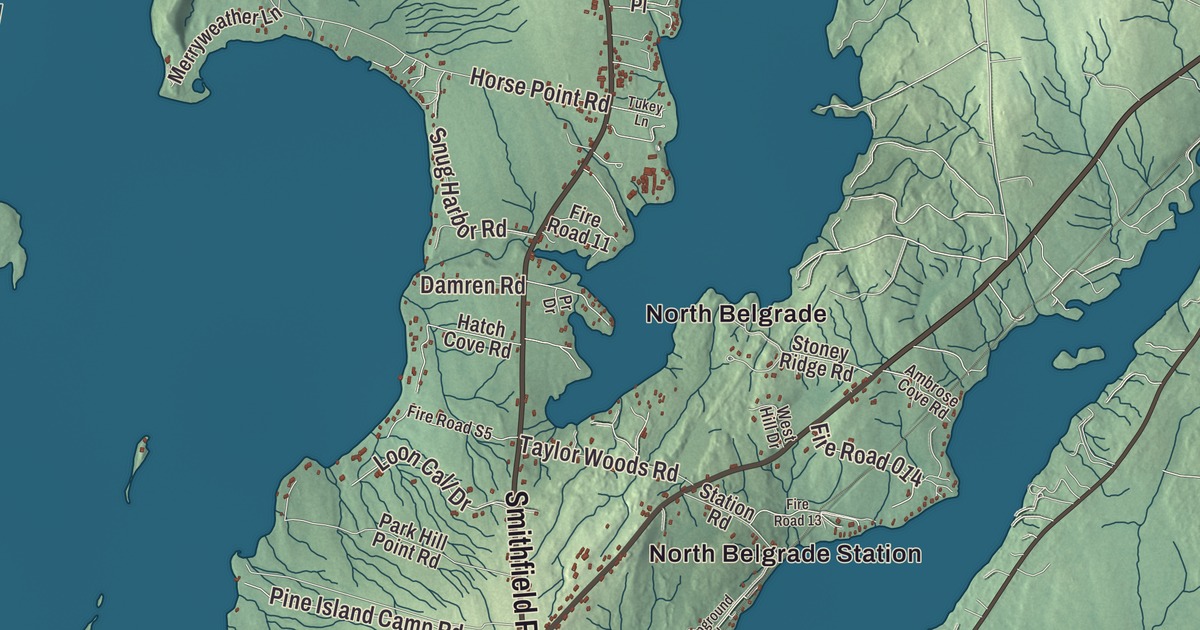
If your summers were spent on Great Pond or Messalonskee Lake, you know this place by the water first. This Belgrade map prints both lakes, along with North Belgrade, North Belgrade Station and a web of roads: Augusta Road, Smithfield Road, Manchester Road, West Road, Minot Hill Road and Depot Road. Click here to purchase a print of this map for your wall.
Belgrade is a town in Kennebec County.
KNOWOL made this map in 2026 from public survey data, styled like a page from an old atlas. The hills are shaded from United States Geological Survey elevation data, and the roads and town line come from the Census Bureau. Of the 57.93 square miles the bureau counts in Belgrade, 14.69 are water, and 3,250 people lived here at the 2020 census, a number its town page says roughly doubles in summer when people come back to their camps.
Washington Plantation becomes Belgrade
The land first belonged to the Plymouth Company, and settlers took their titles from it. Philip Snow came up from New Hampshire in 1774 and was the first to settle what was then called Washington Plantation. On February 3, 1796, the plantation was incorporated as Belgrade, named for Belgrade in Serbia. Farming was the main work, with potatoes the chief crop, and the outlets of the ponds turned mills. By 1859 there were a shovel factory, a spool factory and several sawmills and gristmills, and by 1886 there were factories for rakes, shingles, excelsior, scythes and boxes as well.
Two brothers born in Belgrade went on to govern Maine. Anson P. Morrill, born here in 1803, was the state’s 24th governor and later a congressman. Lot M. Morrill, born here in 1813 as one of 14 children, became the 28th governor, a United States senator and Secretary of the Treasury under President Grant. In the Senate he sponsored legislation that outlawed slavery in Washington, D.C.
With the arrival of the railroad, Belgrade grew into a resort of fishing, boating and lakeside cottages. The Portland architect John Calvin Stevens designed the Belgrade Hotel at Belgrade Lakes, built in 1899, and one of its cottages, The Birches, built in 1916, still stands on Foster Lane; its page calls it the best-preserved surviving building tied to the hotel, which burned in 1955. E. B. White came to the lakes as a boy and wrote about coming back with his own son in “Once More to the Lake,” published in Harper’s Magazine in 1941. The playwright Ernest Thompson spent summers at Great Pond too, and those stays inspired his 1979 play On Golden Pond, which became the Academy Award winning film of 1981.
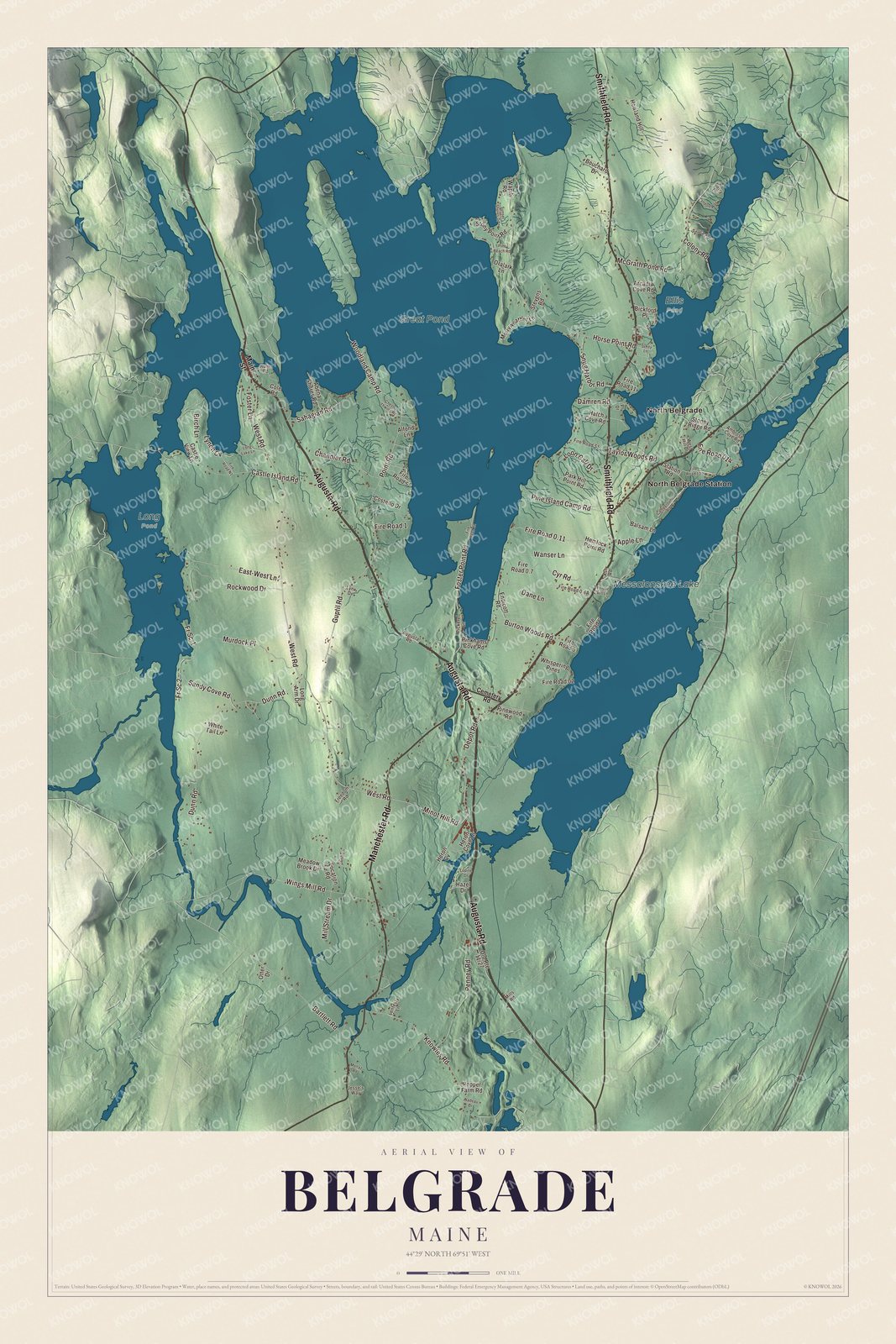
Click to explore a larger preview. The digital watermark does not appear on printed maps.
See it on a wall
The Belgrade map as a framed print. Swipe for more.


Around the lakes
Great Pond is printed on the map. It’s the largest of the Belgrade Lakes, 8,239 acres, and most of it lies in Belgrade, with Rome at its north end. The Great Pond Storage Dam, built on Belgrade Stream in 1886 for power, gave the lake its present shape. Hoyt, Chute, Joyce, Oak, Otter and Pine islands sit in its waters, and Salmon Lake flows into its east side through a short channel near North Belgrade.
Messalonskee Lake is printed as well. Its page says it’s more commonly called Snow Pond, after Philip Snow, who settled here in 1774. It’s a narrow lake about nine miles long, the deepest of the chain at 113 feet, and a dam built in Oakland in 1905 made it larger. The New England Music Camp, founded in 1937, is one of the summer camps on the lake. The chain runs from East Pond to North Pond, Great Pond, Long Pond and Messalonskee, and the water leaves by Messalonskee Stream for the Kennebec River at Waterville.
Augusta Road is printed too. Maine Route 27 follows it, and at number 538, in the northern part of town, the Foster Farm Barn stands behind a farm stand. Frank and Edgar Foster built it in the first years of the 1900s on land their parents had farmed since the late 1850s, and it was laid out for a dairy herd, with concrete manure troughs and vents in the walls and roof. In 1902 the brothers were reported to keep fifteen cows. Route 27 also passes through the village of Belgrade Lakes and the Chandler Store, built in 1838, which its page counts as one of only two known commercial buildings in Maine made of granite blocks. The stone was quarried in Vienna and hauled by sled across the frozen surface of Long Pond. Smithfield Road, Manchester Road, West Road, Minot Hill Road and Depot Road are printed on the map, and so are North Belgrade and North Belgrade Station.
This Belgrade map makes a handsome addition to an office, library or den, and it can teach children the geography and history of the Belgrade Lakes. It’s made for anyone who calls Belgrade home, from North Belgrade to the shore of Messalonskee Lake, as it looks today. Zoom in on the preview above to explore the details, then click here to get your copy of the Belgrade, Maine map.

Sources
- Belgrade, Maine, Wikipedia
- Anson P. Morrill, Wikipedia
- Lot M. Morrill, Wikipedia
- The Birches (Belgrade Lakes, Maine), Wikipedia
- Once More to the Lake, Wikipedia
- On Golden Pond (play), Wikipedia
- Belgrade Lakes, Wikipedia
- Great Pond, Wikipedia
- Messalonskee Lake, Wikipedia
- Foster Farm Barn, Wikipedia
- Chandler Store, Wikipedia