
A hilltop town on the Ware River, named in 1776 for a friend of American liberty, whose dairies, powder mills, palm-leaf hat shops and cotton mills once ringed a fifteen-acre common that still hosts summer band concerts.
Barre then and now
The same town 135 years apart. Click either map to look closer.
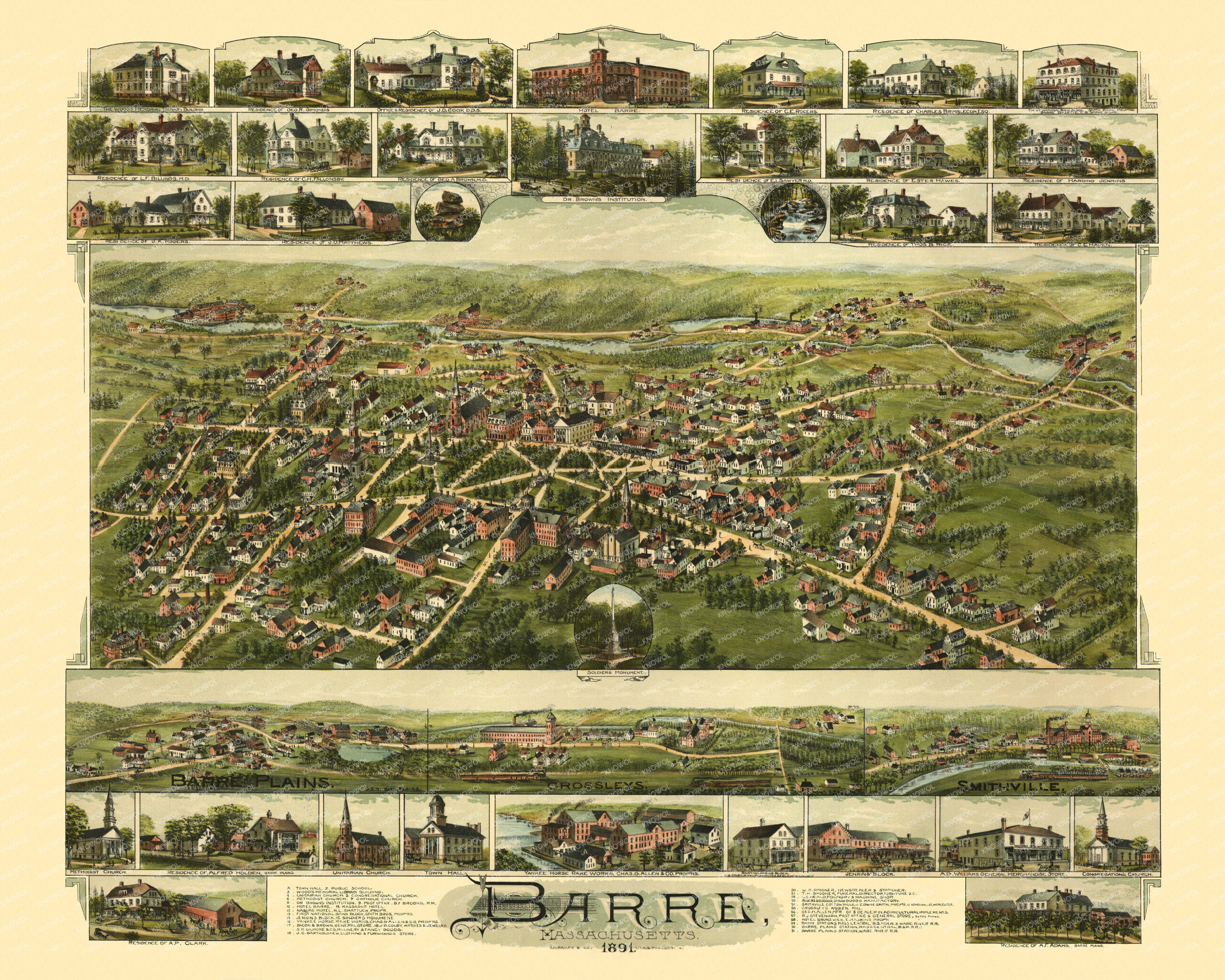
The bird's-eye view
By O.H. Bailey
Barre drawn as if from the sky in 1891, with the Town Hall, Wood's Memorial Library, the Naquag Hotel, the Yankee Horse Rake Works, the Smithville Cotton Mills, Crossley's Woolen Mill and Barre Plains Station.5
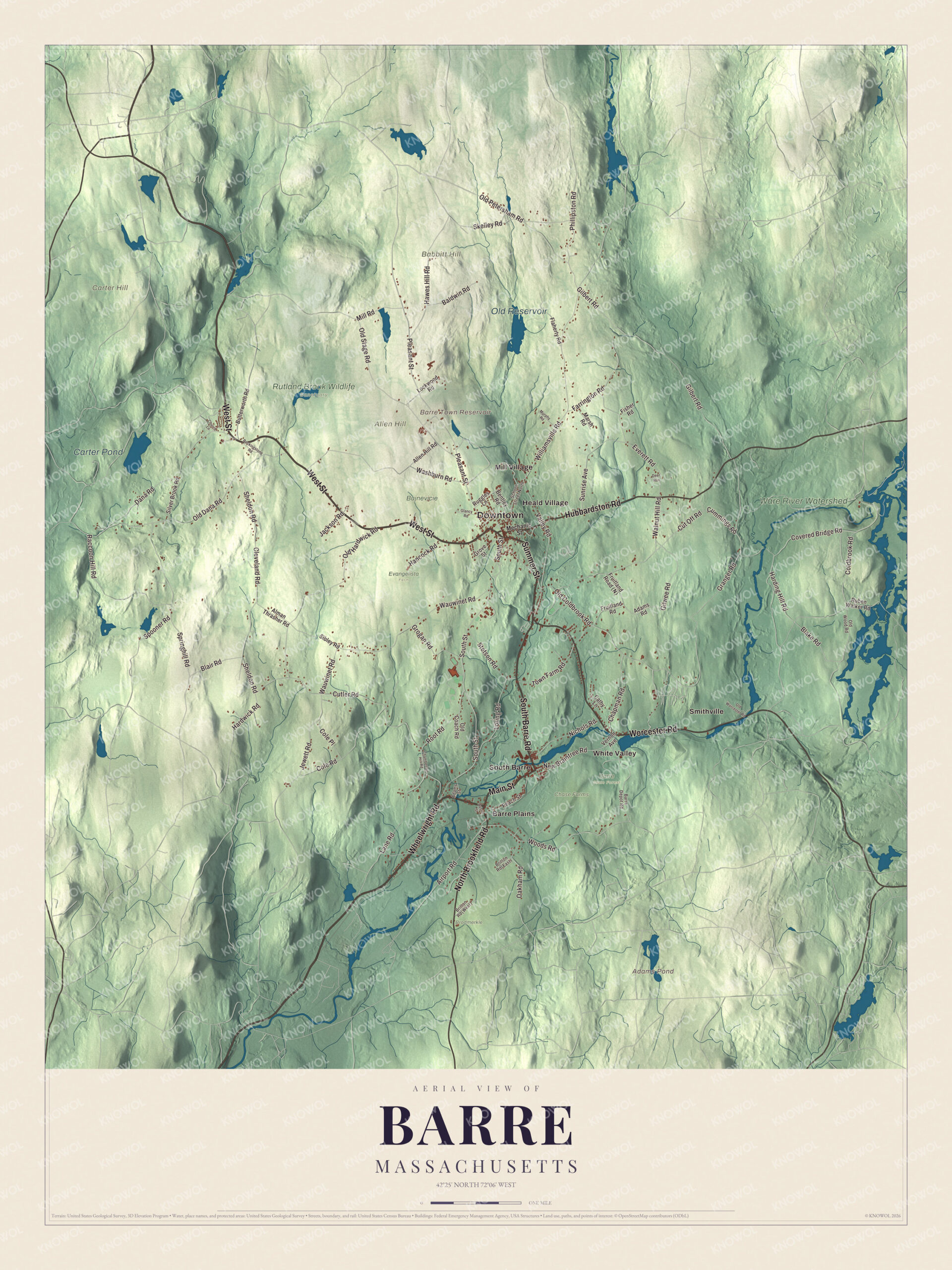
Barre today
By KNOWOL
Shaded hills and every street, from the common out to Barre Plains, South Barre and White Valley, with the Barre Town Reservoir, the Old Reservoir, Adams Pond, Carter Pond, Allen Hill, Babbitt Hill and Carter Hill printed by name.6
The history of Barre, Massachusetts
The town that wouldn't be Hutchinson
In 1773 the people of Rutland District voted to ask the General Court to make them a town called Barre, after Colonel Isaac Barré, the member of Parliament who had stood up for the colonies against the Stamp Act and given the patriots the name Sons of Liberty. When the act passed in June 1774, though, the town was named Hutchinson, after the governor most patriots despised, and an 1883 history says Governor Gage had the name put in. Barre's people couldn't stand to sign their letters from Hutchinson. In 1776 they petitioned again and asked to be called Wilkes, after another friend of America. Someone, still unknown, wrote in Barre instead, and the new name passed on November 7, 1776.78916
Palm leaf, powder and the first hay tedder
Barre's streams kept a surprising mix of shops busy. About 1826 Silas Bemis and his son-in-law built gunpowder mills on the Ware River, and powder was made there until 1865. Around 1829 a Dedham woman took apart an imported palm-leaf hat to learn how it was made, taught a woman in Petersham, and she taught the women of Barre. Braiding hats at home became a big business, and by 1888 the hat works on Prince River made more than 200,000 dozen hats a year. Up the same stream, Stephen Heald's foundry grew into Heald Village, and among the farm tools made there was E. W. Bullard's hay tedder, which the county history calls the first machine ever built for turning hay in the field.1011
Smithville and the white trees
About 1825 Benjamin Clark built a brick cotton factory on the Ware River, the first big mill in that part of the state, and went broke doing it. The company that took it over did no better until it hired John Smith, an English-born millwright, to run the mill by the yard. When the factory burned, Smith bought it at auction, built a new mill and ran it until he died in 1859, and the village around it took his name. In 1889 Smithville was called a model factory village of neatly painted houses and shade trees. Some of those trees were so big and so close to the road that the selectmen ordered them cut. Smith saved them by promising to keep their trunks painted white fifteen feet up, and his sons kept the promise.121314
Barre, Massachusetts through the years
25 moments from 1720 to today.
- 1720European settlement begins in what was then the Northwest District of Rutland.1
- 1749The northwest quarter of Rutland is set off as Rutland District, a town in all but its seat in the General Court.7
- 1753A church is gathered here and Rev. Thomas Frink is installed as its minister.15
- 1773The district votes unanimously to petition to become a town, asking for the name Barre.7
- 1774On June 17 the town is incorporated, but under the name Hutchinson, which Governor Gage is said to have put in.8
- 1776On November 7 the hated name is dropped and the town becomes Barre. The people had asked for Wilkes.8
- 1792The Barre Common is laid out.16
- 1800Barre is one of the leading towns of the county; only three pay more state tax.7
- 1825About this year Benjamin Clark builds a brick cotton factory, the first big mill in this part of the state, at what becomes Smithville.12
- 1826About this year Silas and Charles Bemis build gunpowder mills on the Ware River.10
- 1827The First Parish buys stoves for its meetinghouse, ahead of every neighboring town.17
- 1829About this year palm-leaf hat braiding reaches Barre by way of a Dedham woman and a Petersham woman.10
- 1830Stephen Heald starts the foundry and machine shop that grows into Heald Village.10
- 1839One of the state's first normal schools for teachers opens upstairs in the new town hall.3
- 1844The Barre Patriot is started on July 26 to answer the Barre Gazette.18
- 1849The Greek Revival Barre Congregational Church is built facing the common.16
- 1851The Worcester West Agricultural Society is chartered and begins its fall fairs in Barre.19
- 1873The Ware River Railroad opens for travel to Barre Plains in October.10
- 1883The one-room No. 4 Schoolhouse is built on Farrington Road.20
- 1887The Woods Memorial Library building, Henry Woods's gift to his native town, is dedicated on December 30.21
- 1891O.H. Bailey publishes his bird's-eye view of Barre.5
- 1894The brick Romanesque Barre Savings Bank goes up on the common.16
- 1943Barre gives Seaman Basil Izzi, who survived 83 days on a life raft, a hometown welcome on April 11.1
- 1958The Army Corps of Engineers finishes the Barre Falls Dam on the Ware River.22
- 1976The Insight Meditation Society opens its first retreat center in an old Barre mansion on February 14.23
Places to see in Barre, Massachusetts
Places worth a visit in Barre today.
- Barre CommonCenter of town. The 15-acre green, laid out 1792.
- Barre Congregational ChurchNorth end of the common. Greek Revival church of 1849.
- Lawrence-Holman-Graziani HouseOn the common. Six-column temple front of 1836.
- Barre Historical SocietyCommon Street. Temple-front building of 1836.Visit their website
- Barre Savings BankOn the common. Brick Romanesque bank of 1894.
- Riverside CemeteryBarre. Jacob Riis lies under a boulder.
- Insight Meditation SocietyBarre. Retreat center opened in 1976.Visit their website
- Barre Center for Buddhist StudiesLockwood Road. Study center begun in 1990.Visit their website
- Barre Falls DamOn the Ware River. Flood control dam of 1956 to 1958.
- Basil D. Izzi Memorial BridgeRoute 32 near South Barre. Named for the life-raft survivor.
Barre on the National Register of Historic Places
All 2 places in Barre on the National Register of Historic Places that still stand today, oldest first, and why each one matters.4
-
Barre Common District
The 15-acre common was laid out in 1792 and has been the center of Barre's civic life ever since, once a militia training ground and the site of the town pound. Around it stand the Greek Revival Congregational Church of 1849, the temple-front Lawrence-Holman-Graziani House and Historical Society building of 1836, and the brick Barre Savings Bank of 1894, and its bandstand, the third, still hosts summer concerts.16
-
No. 4 Schoolhouse
A one-room wood schoolhouse built in 1883, at least the second in the town's fourth district. It held classes until 1930, when Barre centralized its schools, and a local group bought it in 1937 and has kept it as a community center since.20
Barre in their words
“to the influences of hills and valleys not often surpassed in their beauty; or to air than which none is purer; or to skies than which none are fairer.”
Mellen Chamberlain, at the dedication of the Woods Memorial Library, Barre, December 30, 188721
“The people of this town could not patiently endure to date their letters, or subscribe their names, or anywhere report themselves as belonging to Hutchinson”
History of Worcester County, 1879, on why the town dropped the name Hutchinson7
“Barre is a large, flourishing, and well-built village.”
John Warner Barber, Historical collections of every town in Massachusetts, 183924
Towns near Barre, Massachusetts
Sources for the history of Barre
- Barre, Massachusetts, Wikipedia
- A gazetteer of the state of Massachusetts (1890), on Barre, Internet Archive
- History of Worcester County, Massachusetts, volume 1 (1889), on Barre's schools, Internet Archive
- National Register of Historic Places listings in Worcester County, Massachusetts, Wikipedia
- Beautifully Detailed Map of Barre, MA from 1891, restored by KNOWOL
- Map of Barre, Massachusetts in 2026, KNOWOL
- History of Worcester County, Massachusetts (1879), on Barre, Internet Archive
- Origin of the names of the towns in Worcester County (1883), on Barre, Internet Archive
- Origin of the names of the towns in Worcester County (1883), on Colonel Isaac Barre, Internet Archive
- History of Worcester County, Massachusetts, volume 1 (1889), on Barre's mills and railroads, Internet Archive
- History of Worcester County, Massachusetts, volume 1 (1889), on the Barre hat works, Internet Archive
- History of Worcester County, Massachusetts (1889), on the Smithville cotton mill, Internet Archive
- Biographical history of Massachusetts (1909), on John Smith of Smithville, Internet Archive
- Genealogical and biographical records of American families: Massachusetts (1928), on John Smith, Internet Archive
- A gazetteer of Massachusetts (1849), on Barre, Internet Archive
- Barre Common District, Wikipedia
- History of Worcester County, Massachusetts (1889), on the First Parish of Barre, Internet Archive
- Proceedings at the semi-centennial anniversary of the connection of Caleb Arnold Wall with the Worcester County press (1887), Internet Archive
- History of Worcester County, Massachusetts, volume 1 (1889), on the Barre library and fair, Internet Archive
- No. 4 Schoolhouse, Wikipedia
- John Adams, the statesman of the American Revolution, with other essays and addresses (1899), Mellen Chamberlain's address at the Woods Memorial Library, Internet Archive
- Barre Falls Dam, Wikipedia
- Insight Meditation Society, Wikipedia
- Historical collections of every town in Massachusetts (1839), on Barre, Internet Archive