
A Mystic River city where the first bridge over the river went up in 1637, and where Medford rum, Medford crackers and more than five hundred Medford-built ships carried the town's name around the world.
Then and now
The same town 146 years apart. Click either map to look closer.
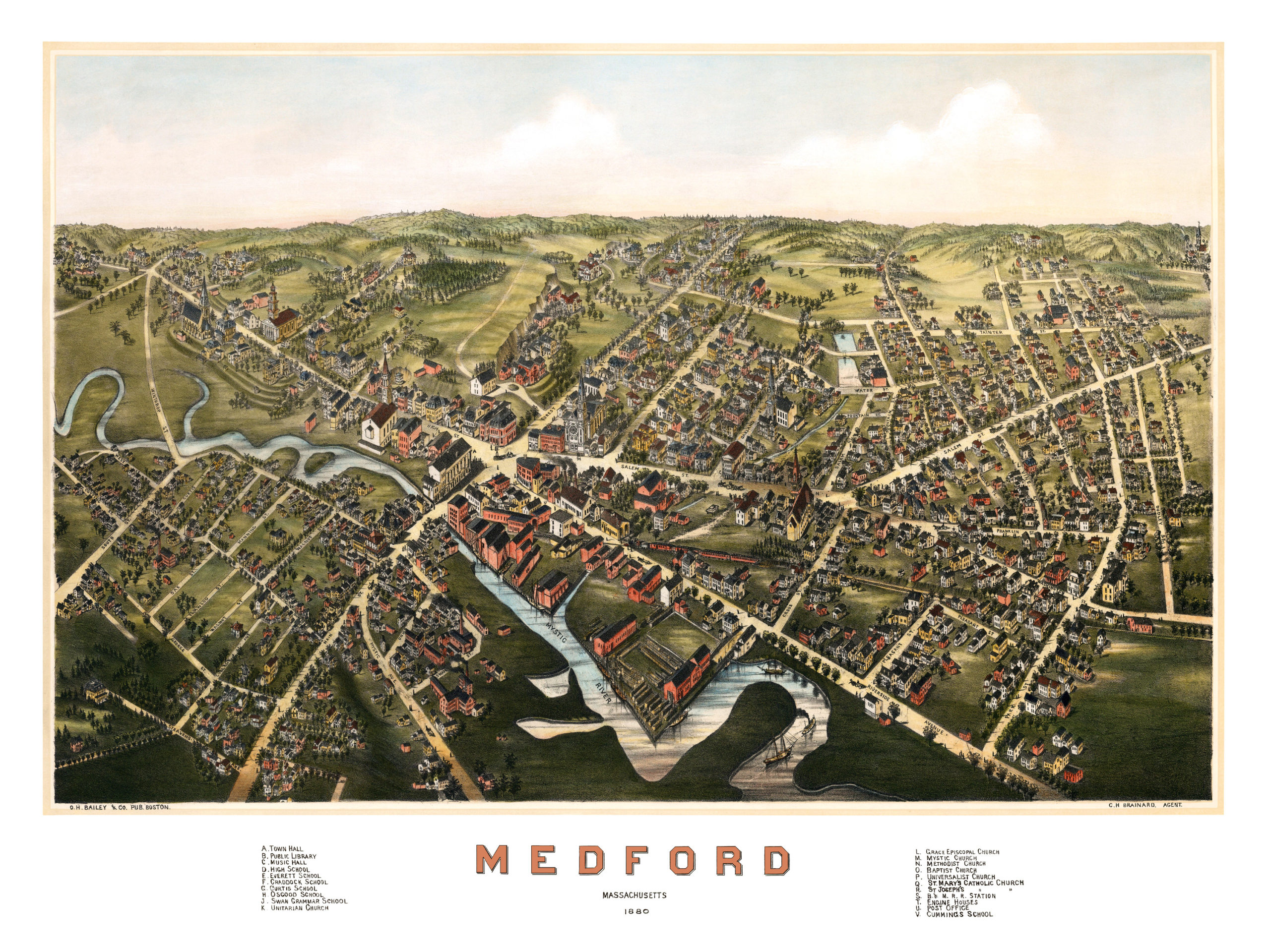
The bird's-eye view
By O.H. Bailey
Medford drawn as if from the sky at the end of the 1800s, with the Town Hall, Music Hall, the Everett, Craddock and Swan schools, Mystic Church, St. Mary's Catholic Church, the engine houses and the B&M railroad station.5
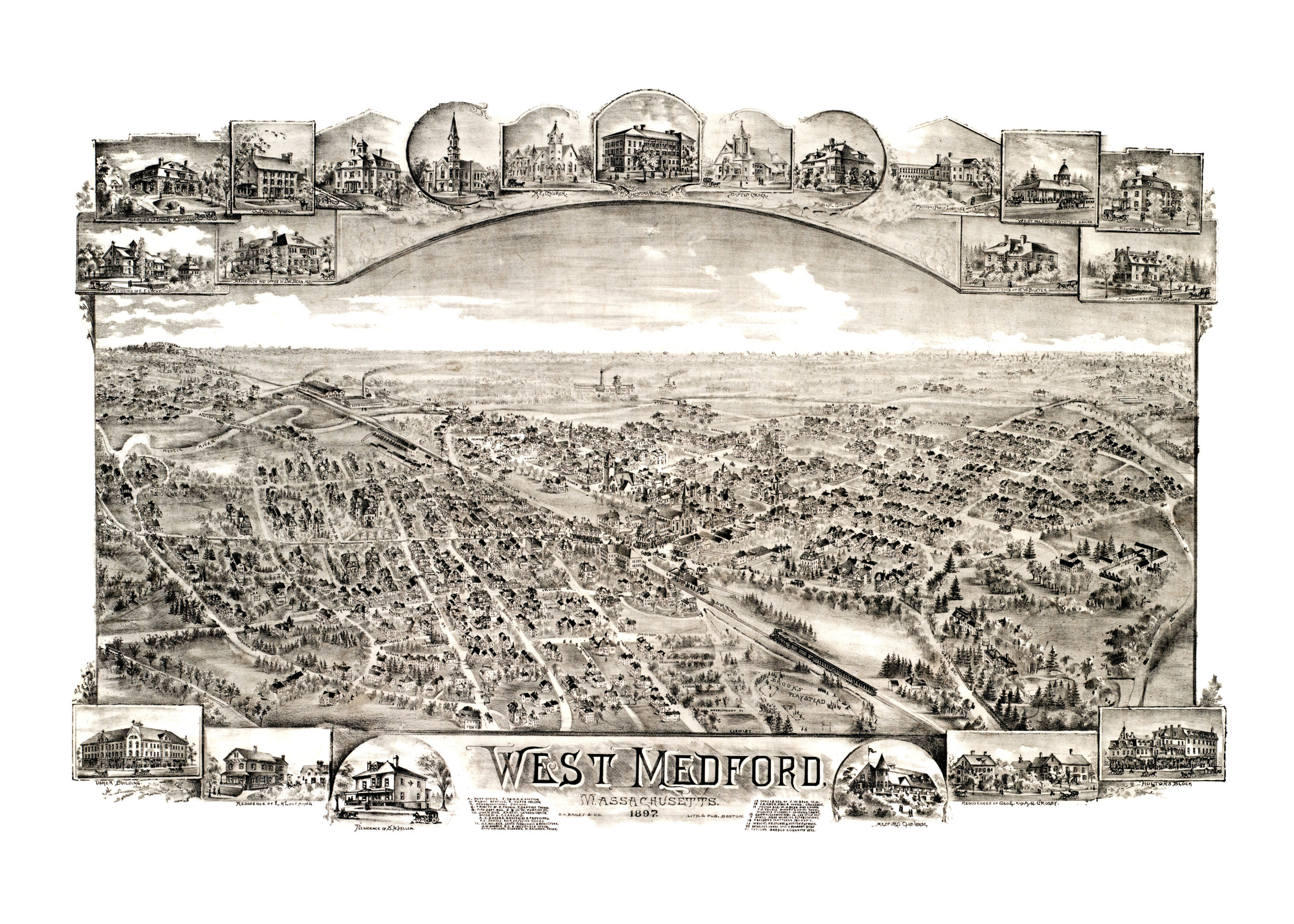
West Medford in 1897
By O.H. Bailey & Co.
A view of West Medford, one part of the city, with the Medford Club House, the Usher Building, Holton's Block, the West Medford railroad station and the Medford Library.6
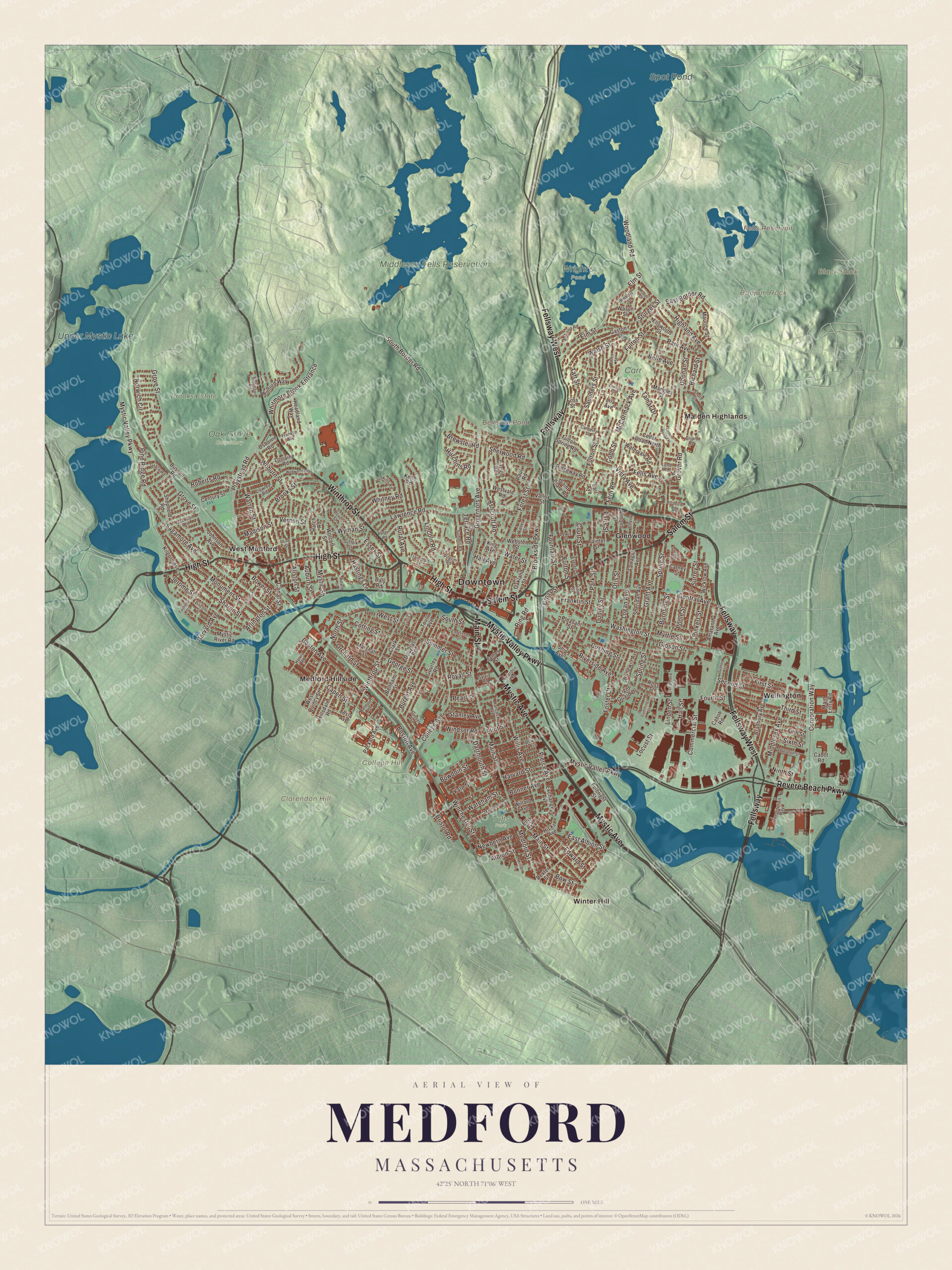
Medford today
By KNOWOL
Medford Square and the Mystic River through the middle of the city, Main, High and Salem Streets, the Mystic Valley Parkway, the Upper Mystic Lake, Spot Pond, Bellevue Pond and the Middlesex Fells Reservation.2
The story of Medford
Rum, crackers and ships
Three things carried Medford's name around the world. Andrew Hall is thought to have started the first distillery in 1735, beside a big spring of unusually good water, and the town's 1855 history says Medford rum got so famous that distillers elsewhere in New England put Medford's name on their own barrels. Convers Francis took over Ebenezer Hall's bakery in 1797 and invented the Medford cracker. By 1805 it was known across the country, and in 1834 the town's historian spotted a Medford crackers sign in a London shop window. They were called crackers because each one cracked into two equal halves. Then came the ships. Thatcher Magoun laid his first keel in 1802, and by 1855 Medford's yards had built 513 vessels.7893
The moths of Myrtle Street
In 1868 the French naturalist Leopold Trouvelot was trying to breed a better silkworm at his house on Myrtle Street in Glenwood, and some of his gypsy moths got loose. His next-door neighbors, the Belchers, later told the state that the caterpillars bothered them for six or eight years before the worst came in 1889, when every leaf was eaten off their apple and pear trees. People walking to the Glenwood station had caterpillars dropping onto their clothes from the trees. The state sprayed the Glenwood and Wellington sections, burned clusters of caterpillars with big kerosene torches, and posted about a dozen special policemen on the roads out of Medford and Malden, because caterpillars were riding out on wagons. The moth spread over North America anyway.1101112
When New Hampshire came to Medford
On the night of April 18, 1775, Paul Revere came up the Medford road. An 1880 county history says he roused the captain of the minute-men and set the alarm bells going before he galloped over the bridge. That captain was Isaac Hall, whose house still stands on High Street. Within a week the men of New Hampshire were hurrying into Medford, picked as their meeting place, and their officers were quartered at the Admiral Vernon tavern. They asked John Stark to take charge of them. A 1911 book says Stark made his headquarters at the Old Garrison House, and that after Bunker Hill the bodies of about twenty-five of his soldiers were brought there and buried nearby. A marker in the Salem Street Burying Ground still honors New Hampshire men who fell at Bunker Hill.1314151617
Through the years
25 moments from 1630 to today.
- 1630English colonists settle Medford as part of Charlestown.1
- 1631Governor Winthrop's exploring party crosses the Mystic at Medford in February.18
- 1632A ship of a hundred tons is built here, a big job for those early days.18
- 1634William Wood calls Medford a very fertile and pleasant place.19
- 1637The first bridge over the Mystic, a toll bridge, goes up where the Cradock Bridge stands now.2
- 1639The colony buys the land of present West Medford from the Squaw Sachem of Mistick.1
- 1677The brick Peter Tufts House, with walls 18 inches thick, is built about this year.20
- 1686The traveler John Dunton finds Medford but a small village of a few houses.21
- 1735Andrew Hall is thought to start Medford's first distillery, beside a big spring.7
- 1754Mistick Field, south of the river, is moved from Charlestown to Medford.1
- 1775On his midnight ride Paul Revere rouses the captain of Medford's minute-men.13
- 1775New Hampshire men gather in Medford and ask John Stark to take charge of them.15
- 1797Convers Francis takes over Ebenezer Hall's bakery and goes on to invent the Medford cracker.8
- 1802Thatcher Magoun lays his first keel on the Mystic.9
- 1834Medford's historian sees a Medford crackers sign in a London shop window.8
- 1845Medford's yards build thirty vessels in a single year.22
- 1850The Shooting Star, Medford's first clipper ship, is built.22
- 1852Tufts College is chartered.1
- 1855The town's history counts 513 vessels built in Medford since 1800.3
- 1868Leopold Trouvelot's gypsy moths escape from his house on Myrtle Street.1
- 1874Medford's clay beds have turned out as many as 16,500,000 bricks in a year.23
- 1882The Massachusetts Historical Society hears the old Cradock House may be torn down, and Medford starts raising money to save it.24
- 1889The gypsy moth caterpillars reach their worst in Glenwood.10
- 1892Medford becomes a city, and its new seal shows the Peter Tufts House.20
- 1905Medford celebrates the 275th anniversary of its settlement.25
Places to see
Places worth a visit in Medford today.
- Medford SquareWhere Main and High Streets meet. The old heart of town.
- Cradock BridgeMain Street over the Mystic. Where the first Mystic bridge stood, 1637.
- Peter Tufts HouseRiverside Avenue. Brick house of about 1677.
- Old Ship Street Historic DistrictPleasant Street. Houses from the shipbuilding years.
- Grace ChurchHigh Street. One of H. H. Richardson's earliest works.Visit their website
- Lydia Maria Child's grandparents' houseSouth Street. The house in Over the River.
- Sagamore ParkWest Medford. A Native burial site of the contact period.
- Tufts UniversityMedford Hillside. Campus on both sides of the Somerville line.Visit their website
- Mystic Valley ParkwayAlong the Mystic Lakes. Olmsted Brothers parkway of 1894 and 1895.
- Middlesex Fells ReservationNorth of the city. Woods and ponds shared with four towns.Visit their website
On the National Register
20 of the 36 places in Medford on the National Register of Historic Places that still stand today, oldest first, and why each one matters. See the full list of National Register places in Medford.4
-
Peter Tufts House
National Historic Landmark
A brick house with walls 18 inches thick, thought to date from 1677 or 1678, and possibly the oldest surviving house in the country with a gambrel roof. Long and wrongly called the Cradock House, it was saved from demolition in 1887 and pictured on the city seal in 1892.20
-
Salem Street Burying Ground
The Wade family's private burying ground, bought by the town in 1717, with stones dated from 1683 to 1881. A marker near the Riverside Avenue gate remembers New Hampshire soldiers who fell at Bunker Hill and were buried in the town.17
-
Jonathan Wade House
One of a handful of Medford houses with brickwork from the 1600s; a brick house stood here in 1689, when Jonathan Wade Jr. died. It was given Georgian styling in the mid-1700s and was owned in the 1800s by Samuel C. Lawrence, Medford's first mayor.26
-
Isaac Royall House
National Historic Landmark
The brick core of the mansion went up about 1692, and Isaac Royall Sr. enlarged it in the 1730s. It keeps the only surviving quarters in Massachusetts built for the enslaved people who worked the estate, and it has Revolutionary ties to John Stark and George Washington. It's now a museum.27
-
Albree-Hall-Lawrence House
A farmhouse built in at least three stages before 1850; a house already stood here when John Albree bought the farm in 1720. Francis Parkman lived here as a child in the 1830s, and Samuel C. Lawrence, the first mayor, later took the farm into his estate.28
-
Isaac Hall House
Built about 1720 by Andrew Hall, it's the oldest surviving house in Medford Square. His son Isaac, captain of the Medford minute company, remodeled it about 1780, and Paul Revere stopped here on the night of April 18, 1775.14
-
Edward Oakes House
A two-and-a-half-story timber-frame house with a gambrel roof and a saltbox leanto, probably built by Edward Oakes about 1728. It's one of the oldest wood-frame houses left in Medford.29
-
Charles Brooks House
A two-and-a-half-story house of about 1765 with brick side walls that hold its four chimneys. It was the home of Rev. Charles Brooks, who worked for the state's normal schools and cowrote an early history of Medford.30
-
Unitarian Universalist Church and Parsonage
The parish was gathered in 1690. Its Gothic Revival church of 1893 to 1894 is the congregation's fifth building, and the Federal parsonage was built in 1785 for Rev. David Osgood.31
-
Old Ship Street Historic District
The neighborhood around Thatcher Magoun's shipyard, which ran from 1803 into the 1870s. The yards are gone, but Federal and Greek Revival houses from the shipbuilding years, about 1803 to 1855, still line the street.32
-
Paul Curtis House
Called Grandfather's House, it's claimed as the house in Lydia Maria Child's poem Over the River and Through the Wood. The shipbuilder Paul Curtis enlarged the early farmhouse about 1839 and gave it an Ionic portico, and Tufts restored it in 1976.33
-
John B. Angier House
A Gothic Revival house of 1842 by Alexander Jackson Davis, with grounds first landscaped by Andrew Downing, built for the schoolteacher John B. Angier, whose pupils included Francis Parkman. It's a rare Massachusetts example of the style.34
-
Mystic Dam
Built in 1864 and 1865 by the Charlestown Water Commission across the narrows between the Upper and Lower Mystic Lakes, with its west end in Arlington and its east end in Medford. It's more than 1,500 feet long.35
-
Grace Episcopal Church
One of H. H. Richardson's earliest works, built of glacial boulders with granite trim, and the earliest of his churches still standing. John LaFarge's window Rebecca at the Well is in the south wall of the nave.36
-
Shepherd Brooks Estate
The brick Queen Anne manor of 1880, designed by Peabody and Stearns for Shepherd Brooks, stands on the only major 19th-century estate in Medford left largely undeveloped. The city owns the land, and the manor, carriage house and 50 acres are protected for good.37
-
Lawrence Light Guard Armory
A granite and brick Romanesque Revival armory built in 1891 to a design by Shepley, Rutan and Coolidge. Round turrets with crenellated tops flank its entrance.38
-
Mystic Valley Parkway, Metropolitan Park System of Greater Boston MPS
Designed in 1894 and 1895 by the Olmsted Brothers, with Charles Eliot in the lead, as one of the pleasure roads of Boston's Metropolitan Park System. It runs along the east side of the Mystic Lakes, on the path of the old Middlesex Canal.39
-
Old Medford High School
The city's high school of 1894 to 1896, enlarged in 1914, 1929 and 1939. It now holds condominiums and the Chevalier Theatre.40
-
Park Street Railroad Station
Built by the Boston and Maine in 1894, it was unusually fine for a branch line stop because of Samuel C. Lawrence, who had his own gardeners tend the grounds. It's the only railroad station building left in Medford.41
-
Middlesex Fells Reservoirs Historic District
Three reservoirs in the Middlesex Fells, with their gate houses and pumping stations, developed by the Metropolitan District Commission from the late 1800s. A gatehouse at the south end of Spot Pond straddles the Stoneham and Medford line.42
In their words
“Every man, woman, and child in Medford knows the "Old Fort," as the older inhabitants love to call it, and will point you to the site with visible pride that their pleasant town contains so interesting a relic.”
Historic mansions and highways around Boston, 1899, on the Peter Tufts House43
“Eight generations of men and women have been born in Medford, have lived and labored and passed away, and yet the place is Medford still, no mean city, for twenty thousand people call it by the dearest name of home.”
A sermon at Trinity Church for Medford's 275th anniversary, 190525
“This bread deserved all the fame it acquired; for never had there been any so good, and we think there is now none better.”
History of the town of Medford, 1855, on the Medford cracker8
Nearby towns
Sources
- Medford, Massachusetts, Wikipedia
- Map of Medford, Massachusetts in 2026, KNOWOL
- History of the town of Medford, Middlesex County, Massachusetts (1855), on the register of vessels, Internet Archive
- National Register of Historic Places listings in Medford, Massachusetts, Wikipedia
- Amazing old map of Medford, Massachusetts from 1880, restored by KNOWOL
- This is how West Medford, Massachusetts looked in 1897, restored by KNOWOL
- History of the town of Medford, Middlesex County, Massachusetts (1855), on the first distillery, Internet Archive
- History of the town of Medford, Middlesex County, Massachusetts (1855), on Medford crackers, Internet Archive
- History of the town of Medford, Middlesex County, Massachusetts (1855), on Thatcher Magoun, Internet Archive
- The gypsy moth: a report of the work of destroying the insect in the commonwealth of Massachusetts (1896), on its first ravages, Internet Archive
- The gypsy moth: a report of the work of destroying the insect in the commonwealth of Massachusetts (1896), on the Glenwood station, Internet Archive
- The gypsy moth: a report of the work of destroying the insect in the commonwealth of Massachusetts (1896), on guarding the highways, Internet Archive
- History of Middlesex County, Massachusetts (1880), on Paul Revere's ride, Internet Archive
- Isaac Hall House, Wikipedia
- Medford in the Revolution: military history of Medford, Massachusetts, 1765-1783 (1903), Internet Archive
- Landmarks in the Old Bay State, by William R. Comer (1911), Internet Archive
- Salem Street Burying Ground, Wikipedia
- History of Middlesex County, Massachusetts (1880), on Cradock's plantation, Internet Archive
- History of Middlesex County, Massachusetts (1890), on Cradock's grant, Internet Archive
- Peter Tufts House, Wikipedia
- Historic homes and places and genealogical and personal memoirs relating to the families of Middlesex County, Massachusetts (1908), on Medford's taverns, Internet Archive
- Early ship-building in Massachusetts (1869), Internet Archive
- A gazetteer of the state of Massachusetts (1874), Internet Archive
- Proceedings of the Massachusetts Historical Society, 1882 to 1883 (1882), Internet Archive
- Proceedings of the celebration of the two hundred and seventy-fifth anniversary of the settlement of Medford, Massachusetts (1906), Internet Archive
- Jonathan Wade House, Wikipedia
- Isaac Royall House, Wikipedia
- Albree-Hall-Lawrence House, Wikipedia
- Edward Oakes House, Wikipedia
- Charles Brooks House, Wikipedia
- Unitarian Universalist Church and Parsonage, Wikipedia
- Old Ship Street Historic District, Wikipedia
- Paul Curtis House, Wikipedia
- John B. Angier House, Wikipedia
- Mystic Dam, Wikipedia
- Grace Episcopal Church, Wikipedia
- Shepherd Brooks Estate, Wikipedia
- Lawrence Light Guard Armory, Wikipedia
- Mystic Valley Parkway, Metropolitan Park System of Greater Boston MPS, Wikipedia
- Old Medford High School, Wikipedia
- Park Street Railroad Station, Wikipedia
- Middlesex Fells Reservoirs Historic District, Wikipedia
- Historic mansions and highways around Boston (1899), Internet Archive