
A hill town on the old Post Road where stagecoaches once crowded the taverns at noon, the Howes worked out a famous bridge truss and the sewing machine, and boot and wire factories filled the village.
Then and now
The same town 149 years apart. Click either map to look closer.
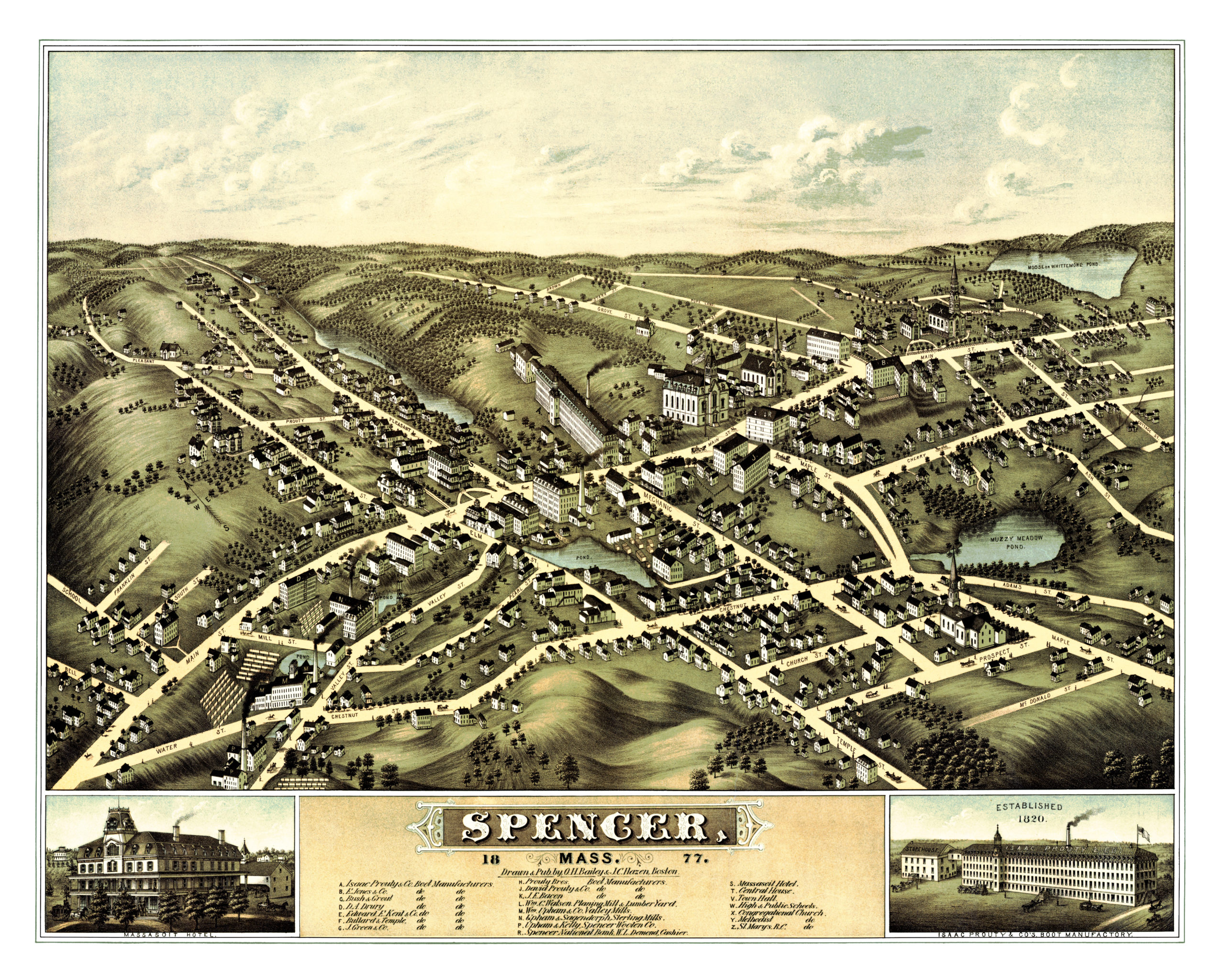
The bird's-eye view
By O.H. Bailey and J.C. Hazen
Spencer drawn as if from the sky in 1877, with the Massasoit Hotel, Muzzy Meadow Pond, the Town Hall, the Spencer National Bank and ten boot manufacturers.5
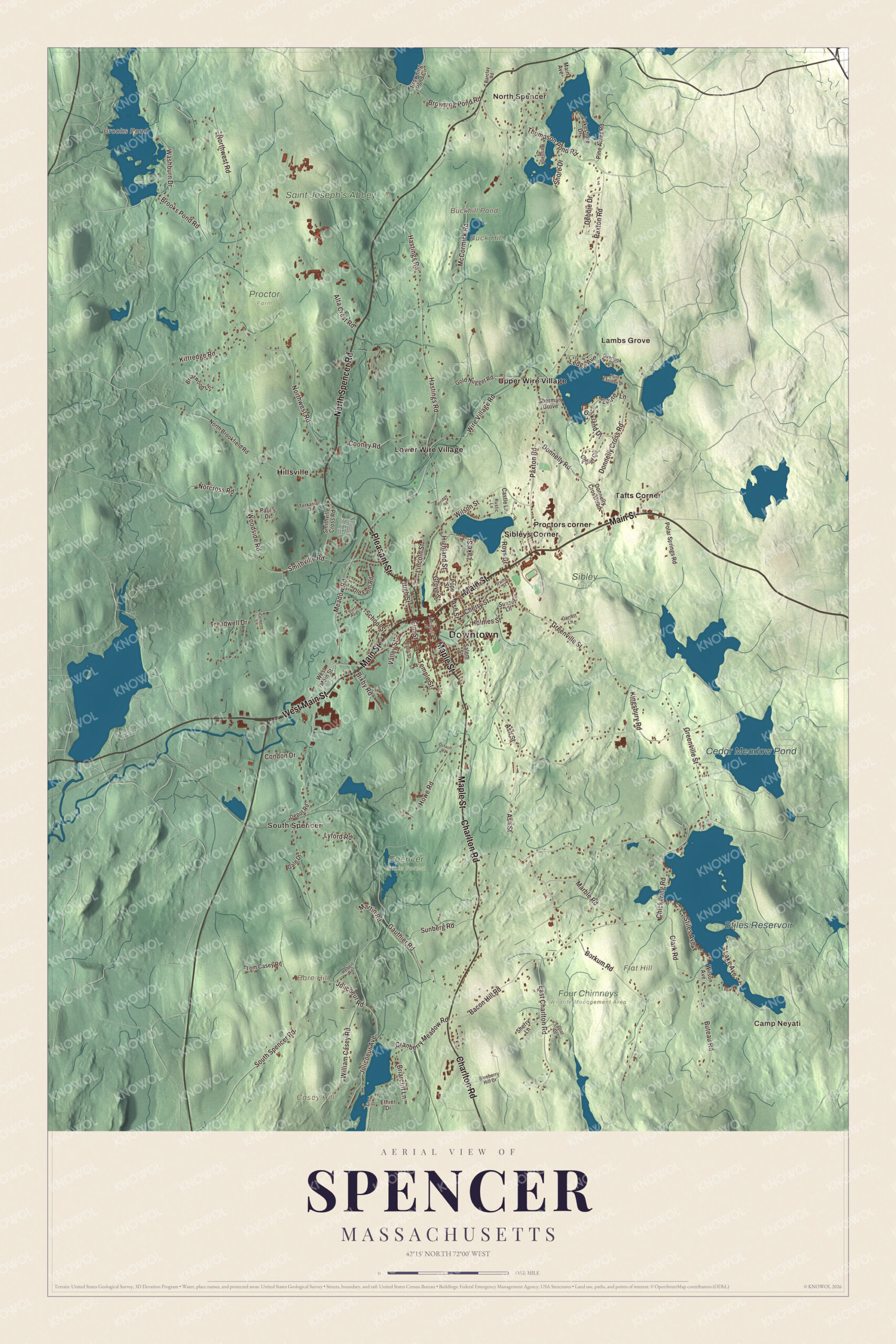
Spencer today
By KNOWOL
Shaded hills and every street from North Spencer to South Spencer, with Main Street crossing east to west, Lower Wire Village, Buck Hill, Brooks Pond and Stiles Reservoir.6
The story of Spencer
A night at the Jenks tavern
Spencer grew up along the stage road from Boston to Springfield, and the road made the village. In 1788 the lower village had just three houses, and all three were taverns. The best known was the Jenks tavern, on the spot where the Massasoit Hotel later stood. That year a French traveler stopped for the night while the place was still half built. He found the rooms neat, the beds good and the sheets clean, and supper, cider, tea and punch cost fourteen pence a head. He thought it beat any tavern in France. Spencer was a relay station where coaches changed horses, and the county history says fifteen coaches at noon was nothing unusual, twenty-five on busy days. George Washington stopped at the Jenks tavern in 1789.271
Boots in a back room, wire by the river
In 1820 Isaac Prouty was making boots to order in a small room of his own house in North Spencer. The work kept growing, and in 1856 he moved into a new factory in the village. By 1899 a county book called his business one of the largest boot and shoe factories in the world. Asa T. Jones started in 1841 in the old Livermore house at Main and North streets, and his firm's factory could later make 2,500 pairs of shoes a day. Wire came with an Englishman, Richard Sugden, who read about Spencer's wire works in a handbook on the ship over in 1845. In 1876 he formed the Spencer Wire Company in Lower Wire Village. By 1885 Spencer counted 83 private firms.893101112
The inventing Howes
Spencer's Howe family turned out inventors. William Howe, born here in 1803, was a carpenter and builder who also kept a tavern. While putting up a church with a long roof in Warren, he worked out the system now called the Howe truss, then used it for a bridge in West Warren. The county history says it was the safest and most reliable truss of its day, and it went into roofs, depots and railroad bridges. His brother Tyler patented a spring bed. Their nephew Elias Howe Jr. was born in Spencer in 1819, and in 1846 he received the first U.S. patent for a lockstitch sewing machine. His old estate, with the mill pond and dam he built, is now part of Spencer State Forest.131416
Through the years
25 moments from 1717 to today.
- 1717Nathaniel Wood first settles in what is now Spencer.1
- 1721Samuel Bemis makes the first permanent settlement.1
- 1740The first mill goes up on the Seven Mile River.1
- 1753Spencer splits from Leicester on April 12, named for acting governor Spencer Phips.1
- 1775Isaac Jenks takes over the house that becomes the famous Jenks tavern.2
- 1775Fifty-six men under Captain Ebenezer Mason set out for Boston as the Revolution begins.1
- 1777Mrs. Pope arrives from Newton as the pastor's bride, and stays 77 years in the same room.15
- 1788A French traveler sleeps at the half-built Jenks tavern and praises its clean sheets.7
- 1789George Washington stops at Jenk's Tavern.1
- 1803William Howe, inventor of the Howe truss, is born in Spencer on May 12.14
- 1812Elliot Prouty begins drawing wire in his own mill.1
- 1819Elias Howe Jr. is born in Spencer on July 9.14
- 1820Isaac Prouty starts making boots in a small room of his house in North Spencer.8
- 1841Asa T. Jones starts making boots and shoes in the old Livermore house at Main and North streets.3
- 1846Elias Howe receives the first U.S. patent for a lockstitch sewing machine.6
- 1847Richard Sugden and Nathaniel Myrick buy a small wire works in Spencer.10
- 1856Isaac Prouty moves his boot business into a new factory in the village.8
- 1876Sugden buys the Prouty wire works in Lower Wire Village and forms the Spencer Wire Company.11
- 1877O.H. Bailey and J.C. Hazen publish their bird's-eye view of Spencer.5
- 1878The town votes $25,000 toward a branch railroad from South Spencer to the center.16
- 1885Spencer counts 83 private firms.12
- 1888Four leading citizens begin giving the town a high school, a library, a park and fair grounds.1
- 1950Trappist monks make St. Joseph's Abbey their home in Spencer.6
- 1986The Spencer Town Center Historic District is listed on the National Register.17
- 2022The abbey's brewery, maker of the first certified Trappist beer in the U.S., closes.1
Places to see
Places worth a visit in Spencer today.
- Spencer Town Center Historic DistrictMain, Pleasant and Maple streets. Downtown of the boot and wire years.
- Colonial milestonesThe old Post Road, Route 9. Old stones still marking the way.
- Spencer State ForestHowe Pond, off Route 31. Elias Howe's old estate and mill pond.Visit their website
- St. Joseph's AbbeySpencer. Trappist monastery here since 1950.Visit their website
- Lower Wire VillageSpencer. Home of the Spencer Wire Company.
- Spencer Agricultural Fair GroundsSmithville Road. A gift to the town, 1888 to 1889.Visit their website
- Midstate TrailAcross town. 92 miles, linking forests and wildlife areas.Visit their website
- Moose Hill wildlife areaSpencer. Named for the moose once found here.
- Buck Hill wildlife areaSpencer. Wild land on the Midstate Trail.
On the National Register
All 4 places in Spencer on the National Register of Historic Places that still stand today, oldest first, and why each one matters.4
-
1767 Milestones
Granite milestones along the old Upper Boston Post Road, now Route 9 through Spencer, that told stage travelers the miles to Boston. They're named for a 1767 province order to set stones along the main roads, and 40 surviving stones between Boston and Springfield were listed together in 1971.18
-
Barnes-Hill House
A well-preserved Federal farmhouse of about 1800 on North Brookfield Road. Its best-known owner, Sullivan Hill, opened a chair factory across the street, and the little village of Hillsville grew up around the crossroads. Hill is said to have brought the cane-seated chair to Massachusetts.19
-
Grove Street School
Built as a one-story brick schoolhouse in 1876, it was full by 1878, and a second story designed by Fuller & Delano was added in 1883. Its jerkin-headed gables carry heavy brackets and decorated bargeboards.20
-
Spencer Town Center Historic District
Spencer's downtown along Main Street, which began as a Native American trail and became the colonists' main road east and west. The district, later enlarged with the East Main Street and Cherry Street area and twice more in 2003, takes in the homes, mills and boot factories of the town's industrial peak in the late 1800s, plus Luther Hill Park.17
In their words
“The chambers were neat, the beds good, the sheets clean, the supper passable; cider, tea, punch, and all for fourteen pence per head.”
A French traveler on the Jenks tavern in 1788, from the History of Spencer, 18607
“It was not unusual to see fifteen coaches congregated here at the noon hour, and upon extra occasions, twenty-five.”
History of Worcester County, 18892
“Founded what is now one of the largest boot and shoe factories in the world.”
Biographical review of Worcester County, 1899, on Isaac Prouty9
Nearby towns
Sources
- Spencer, Massachusetts, Wikipedia
- History of Worcester County, Massachusetts (1889), on Spencer's taverns, Internet Archive
- Historic homes and institutions and genealogical and personal memoirs of Worcester County, Massachusetts (1907), on Erastus Jones, Internet Archive
- National Register of Historic Places listings in Worcester County, Massachusetts, Wikipedia
- Restored bird's eye view of Spencer, MA from 1877, KNOWOL
- Map of Spencer, Massachusetts in 2026, KNOWOL (USGS elevation, Census Bureau roads)
- History of Spencer, Massachusetts, from its earliest settlement to the year 1860 (1860), on the French traveler at the Jenks tavern, Internet Archive
- History of Worcester County, Massachusetts (1889), on Isaac Prouty, Internet Archive
- Biographical review … containing life sketches of leading citizens of Worcester County, Massachusetts (1899), on George P. Prouty, Internet Archive
- One of a thousand, a series of biographical sketches of one thousand representative men resident in the Commonwealth of Massachusetts (1890), on Richard Sugden, Internet Archive
- History of Worcester County, Massachusetts (1889), on Richard Sugden and the Spencer Wire Company, Internet Archive
- History of Worcester County, Massachusetts (1889), on Spencer's business firms, Internet Archive
- Publications, Cambridge Historical Society (1906), on William Howe, Internet Archive
- History of Worcester County, Massachusetts (1889), on William and Elias Howe, Internet Archive
- History of Spencer, Massachusetts, from its earliest settlement to the year 1860 (1860), on Mrs. Pope, Internet Archive
- History of Worcester County, Massachusetts (1889), on the Spencer branch railroad, Internet Archive
- Spencer Town Center Historic District, Wikipedia
- 1767 Milestones, Wikipedia
- Barnes-Hill House, Wikipedia
- Grove Street School, Wikipedia