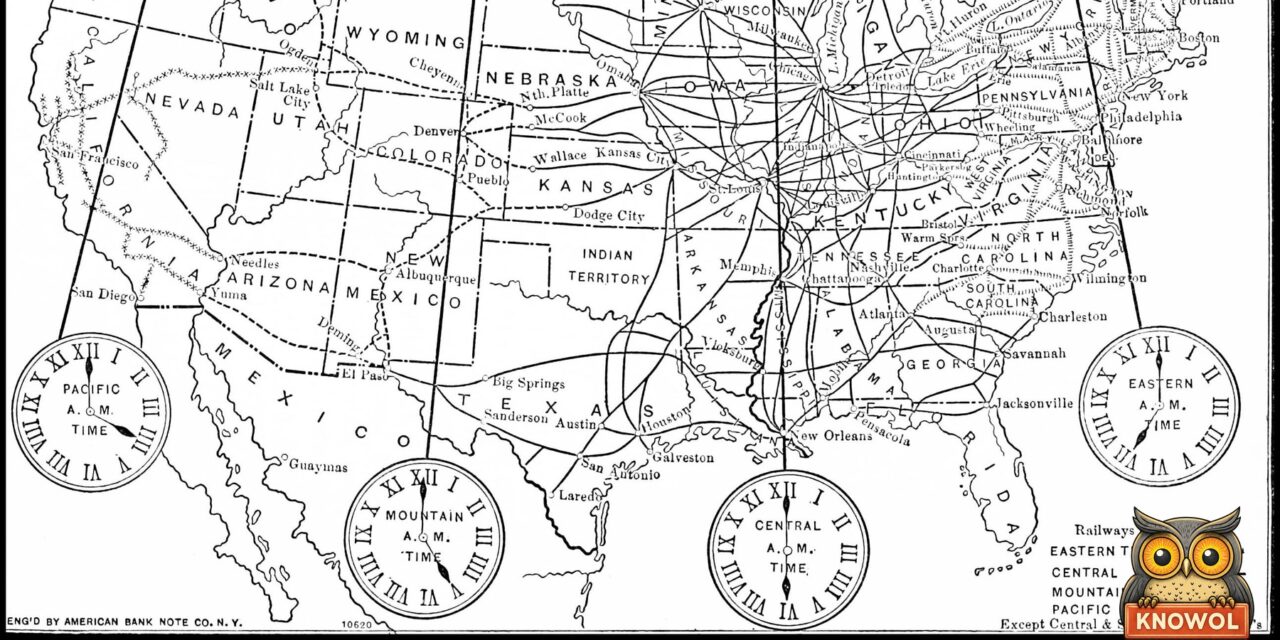
At noon on Sunday, November 18, 1883, people in Portland, Maine, gathered in front of the city’s church clocks with their pocket watches in their hands. The clocks reached twelve. Then their hands stopped and stayed stopped.
About 19 minutes later, the city electrician struck the fire alarm. That was the signal. The church clocks started up again and “struck the hour of twelve,” the Portland Daily Press reported the next morning. The crowds “changed their watches to standard time.” Portland had just had noon twice in one day.
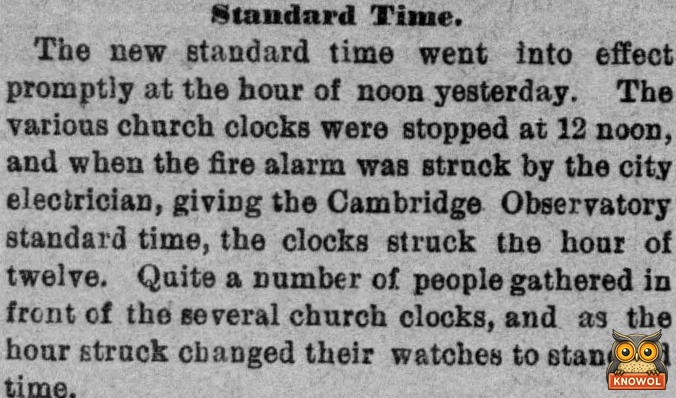
“Standard Time.” The Portland Daily Press, Portland, Maine, November 19, 1883, page 4. Library of Congress, Chronicling America. Click the clipping to read it full size.
Every town ran on its own clock
Before 1883, noon meant the moment the sun stood highest over your own town. The Earth turns from west to east, so the sun reaches its highest point in Maine a little before it does in Boston, and in Boston before New York. Every town’s clocks were a few minutes different from the next town’s.
That worked fine when people traveled by horse. It was a mess for railroads. The Maine Central railroad didn’t even use Portland’s time. Its trains ran on “the present Boston time,” the Press explained, even while Portland’s city clocks kept Portland’s own time. A traveler had to know which clock to trust.
The railroads’ big idea
In the fall of 1883, the railroads agreed on a fix. Instead of each city keeping “the precise time of its own meridian,” the whole country would use “but five different times,” each one an hour apart. A meridian is an imaginary line running north and south. Everyone in the same wide band of the map would use the same time, so the railroad clocks “in Portland, Boston and New York will be exactly the same.”
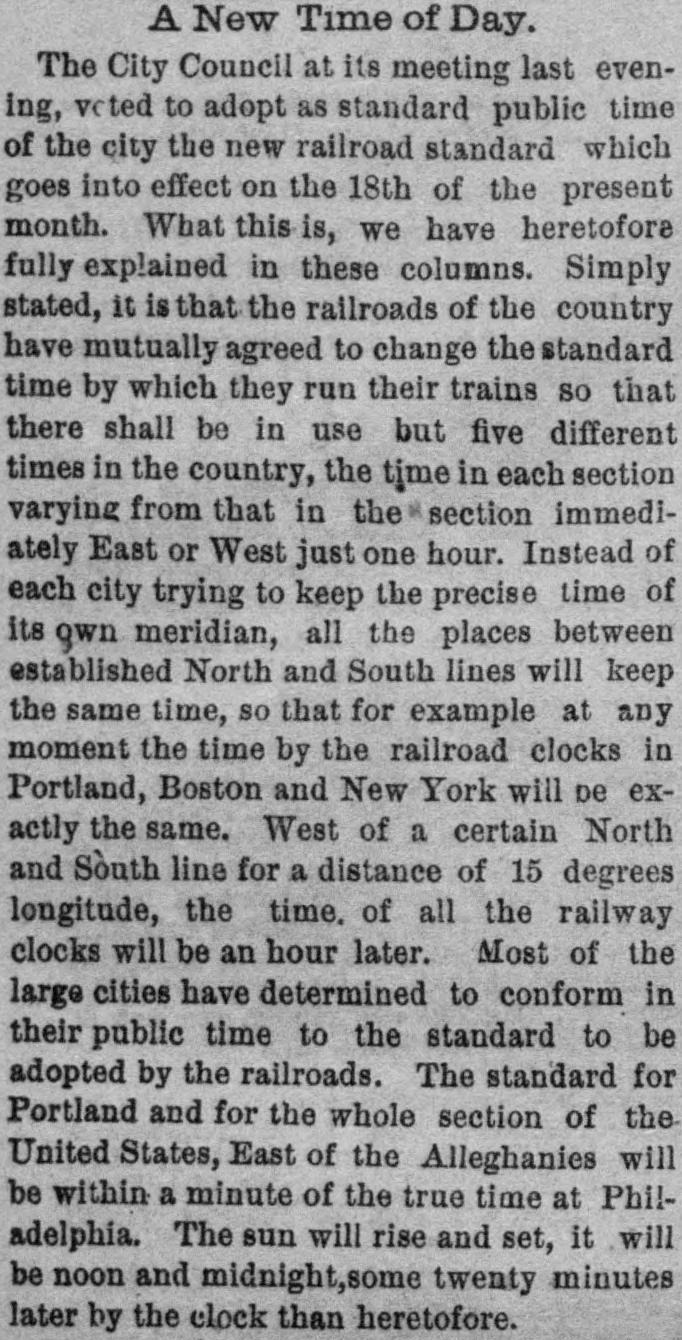
“A New Time of Day.” The Portland Daily Press, Portland, Maine, November 6, 1883, page 2. Library of Congress, Chronicling America. Click the clipping to read it full size.
Portland’s new time would match the sun at Philadelphia, which sits farther west. That meant, the Press said, “The sun will rise and set, it will be noon and midnight, some twenty minutes later by the clock than heretofore.” Heretofore means before now. Portland’s City Council voted to make the railroad time the city’s official time.
Getting ready to stop the clocks
The city made a plan. Its committee on bells and clocks told Mr. Swift, “the superintendent of clocks,” to “stop the city clocks at 12 o’clock noon Sunday, and start them again when the new time is given by a stroke of the fire alarm.” The school superintendent said every clock in the school buildings would be “set back about nineteen minutes.”
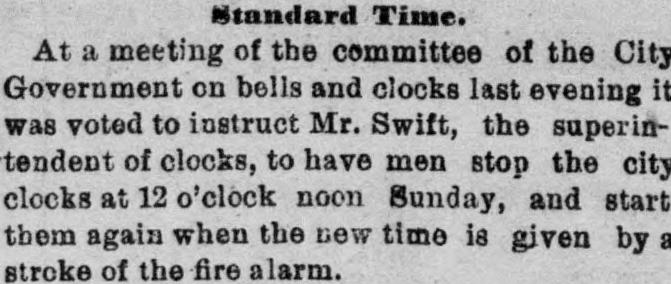
The plan to stop the clocks. The Portland Daily Press, Portland, Maine, November 17, 1883, page 4. Library of Congress, Chronicling America. Click the clipping to read it full size.
The railroads were even stricter. Maine Central engineers and conductors were “required to sign a receipt for the new standard time” when the telegraph operator gave it to them, like signing for a package.
The Press had some fun, too. It suggested two Bible readings for that Sunday’s sermons. One was about the day the sun “stood still.” The other promised to bring the shadow on a sundial “ten degrees backward.”
Noon, and then noon again
On Sunday the plan worked. The new time “went into effect promptly at the hour of noon,” the Press said. The exact moment came from the Cambridge Observatory near Boston. When the city electrician struck the fire alarm, the stopped clocks came back to life and rang twelve.
By Monday, the railroads, banks, custom house, schools and most businesses in Portland had switched. The courts switched too. The post office was still deciding. Postmaster Goddard told the paper he “has not decided whether he will adopt the new standard time.”
Maine picks sides: old time or new
Not everyone in Maine was ready to give up the sun. Some towns fought the new time, and some tried to use both.
- Bangor: Mayor Cummings vetoed the new time, and three aldermen voted with him. The Press called it “Bangor’s Double Time.” The banks switched anyway, and so did two church clocks, while the city’s own clock stayed on local time.
- Lewiston: Postmaster Little opened the post office by the old time and closed it by the new. That gave people “twenty minutes more open post office per day.”
- Belfast: “Some of the jewelers will run two timepieces, one on local and one on railroad time.”
- Portland’s locomotive firemen said they would not switch until Thursday, November 22. Then they planned “a grand band concert and ball at City Hall,” decorated with “paintings and headlights.”
- Portland’s court: A man who owed money he couldn’t pay showed up for his hearing on November 20 by the new standard time. Commissioner Edward J. Jenkins said he was “governed by the old time,” ruled “it was after 10 o’clock,” and the man lost his case. The Press called it “the first legal complication arising from the change of time.”
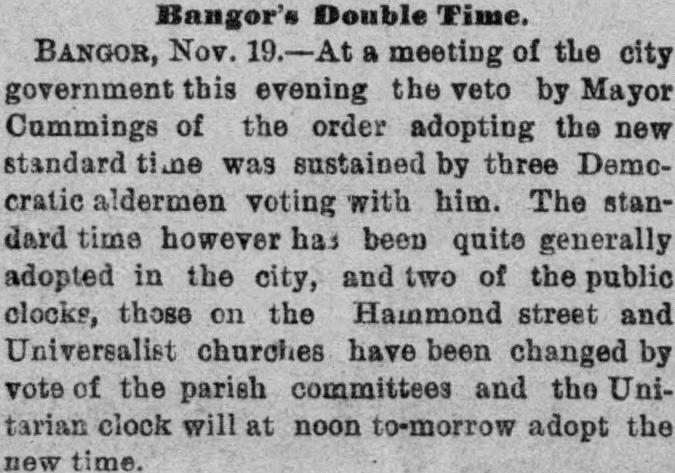
“Bangor’s Double Time.” The Portland Daily Press, Portland, Maine, November 20, 1883, page 1. Library of Congress, Chronicling America. Click the clipping to read it full size.
In the end, the railroad plan won. The Eastern, Central, Mountain and Pacific time zones Americans use today grew out of that Sunday in 1883. Portland’s watchers got to hear noon twice. The rest of us just get one.
Sources
- The Portland Daily Press (Portland, Maine): November 19, 1883, page 4 (“Standard Time”), November 17, 1883, page 4 (stopping the city clocks; school clocks), November 6, 1883, page 2 (“A New Time of Day”), November 14, 1883, page 4 (Maine Central order), November 15, 1883, page 4 (sermon texts; firemen’s ball), November 16, 1883, page 1 (Belfast), November 20, 1883, page 1 (“Bangor’s Double Time”) and November 21, 1883, page 1 (Bangor banks; Lewiston post office; the poor debtor).
- All newspaper images: Library of Congress, Chronicling America. Published 1883, public domain.
- Cover: “Outline Map with Dials Showing Standard Railway Time Compared with Greenwich Mean Noon, Adopted November 18, 1883,” engraved by the American Bank Note Co., Popular Science Monthly, volume 26 (1884 to 1885), Wikimedia Commons, public domain.