On the day before Thanksgiving in 1910, a Washington newspaper sounded the alarm. “WHERE IS A TURKEY FOR TAFT DINNER?” asked the front page of the Washington Herald. The President’s big bird hadn’t shown up. Everyone knew who was supposed to send it: Horace Vose of Westerly, Rhode Island, the man the papers called “the turkey king.”
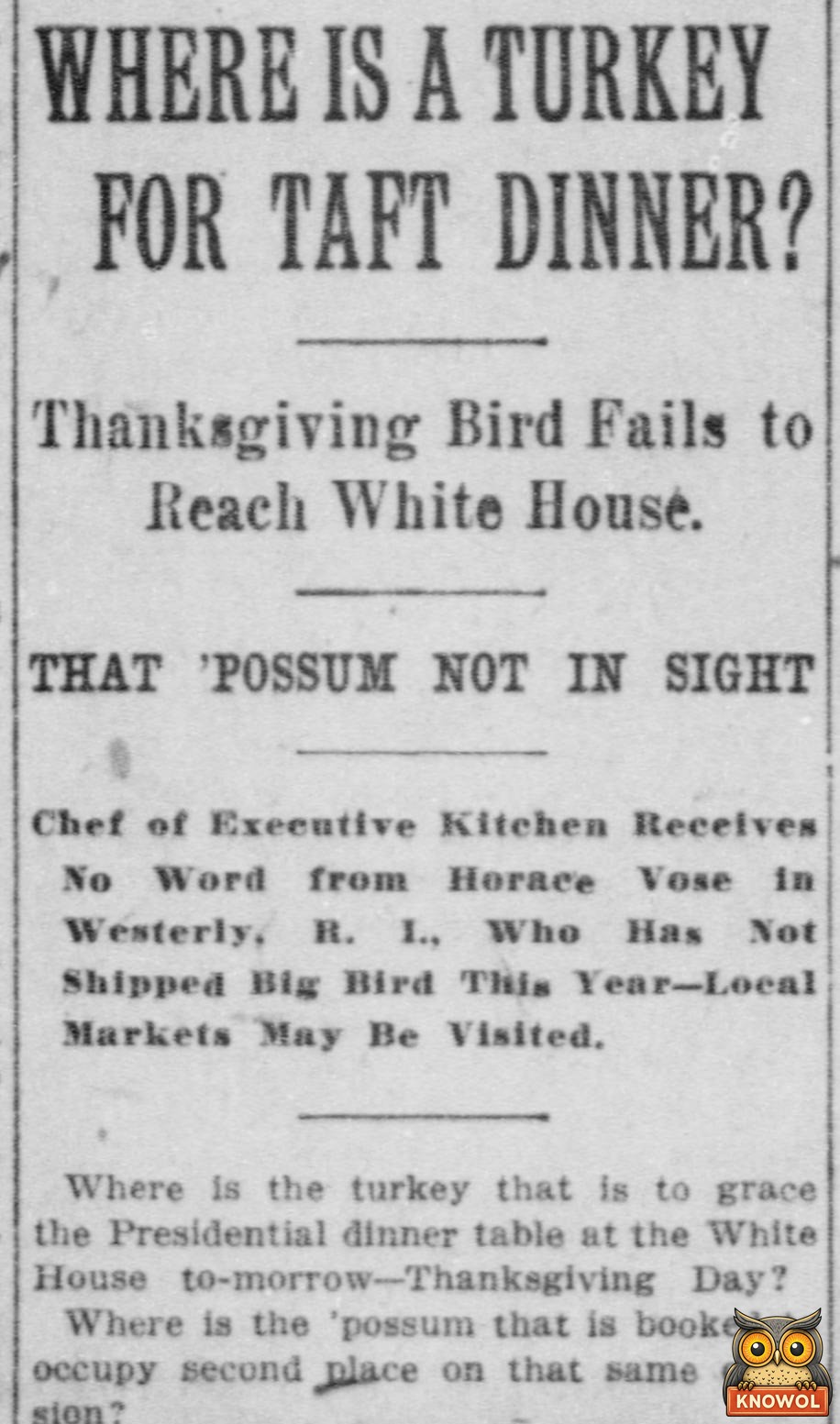
“Where Is a Turkey for Taft Dinner?” The Washington Herald, Washington, D.C., November 23, 1910, page 1. Library of Congress, Chronicling America. Click the clipping to read it full size.
The missing bird
For years Vose had sent the President a giant turkey for Thanksgiving dinner. The Herald said the White House bird “usually weighed between thirty and fifty pounds.” Most years Vose let everyone know a week ahead that it was on the way.
In 1910 nobody heard a word. “For a few days past White House attaches have eagerly watched every incoming express wagon,” the Herald wrote. Attaches were staff members. Express wagons brought packages from the train station, and the staff hoped one would bring “a huge crate.” Even the President’s ‘possum was missing. William Howard Taft was known for loving roast opossum, a Southern dish.
The turkey king
Horace Vose was born in Westerly, in the far southwest corner of Rhode Island, right on the Connecticut line. He started buying and selling turkeys when he was 17. Later he dealt in cattle, ran a milk business and kept a livery stable, a place that rented out horses and carriages. In 1905 the Evening Star of Washington called him “probably the largest buyer and shipper of turkeys for the New York market.”
“It is generally agreed that Rhode Island turkeys are the best in the market,” the Evening Star said in 1896. Western turkeys, it claimed, didn’t have “that grasshopper flavor” of birds raised by Yankee farmers. That’s a hint that New England farm turkeys roamed the fields gobbling up bugs.
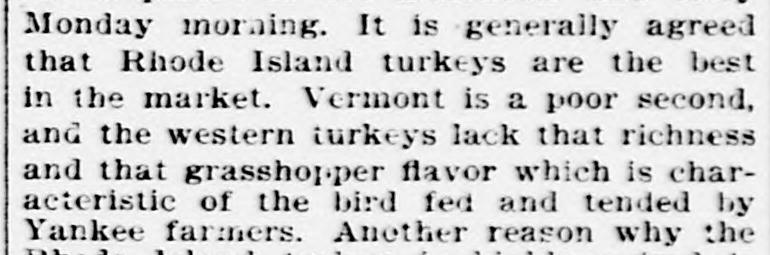
The Evening Star, Washington, D.C., November 25, 1896, page 5. Library of Congress, Chronicling America. Click the clipping to read it full size.
How to pick a President’s turkey
Vose didn’t raise many turkeys himself. Instead he shopped early. While the chicks on nearby farms were still on “their milk diet,” he toured the farms and looked over every flock. If a chick looked promising, he got “an option on it,” a promise that the farmer would sell him that bird later. It was to “receive especial care.” By Thanksgiving, the Star said, “the flower of the Rhode Island turkey farms” was his to choose from.
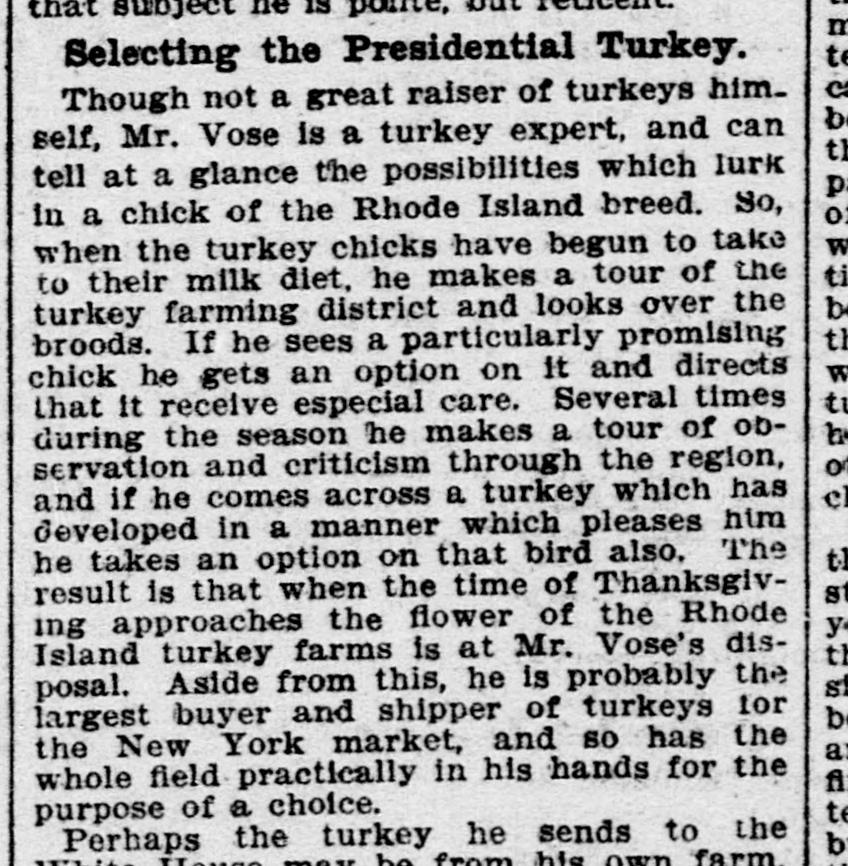
“Selecting the Presidential Turkey.” The Evening Star, Washington, D.C., November 25, 1905, page 13. Library of Congress, Chronicling America. Click the clipping to read it full size.
The winners were giants. In 1892 Vose sent President Benjamin Harrison a 38-pound bird raised on the farm of Horace Brightman. A reporter in Westerly described it as “a big, bronze-backed, yellow-legged, red-wattled fellow.” Wattles are the floppy red skin under a turkey’s beak. In 1896 President Grover Cleveland was sent a 32-pound bronze turkey.
Rhode Island turkey men didn’t dunk their birds in hot water to loosen the feathers, because that could tear the skin. “They pick the birds dry,” the Star explained. They packed the birds on the Sunday before Thanksgiving, and the last express shipments, the fast delivery by train, left Monday evening.
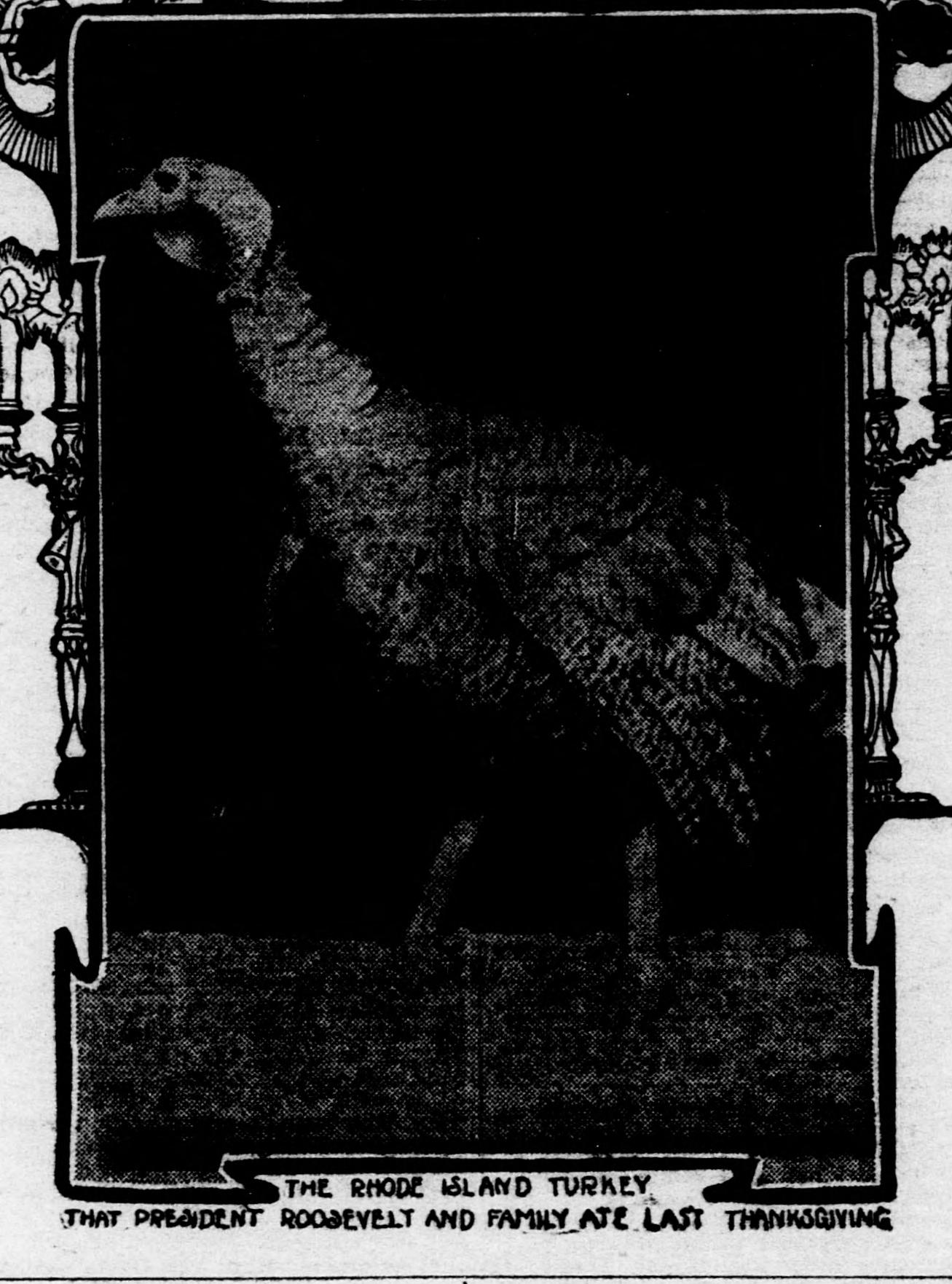
“The Rhode Island Turkey That President Roosevelt and Family Ate Last Thanksgiving.” The Evening Star, Washington, D.C., November 25, 1905, page 13. Library of Congress, Chronicling America. Click the picture to see it full size.
The great turkey mix-up of 1910
In 1910 nothing had gone wrong after all. The turkey had left on Monday and was “speeding by express to the White House,” the Norwich Bulletin of Norwich, Connecticut, reported later. On Thanksgiving Day the Washington Times said dinner would star “Horace Vose’s record-breaking turkey, weighing thirty-seven pounds.” The President, Mrs. Taft, their daughter Helen and her four house guests sat down to eat it.
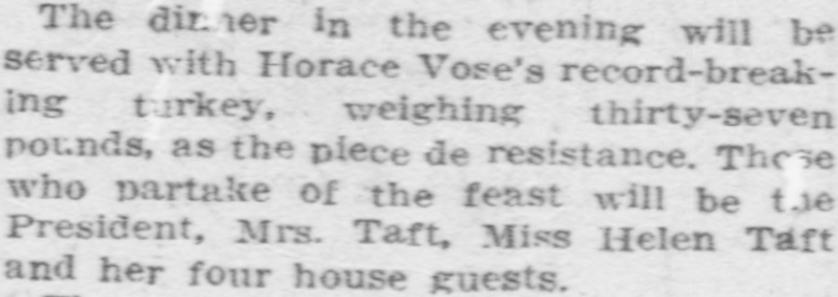
The Washington Times, Washington, D.C., November 24, 1910 (Thanksgiving Day), page 2. Library of Congress, Chronicling America. Click the clipping to read it full size.
Back home, people were annoyed. The Associated Press, a news service, had sent “untruthful information” around the world saying Vose had skipped the President. Then a New York weekly paper printed a photo of a farmer from nearby Stonington, Connecticut, holding a turkey labeled “President Taft’s Turkey.” That bird was named King George, it said, and weighed 44 pounds. The President’s family, it said, knew their turkey came from “Horace Vose of Westerly, the turkey king.”
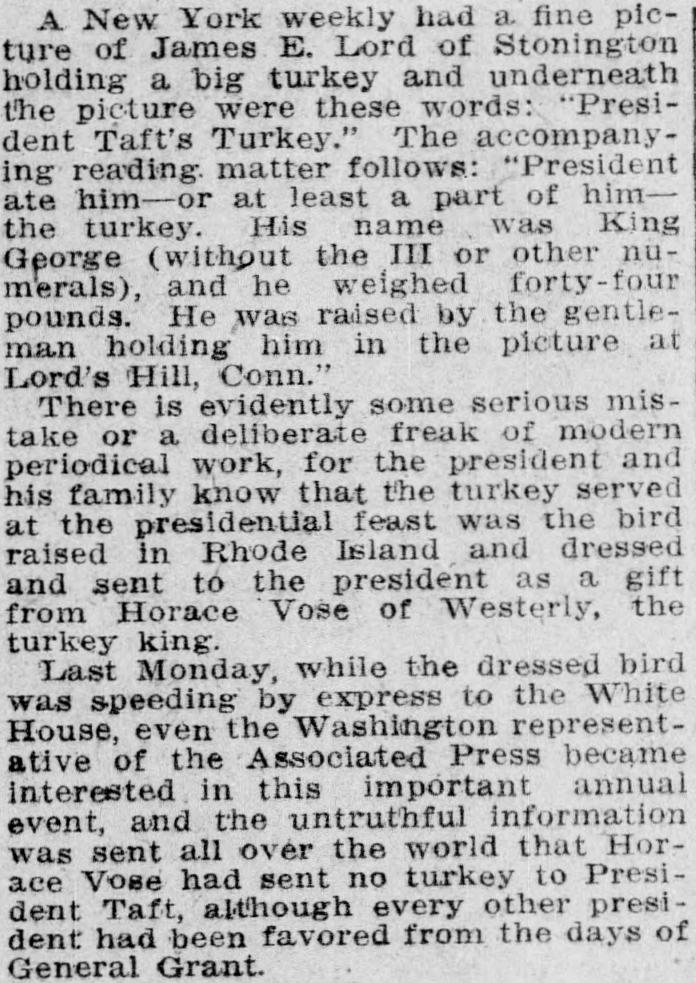
The Norwich Bulletin, Norwich, Connecticut, November 28, 1910, page 2. Library of Congress, Chronicling America. Click the clipping to read it full size.
Thank-you notes from every President
The papers never agreed on when the custom started. The 1905 Star said Vose began “in Gen. Grant’s first term,” which ran from 1869 to 1873. A 1912 story said 1886.
The 1905 Star also passed along gossip that during Cleveland’s years the turkey sometimes came “from across the Connecticut border.” That was true at least once. The 1896 Star said Cleveland’s bird came from B. Frank Williams of Stonington, a town so close that “it is only necessary to cross a bridge” to get from one state to the other.
One thing never changed. The White House sent back other gifts, the Star said, but Vose’s turkey was “never turned back from the kitchen.” Each President signed a thank-you note to him. By 1905 Vose owned “a complete collection of autographs of all the Presidents since Grant.”
Turkey math
- A 38-pound turkey, like Harrison’s, weighs about as much as a typical 5-year-old kid.
- “Record-breaking” was a stretch in 1910. Harrison’s bird in 1892 weighed 38 pounds, one more than Taft’s 37.
- In 1892, “sixty tons of turkeys” left Westerly for eastern markets. That’s 120,000 pounds, or about 10,000 ordinary-size birds.
Two turkeys for Wilson
In 1912 Taft got one more Vose bird, “dressed in true Vose style.” It weighed “a trifle over twenty-five pounds.” In November 1913, Vose had “practically selected” a turkey for the new President, Woodrow Wilson. This time his bird had company. A second turkey came from South Trimble’s farm in Kentucky. On Thanksgiving Day only the White House cook knew which one the Wilsons would eat. An “inside tip” said she “really favored the Rhode Island turkey.” She didn’t want to hurt anyone’s feelings, though. So she cooked both birds, sliced them in the kitchen and served pieces of each, “so that even the president did not know” which turkey he was eating.
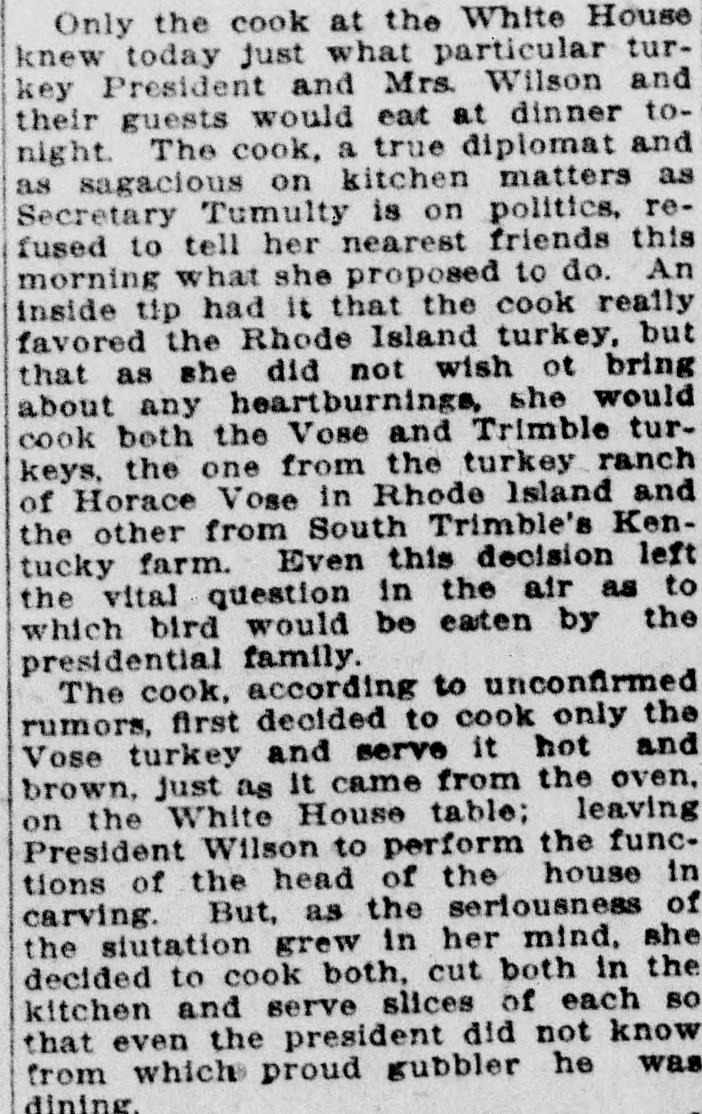
The Wilson turkey mystery, from Washington, November 27, 1913. The Richmond Virginian, Richmond, Virginia, November 28, 1913, page 1. Library of Congress, Chronicling America. Click the clipping to read it full size.
That was Vose’s last Thanksgiving. About three weeks later, on December 20, 1913, he died suddenly at his home in Westerly. He was 73. The Sun of New York ran the headline “TURKEY KING DIES SUDDENLY.” For more than 35 years, it said, he had sent “a monster turkey to the White House.”
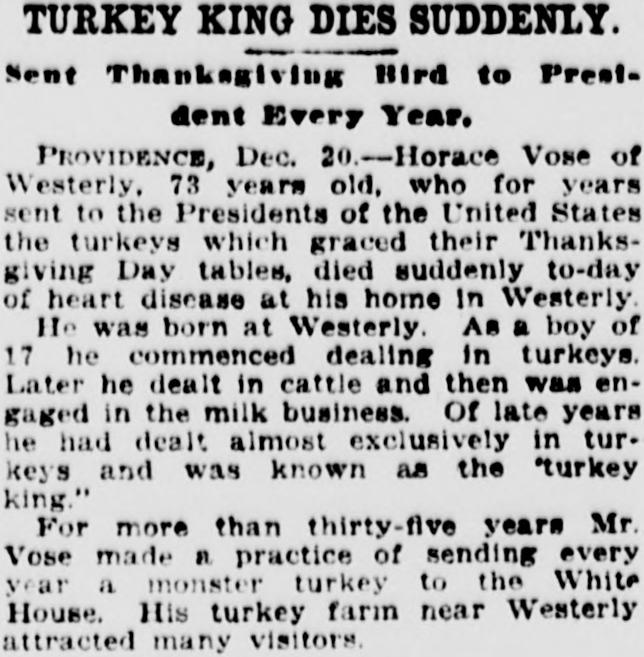
“Turkey King Dies Suddenly.” The Sun, New York, December 21, 1913, page 11. Library of Congress, Chronicling America. Click the clipping to read it full size.
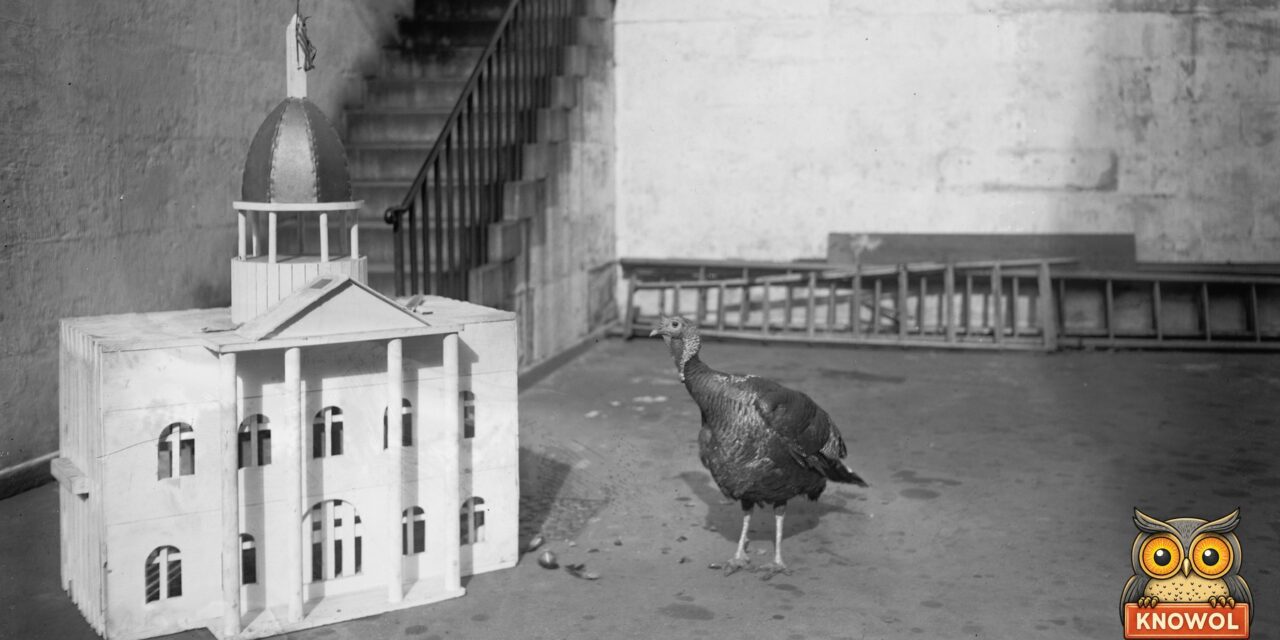
The turkeys kept coming after he was gone. In 1920 one showed up at the White House next to a fancy wooden crate with a dome on top, like a little capitol building. That same year the turkey town of Cuero, Texas, sent President Wilson its biggest bird in a coop “modeled after the White house.” The turkey king would have approved.
Sources
- The Washington Herald (Washington, D.C.): November 23, 1910, page 1 (“Where Is a Turkey for Taft Dinner?”).
- The Washington Times (Washington, D.C.): November 24, 1910, page 2 (the 37-pound turkey).
- Norwich Bulletin (Norwich, Connecticut): November 28, 1910, page 2 (the Westerly news on the Associated Press story and King George), November 27, 1912, page 6 (the 1912 turkey) and November 12, 1913, page 6 (fifty cents a pound; the Wilson turkey).
- The Evening Star (Washington, D.C.): November 25, 1893, page 20 (Westerly letter: the 1892 turkey and sixty tons), November 25, 1896, page 5 (Rhode Island turkeys; Cleveland’s 32-pound bird) and November 25, 1905, page 13 (“Selecting the Presidential Turkey” and the photo).
- The Richmond Virginian (Richmond, Virginia): November 28, 1913, page 1 (“Turkey Mystery Deepens,” a Washington report dated November 27).
- The Sun (New York): December 21, 1913, page 11 (“Turkey King Dies Suddenly”).
- The Rock Island Argus (Rock Island, Illinois): November 16, 1920, page 1 (“Cuero Turkey for President”).
- All newspaper images: Library of Congress, Chronicling America. Published 1893 to 1913, public domain.
- Cover: “White House turkey, 1920, 11/20/20,” National Photo Company, Library of Congress, no known restrictions on publication. This turkey came to the White House in 1920, seven years after Vose died.