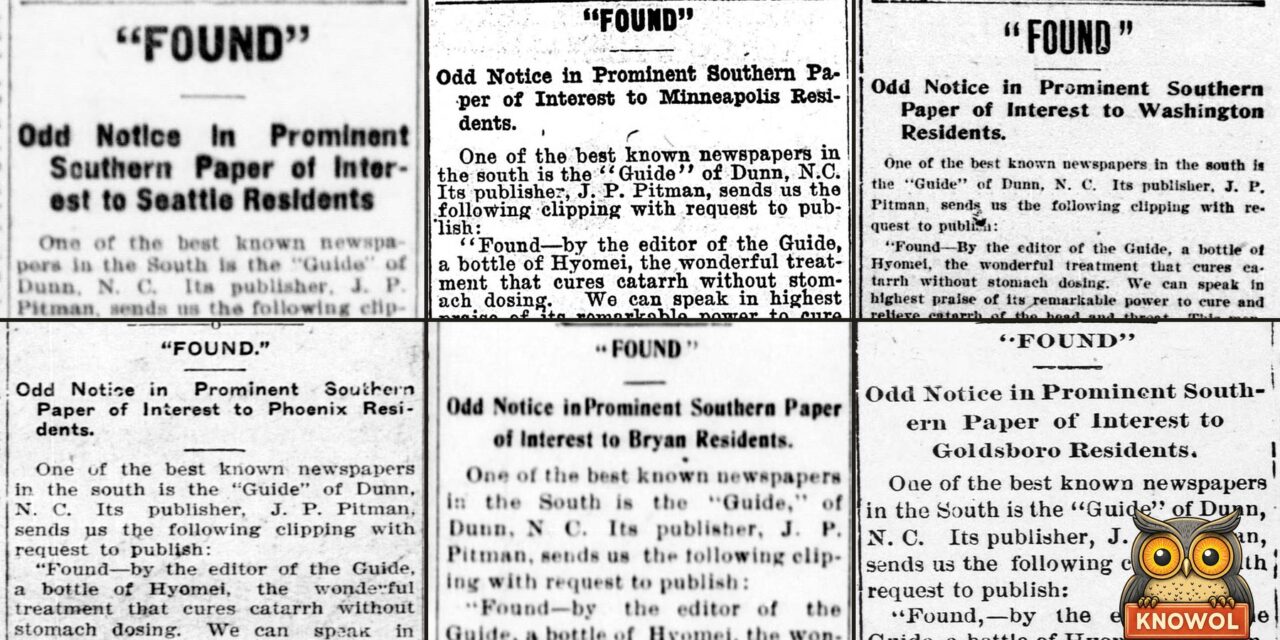
On Tuesday, January 17, 1905, readers of the Seattle Star in Seattle, Washington, turned to page 5 and found a short item under one word: “Found.” A second headline called it an “Odd Notice in Prominent Southern Paper of Interest to Seattle Residents.” That same day papers in Phoenix, Arizona, Topeka, Kansas, Minneapolis and Washington, D.C., printed the very same notice, each one “of Interest” to its own residents. A week later it was the turn of the Americus Times-Recorder in Americus, Georgia. Word for word it was one item. Only two names changed from paper to paper: the town in the headline, and the druggist at the bottom.
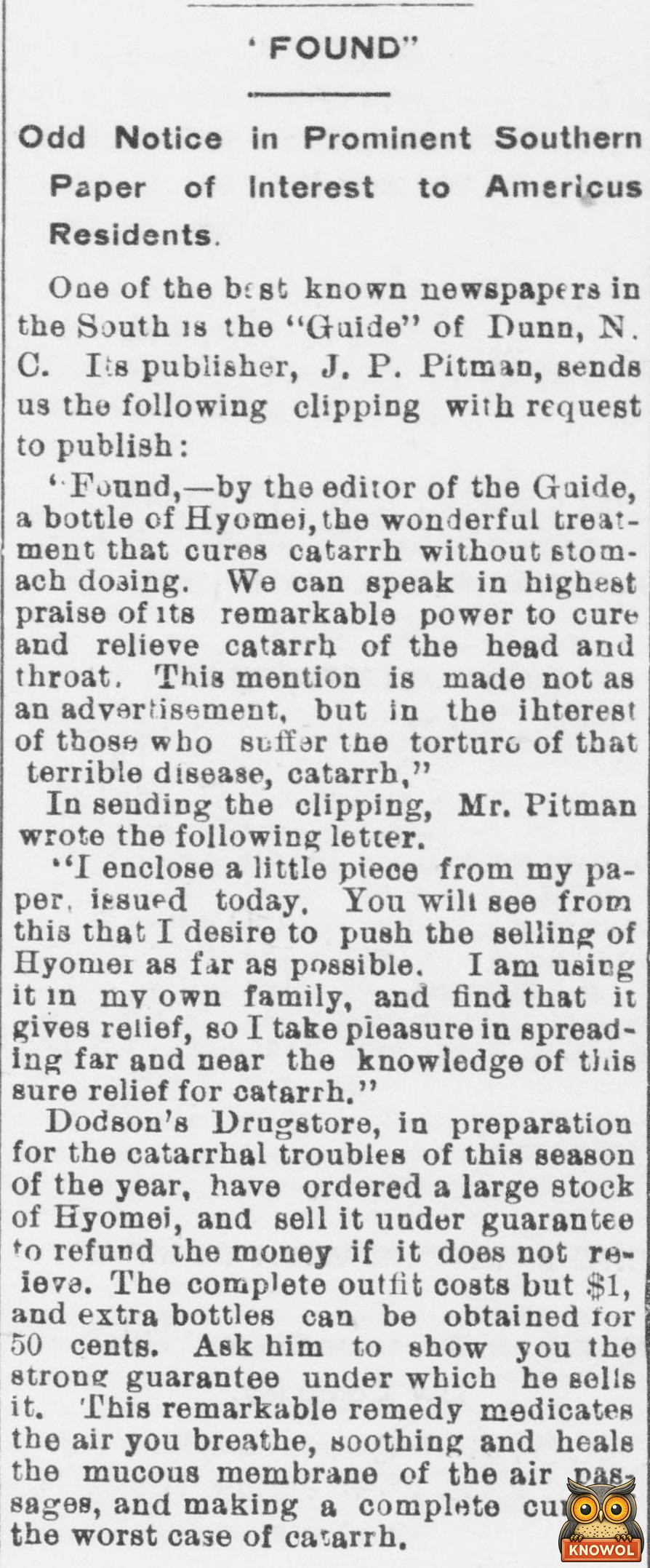
“Found,” the whole Odd Notice as the Americus Times-Recorder printed it for Americus readers. Americus Times-Recorder, Americus, Georgia, January 24, 1905, page 3. Library of Congress, Chronicling America. Click the clipping to read it full size.
A clipping from Dunn
The notice said “one of the best known newspapers in the South” was the “Guide” of Dunn, North Carolina, and that its publisher, J. P. Pitman, had sent a clipping “with request to publish.” In it, the Guide’s editor had found “a bottle of Hyomei, the wonderful treatment that cures catarrh without stomach dosing.” Then came the key line: “This mention is made not as an advertisement, but in the interest of those who suffer the torture of that terrible disease, catarrh.”
A letter from Pitman followed: “You will see from this that I desire to push the selling of Hyomei as far as possible,” he wrote, and he said he was using it in his own family. Catarrh was the everyday word for a nose and throat that swelled, dripped and wouldn’t clear, the kind of misery a long winter brought. The notice promised relief for “the mucous membrane of the air passages.”
The hometown part
The last paragraph is where each paper made the notice its own. In Americus it read: “Dodson’s Drugstore, in preparation for the catarrhal troubles of this season of the year, have ordered a large stock of Hyomei, and sell it under guarantee to refund the money” if it didn’t bring relief. The outfit cost “but $1,” and extra bottles were 50 cents.
Everywhere else the sentence stayed and the store changed. In Seattle the stock belonged to the Quaker Drug Co. In Phoenix it was H. Goodman, in Belfast, Maine, R. H. Moody, and in Topeka, Rowley & Snow. Goldsboro, North Carolina, got J. H. Hill & Son, and Bennington, Vermont, got “Druggist Gokay.” The seams sometimes showed: in Americus the drugstore “have ordered” its stock, but readers were told to “Ask him” about the guarantee.
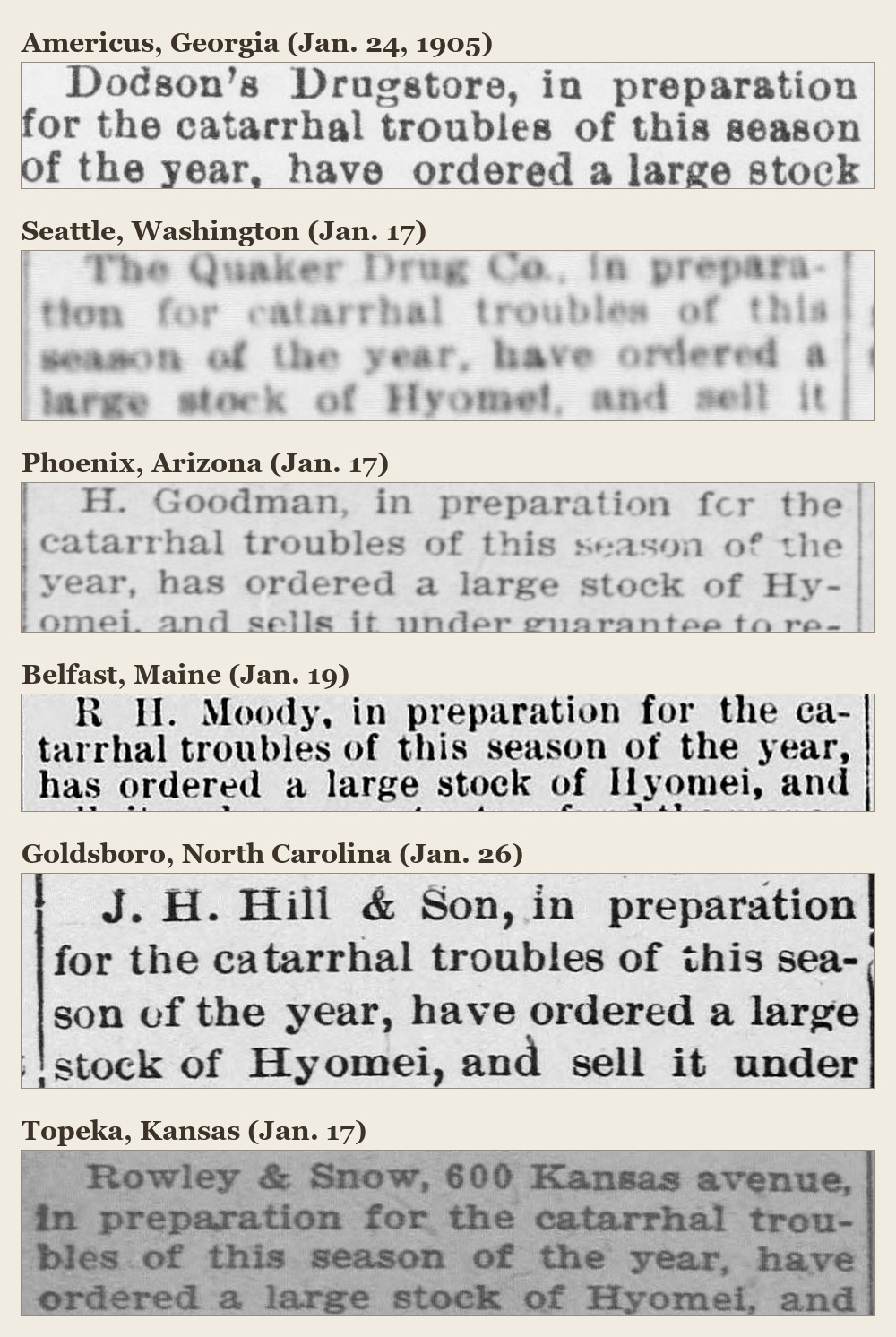
One sentence, six druggists: the hometown paragraph of the Odd Notice as printed in Americus, Georgia; Seattle, Washington; Phoenix, Arizona; Belfast, Maine; Goldsboro, North Carolina; and Topeka, Kansas, January 1905. Crops from the Americus Times-Recorder, Seattle Star, Arizona Republican, Republican Journal, Goldsboro Weekly Argus and Topeka State Journal. Library of Congress, Chronicling America. Click the picture to see it full size.
How far it went
Our own index of 1905 newspapers found the notice in 47 papers. We checked 42 of them on the page scans: 41 towns in 25 of today’s states and Washington, D.C., from January 14 to April 18, 1905. Vermont alone had it in seven papers, and the index shows the Bryan Morning Eagle in Bryan, Texas, running it six times in under three weeks. Hyomei items with other headlines ran all year; counting those, the index holds more than 1,300 in 83 papers.
The real Guide
There really was a Guide in Dunn. The Library of Congress directory of American newspapers lists a Weekly Guide and a Daily Guide there, both published by J. P. Pittman, who spelled his name with two t’s. When he died in 1917, the Smithfield Herald said he had “Edited The Weekly Guide At Dunn, N. C.” for a “Long Number of Years.” We couldn’t find any issues of the Guide from that winter online, so we never saw its own “Found” item, and we can’t say whether Pittman ever wrote it.
A thank-you note, also word for word
Some of the same papers also ran “A Model Business House.” It began: “It is so seldom that an advertiser writes us asking for a bill, wishing to pay his account right up to date, that the letter we had a few days ago from the R. T. Booth Company of Ithaca, N. Y., making this request was a surprise to the office force of the Republican.” That was Phoenix, on the same day as its Odd Notice. In Belfast it was a surprise to “the office force of The Journal,” and in Bennington, “the office force of the Banner.” Each paper put its own name in. The item went on to praise Hyomei and the company’s stomach tablets, “Mi-o-na, the standard remedy for all stomach troubles.”

“A Model Business House,” thanking the R. T. Booth Company for paying its bill, printed directly above the Odd Notice and “Druggist Gokay.” The Bennington Evening Banner, Bennington, Vermont, January 24, 1905, page 3. Library of Congress, Chronicling America. Click the clipping to read it full size.
What was in the bottle
A package of Booth’s Hyomei at the Smithsonian’s National Museum of American History, made in Ithaca, New York, is labeled for “Catarrh of Head and Throat,” head colds and hay fever. In 1912 the American Medical Association’s book Nostrums and Quackery explained that a few drops of “an oily liquid” went on gauze inside a hard rubber “inhaler,” and the user breathed through it. Chemists of the British Medical Association had reported it was essentially 80 percent oil of eucalyptus, with alcohol and liquid paraffin. “Of course, this mixture never cured anything,” the AMA wrote.
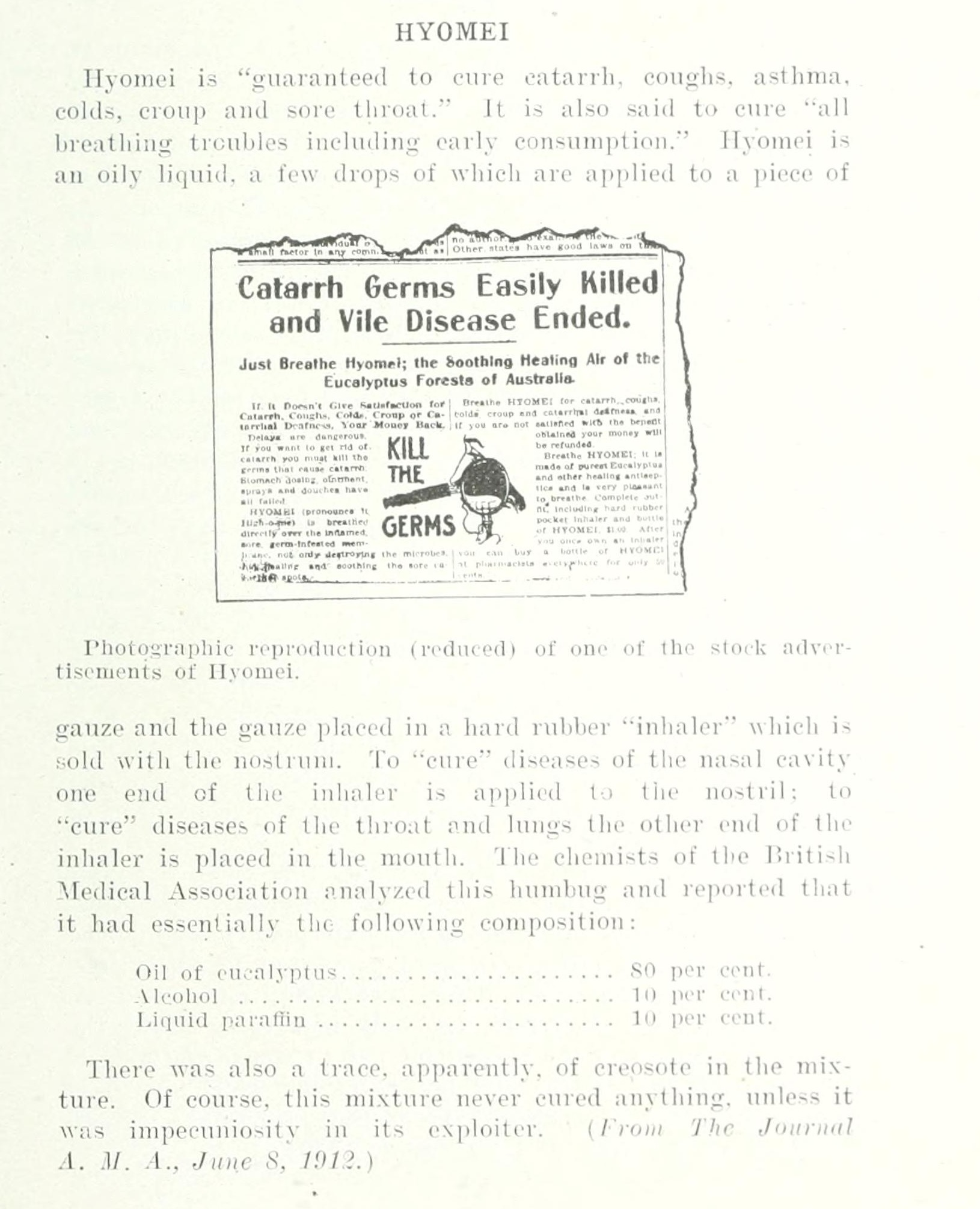
The American Medical Association’s page on Hyomei, with a Hyomei newspaper ad and the British Medical Association’s analysis. Nostrums and Quackery, second edition, Chicago, American Medical Association Press, 1912, page 601. Internet Archive (University of Toronto copy). Public domain. Click the picture to see it full size.
The turning year
The Odd Notice ran in the last winter before the country took a hard look at ads like it. On October 7, 1905, Collier’s magazine began “The Great American Fraud,” a series by Samuel Hopkins Adams that exposed the tricks of patent medicine makers. On June 30, 1906, President Theodore Roosevelt signed the first federal Food and Drugs Act. Side by side, the copies of the Odd Notice show how the trick worked: praise from a faraway “Prominent Southern Paper,” and a neighbor’s store at the bottom to make it feel like home.
Where we found it
These are the 42 papers we checked on the page scans, by town: Montgomery, Alabama; Phoenix, Arizona; Cañon City, Colorado; Stafford Springs, Connecticut; Wilmington, Delaware; Washington, D.C. (the Evening Star and the Washington Times); Americus and Marietta, Georgia; Marshalltown and Missouri Valley, Iowa; Abilene and Topeka, Kansas; Paris, Kentucky; Augusta, Belfast and Paris, Maine; Alma, Michigan; Minneapolis and Sauk Centre, Minnesota; Columbus, Mississippi; Mexico and Monroe City, Missouri; Perth Amboy and Woodbury, New Jersey; Las Vegas, New Mexico; Goldsboro, North Carolina; Vinita, Indian Territory (now Oklahoma); Emporium, Pennsylvania; Olneyville (Providence), Rhode Island; Bryan, Texas; Barre, Barton, Bennington, Brattleboro, Middlebury, Randolph and St. Johnsbury, Vermont; Seattle, Washington; Clarksburg and Shepherdstown, West Virginia; and Grand Rapids (now Wisconsin Rapids), Wisconsin.
Sources
- Americus Times-Recorder (Americus, Georgia), January 24, 1905, page 3 (“Found,” Odd Notice, Dodson’s Drugstore).
- The Seattle Star (Seattle, Washington), January 17, 1905, page 5 (The Quaker Drug Co.).
- Arizona Republican (Phoenix, Arizona), January 17, 1905, page 10 (Odd Notice, H. Goodman) and page 8 (“A Model Business House”).
- The Topeka State Journal (Topeka, Kansas), January 17, 1905, page 10 (Rowley & Snow).
- The Republican Journal (Belfast, Maine), January 19, 1905, page 2 (R. H. Moody) and January 26, 1905, page 6 (“A Model Business House”).
- Goldsboro Weekly Argus (Goldsboro, North Carolina), January 26, 1905, page 8 (J. H. Hill & Son).
- The Bennington Evening Banner (Bennington, Vermont), January 24, 1905, page 3 (“A Model Business House” and the Odd Notice, Druggist Gokay).
- The Washington Times (Washington, D.C.), January 14, 1905, page 3, the earliest copy we found.
- Las Vegas Daily Optic (Las Vegas, New Mexico), April 18, 1905, page 4, the latest copy we confirmed on a scan.
- All newspaper images: Library of Congress, Chronicling America. Published 1905, public domain. The copies were found with KNOWOL’s own index of 1905 newspapers, built from the American Stories dataset (Dell et al., Harvard, CC BY 4.0), which re-reads the Library of Congress page scans; every quote here was read off the scans.
- Library of Congress, U.S. Newspaper Directory: The Weekly Guide (Dunn, N.C.) and The Daily Guide (Dunn, N.C.), both “Dunn, N.C. : J.P. Pittman.”
- The Smithfield Herald (Smithfield, North Carolina), November 2, 1917, page 12, “Editor J. P. Pittman Dead,” DigitalNC.
- Smithsonian, National Museum of American History, Hyomei, Booth’s (maker Booth Hyomei Company; made in Ithaca, New York; ID 1984.0782.097).
- American Medical Association, Nostrums and Quackery, second edition (Chicago, 1912), page 601, “Hyomei”, reprinted from The Journal of the A. M. A., June 8, 1912. Internet Archive, University of Toronto copy. Public domain.
- Smithsonian, Balm of America: Patent Medicine Collection, history (Collier’s series of 1905 and 1906; the law signed June 30, 1906).
- U.S. Food and Drug Administration, history gallery, archived 2009 by the University of North Texas: Collier’s series began October 7, 1905.