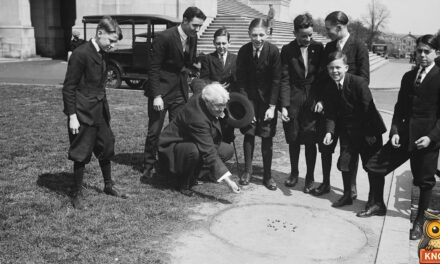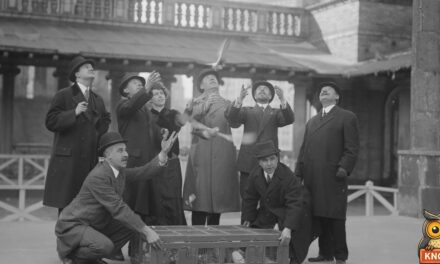
In April 1913, a high school class in Grafton, North Dakota, did a simple experiment. The students took garden seeds that the United States government had sent out for free, and they counted how many would sprout. E. J. Trosper, the man in charge of the work, did not like what they found. He said the government seed was “nothing but junk that might have some value if sent out in ton lots and used as a fertilizer.”
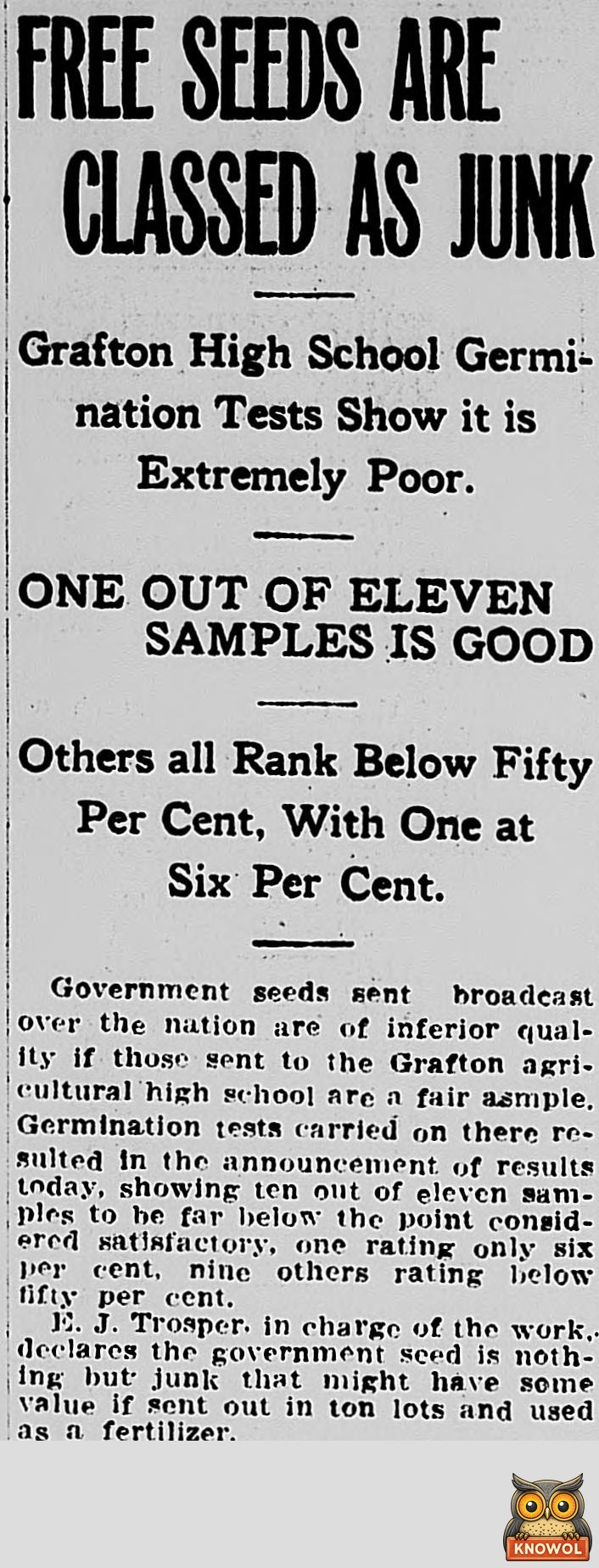
“Free Seeds Are Classed as Junk.” The Evening Times, Grand Forks, North Dakota, April 24, 1913, page 7. Library of Congress, Chronicling America. Click the clipping to read it full size.
The Grand Forks, North Dakota, paper ran the story under a big, blunt headline: “FREE SEEDS ARE CLASSED AS JUNK.” To understand why that made news, you need to know about one of the oddest gifts in American history.
A present from your congressman
For more than 80 years, the United States Congress mailed free garden seeds to people all over the country. Every year, Congress paid the Department of Agriculture to buy seeds and pack them into little paper packets. Then each senator and representative got a share to send to the folks back home.
The seeds traveled “franked.” That means the lawmaker’s printed signature went on the envelope in place of a stamp, so the mail was free too.
It was a giant job. In 1902, the Indianapolis Journal reported that Congress had set aside $270,000 for “about 40,000,000 packages of seed, which will weigh about 1,000 tons.” That’s two million pounds of tiny seeds.
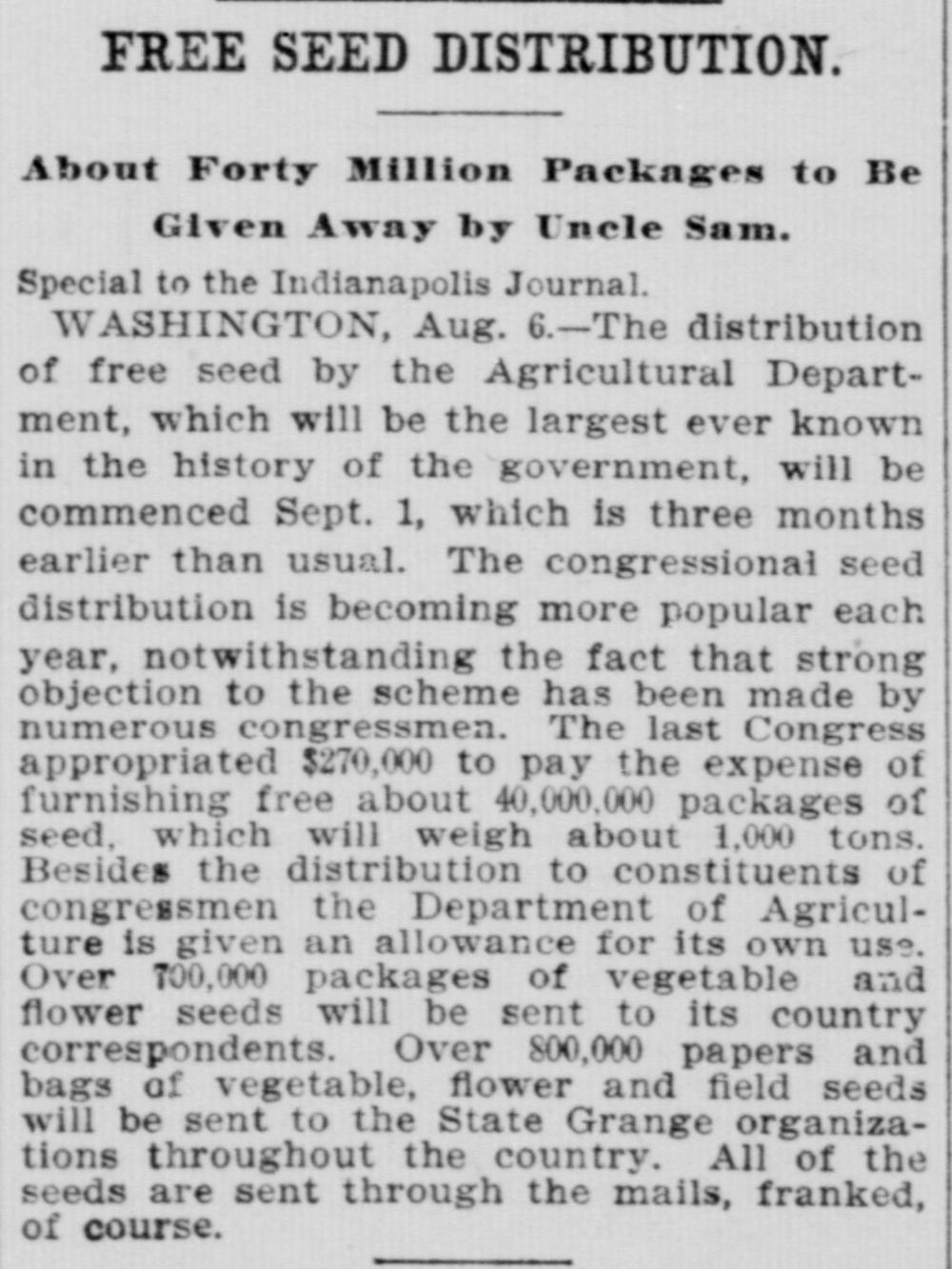
“Free Seed Distribution. About Forty Million Packages to Be Given Away by Uncle Sam.” The Indianapolis Journal, Indianapolis, Indiana, August 7, 1902, page 5. Library of Congress, Chronicling America. Click the clipping to read it full size.
How the seeds got packed
The packing was done in big rooms with clever machines. Seed poured down cloth chutes from the floor above. Each machine opened a little packet, filled it with the right amount of seed and sealed it shut. The worker sitting at the machine mostly just had to watch.
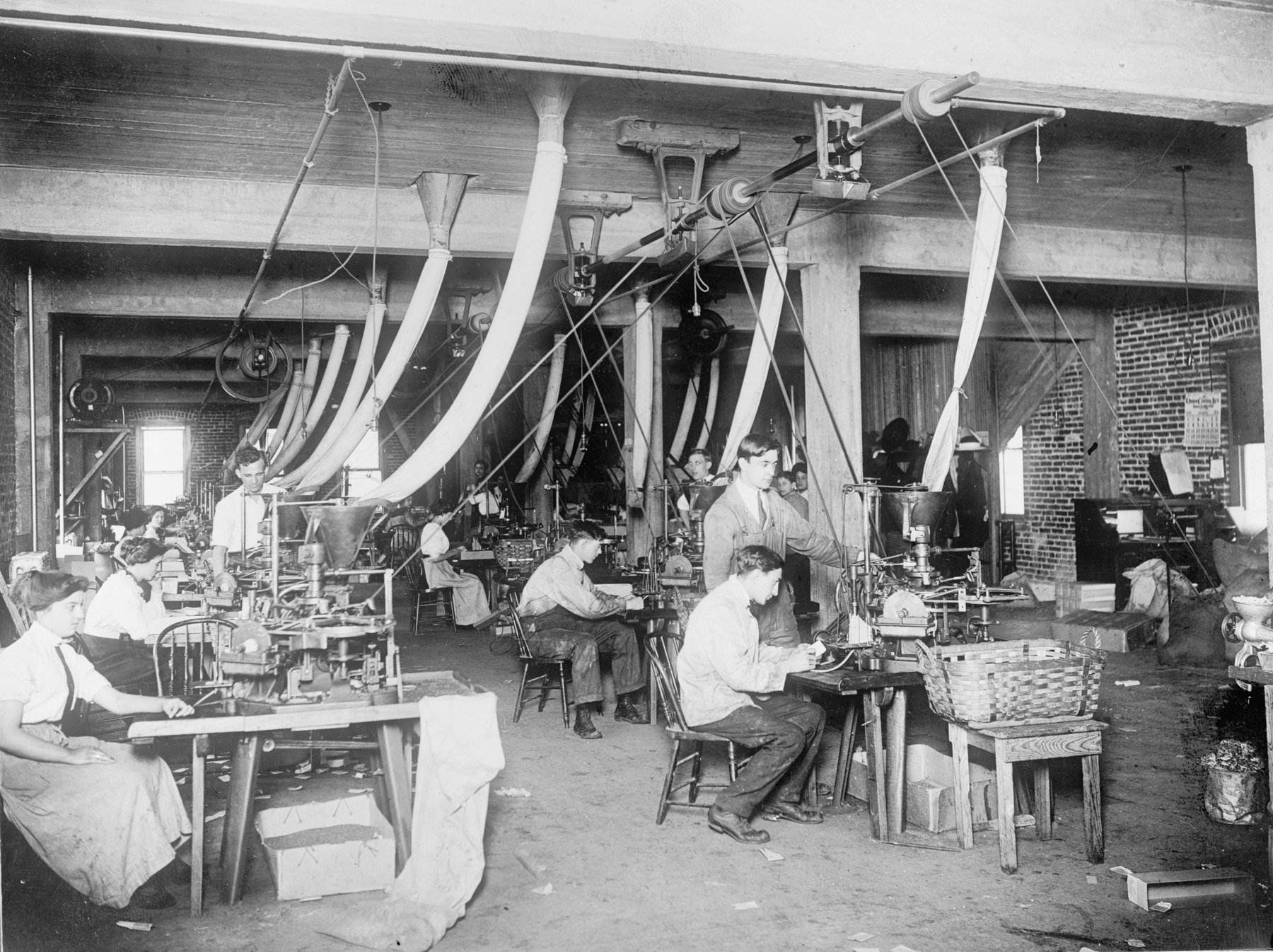
Packing machines for the free seeds, Department of Agriculture, about 1916. The long cloth tubes bring seed down from the floor above. National Photo Company, Library of Congress. Click the picture to see it full size.
Next, the packets went into envelopes, five kinds of seeds to each envelope. The envelopes rode past the workers on a moving belt. Young women sat in a long row, and each one dropped in a single packet from her bin as the envelopes went by.
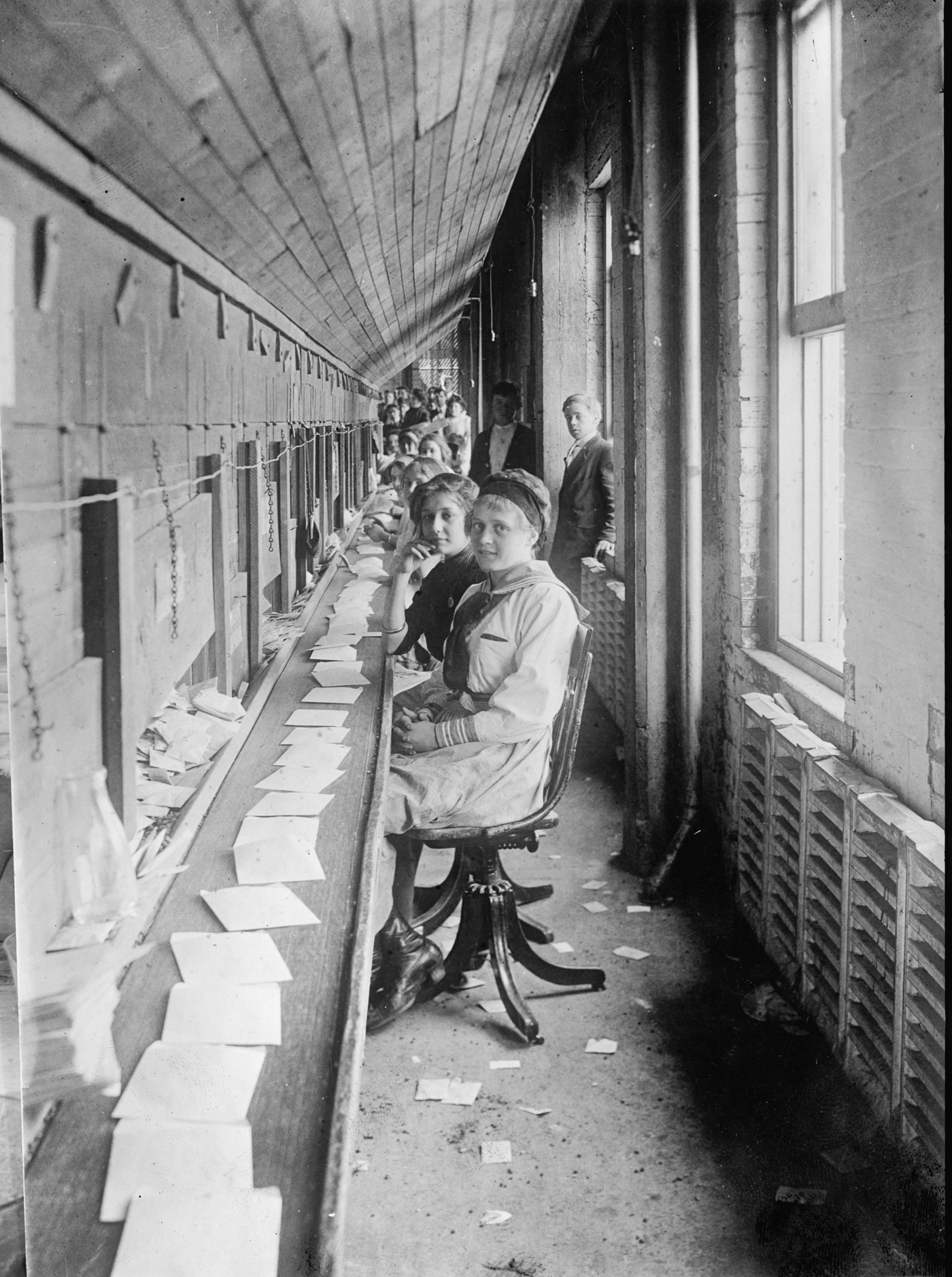
Young women fill seed envelopes on a moving belt, Department of Agriculture, about 1916. National Photo Company, Library of Congress. Click the picture to see it full size.
Seeds made votes
Lawmakers loved the seeds for one big reason. People who got a free gift in the mail might remember the name on the envelope at election time.
In 1903, the Topeka State Journal told about Representative Cromer of Indiana. When the other party tried hard to beat him, he stayed quiet and “sowed his district with garden seeds.” Then, the paper said, “he reaped a bountiful harvest at the polls.” In plain words, he planted seeds and harvested votes.
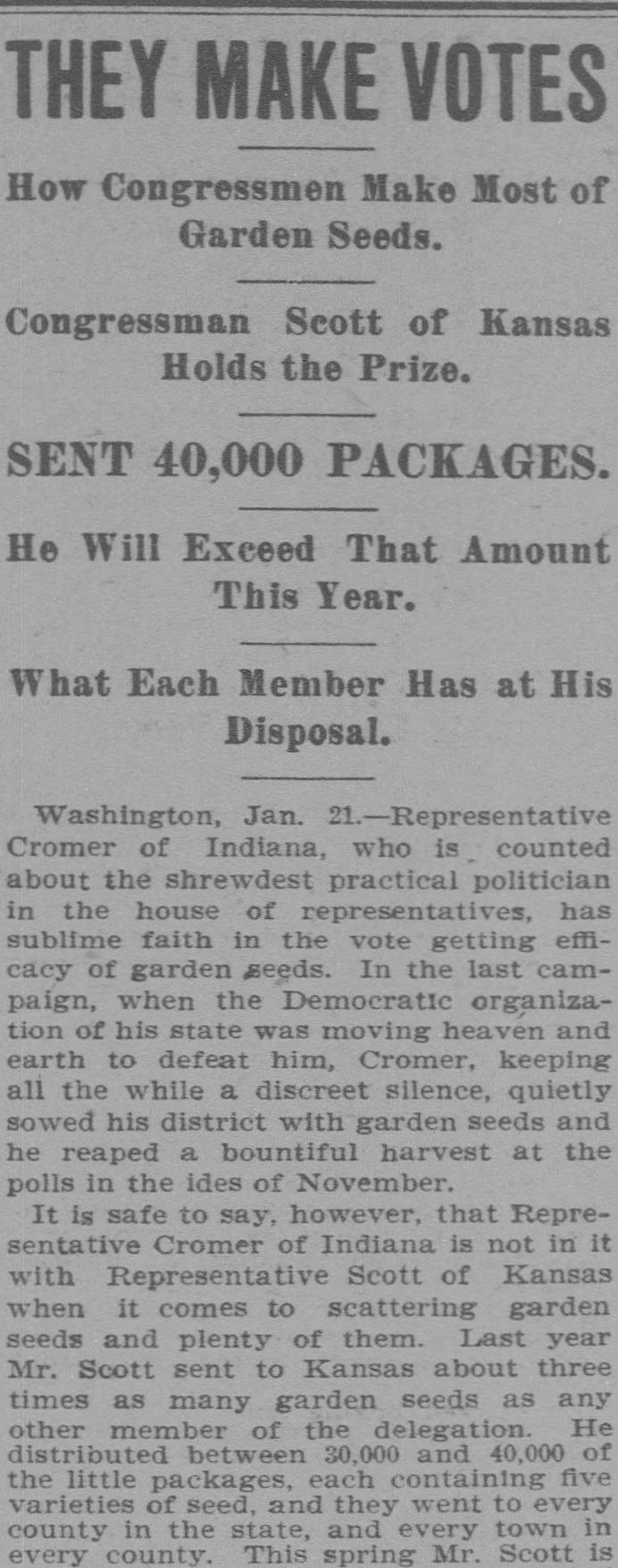
“They Make Votes.” The Topeka State Journal, Topeka, Kansas, January 21, 1903, page 3. Library of Congress, Chronicling America. Click the clipping to read it full size.
The same story said Congressman Scott of Kansas sent home “between 30,000 and 40,000 of the little packages, each containing five varieties of seed.” His seeds went “to every county in the state, and every town in every county.”
Surprise! It’s a cantaloupe
There was one problem. Nobody could be sure what would come up. In 1917, a Denver paper said many people had complained that the seeds grew into “strange and wonderful mixtures.” Some planters expected a fancy new flower. Instead, “a meek and lowly cantaloupe has raised its head.”
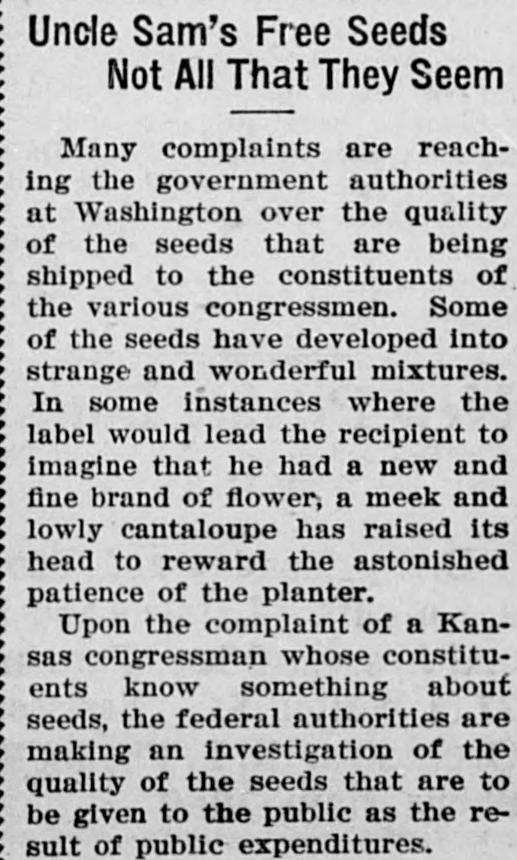
“Uncle Sam’s Free Seeds Not All That They Seem.” The Colorado Statesman, Denver, Colorado, January 20, 1917, page 6. Library of Congress, Chronicling America. Click the clipping to read it full size.
One congressman decided to find out for himself. In April 1916, Congressman Jesse S. Davenport of Oklahoma “donned a pair of blue overalls” and went across the river from Washington to a seven-acre farm. He wanted to grow the government seeds and see. He worried that the packets might “grow turnips instead of early spring radishes.” We could not find a later report on what his garden grew.
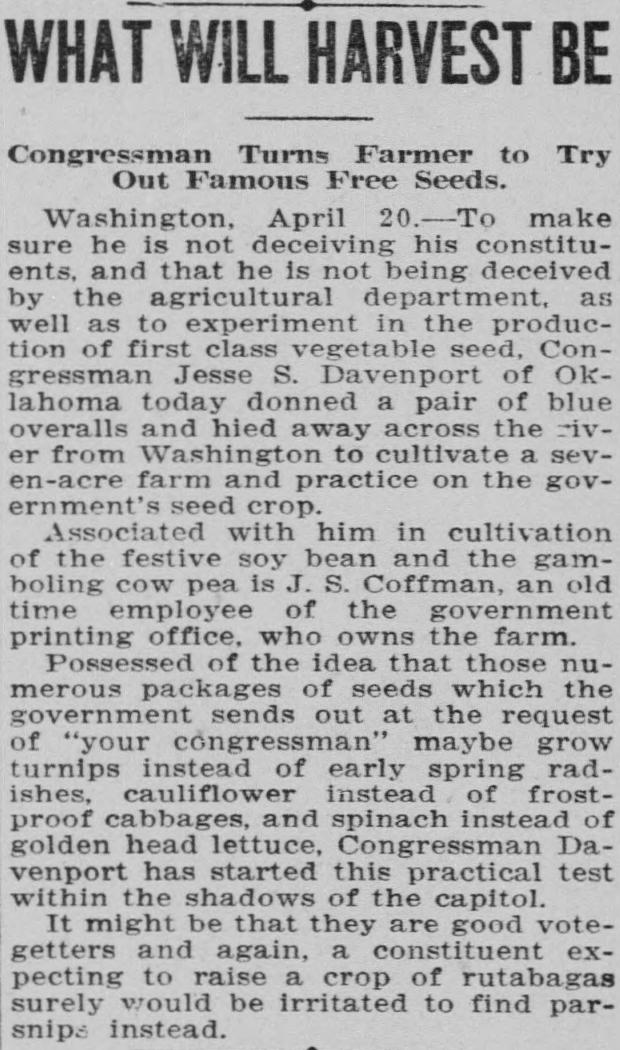
“What Will Harvest Be.” The Topeka State Journal, Topeka, Kansas, April 20, 1916, page 10. Library of Congress, Chronicling America. Click the clipping to read it full size.
The Grafton test
That brings us back to the classroom in Grafton. The agricultural botany class tested 11 kinds of government seeds. A germination test is simple. You keep a counted number of seeds warm and damp, then count how many sprout. Out of every 100 seeds, here is about how many came up:
- Delphinium (a tall blue flower): 6
- Kochia (a leafy bush for flower beds): 17
- Lettuce, tomatoes and cosmos: 30 each
- Onions, radishes and morning glory: 40 each
- Poppy: 45
- Beets: 50
- Muskmelon: 84
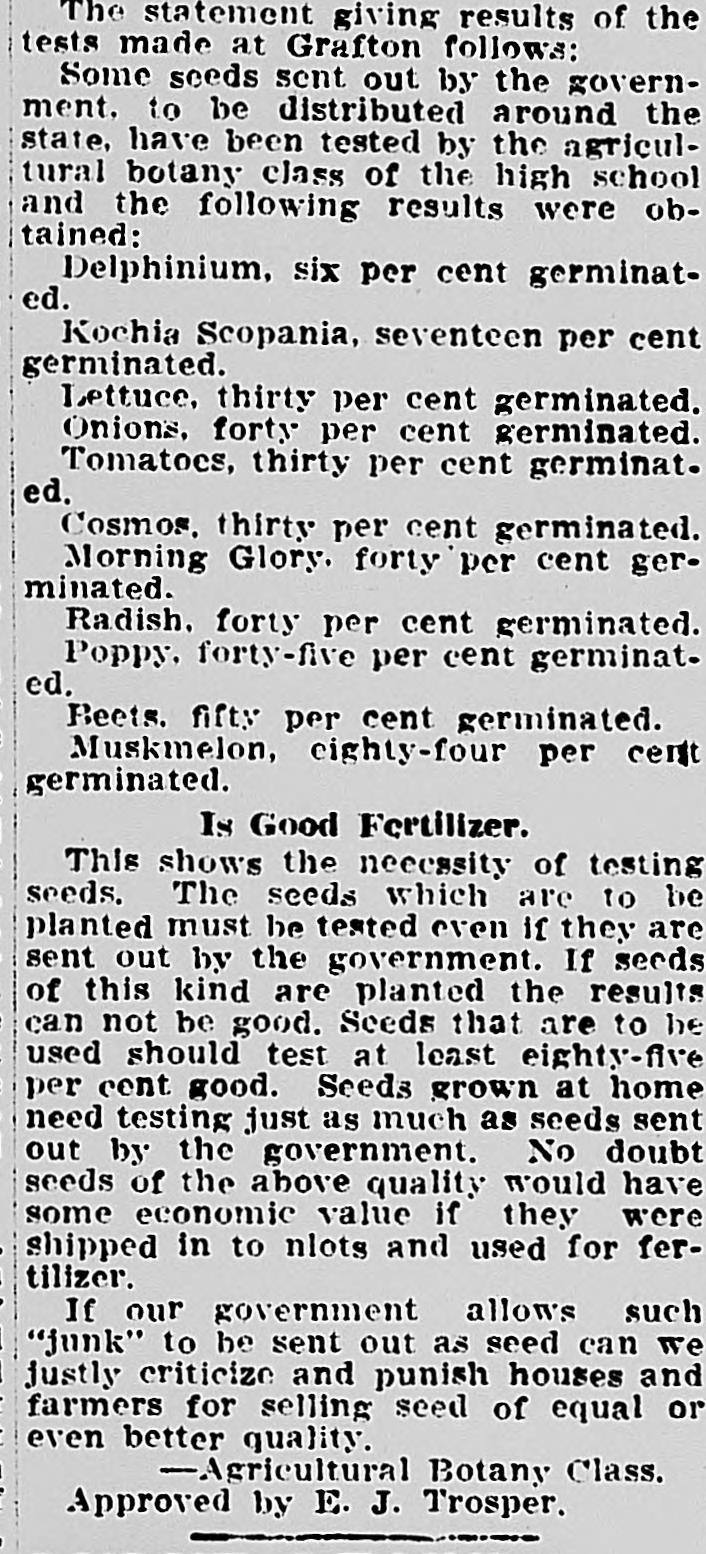
The class’s own report, signed “Agricultural Botany Class. Approved by E. J. Trosper.” The Evening Times, Grand Forks, North Dakota, April 24, 1913, page 7. Library of Congress, Chronicling America. Click the clipping to read it full size.
Even the muskmelon fell just short of the class’s own rule. Good seed, they wrote, “should test at least eighty-five per cent good.” They also made a fair point that still holds today: “Seeds grown at home need testing just as much as seeds sent out by the government.”
The next day, the Grand Forks paper wrote an editorial about it. It hoped “the Grafton experimenters will continue their work, and raise some of the plants to maturity, in order to see whether even the seeds that do germinate produce anything worth raising.” We could not find out whether they did.
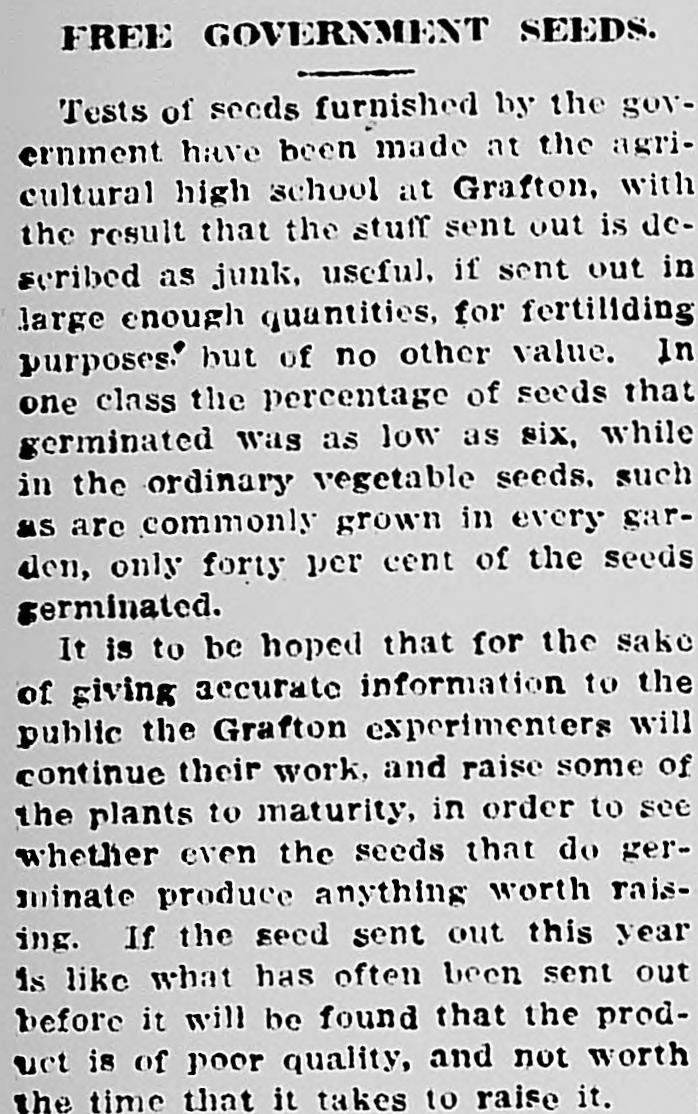
“Free Government Seeds.” The Evening Times, Grand Forks, North Dakota, April 25, 1913, page 4. Library of Congress, Chronicling America. Click the clipping to read it full size.
By the numbers
- 40,000,000: packages of seed planned for 1902.
- 1,000 tons: what those packages weighed.
- 5: kinds of seed in each envelope.
- 6: delphinium seeds out of 100 that sprouted in Grafton.
- $360,000: the yearly amount for free seeds in the early 1920s.
The last free seeds
Lawmakers argued about the free seeds for decades. In early 1923, the Senate finally said no. An Atlanta paper reported that the customary “$360,000 for ‘free seeds'” was refused. During the debate, senators said that “all too often radish seeds developed powerful onions, while Government carrot seeds ended in parsley.”
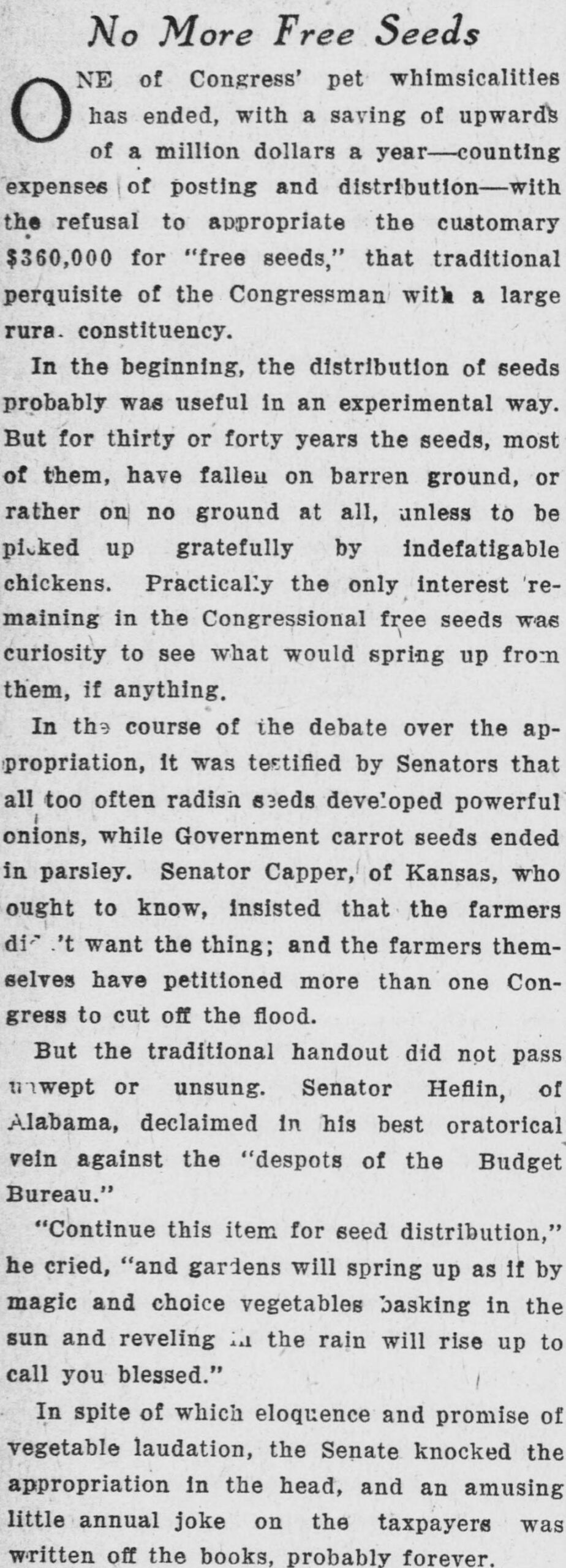
“No More Free Seeds.” Atlanta Tri-Weekly Journal, Atlanta, Georgia, January 23, 1923, page 4. Library of Congress, Chronicling America. Click the clipping to read it full size.
Not everybody cheered. In Springfield, Massachusetts, backyard gardeners who had gotten free seeds “for the past 30 years or more” were “decidedly peeved.” They said the government seeds were better than the ones in stores.
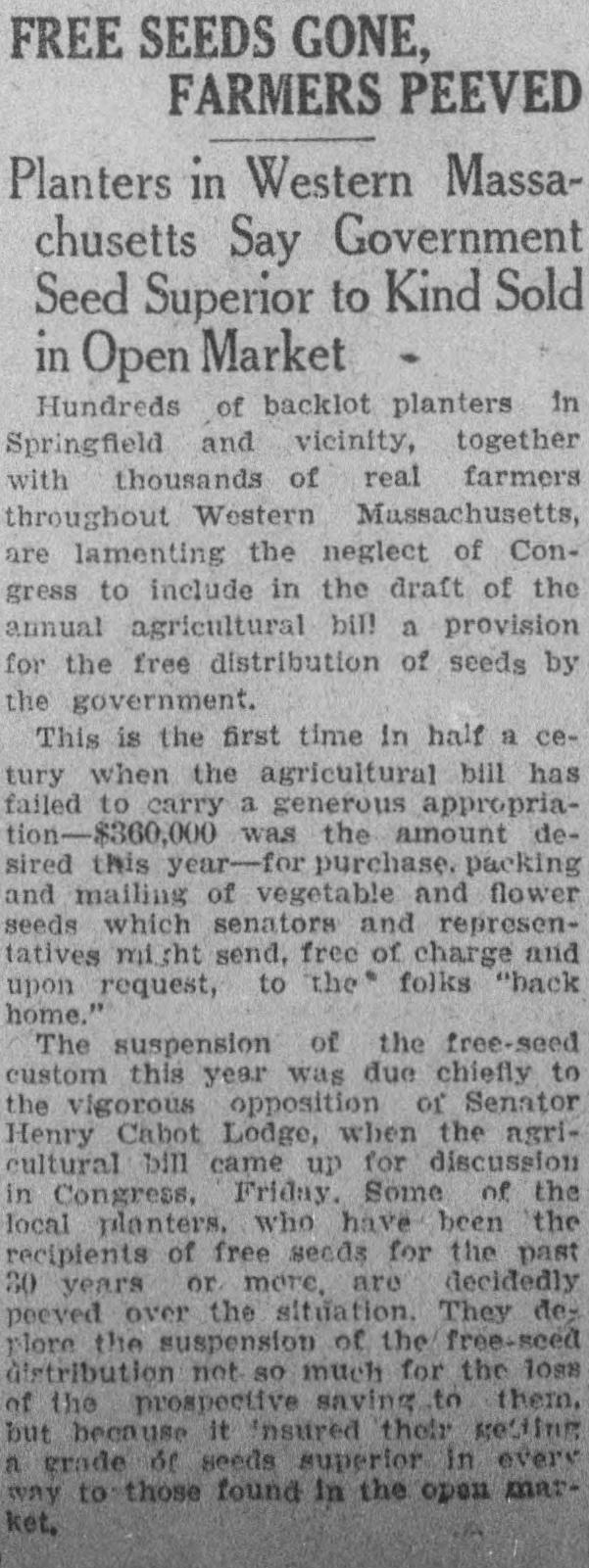
“Free Seeds Gone, Farmers Peeved.” Springfield Weekly Republican, Springfield, Massachusetts, January 18, 1923, page 14. Library of Congress, Chronicling America. Click the clipping to read it full size.
That spring, Congressman Addison T. Smith of Idaho sent a supply of seeds to the newspaper in Mountain Home, Idaho, so the editors could hand them out. In his letter he explained that “there will be no seeds available for distribution next year.” The paper put it in plain words at the top: “LAST YEAR FOR GIVING FREE SEEDS.”
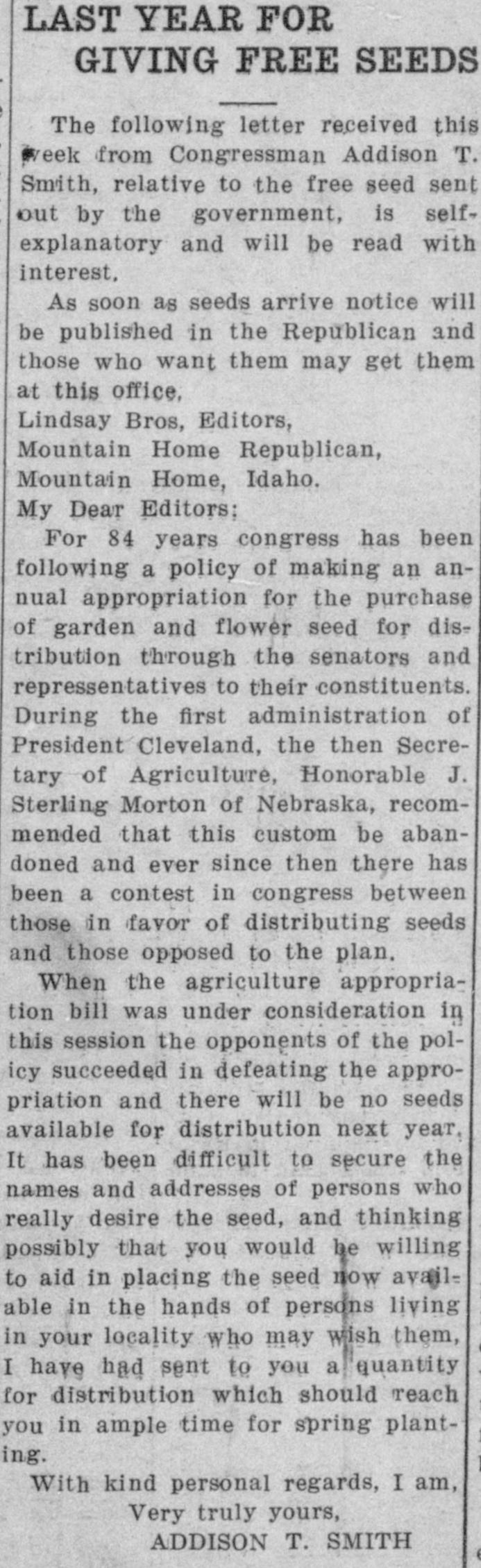
“Last Year for Giving Free Seeds.” Mountain Home Republican, Mountain Home, Idaho, March 10, 1923, page 1. Library of Congress, Chronicling America. Click the clipping to read it full size.
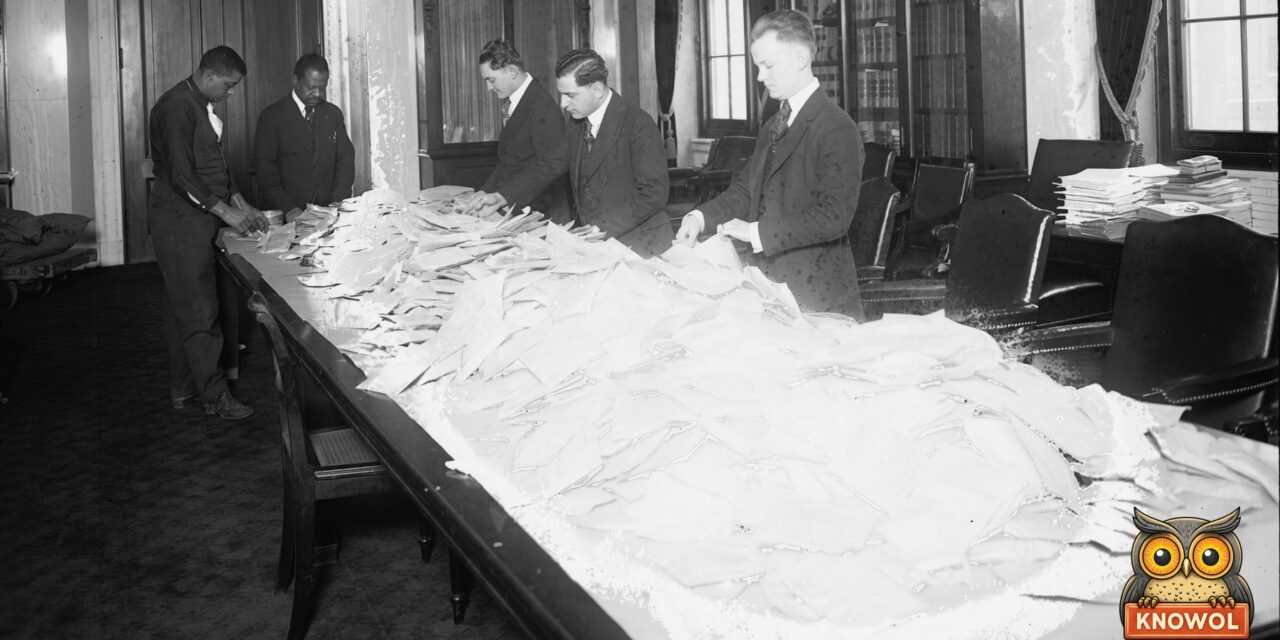
The photo at the top of this story was taken in Washington in 1919 or 1920, near the end. It shows the office of Senator Penrose of Pennsylvania, with a long table buried in seed envelopes waiting to go out. For more than 80 years, envelopes like these landed in mailboxes every spring. Lots of people planted them and hoped. But in 1913, a class in Grafton, North Dakota, did the simplest science there is. They planted the seeds and counted what came up.
Sources
- The Evening Times (Grand Forks, North Dakota): “Free Seeds Are Classed as Junk,” April 24, 1913, page 7; “Free Government Seeds,” April 25, 1913, page 4. Library of Congress, Chronicling America.
- “Free Seed Distribution,” The Indianapolis Journal (Indianapolis, Indiana), August 7, 1902, page 5. Library of Congress, Chronicling America.
- The Topeka State Journal (Topeka, Kansas): “They Make Votes,” January 21, 1903, page 3; “What Will Harvest Be,” April 20, 1916, page 10. Library of Congress, Chronicling America.
- “Uncle Sam’s Free Seeds Not All That They Seem,” The Colorado Statesman (Denver, Colorado), January 20, 1917, page 6. Library of Congress, Chronicling America.
- “No More Free Seeds,” Atlanta Tri-Weekly Journal (Atlanta, Georgia), January 23, 1923, page 4. Library of Congress, Chronicling America.
- “Free Seeds Gone, Farmers Peeved,” Springfield Weekly Republican (Springfield, Massachusetts), January 18, 1923, page 14. Library of Congress, Chronicling America.
- “Last Year for Giving Free Seeds,” Mountain Home Republican (Mountain Home, Idaho), March 10, 1923, page 1. Library of Congress, Chronicling America.
- Photos: “Seed distribution, Sen. Penrose ofc.” (the cover, 1919 or 1920); “Seed distribution, Dept. of Agrl.” (packing machines, about 1916); “Seed distribution, Dept. of Agrl.” (filling envelopes, about 1916). National Photo Company Collection, Library of Congress Prints and Photographs Division. No known restrictions on publication.