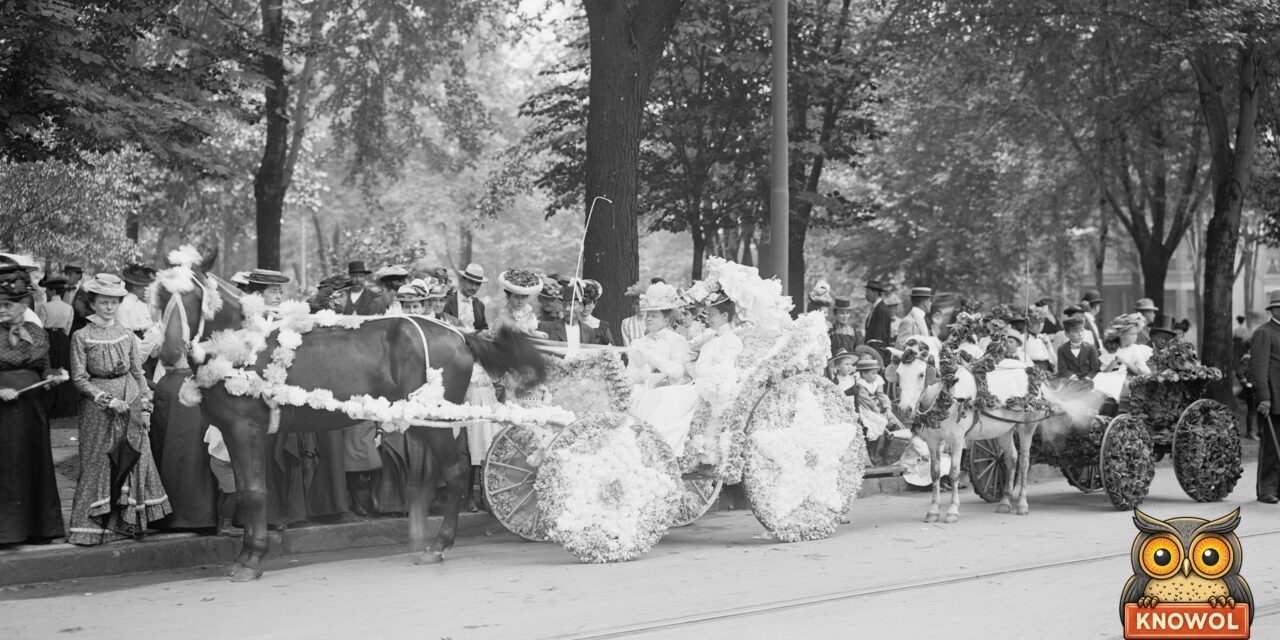
On Tuesday, October 1, 1895, a few minutes past 2 in the afternoon, a rocket shot up over Kansas City, Missouri. It was the signal. Along Fourteenth Street, carriages started rolling, and they were covered in flowers, right down to the wheels. It was Kansas City’s very first flower parade.
The next morning, the Kansas City Daily Journal put it on the front page under a big headline: “VISTA OF FLOWERS.” A vista is a long, wide view. Underneath, the paper called it “THE FIRST ANNUAL FLORAL PROCESSION OF KANSAS CITY.” A procession is a parade.
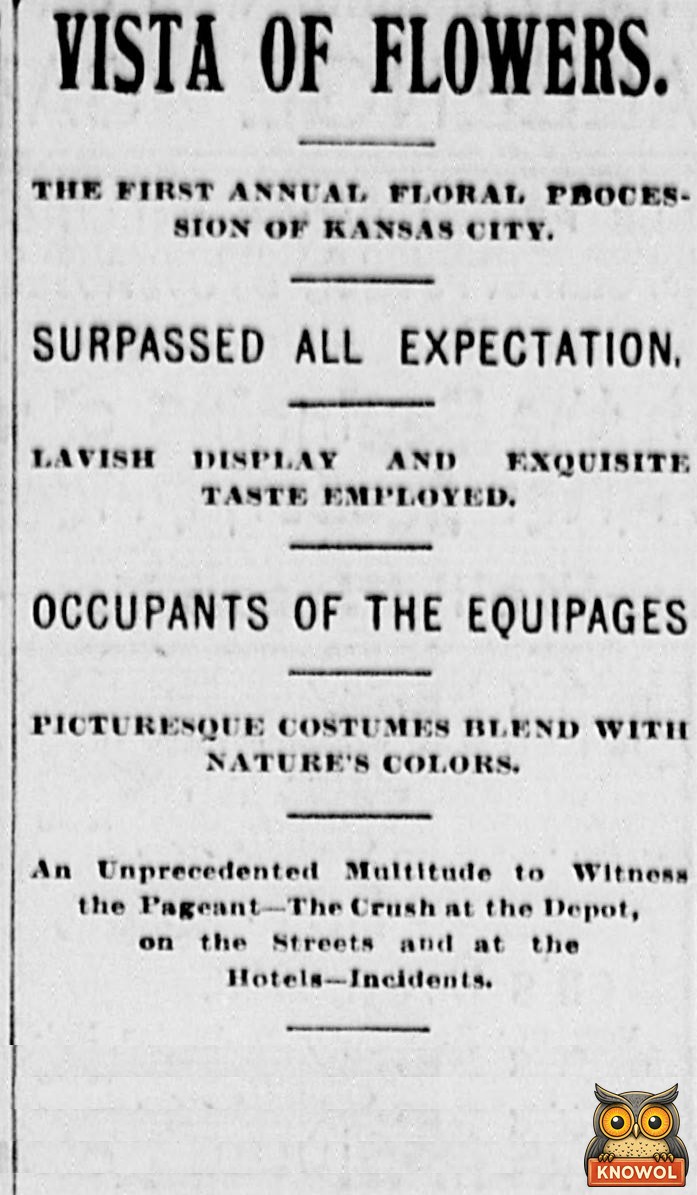
“Vista of Flowers. The First Annual Floral Procession of Kansas City.” Kansas City Daily Journal, Kansas City, Missouri, October 2, 1895, page 1. Library of Congress, Chronicling America. Click the clipping to read it full size.
A 3-Year-Old Jockey Rode a Burro in Kansas City
In Kansas City that afternoon, the rider people loved most was the smallest one. The Journal said he “appealed to the heart of every mother and every blessed small boy and girl and everybody else.”
His name was “little William Wallace Crutcher,” and he was “just 3 years old.” He was dressed as a jockey, a racehorse rider. He rode a burro, a small donkey. The paper called his burro a “genus Colorado mocking bird.” That was a joke. A burro’s loud hee-haw is nothing like a songbird.
William, the paper said, was “not quite as tall as his name is long.” And he “rode like a three-times winner.” The Journal joked that almost every woman along the route cried out the same words: “Oh, ain’t he cute!”
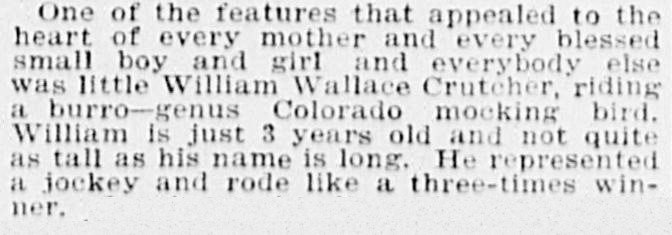
Three-year-old William Wallace Crutcher, dressed as a jockey, rode a burro in the parade. Kansas City Daily Journal, Kansas City, Missouri, October 2, 1895, page 1. Library of Congress, Chronicling America. Click the clipping to read it full size.
Two Kids Sat in a Giant Shoe of Water Lilies
Stores in Kansas City built floats for the parade, too. The Holland Shoe Company made “a great big shoe, covered with yellow and white water lilies.” High up in the top of the shoe sat two children, Master Paul Dold and Miss Elizabeth Jewett.
They took the job seriously. The Journal said they were “both as solemn as owls.” The boy held yellow ribbons, which “served as reins,” like the straps you steer a horse with. The girl held “a dainty white parasol over his head.” A parasol is a small umbrella for shade. The shoe float won third prize among the stores, a white ribbon.
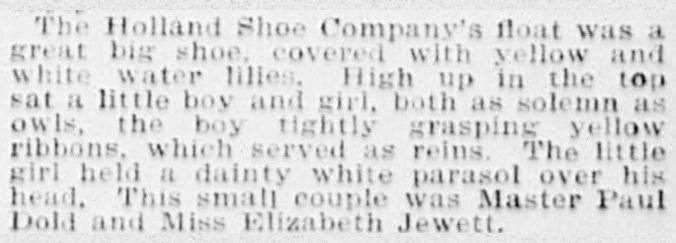
The Holland Shoe Company’s float: a giant shoe of water lilies with two children in the top. Kansas City Daily Journal, Kansas City, Missouri, October 2, 1895, page 1. Library of Congress, Chronicling America. Click the clipping to read it full size.
Other small riders shared the street. In one Kansas City carriage, a 3-year-old played baby Moses from the Bible story, in “a cluster of bullrushes.” He “kicked his bare legs in the sun and clapped his little hands in glee.” Not everybody had fun, though. On the Wells-Fargo Express wagon lay a bulldog with “a bunch of roses” tied to his collar. “For the first time in his life, probably, the dog was frightened,” the paper said.
Kansas City Carriages Carried Thousands of Flowers
The Journal counted flowers like a kid counting candy. One Kansas City carriage carried “seven thousand yellow and white chrysanthemums,” with a white swan resting on top. W. A. Wilson’s carriage had “thousands of pink and white carnations.” It won a prize, and the paper printed a drawing of it.
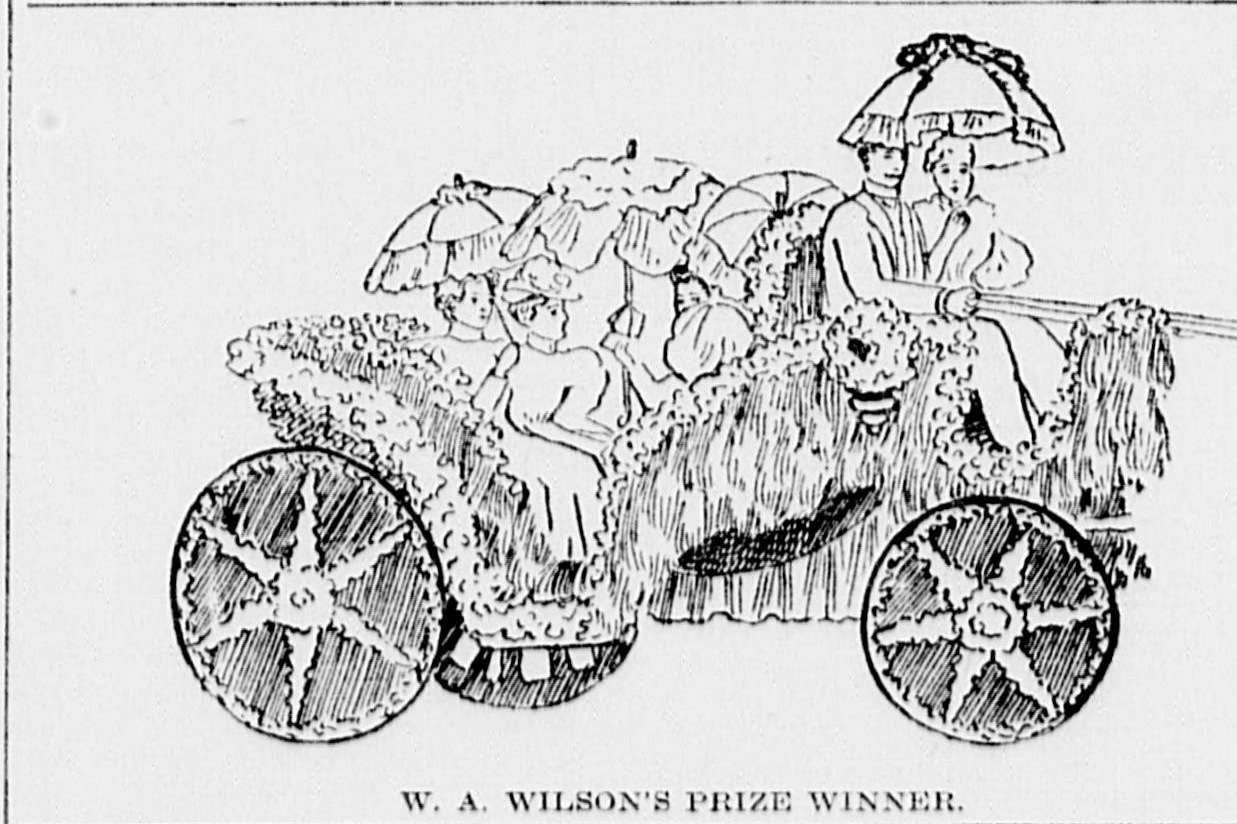
The paper’s own drawing of W. A. Wilson’s prize carriage, with flower-covered wheels and riders under parasols. Kansas City Daily Journal, Kansas City, Missouri, October 2, 1895, page 1. Library of Congress, Chronicling America. Click the picture to see it full size.
Some riders picked surprising flowers. Three young women rode in a carriage covered with pumpkin blossoms. Nobody expected much from a pumpkin flower. But the Journal said that after this parade, it “will never be said again” that “a pumpkin blossom is not a thing of beauty.”
Watches for Kids and a Prize for the Most Awkward
Prizes went out at 6 o’clock that evening. The best decorated pony cart driven by a girl won “watch and chain” for Miss Grace Berger. The best pony cart driven by a boy won the same for Master John S. Taft.
The grown-ups who ran the parade had some fun with themselves, too. There was a prize “for the most awkward aide,” a bronze sculpture from Austria for Dr. John M. Langsdale. And there was one “for the most awkward director”: a bronze statue called “The Gnome,” for Mr. Dent Yates.
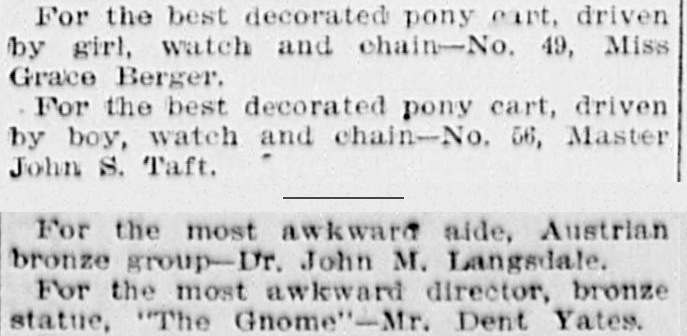
Part of the prize list: watches for the best pony carts, and joke prizes for the most awkward aide and director. Two pieces of the same list, joined. Kansas City Daily Journal, Kansas City, Missouri, October 2, 1895, page 1. Library of Congress, Chronicling America. Click the clipping to read it full size.
The crowd was too big to count, and the reporter proved it. “There were thousands, there were tens of thousands; there were hundreds of thous” is how the sentence went, stopping in the middle of a word. Then came a fresh start: “Anyway, the people of Missouri, of Kansas, of Nebraska and of Iowa were there.”
Even a Kansas City Jury Got to Watch
One group of Kansas City people was stuck in a courtroom that week. They were a jury, in the middle of a trial about cheating in an election. Judge Wofford had a fix. He would hold court only in the mornings on parade days. The Journal said everyone in the room agreed, “the lawyers on both sides of the case, the witnesses and the jury.”
The judge let the lawyers decide if the jury could see the parades “under a marshal’s care,” with a court officer watching over them. The answer was yes. The jurors saw the flower parade from a high spot on Grand Avenue. The next day’s paper reported that “its verdict was that it was better than any testimony it had heard during the week.” Testimony is what witnesses say in court.
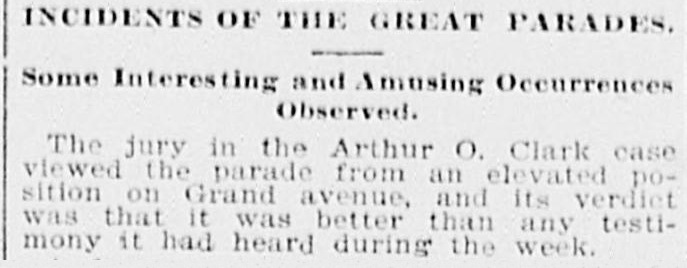
“Incidents of the Great Parades”: the jury’s verdict on the flower parade. Kansas City Daily Journal, Kansas City, Missouri, October 2, 1895, page 3. Library of Congress, Chronicling America. Click the clipping to read it full size.
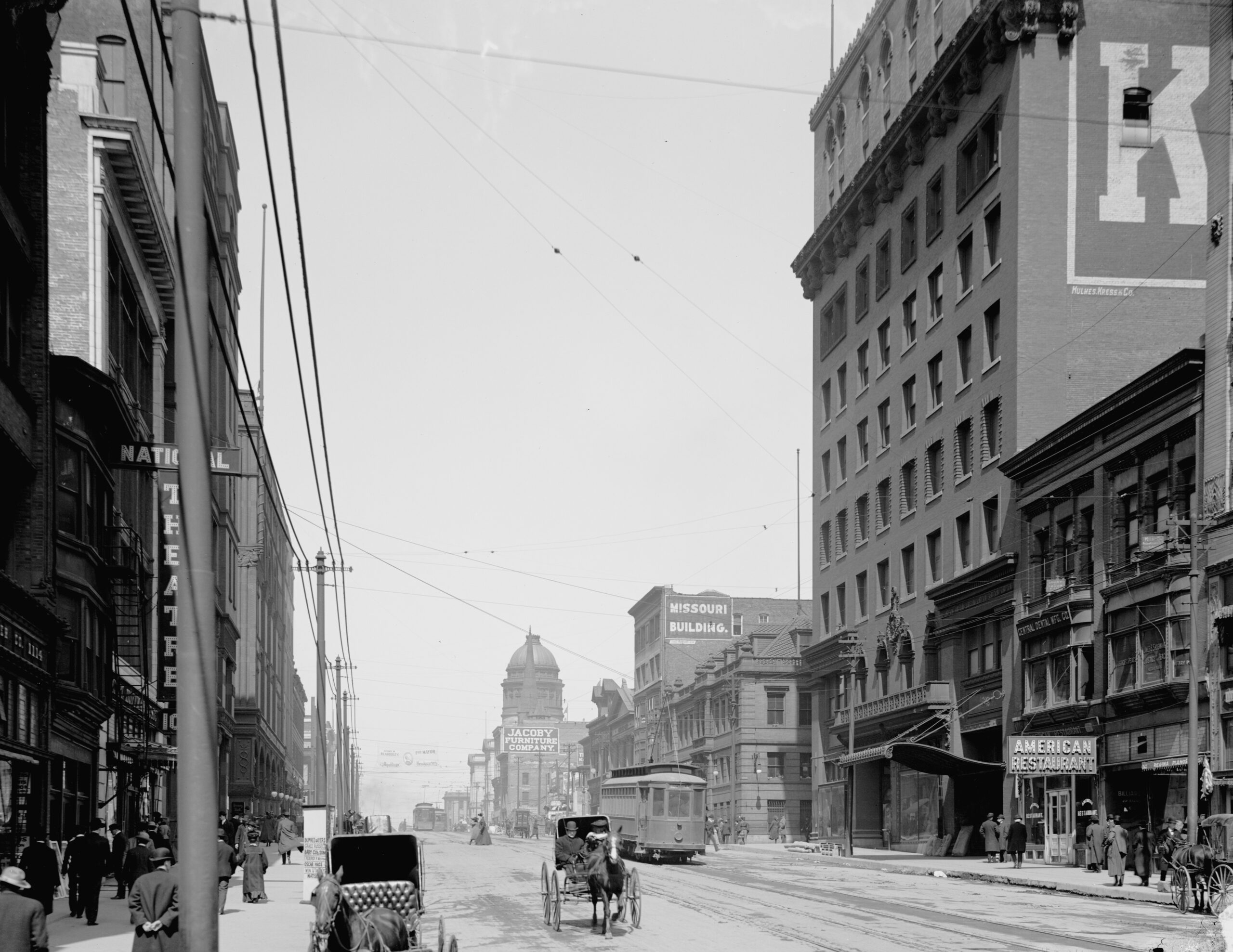
Grand Avenue in Kansas City, Missouri, a few years after the parade, with buggies and a streetcar. The jury watched the flower parade from a high spot on this street. Detroit Publishing Co., between 1900 and 1910. Library of Congress. Click the picture to see it full size.
That Night, Pallas Athene Came to Kansas City
The flowers were only the start. At night came the great float parade of “Kansas City’s own Priests of Pallas.” Their floats were said to carry Pallas Athene, the goddess of wisdom in old Greek stories, into town for a visit. This was “the ninth visit of brave and beautiful Pallas Athene” to Kansas City.
While they waited, the crowds “made a perfect bedlam with their horns, their whistles, their kazoos, their cowbells.” A bedlam is a wild, noisy mess. Then came floats full of myths, history and opera stories. The very last one, announced by “The Star Spangled Banner,” showed “Home, Sweet Home.” It was a little pioneer house with “a happy family gathered on the porch.”
Getting to Kansas City From Wichita, Kansas
Kansas City wanted visitors. Four days before the parade, the Wichita Daily Eagle in Wichita, Kansas, ran a notice called “CARNIVAL WEEK AT KANSAS CITY.” It promised that “millions of roses will bedeck beautiful horses and carriages.” Bedeck means cover and decorate.
A round-trip train ticket from Wichita cost “$6.15.” Special trains would wait until the night parade was over. Then they would carry everyone home, and “reach Wichita early Wednesday morning.” So a family could see both parades in one day and ride home through the night.
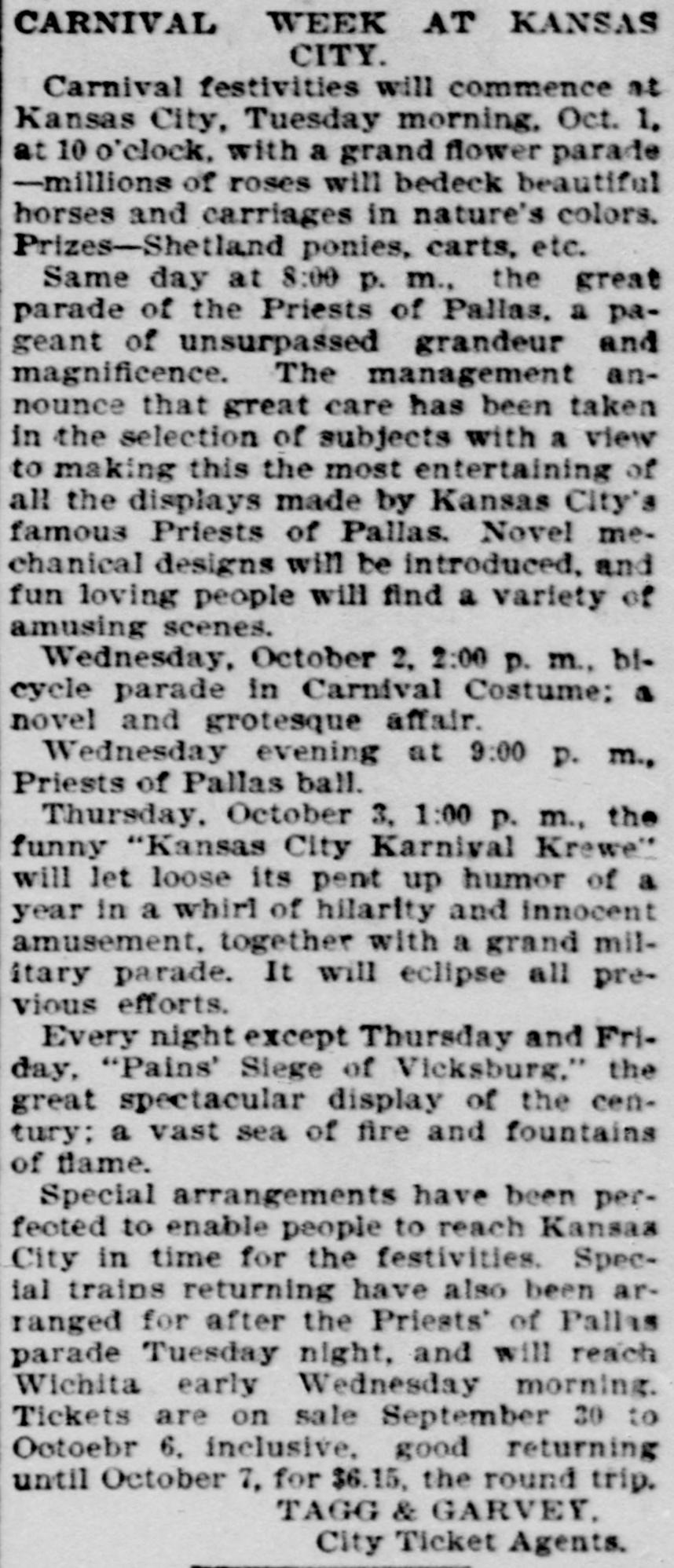
“Carnival Week at Kansas City,” a notice from Wichita’s city ticket agents, Tagg & Garvey, listing every big show of the week and the $6.15 round trip. Wichita Daily Eagle, Wichita, Kansas, September 27, 1895, page 8. Library of Congress, Chronicling America. Click the clipping to read it full size.
The rest of the week had more. There was a “bicycle parade in Carnival Costume” and a fireworks show named for the Civil War battle at Vicksburg, with “a vast sea of fire and fountains of flame.”
A Year Later, Topeka Said Its Parade Was Better
The Kansas City Journal had made a promise in 1895. “The flower parade, like the new paper in a country town, has come to stay.” It was right. In October 1896, Kansas City held its flower parade again.
By then, Topeka, Kansas, had a flower parade of its own. Some Topeka women went to Kansas City to see the rival show. One of them was Mrs. C. S. Sutton, who led the committee that raised money for Topeka’s parade. Her verdict came out in the Topeka State Journal under the headline “OUR PARADE THE BEST.” The Kansas City parade, it said, “did not come up to the standard of the Topeka floral parade. It was not as long.”
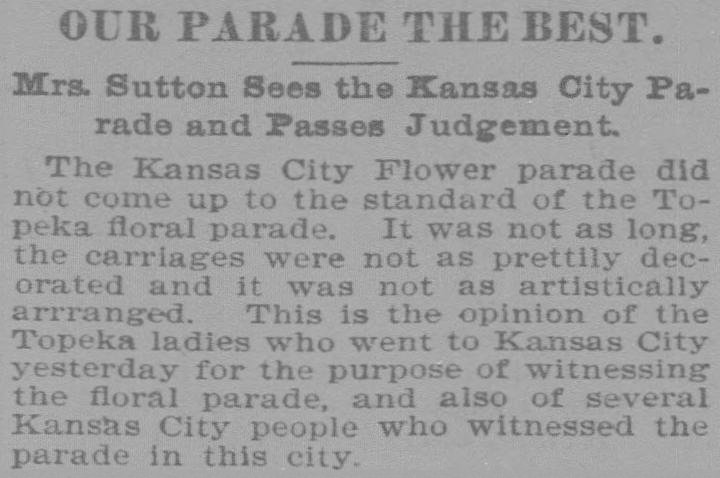
“Our Parade the Best.” A Topeka woman judges the 1896 Kansas City flower parade. Topeka State Journal, Topeka, Kansas, October 8, 1896, page 6. Library of Congress, Chronicling America. Click the clipping to read it full size.
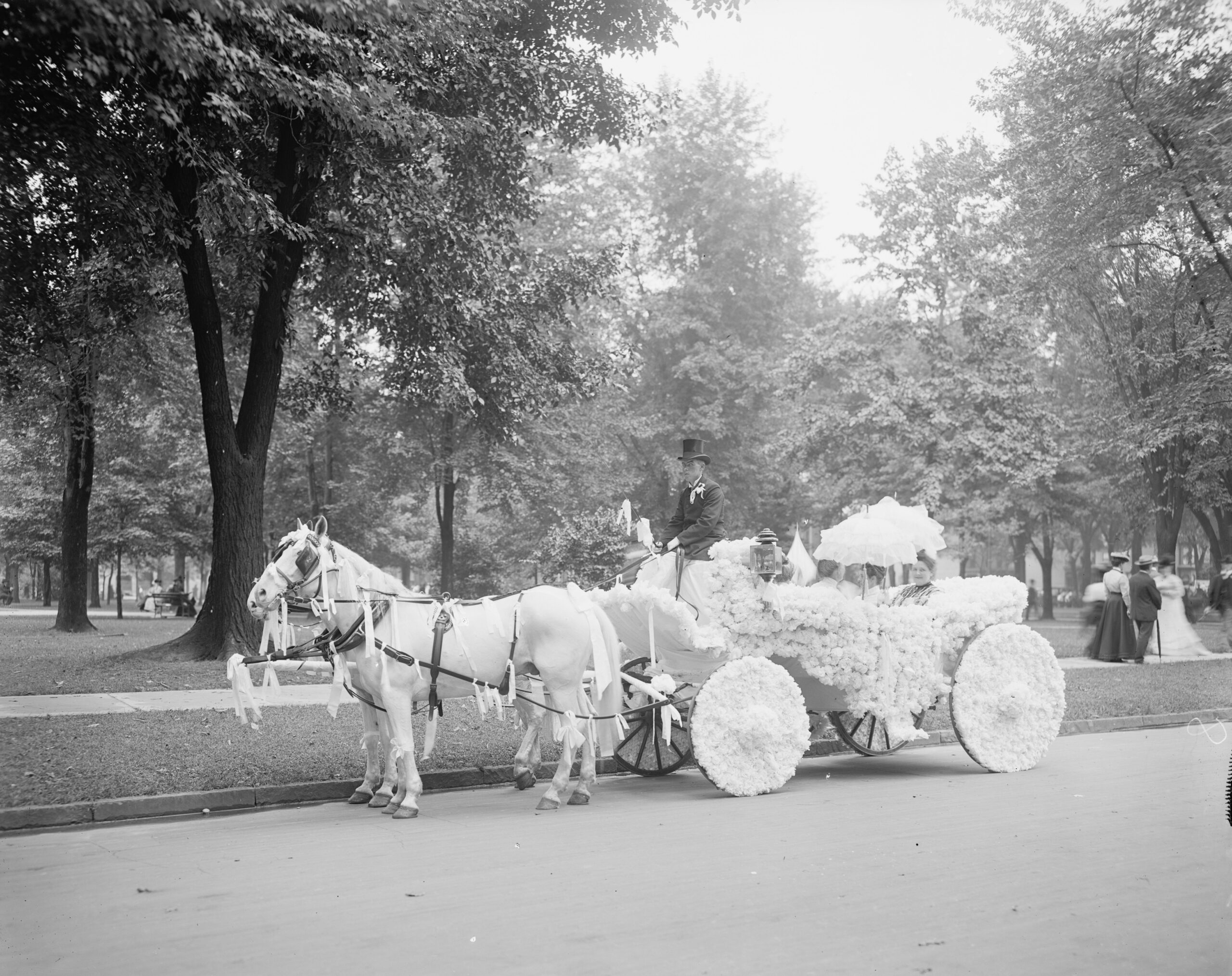
Another flower carriage of the same kind: white horses and wheels made of white flowers, in a parade in Detroit, Michigan, in 1901. It is not Kansas City. Detroit Publishing Co., Library of Congress. Click the picture to see it full size.
The photo at the top of this page isn’t Kansas City either. It shows a flower parade in Detroit, Michigan, in 1901: a carriage covered in white blossoms, and a flower-covered pony cart carrying two children. Kansas City’s first parade looked a lot like it. The grown-ups could argue about whose flowers were best. In 1895, a 3-year-old jockey on a burro had already won the crowd.
Sources
- “Vista of Flowers. The First Annual Floral Procession of Kansas City,” Kansas City Daily Journal (Kansas City, Missouri), October 2, 1895, page 1. Library of Congress, Chronicling America. The parade, the riders, the prize list and the drawing.
- “Incidents of the Great Parades,” Kansas City Daily Journal, October 2, 1895, page 3. Library of Congress, Chronicling America.
- “The Ninth Visit. Pallas Athene and Her Gorgeous Pageant Arrive,” Kansas City Daily Journal, October 2, 1895, page 5. Library of Congress, Chronicling America.
- “Prosecution Will Rest,” Kansas City Daily Journal, October 1, 1895, page 4. Library of Congress, Chronicling America. The judge’s parade-day plan.
- “Carnival Week at Kansas City,” Wichita Daily Eagle (Wichita, Kansas), September 27, 1895, page 8. Library of Congress, Chronicling America.
- “Our Parade the Best,” Topeka State Journal (Topeka, Kansas), October 8, 1896, page 6. Library of Congress, Chronicling America.
- Bi-centenary celebration, floral parade, carriage of Mrs. F.F. Ingram, Detroit, Mich., Detroit Publishing Co., 1901 (the cover). Library of Congress Prints and Photographs Division, Detroit Publishing Company Collection. No known restrictions on publication.
- Bi-centenary celebration, floral parade, Ladies of the Maccabees, Detroit, Mich., Detroit Publishing Co., 1901. Library of Congress Prints and Photographs Division, Detroit Publishing Company Collection. No known restrictions on publication.
- Grand Avenue, Kansas City, Missouri, Detroit Publishing Co., between 1900 and 1910. Library of Congress Prints and Photographs Division, Detroit Publishing Company Collection. No known restrictions on publication.
- The newspapers and photographs above were all published before 1931 and are in the public domain.